

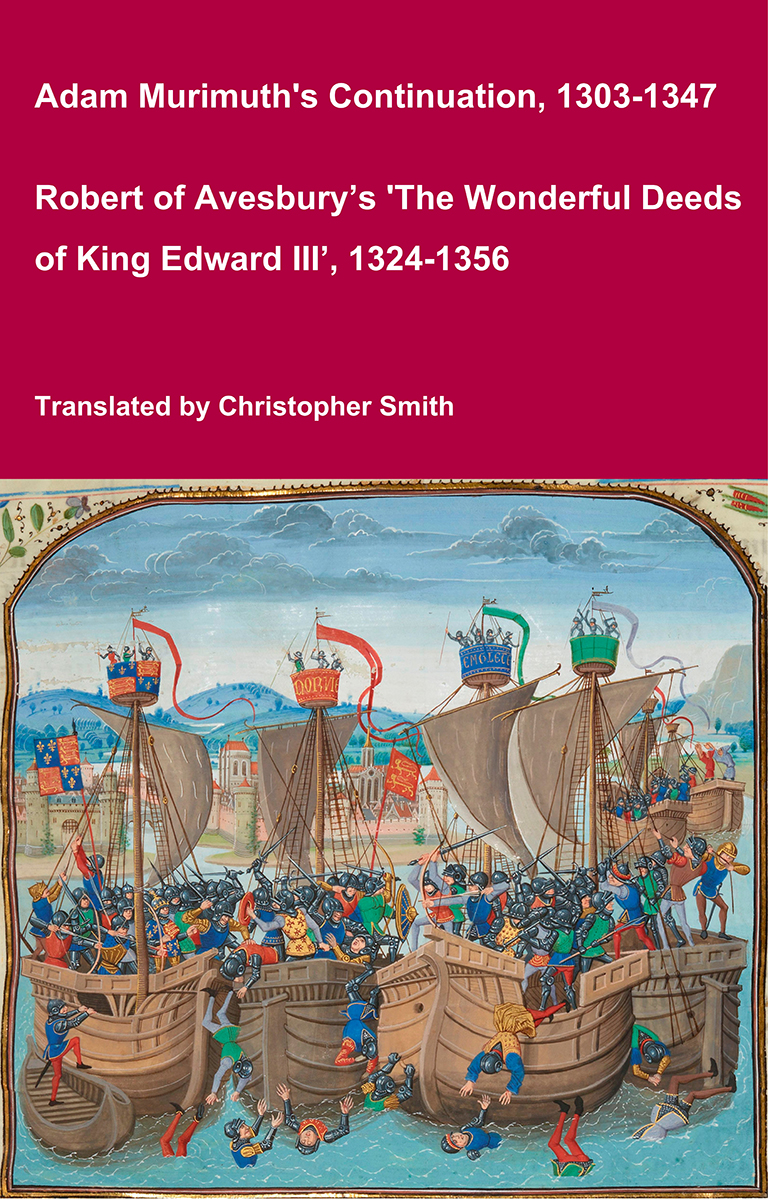
Adam Murimuth's Continuation and Robert of Avesbury’s 'The Wonderful Deeds of King Edward III'
This volume brings together two of the most important contemporary chronicles for the reign of Edward III and the opening phases of the Hundred Years’ War. Written in Latin by English clerical observers, these texts provide a vivid and authoritative window into the political, diplomatic, and military history of fourteenth-century England and its continental ambitions. Adam Murimuth Continuatio's Chronicarum continues an earlier chronicle into the mid-fourteenth century, offering concise but valuable notices on royal policy, foreign relations, and ecclesiastical affairs. Its annalistic structure makes it especially useful for establishing chronology and tracing the development of events year by year. Complementing it, Robert of Avesbury’s De gestis mirabilibus regis Edwardi tertii is a rich documentary chronicle preserving letters, treaties, and official records alongside narrative passages. It is an indispensable source for understanding Edward III’s claim to the French crown, the conduct of war, and the mechanisms of medieval diplomacy. Together, these works offer scholars, students, and enthusiasts a reliable and unembellished account of a transformative period in English and European history. Essential for anyone interested in medieval chronicles, the Hundred Years’ War, or the reign of Edward III.
Available at Amazon in eBook and Paperback format.
Scarborough Castle is in Scarborough, North Yorkshire [Map], Castles in North Yorkshire.
In 1273 John Vesci was appointed Governor of Scarborough Castle.
Close Rolls Edward II 1307-1313. 24th January 1308 King Edward II of England [aged 23]. Westminster Palace [Map]. To John Sampson [aged 61], constable of the king's castle of Scardeburgh [Map]. Order to permit Henry Percy [aged 34] and his consort and their household to dwell in the houses within the said castle, provided that the castle be safely guarded.
Close Rolls Edward II 1307-1313. 17th March 1308 King Edward II of England [aged 23]. Westminster Palace [Map]. To John Sampson [aged 61], constable of the king's castle of Scardeburgh [Map]. Order to permit Henry Percy and his consort and their household to dwell in the houses within the said castle, provided that the castle be safely guarded.
In 1319 Thomas Ughtred 1st Baron Ughtred [aged 27] was appointed Governor of Scarborough Castle.
On 25th April 1557 Thomas Stafford [aged 24] sailed from Dieppe with two ships and over 30 men. He took Scarborough Castle [Map] and declared himself Protector of the Realm.
On 28th April 1557 Henry Neville 5th Earl of Westmoreland [aged 32] retook Scarborough Castle [Map] and captured the rebels.
Henry Machyn's Diary. April 1557. The (blank) day of Aprell suffered dethe in [several] plases in the Northe for entrying in-to Sk[arborough] castyll [Map], (for) the wyche at London master Thomas [Stafford] [aged 24] was heddyd on Towre hylle [Map]; and at Tyborne [Map] John Procter aleas Wylliamsun, Wyllyam Stowe, John Bradford, and more in dyvers plases; [in York]shyre, John Wylborne, Clement Tyllyd, John Cawsewelle, and Robart Hunter, at York, [by the] dethe of hangyng, drahyns, and quarter[ing].
Henry Machyn's Diary. 2nd May 1557. The ij day of May dyd pryche at Powlles crosse [Map] dyd pryche docthur Chadsay, and mad a godly sermon, and ther he declaryd that serten trayturs that was taken at Skarborow castyll [Map], the wyche they fled over the see a-for ....
Henry Machyn's Diary. 3rd May 1557. [The iij day of May came five persons to the Tower [Map], the chief of those that had taken the] castylle of Skarborow [Map] in Yorke-shyre, [viz. Stafford [aged 24], Saund]urs, Seywelle, and Prowtter, and a Frenche man.
In 1645 Henry Constable 1st Viscount Dunbar [aged 56] was killed at the Siege of Scarborough Castle. His son John [aged 30] succeeded 2nd Viscount Dunbar. Mary Brudenell Viscountess Dunbar by marriage Viscountess Dunbar.
In 1645 Michael Wharton [aged 51] was killed during the Siege of Scarborough Castle.
Chronicle of Walter of Guisborough
A canon regular of the Augustinian Guisborough Priory, Yorkshire, formerly known as The Chronicle of Walter of Hemingburgh, describes the period from 1066 to 1346. Before 1274 the Chronicle is based on other works. Thereafter, the Chronicle is original, and a remarkable source for the events of the time. This book provides a translation of the Chronicle from that date. The Latin source for our translation is the 1849 work edited by Hans Claude Hamilton. Hamilton, in his preface, says: 'In the present work we behold perhaps one of the finest samples of our early chronicles, both as regards the value of the events recorded, and the correctness with which they are detailed; Nor will the pleasing style of composition be lightly passed over by those capable of seeing reflected from it the tokens of a vigorous and cultivated mind, and a favourable specimen of the learning and taste of the age in which it was framed.'
Available at Amazon in eBook and Paperback format.
Chronicle of Roger de Hoveden. On the same day, the king dispossessed Gerard de Camville of Lincoln Castle [Map] and the Sheriffdom of Lincolnshire, as well as Hugh Bardolf of the Sheriffdom of Yorkshire, York Castle, Scarborough Castle [Map], and the custody of Westmorland. All of these properties were then put up for sale. As a result, when the chancellor negotiated to pay the king 1,500 marks upfront for the sheriffdoms of Yorkshire, Lincolnshire, and Northamptonshire, along with an additional 100 marks annually from each county. Geoffrey, Archbishop of York, instead offered the king 3,000 marks for the sheriffdom of Yorkshire, along with an annual payment of 100 marks. Thus, the chancellor was dismissed, and the Archbishop of York won control of the sheriffdom, effectively becoming the king's servant and throwing himself into the king's power.
Fodem die rex dissaisivit Gyrardum de Camvilla de castello et vicecomitatu Lincolniensi, et Hugonem Bardolf de vicecomitatu Eboraci siræ, et de castello Eboraci, et de castello de Scardheburg, et de custodia de Westmerilande; et omnia supradicta exposuit venditioni. Unde factum est, quod cum cancellarius conventionasset, se daturum regi pro vicecomitatu Eboraci siræ, et pro vicecomitatu Lincolniensi, et pro vicecomitatu Nordhamtesiræ, mille et quingentas marcas in principio conventionis, et singulis annis de unoquoque prædictorum comitatuum centum marcas de incremento; Gaufridus Eboracensis archiepiscopus obtulit regi tria millia marcarum pro vicecomitatu Eboracensi, et singulis annis centum marcas de incremento: et sic abjecto cancellario, Eboracensis archiepiscopus obtinuit vicecomitatum Eboracensem, et ita facta est regis serviens, et præcipitavit se in potentias regis.