

Henrici Quinti, Angliæ Regis, Gesta, is a first-hand account of the Agincourt Campaign, and subsequent events to his death in 1422. The author of the first part was a Chaplain in King Henry's retinue who was present from King Henry's departure at Southampton in 1415, at the siege of Harfleur, the battle of Agincourt, and the celebrations on King Henry's return to London. The second part, by another writer, relates the events that took place including the negotiations at Troye, Henry's marriage and his death in 1422.
Available at Amazon in eBook and Paperback format.
Skelton is in North Yorkshire.
See: Skelton Castle [Map].
Around 1070 Robert Bruce 1st Lord Annandale 1st Lord Skelton was born at Skelton.
Around 1127 Adam Bruce was born to Adam Bruce 2nd Lord Skelton [aged 22] at Skelton.
On 4th February 1160 Isabel Bruce was born to Adam Bruce [aged 33] at Skelton. She married (1) Roger Maudit (2) before 29th September 1198 Henry Percy, son of Jocelin Percy and Agnes Percy 4th Baroness Percy Topcliffe.
Around 1185 Peter Bruce was born to Peter Bruce [aged 15] and Juetta Flamville [aged 48] at Skelton. He married (1) Johanna Lacy, daughter of John Fitzrichard 6th Baron Halton and Alice Essex (2) Hawise Lancaster and had issue.
Around 1185 Peter Brus was born at Skelton.
On 11th March 1196 Adam Bruce [aged 69] died at Skelton.
Around 1319 Walter Fauconberg 4th Baron Fauconberg was born to John Fauconberg 3rd Baron Fauconberg [aged 28] at Skelton. He married (1) Maud Pateshull Baroness Fauconberg and had issue (2) before 20th July 1345 Isabel Bigod.
Skelton Castle is also in Castles in North Yorkshire.
Around 1105 Adam Bruce 2nd Lord Skelton was born to Robert Bruce 1st Lord Annandale 1st Lord Skelton [aged 35] and Agnes Paynel Lady Annandale Lady Skelton at Skelton Castle [Map].
Around 1143 Adam Bruce 2nd Lord Skelton [aged 38] died at Skelton Castle [Map].
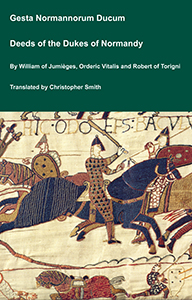
The Deeds of the Dukes of Normandy
The Gesta Normannorum Ducum [The Deeds of the Dukes of Normandy] is a landmark medieval chronicle tracing the rise and fall of the Norman dynasty from its early roots through the pivotal events surrounding the Norman Conquest of England. Originally penned in Latin by the monk William of Jumièges shortly before 1060 and later expanded at the behest of William the Conqueror, the work chronicles the deeds, politics, battles, and leadership of the Norman dukes, especially William’s own claim to the English throne. The narrative combines earlier historical sources with firsthand information and oral testimony to present an authoritative account of Normandy’s transformation from a Viking settlement into one of medieval Europe’s most powerful realms. William’s history emphasizes the legitimacy, military prowess, and governance of the Norman line, framing their expansion, including the conquest of England, as both divinely sanctioned and noble in purpose. Later chroniclers such as Orderic Vitalis and Robert of Torigni continued the history, extending the coverage into the 12th century, providing broader context on ducal rule and its impact. Today this classic work remains a foundational source for understanding Norman identity, medieval statesmanship, and the historical forces that reshaped England and Western Europe between 800AD and 1100AD.
Available at Amazon in eBook and Paperback format.
In 1170 Peter Bruce was born to Adam Bruce [aged 43] at Skelton Castle [Map]. He married Juetta Flamville and had issue.
Around 1192 Agnes Bruce was born to Peter Bruce [aged 22] and Juetta Flamville [aged 55] at Skelton Castle [Map]. She married William Lancaster.
Around 1206 Juetta Flamville [aged 69] died at Skelton Castle [Map].
Around 1221 Peter Bruce was born to Peter Bruce [aged 36] and Hawise Lancaster at Skelton Castle [Map]. He married Hilaria Mauley and had issue.
Around 1239 Agnes Bruce was born to Peter Bruce [aged 18] and Hilaria Mauley [aged 18] at Skelton Castle [Map]. She married before November 1242 Walter Fauconberg 1st Baron Fauconberg and had issue.
On 18th September 1272 Peter Bruce [aged 51] died at Skelton Castle [Map].
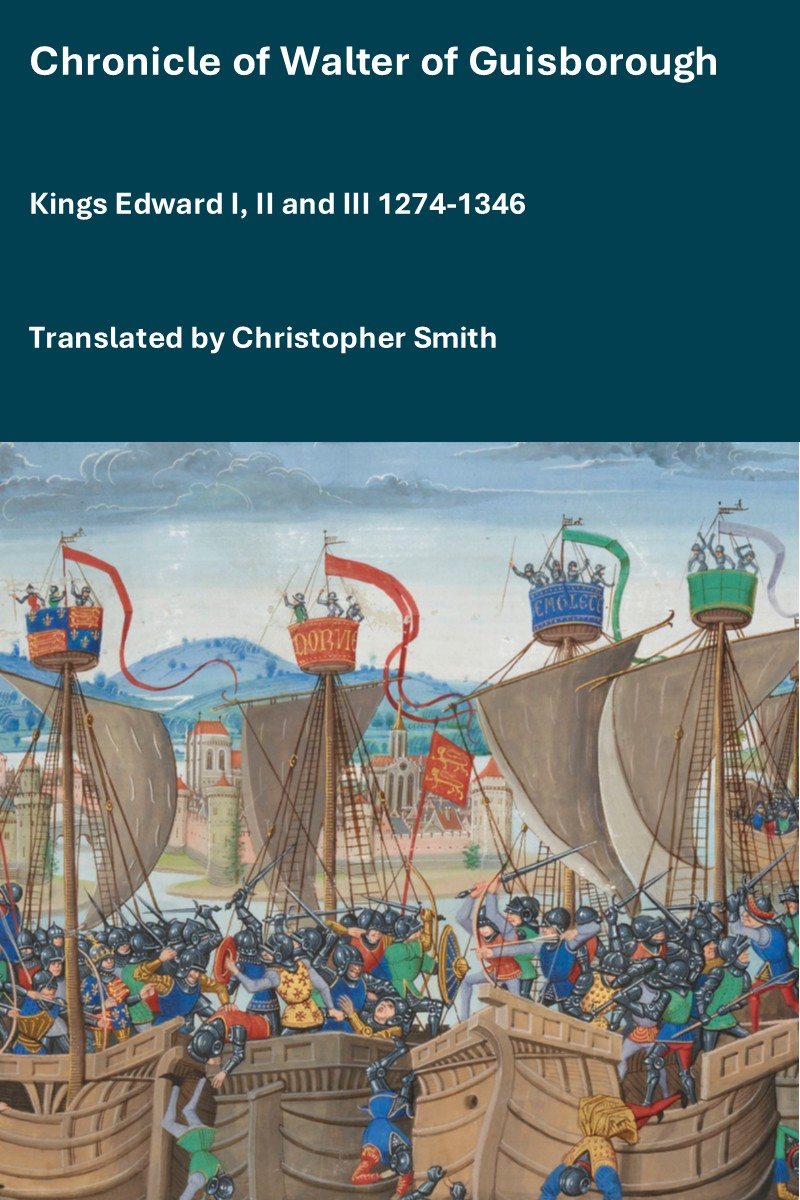 Chronicle of Walter of Guisborough. In the same year died Sir Walter de Faucomberge [aged 84] the elder, who had married Agnes, sister of Peter de Brus, to whom as her share fell the castle of Skelton [Map]. He died on the Feast of the Commemoration of All Souls [2nd November 1304], that is, in the night between the feast of All Saints and the feast of All Souls, and was buried at Killing in Howdenshire, in the church of the holy nuns [Map], which had been founded by his ancestors.
Eodem anno obiit dominus Walterus de Faucomberge primus, qui duxerat Agnetem sororem Petri de Brus, cui in partem suam cecidit castrum de Skelton, die scilicet Commemorationis Animarum, inter sanctos festi præcedentis et sanctas animas festi subsequentis media quasi nocte numeratus, sepultusque est apud Killing in Howdernes in ecclesia sanctarum monialium, quæ erat ex fundatione antecessorum suorum.