

Abbot John Whethamstede’s Chronicle of the Abbey of St Albans
Abbot John Whethamstede's Register aka Chronicle of his second term at the Abbey of St Albans, 1451-1461, is a remarkable text that describes his first-hand experience of the beginning of the Wars of the Roses including the First and Second Battles of St Albans, 1455 and 1461, respectively, their cause, and their consequences, not least on the Abbey itself. His text also includes Loveday, Blore Heath, Northampton, the Act of Accord, Wakefield, and Towton, and ends with the Coronation of King Edward IV. In addition to the events of the Wars of the Roses, Abbot John, or his scribes who wrote the Chronicle, include details in the life of the Abbey such as charters, letters, land exchanges, visits by legates, and disputes, which provide a rich insight into the day-to-day life of the Abbey, and the challenges faced by its Abbot.
Available at Amazon in eBook and Paperback format.
St Andrew's Church, Blickling is in Blickling, Norfolk, Churches in Norfolk.
After 2nd January 1402. St Andrew's Church, Blickling [Map]. Memorial brass to Nicholas Dagworth of Blickling.
Nicholas Dagworth of Blickling: he was born to Nicholas Dagworth. Around 1395 he and Eleanor Rossall were married. On 2nd January 1402 he died without issue. His widow Eleanor Rossall sold her third of the Blickling, Norfolk estates to John Erpingham. Around 1409 married a second time John Mortimer.


Engravings of Sepulchral Brasses Volume 1. Plate XIII. Sir Nicholas Dagworth, at Blickling [Map], 1401.
Blomefield's Norf. vi. 384. Gough's Sepulch. Monum. ii. 5: At the east end of the south aisle of Blickling Church, is a brass figure, armed cap-a-pie; under his head lie his helmet and crest, a griffin's head erased. About him are four shields; at the first corner, Ermine, on a fess Gules 3 Bezants, Dagworth: at the fourth, Gules, a fess between six martlets or, Rosale; 2 and 3, the same arms impaled. Round the slab was this inscription:
"Here lies Nicholas of Dagworth, knight, formerly lord of Blickling, who died on the [?] day of the month of January, in the year of our Lord 1401. May God be merciful to his soul. Amen."
"Hic jacet Nicholaus de Dagworth, miles, quondam dominus de Blickling, qui obiit die mensis Januarii, anno domini Millessimo cccc. primo, cujus anime propicietur Deus. Amen."
"In 1364, Sir Nicholas Dagworth, Knt. afterwards Lord of Blickling, was commander in Acquitaine; in 1373 he was employed by King Edward III. in a secret negotiation with John Fastolff and others, in France. In 1376 he was sent by the King and council into Ireland, to examine into Sir William de Windsor's carriage there: but, at the motion of Dame Alice Perers, he was stopped, she declaring him Sir William's enemy, and that it was unjust to appoint one enemy to judge another; but the next year he was sent with full commission to reform the state of that kingdom. He was in as great esteem of King Richard II. as he had always been with Edward IIL., for in 1380 he, Sir John Haukewood, and Walter Skirlawe, doctor of the decrees, and dean of St. Martin's le Grand, London, were sent into France to treat with the dukes and lords of Italy; and the same year, being one of the privy chamber to the King, he, with Bernard Vansedles, Simon de Burley the chamberlain, Robert Braybrook, licentiate in the laws, and Walter Skirlawe, had like powers to treat with the German princes; the next year, he and Skirlawe went as ambassadors to Pope Urban VI., and had power to treat with the King of Naples.
In 1384, he, John Baam and Sir John Haukewood, went ambassadors to the Pope, and to treat with Charles, King of Jerusalem and Sicily: and, notwithstanding his being so much in favour, in the 11th of Richard IJ. he was one of those impeached in parliament, and was imprisoned in Rochester castle in Kent; but being honourably discharged, was next year appointed a commissioner to treat with the French King, and with the Earl of Flanders; .in the 13th of Richard II. he was made one of the commissioners to take the oath of the King of Scotland, to the treaty then concluded, and afterwards demanded satisfaction of the Scots for infringing that treaty, and also the money for redemption of Robert Bruce.
He retired to his house at Blickling in Norfolk, and died without issue in January 1401.
[He appears to have made his will in December 1396, wherein, however, he ordered his body to be buried in the church of St. Bennett, near Paul's wharf, London. To Eleanor, his wife, who was the daughter of Walter, and sister and co-heir of Sir John Rosale, of Shropshire, he bequeathed one third part of his goods "to be quiet." (Testamenta Vetusta.) She was only twenty-six years old at his decease (Esch. 5 Hen.IV), and afterwards married John Mortimer, and was living in the 10th Hen. IV. Dugdale says of Sir Nicholas Dagworth that "with thirteen horse he fought with sixty French near to Flaveny; and by the means of certain chariots, which he made use of for his defence, (being placed in a circle whereunto he could enter at pleasure,) utterly vanquished them." Baronage, ii. 148. N.]
[In this brass appears the first approach towards pauldrons, in the overlapping epaulieres, which are considerably extended in front. The plates under the genouillieres occur likewise here, covering the upper edge of the greaves. See Meyrick's Armour, ii.92. The cord which attaches the camail to the bascinet is also covered, a protection rendered necessary, as it was so often hewn down by the cut of the sword, and this is probably the earliest instance. S. R. M.]
 Become a Member via our Buy Me a Coffee page to read more.
On 26th June 1458 Cecily Boleyn [aged 50] died at Blickling, Norfolk. She was buried at St Andrew's Church, Blickling [Map]

After 26th June 1458. St Andrew's Church, Blickling [Map]. Memorial brass to Cecily Boleyn [deceased]. The inscription reads "Here lyth Cecilie Boleyn, Suster to Geffrey Boleyn, Lord of the Manor of Blicklyng, whiche Cecille decessed in her Maydenhode, of the Age of L. Yeeres, the xxvi Day of Juyn the Yer of our Lord Mcccclviij, whose Soule God pardoune Amen."
Cecily Boleyn: In 1408 she was born to Geoffrey Boleyn and Alice Bracton. Coefficient of inbreeding 3.12%. On 26th June 1458 Cecily Boleyn died at Blickling, Norfolk. She was buried at St Andrew's Church, Blickling [Map]

On 31st October 1479 Anna Boleyn [aged 3] died. Brass in St Andrew's Church, Blickling [Map]. Her incription reads "Hic iacet Anna Boleyn, filia Willi; Boleyn, Armigeri, Etatis trium Annorum undecem Mensum et tredecem Dierum, que obiit ultimo Die Mensis Octobr' Anno Domini Mcccclrrir cuius anime propicietur Deus Amen." i.e. "Here lies Anne Boleyn, daughter of Will; Boleyn, Squire, of the Age of Three Years, Eleven Months and Thirteen Days, who died on the last Day of the Month of October, in the Year of the Lord Mccclxxix, whose soul may God have mercy on him, Amen." The amorial shows her father's [aged 28] and mother's [aged 25] quartered.
Anna Boleyn: In 1476 she was born to William Boleyn and Margaret Butler.

Engravings of Sepulchral Brasses Volume 1. Plate XXXII. Ann Boleyn [deceased], at Blickling [Map], 1479.
Blomefield's Norf. vi. 388. Gough's Sepulch. Monum. ii. 184.
This brass is to the memory of Ann, infant daughter of Sir William Boleyn and his lady Margaret, daughter and coheir of Thomas Butler, Earl of Ormond, and aunt of the unfortunate queen who afterwards bore her name.
This brass gives us the first example of the necklace, which nevertheless had been for many years a conspicuous feature in female attire.
[The arms are Boleyn, Argent, a chevron gules, between three bulls' heads couped Sable, quarterly with Azure, three mullets, a chief dauncette or, Bracton, the heiress of Bracton having been wife of Geoffery, grandfather of Sir William Boleyn. The mullets, which were probably enamelled, do not appear. There was in the chancel at Blickling another brass of this family, representing Cecily, sister of Geoffrey Boleyn, lord of Blickling: she died 26 June, 1458, aged 50. The most interesting memorial of the family, which, from the connexion with Queen Elizabeth, possesses an additional interest, is the brass in Hever church, Kent, of Sir Thomas Boleyn, the eldest brother of Cecily, who was created Earl of Wiltshire by Henry VI. It is engraved in Thorpe's Custumale Roff. p. 115. Impressions of both are preserved in the British Museum.—A. W.]

After 23rd April 1485. St Andrew's Church, Blickling [Map]. Memorial brass to Isabella Boleyn [deceased]. The inscription reads "Hic jacet Isabella Cheyne, quondam Uxor Willi. Cheney Amigeri, de Insula de Shippey, in Comitatu Cancie que obijt xxiijo die Mensis Aprilis, Anno Domini Mcccclxxxv, cuius anime propicietur DeusAmen." i.e. "Here lies Isabella Cheyne, formerly the wife of Will. Cheney Knight, of the Island of Shippey, in the County of Canterbury, who died on the xxiith day of the month of April, in the year of the Lord Mccclxxxv, may God bless her soul."
Isabella Boleyn: Henry Aucher and she were married. William Cheney and she were married. In 1434 she was born to Geoffrey Boleyn and Ann Hoo at Blickling, Norfolk. On 23rd April 1485 Isabella Boleyn died at Blickling, Norfolk.

On 30th September 1493 Anthony Boleyn [aged 18] died. St Andrew's Church, Blickling [Map].
Anthony Boleyn: In 1475 he was born to William Boleyn and Margaret Butler.

On 18th August 1512 Anne Wood aka Wode died in childbirth whilst visiting her sister Elizabeth at Blickling, Norfolk. St Andrew's Church, Blickling [Map]. Memorial brass to Anne Wood aka Wode depicted holding the two and female twins that she died giving birth to. The inscription:
Pray for the soul of Anne Wode, the second wife of Thomas Astley of Melton Constable [aged 43], Esquire, who on the feast day of Saint Agapitus the Martyr gave birth to a male and a female child, and after the peril of childbirth, suddenly departed to the Lord in the year one thousand five hundred and twelve of Christ.
Orate p[ro] a[n]i[m]a Anne a wode ux[oris] s[e]cu[n]de Tho[m]e Asteley de Melton Constable. Armig[eri], que in die s[an]c[t]i Agapiti Martyris masculu[m] et femella[m] ad partu[m] pep[er]it et post pariendi p[er]iculu[m] subito migravit ad Domi[num] A[nn]o M[illensim]o benignissimi Vo XIIo Xpi.
Anne Wood aka Wode: she was born to John Wood aka Wode. Before 1507 Thomas Astley of Hilmorton and Melton Constable and she were married.
Thomas Astley of Hilmorton and Melton Constable: In 1469 he was born. On 19th October 1543 he died.
On 10th August 1529 Robert Clere [aged 83] died at Ormesby St Margaret, Norfolk. He was buried at St Andrew's Church, Blickling [Map] where his inscription reads "Orate pro anima Roberti Clere Militis, qui obiit decimo die Mensis Augusti, Anno Domini Millessimo Quingentissimo Uices simo Nono, cuius anime propicietur Deus Amen." i.e. "Pray for the soul of Robert Clere Militis, who died on the tenth day of the month of August, in the year of the Lord one thousand five hundred and twenty-nine, may God rest his soul, Amen."
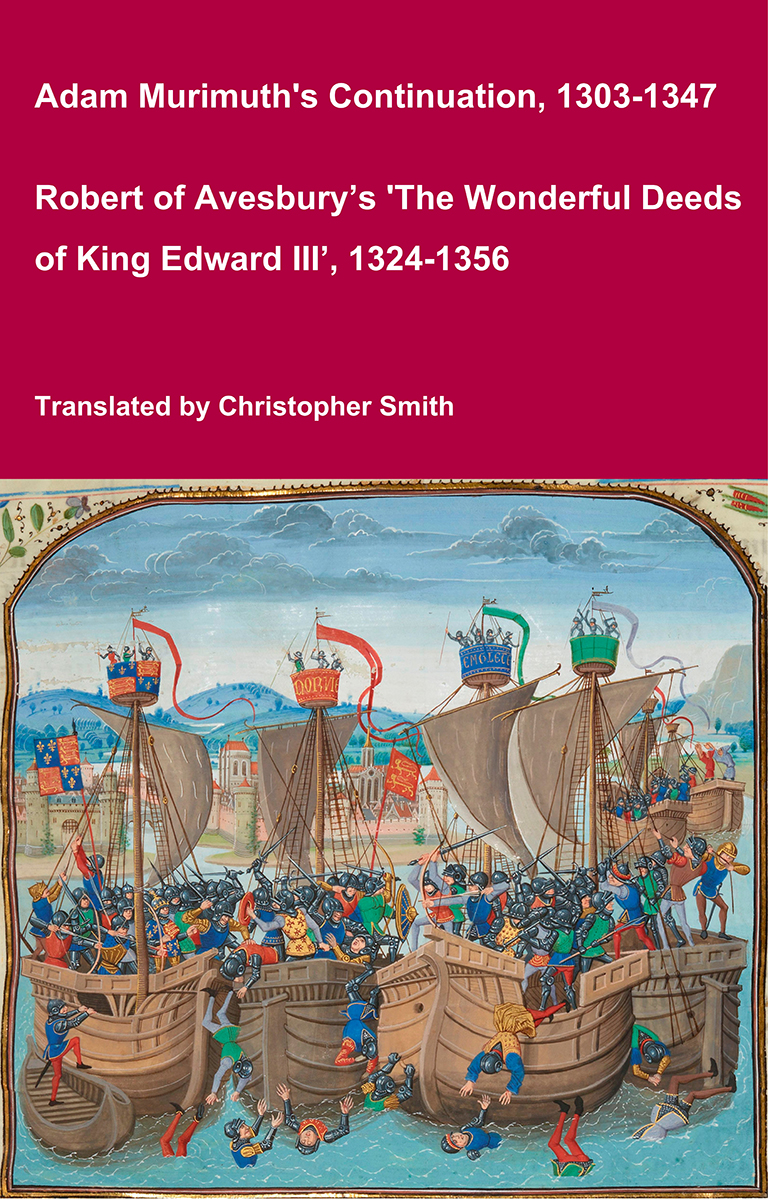
Adam Murimuth's Continuation and Robert of Avesbury’s 'The Wonderful Deeds of King Edward III'
This volume brings together two of the most important contemporary chronicles for the reign of Edward III and the opening phases of the Hundred Years’ War. Written in Latin by English clerical observers, these texts provide a vivid and authoritative window into the political, diplomatic, and military history of fourteenth-century England and its continental ambitions. Adam Murimuth Continuatio's Chronicarum continues an earlier chronicle into the mid-fourteenth century, offering concise but valuable notices on royal policy, foreign relations, and ecclesiastical affairs. Its annalistic structure makes it especially useful for establishing chronology and tracing the development of events year by year. Complementing it, Robert of Avesbury’s De gestis mirabilibus regis Edwardi tertii is a rich documentary chronicle preserving letters, treaties, and official records alongside narrative passages. It is an indispensable source for understanding Edward III’s claim to the French crown, the conduct of war, and the mechanisms of medieval diplomacy. Together, these works offer scholars, students, and enthusiasts a reliable and unembellished account of a transformative period in English and European history. Essential for anyone interested in medieval chronicles, the Hundred Years’ War, or the reign of Edward III.
Available at Amazon in eBook and Paperback format.
In 1561 James Boleyn [aged 68] died. His great-nephew Edward Clere [aged 24], grandson of James' sister Alice Boleyn, inherited the estate at Blickling, Norfolk. Curiously Edward Clere's mother was Anne Tyrrell, grand-daughter of James Tyrrell who had been executed in 1502, and who had reportedly confessed to the murder of the Princes in the Tower.
He was buried at St Andrew's Church, Blickling [Map] on 6th September 1561. In his will he left he great-niece Queen Elizabeth I of England and Ireland [aged 27] a basin and gilt ewer and "my written book of the revelations of Saint Bridget".

In or after 1582. Memorial to Elizabeth Gurdon 1565-1582 who, apparently died of a cold whilst visiting Edward Clere [aged 45]. Semicircular niche with leaf spandrels and modillion cornice on Ionic colonnettes containing a kneeling figure at St Andrew's Church, Blickling [Map].

On 8th June 1606 Edward Clere [aged 69] died. Chest tomb in St Andrew's Church, Blickling [Map].
On 22nd August 1622 Henry Clere 1st Baronet [aged 24] died without surviving male issue. Baronet Clere of Ormesby in Norfolk extinct. He was buried at St Andrew's Church, Blickling [Map] where his inscription reads:
Here rests Henry Clere, Baronet, who married Meriel, daughter of Edmund Lord Mondeford, Knight of the Golden Knight, by whom he had an only daughter, Abigail, who died xxii. Augustus, Anno Domini Mdcxxii. of his age - - - - - - - - - - -.
Hic requiescit Henricus Clere Baronettus, qui Thalamo sibi Conjunxit, Merielem, Filiam Edmundi Domini Mondeford, Equitis Aurati, ex quâ habuit prolem Filiam unicam, Abigalem, obijt xxii. Augusti, Anno Domini Mdcxxii. Ætatis suæ - - - - - - - - - - -".

On 29th December 1625 Henry Hobart 1st Baronet [aged 65] died. He was buried at St Andrew's Church, Blickling [Map]. His son John [aged 32] succeeded 2nd Baronet Hobart of Intwood in Norfolk. Frances Egerton Lady Hobart by marriage Lady Hobart of Intwood in Norfolk.
On or before 12th October 1635 Philippa Hobart was born to John Hobart 2nd Baronet [aged 42] and Frances Egerton Lady Hobart. She was bvaptised on 12th October 1635 at St Andrew's Church, Blickling [Map]. She married 1647 her first cousin John Hobart 3rd Baronet.

After 1st August 1821. St Andrew's Church, Blickling [Map]. Memorial to William Assheton Harbord 2nd Baron Suffield [deceased] erected by his widow Caroline Hobart Baroness Suffield.

After 14th November 1841. St Andrew's Church, Blickling [Map]. Monument to John Kerr 7th Marquess Lothian [deceased] and Cecil Chetwynd-Talbot Marchioness Lothian [aged 33].
John Kerr 7th Marquess Lothian: On 1st February 1794 he was born to William Kerr 6th Marquess Lothian and Harriet Hobart Viscountess Belmore. On 27th April 1824 William Kerr 6th Marquess Lothian died at Richmond, Surrey [Map]. His son John succeeded 7th Marquess Lothian, 10th Earl Lothian, 8th Earl Lothian. In 1831 John Kerr 7th Marquess Lothian and Cecil Chetwynd-Talbot Marchioness Lothian were married. She by marriage Marchioness Lothian. She the daughter of Charles Chetwynd-Talbot 2nd Earl Talbot and Frances Thomasina Lambart Countess Talbot. He the son of William Kerr 6th Marquess Lothian and Harriet Hobart Viscountess Belmore. On 14th November 1841 John Kerr 7th Marquess Lothian died at Blickling Hall, Norfolk [Map]. His son William succeeded 8th Marquess Lothian, 11th Earl Lothian, 9th Earl Lothian. He inherited the Blickling, Norfolk estate and made significant changes.
Cecil Chetwynd-Talbot Marchioness Lothian: On 17th April 1808 she was born to Charles Chetwynd-Talbot 2nd Earl Talbot and Frances Thomasina Lambart Countess Talbot. On 13th May 1877 Cecil Chetwynd-Talbot Marchioness Lothian died at Rome, Italy [Map]. She was buried at the Church of St David's Dalkeith.
In 1870 William Schomberg Kerr 8th Marquess Lothian [aged 38] died without issue. His brother Schomberg [aged 36] succeeded 9th Marquess Lothian. Victoria Alexandrina Montagu-Douglas-Scott Marchioness Lothian [aged 25] by marriage Marchioness Lothian. Monument at St Andrew's Church, Blickling [Map] sculpted by George Frederick Watts [aged 52] in 1878.
William Schomberg Kerr 8th Marquess Lothian: In 1832 he was born to John Kerr 7th Marquess Lothian and Cecil Chetwynd-Talbot Marchioness Lothian. On 12th August 1857 William Schomberg Kerr 8th Marquess Lothian and Constance Harriet Mahonesa Talbot Marchioness Lothian were married. She by marriage Marchioness Lothian. She the daughter of Henry John Chetwynd-Talbot 3rd Earl Talbot 18th Earl of Shrewsbury and Sarah Elizabeth Beresford Countess Talbot Shrewsbury Waterford. He the son of John Kerr 7th Marquess Lothian and Cecil Chetwynd-Talbot Marchioness Lothian. They were first cousins.
Schomberg Henry Kerr Kerr 9th Marquess Lothian: On 2nd December 1833 he was born to John Kerr 7th Marquess Lothian and Cecil Chetwynd-Talbot Marchioness Lothian. In 1865 Schomberg Henry Kerr Kerr 9th Marquess Lothian and Victoria Alexandrina Montagu-Douglas-Scott Marchioness Lothian were married. She the daughter of Walter Scott 5th Duke Buccleuch 7th Duke Queensberry and Charlotte Anne Thynne Duchess Buccleuch Duchess Queensbury. He the son of John Kerr 7th Marquess Lothian and Cecil Chetwynd-Talbot Marchioness Lothian. They were sixth cousins. On 17th January 1900 Schomberg Henry Kerr Kerr 9th Marquess Lothian died. His daughter Robert succeeded 10th Marchioness Lothian, 12th Countess Lothian, 10th Countess Lothian.
Victoria Alexandrina Montagu-Douglas-Scott Marchioness Lothian: On 20th November 1844 she was born to Walter Scott 5th Duke Buccleuch 7th Duke Queensberry and Charlotte Anne Thynne Duchess Buccleuch Duchess Queensbury. On 19th June 1938 Victoria Alexandrina Montagu-Douglas-Scott Marchioness Lothian died.


Around 1904. St Andrew's Church, Blickling [Map]. Monument to Constance Harriet Mahonesa Talbot Marchioness Lothian sculpted by Arthur George Walker [aged 42] around 1904.
Constance Harriet Mahonesa Talbot Marchioness Lothian: On 15th June 1836 she was born to Henry John Chetwynd-Talbot 3rd Earl Talbot 18th Earl of Shrewsbury and Sarah Elizabeth Beresford Countess Talbot Shrewsbury Waterford at Blickling Hall, Norfolk [Map]. On 10th October 1901 Constance Harriet Mahonesa Talbot Marchioness Lothian died without issue at Blickling Hall, Norfolk [Map].


The Deeds of the Dukes of Normandy
The Gesta Normannorum Ducum [The Deeds of the Dukes of Normandy] is a landmark medieval chronicle tracing the rise and fall of the Norman dynasty from its early roots through the pivotal events surrounding the Norman Conquest of England. Originally penned in Latin by the monk William of Jumièges shortly before 1060 and later expanded at the behest of William the Conqueror, the work chronicles the deeds, politics, battles, and leadership of the Norman dukes, especially William’s own claim to the English throne. The narrative combines earlier historical sources with firsthand information and oral testimony to present an authoritative account of Normandy’s transformation from a Viking settlement into one of medieval Europe’s most powerful realms. William’s history emphasizes the legitimacy, military prowess, and governance of the Norman line, framing their expansion, including the conquest of England, as both divinely sanctioned and noble in purpose. Later chroniclers such as Orderic Vitalis and Robert of Torigni continued the history, extending the coverage into the 12th century, providing broader context on ducal rule and its impact. Today this classic work remains a foundational source for understanding Norman identity, medieval statesmanship, and the historical forces that reshaped England and Western Europe between 800AD and 1100AD.
Available at Amazon in eBook and Paperback format.

Academy Architecture 1905. 1905. Memorial to the late Marchioness of Lothian at Blickling [Map], Arthur G. Walker [aged 43], Sculptor.