

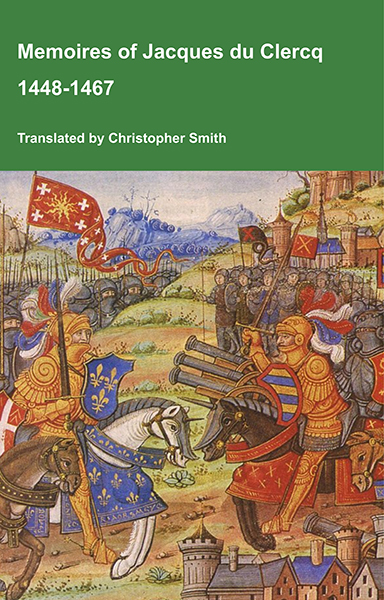
This is a translation of the 'Memoires of Jacques du Clercq', published in 1823 in two volumes, edited by Frederic, Baron de Reissenberg. In his introduction Reissenberg writes: 'Jacques du Clercq tells us that he was born in 1424, and that he was a licentiate in law and a counsellor to Philip the Good, Duke of Burgundy, in the castellany of Douai, Lille, and Orchies. It appears that he established his residence at Arras. In 1446, he married the daughter of Baldwin de la Lacherie, a gentleman who lived in Lille. We read in the fifth book of his Memoirs that his father, also named Jacques du Clercq, had married a lady of the Le Camelin family, from Compiègne. His ancestors, always attached to the counts of Flanders, had constantly served them, whether in their councils or in their armies.' The Memoires cover a period of nineteen years beginning in in 1448, ending in in 1467. It appears that the author had intended to extend the Memoirs beyond that date; no doubt illness or death prevented him from carrying out this plan. As Reissenberg writes the 'merit of this work lies in the simplicity of its narrative, in its tone of good faith, and in a certain air of frankness which naturally wins the reader’s confidence.' Du Clercq ranges from events of national and international importance, including events of the Wars of the Roses in England, to simple, everyday local events such as marriages, robberies, murders, trials and deaths, including that of his own father in Book 5; one of his last entries.
Available at Amazon in eBook and Paperback format.
St Cuby's Church, Duloe is in Duloe, Cornwall, Churches in Cornwall.
St Cuby's Church, Duloe [Map].


Around 550. St Cuby's Church, Duloe [Map]. St Cuby's Font stood for 1300 years at St Cuby's Well, Duloe [Map].


Around 1550. St Cuby's Church, Duloe [Map]. Below east window of chapel, slate with 2 Elizabethan ladies with their families.

In 1592 Anna Coffyn died. Slate memorial at St Cuby's Church, Duloe [Map]. In Elizabethan dress holding gloves and book. 2 shields in spandrels with skull below.

1610. St Cuby's Church, Duloe [Map]. Beneath north window table tomb of John Killiow of Westnorth, died 1610 and wife Dorothy Trevelyan who died in 1600 and whose arms are impaled with those of her husband on panel above tomb. Strapwork decoration.

In 1629 Maria Arundel died. Slate monument at St Cuby's Church, Duloe [Map].
Maria Arundel: she was born to Thomas Arundell.
On 28th March 1793 Harry Bewes [aged 52] died. He was buried at St Cuby's Church, Duloe [Map]. Monument by William Adran, 1793, signed 'Adran Fect London'.
Harry Bewes: Around 1741 he was born.


On 15th April 1824 Edward Buller 1st Baronet [aged 59] died. Baronet Buller of Trennant Park in Cornwall extinct. He was buried at St Cuby's Church, Duloe [Map].
Edward Buller 1st Baronet: On 24th December 1764 he was born to John Buller and Mary St Aubyn. On 3rd October 1808 Edward Buller 1st Baronet was created 1st Baronet Buller of Trennant Park in Cornwall.

After 1839. St Cuby's Church, Duloe [Map]. Memorial to John Ogilvy.

After 19th July 1863. St Cuby's Church, Duloe [Map]. Grave of Thomas Serpell who was "unfortunately drowned at Shallow-pool ... aged 18 years and 10 months."
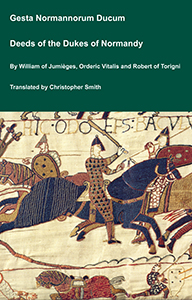
The Deeds of the Dukes of Normandy
The Gesta Normannorum Ducum [The Deeds of the Dukes of Normandy] is a landmark medieval chronicle tracing the rise and fall of the Norman dynasty from its early roots through the pivotal events surrounding the Norman Conquest of England. Originally penned in Latin by the monk William of Jumièges shortly before 1060 and later expanded at the behest of William the Conqueror, the work chronicles the deeds, politics, battles, and leadership of the Norman dukes, especially William’s own claim to the English throne. The narrative combines earlier historical sources with firsthand information and oral testimony to present an authoritative account of Normandy’s transformation from a Viking settlement into one of medieval Europe’s most powerful realms. William’s history emphasizes the legitimacy, military prowess, and governance of the Norman line, framing their expansion, including the conquest of England, as both divinely sanctioned and noble in purpose. Later chroniclers such as Orderic Vitalis and Robert of Torigni continued the history, extending the coverage into the 12th century, providing broader context on ducal rule and its impact. Today this classic work remains a foundational source for understanding Norman identity, medieval statesmanship, and the historical forces that reshaped England and Western Europe between 800AD and 1100AD.
Available at Amazon in eBook and Paperback format.

After 1918. St Cuby's Church, Duloe [Map]. War Memorial.

After 18th November 1936. St Cuby's Church, Duloe [Map]. Memorial to Bennett John Toms, Churchwarden, died at sea.

On 22nd October 1942. St Cuby's Church, Duloe [Map]. C Rawlings, Regulating Petty Officer, Royal Navy. D/MX 60806. HMS Drake. Aged thirty. Died of acute appendicitis.

20th February 1945. St Cuby's Church, Duloe [Map]. Grave of William Richard Tambling, RAF. Killed on Active Service. Aged twenty-six years.
Wireless Operator on Martinet TT.I MS690 which crashed.