

The History of William Marshal was commissioned by his son shortly after William’s death in 1219 to celebrate the Marshal’s remarkable life; it is an authentic, contemporary voice. The manuscript was discovered in 1861 by French historian Paul Meyer. Meyer published the manuscript in its original Anglo-French in 1891 in two books. This book is a line by line translation of the first of Meyer’s books; lines 1-10152. Book 1 of the History begins in 1139 and ends in 1194. It describes the events of the Anarchy, the role of William’s father John, John’s marriages, William’s childhood, his role as a hostage at the siege of Newbury, his injury and imprisonment in Poitou where he met Eleanor of Aquitaine and his life as a knight errant. It continues with the accusation against him of an improper relationship with Margaret, wife of Henry the Young King, his exile, and return, the death of Henry the Young King, the rebellion of Richard, the future King Richard I, war with France, the death of King Henry II, and the capture of King Richard, and the rebellion of John, the future King John. It ends with the release of King Richard and the death of John Marshal.
Available at Amazon in eBook and Paperback format.
St Mary the Virgin Church, Newton Solney is in Newton Solney, Derbyshire [Map], Churches in Derbyshire.
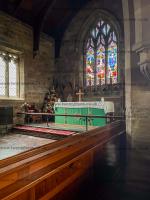
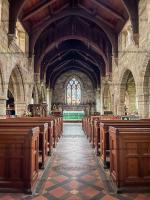
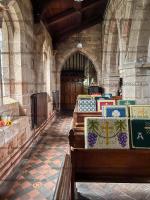
St Mary the Virgin Church, Newton Solney [Map]. Interior.
St Mary the Virgin Church, Newton Solney [Map]. Exterior.

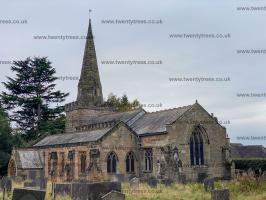
St Mary the Virgin Church, Newton Solney [Map]. The River Trent flows around 200m from the church.
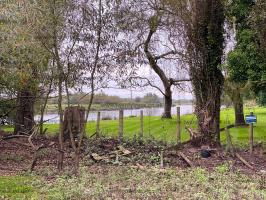

Around 1350. St Mary the Virgin Church, Newton Solney [Map]. Effigy of unknown knight.
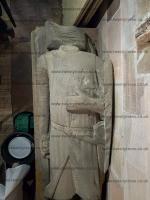
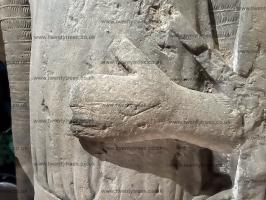
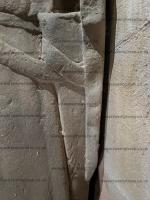
Around 1350. St Mary the Virgin Church, Newton Solney [Map]. Effigy of unknown knight.
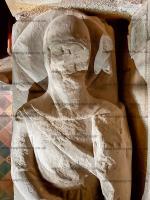
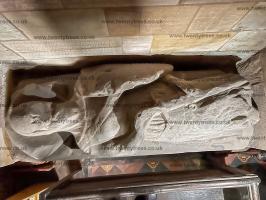
Around 1375. St Mary the Virgin Church, Newton Solney [Map]. Effigy of unknown member of the Solney family. Goat belt buckle. Camail and Jupon Period.


After 1709. St Mary the Virgin Church, Newton Solney [Map]. Monument to Henry Every 3rd Baronet (age 60) commissioned by his wife Anne Russell Lady Guise sculpted by Thomas Carter (age 7).
Henry Every 3rd Baronet: In 1649 he was born to Henry Every 2nd Baronet and Vere Herbert. On 29th September 1700 Henry Every 2nd Baronet died. His son Henry succeeded 3rd Baronet Every of Egginton in Derbyshire. In or before 1709 Henry Every 3rd Baronet and Anne Russell Lady Guise were married. On 1st September 1709 Henry Every 3rd Baronet died. His brother John succeeded 4th Baronet Every of Egginton in Derbyshire.
Anne Russell Lady Guise: In or before 1687 Richard Lygon and she were married. On or after 2nd January 1711 , the date of their marriage license, John Guise 3rd Baronet and she were married. She by marriage Lady Guise of Elmore in Gloucestershire. His second marriage, her third.
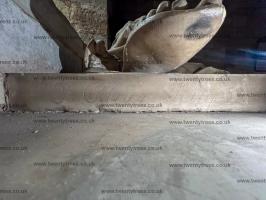
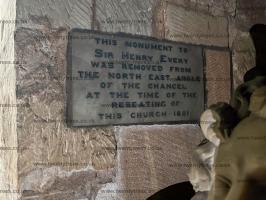
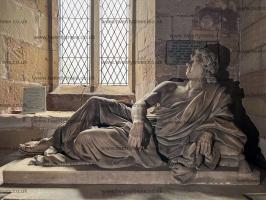
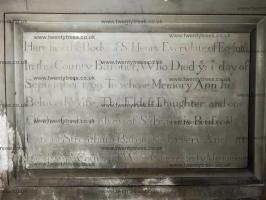
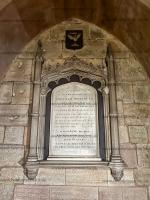
After 1842. St Mary the Virgin Church, Newton Solney [Map]. Memorial to Abraham Hoskins.
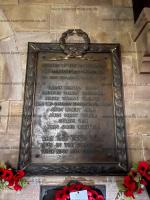
After 1919. St Mary the Virgin Church, Newton Solney [Map]. Memorial to those who died in WWI.
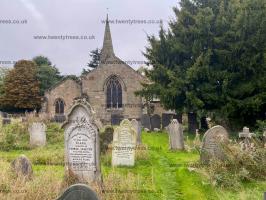
After 9th November 1919. St Mary the Virgin Church, Newton Solney [Map]. Grave of William Henry Taylor, Royal Army Service Corps. Son of Tom and Maria Taylor. Born at Newton Solney, Burton-on-Trent.