


Text this colour links to Pages. Text this colour links to Family Trees. Text this colour are links that disabled for Guests.
Place the mouse over images to see a larger image. Click on paintings to see the painter's Biography Page.
Mouse over links for a preview. Move the mouse off the painting or link to close the popup.
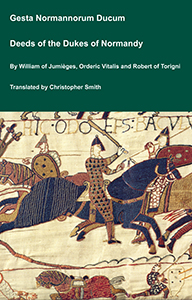
The Deeds of the Dukes of Normandy
The Gesta Normannorum Ducum [The Deeds of the Dukes of Normandy] is a landmark medieval chronicle tracing the rise and fall of the Norman dynasty from its early roots through the pivotal events surrounding the Norman Conquest of England. Originally penned in Latin by the monk William of Jumièges shortly before 1060 and later expanded at the behest of William the Conqueror, the work chronicles the deeds, politics, battles, and leadership of the Norman dukes, especially William’s own claim to the English throne. The narrative combines earlier historical sources with firsthand information and oral testimony to present an authoritative account of Normandy’s transformation from a Viking settlement into one of medieval Europe’s most powerful realms. William’s history emphasizes the legitimacy, military prowess, and governance of the Norman line, framing their expansion, including the conquest of England, as both divinely sanctioned and noble in purpose. Later chroniclers such as Orderic Vitalis and Robert of Torigni continued the history, extending the coverage into the 12th century, providing broader context on ducal rule and its impact. Today this classic work remains a foundational source for understanding Norman identity, medieval statesmanship, and the historical forces that reshaped England and Western Europe between 800AD and 1100AD.
Available at Amazon in eBook and Paperback format.
St Mary's Church, Bury St Edmunds is in Bury St Edmunds, Suffolk [Map].
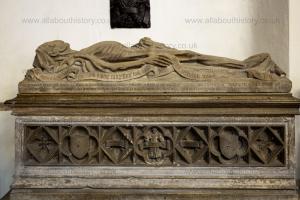
1467. The Cadaver tomb of John Baret at St Mary's Church, Bury St Edmunds. His tomb, which he had made before his death, once stood between the arch of the nave and his chantry. The roof painted with motto Grace me Govern and his SS collar is in wonderful preservation.
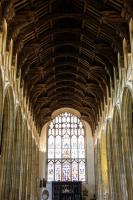
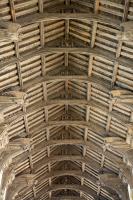
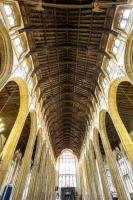
Around 1500. The nave roof at St Mary's Church, Bury St Edmunds is of single hammer-beam constructions, with eleven pairs of life-sized angels. The angels show a procession in honour of the Assumption of the Blessed Virgin Mary.
In 1501 William Carew died. He was buried at St Mary's Church, Bury St Edmunds.
William Carew: he was born to Nicholas Carew and Joan Courtenay. He a great x 4 grandson of King Edward I of England.
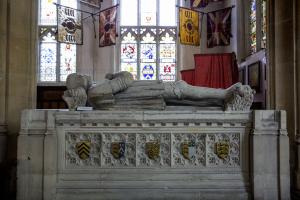
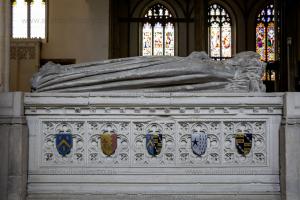
On 1st March 1536 Robert Drury (age 82) died. He was buried at St Mary's Church, Bury St Edmunds where he has a monument with him and his wife Anne Calthorpe represented.
Robert Drury: In 1454 he was born to Roger Drury of Hawstead in Suffolk at Hawstead, Suffolk. Before 1494 Robert Drury and Anne Calthorpe were married. On 15th October 1495 he was appointed Speaker of the House of Commons during the 5th Parliament of Henry VII. After 12th November 1529 Robert Drury and Anne Jerningham were married. The difference in their ages was 50 years.


During the dissolution, around 4th November 1539, the remains of Mary Tudor Queen Consort France were reburied at St Mary's Church, Bury St Edmunds.
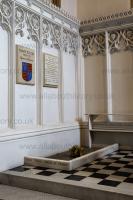

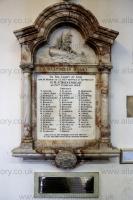
26th February 1852. Memorial at St Mary's Church, Bury St Edmunds to the fifty-five men of the Suffolk Regiment who drowned during the sinking of HMS Birkenhead from which the "Birkenhead Drill" i.e. women and children first, is named.
Rudyard Kipling's 1893 poem:
To take your chance in the thick of a rush, with firing all about,
Is nothing so bad when you've cover to 'and, an' leave an' likin' to shout;
But to stand an' be still to the Birken'ead drill is a damn tough bullet to chew,
An' they done it, the Jollies – 'Er Majesty's Jollies – soldier an' sailor too!
Their work was done when it 'adn't begun; they was younger nor me an' you;
Their choice it was plain between drownin' in 'eaps an' bein' mopped by the screw,
So they stood an' was still to the Birken'ead drill, soldier an' sailor too!
 Become a Member via our Buy Me a Coffee page to read more.