

Jean de Waurin's Chronicle of England Volume 6 Books 3-6: The Wars of the Roses
Jean de Waurin was a French Chronicler, from the Artois region, who was born around 1400, and died around 1474. Waurin’s Chronicle of England, Volume 6, covering the period 1450 to 1471, from which we have selected and translated Chapters relating to the Wars of the Roses, provides a vivid, original, contemporary description of key events some of which he witnessed first-hand, some of which he was told by the key people involved with whom Waurin had a personal relationship.
Available at Amazon in eBook and Paperback format.
Wallingford Castle is in Wallingford, Oxfordshire [Map], Castles in Oxfordshire.
Chronicon ex Chronicis by Florence and John of Worcester. October 1139. The Empress at Bristol Castle-Cruelties at Gloucester. This lady [aged 37] stayed at Bristol more than two months, receiving homage from all, and exercising the prerogatives of the crown of England at her pleasure. She went there in the month of October, and came on the eighteenth of the calends of November (15th October) to Gloucester, where she received the submission and homage of the citizens and the people of the neighbourhood. But tortures worthy of Decius and Nero, and death in various shapes, were inflicted on those who refused to do her homage, and chose to maintain their fealty to the king; and the city, glorious in past ages, was filled with shrieks and fearful torments, and became horrible to those who inhabited it. In the midst of these miseries the king laid siege to the castle of Wallingford [Map], which stood out against him. Weary of the long siege, and having erected forts in opposition to it, he marched away, and encamped near Malmesbury, where he also threw up works against his adversaries, the authors of rebellion.
Anglo-Saxon Chronicle. 1140. And the earl stole out, and went after Robert, Earl of Glocester [aged 41], and brought him thither with a large army. And they fought strenuously on Candlemas day against their lord, and took him; for his men forsook him and fled. And they led him to Bristol, and there put him into prison in close quarters. Then was all England stirred more than ere was, and all evil was in the land. Afterwards came the daughter of King Henry, who had been Empress of Germany [aged 37], and now was Countess of Anjou. She came to London; but the people of London attempted to take her, and she fled, losing many of her followers. After this the Bishop of Winchester, Henry [aged 42], the brother of King Stephen [aged 46], spake with Earl Robert, and with the empress, and swore them oaths, "that he never more would hold with the king, his brother," and cursed all the men that held with him, and told them, that he would give them up Winchester; and he caused them to come thither. When they were therein, then came the king's queen with all her strength, and beset them, so that there was great hunger therein. When they could no longer hold out, then stole they out, and fled; but those without were aware, and followed them, and took Robert, Earl of Glocester, and led him to Rochester, and put him there into prison; but the empress fled into a monastery. Then went the wise men between the king's friends and the earl's friends; and settled so that they should let the king out of prison for the earl, and the earl for the king; and so they did. After this settled the king and Earl Randolph at Stamford, and swore oaths, and plighted their troth, that neither should betray the other. But it availed nothing. For the king afterwards took him at Northampton, through wicked counsel, and put him into prison; and soon after he let him out again, through worse counsel, on the condition that he swore by the crucifix, and found hostages, that he would give up all his castles. Some he gave up, and some gave he not up; and did then worse than he otherwise would. Then was England very much divided. Some held with the king, and some with the empress; for when the king was in prison, the earls and the rich men supposed that he never more would come out: and they settled with the empress, and brought her into Oxford, and gave her the borough. When the king was out, he heard of this, and took his force, and beset her in the tower.165 And they let her down in the night from the tower by ropes. And she stole out, and fled, and went on foot to Wallingford [Map]. Afterwards she went over sea; and those of Normandy turned all from the king to the Earl of Anjou [aged 26]; some willingly, and some against their will; for he beset them till they gave up their castles, and they had no help of the king. Then went Eustace, the king's son, to France, and took to wife the sister of the King of France. He thought to obtain Normandy thereby; but he sped little, and by good right; for he was an evil man. Wherever he was, he did more evil than good; he robbed the lands, and levied heavy guilds upon them. He brought his wife to England, and put her into the castle at…166 Good woman she was; but she had little bliss with him; and Christ would not that he should long reign. He therefore soon died, and his mother also. And the Earl of Anjou died; and his son Henry took to the earldom. And the Queen of France parted from the king; and she came to the young Earl Henry; and he took her to wife, and all Poitou with her. Then went he with a large force into England, and won some castles; and the king went against him with a much larger force. Nevertheless, fought they not; but the archbishop and the wise men went between them, and made this settlement: That the king should be lord and king while he lived, and after his day Henry should be king: that Henry should take him for a father; and he him for a son: that peace and union should be betwixt them, and in all England. This and the other provisions that they made, swore the king and the earl to observe; and all the bishops, and the earls, and the rich men. Then was the earl received at Winchester, and at London, with great worship; and all did him homage, and swore to keep the peace. And there was soon so good a peace as never was there before. Then was the king stronger than he ever was before. And the earl went over sea; and all people loved him; for he did good justice, and made peace.
Note 165. The tower of the castle at Oxford, built by D'Oyley, which still remains.
Note 166. The MS. is here deficient.
 Become a Member via our Buy Me a Coffee page to read more.
In July 1153 King Henry "Curtmantle" II of England [aged 20] arrived at Wallingford Castle [Map] to relieve the siege that King Stephen I England [aged 59] had commenced in 1152.
In April 1156 William Plantagenet IX Count Poitiers [aged 2] died at Wallingford Castle [Map]. He was buried at Reading Abbey, Berkshire [Map] at the feet of his great-grandfather King Henry I "Beauclerc" England.
In 1216 Richard Fitzroy [aged 26] was appointed Constable of Wallingford Castle.
On 26th October 1232 Ranulf de Blondeville Gernon 6th Earl Chester 1st Earl Lincoln [aged 62] died at Wallingford Castle [Map]. His nephew John [aged 25] succeeded 7th Earl Chester.
On 31st May 1326 Maurice Berkeley 7th and 2nd Baron Berkeley [aged 55] died at Wallingford Castle [Map]. He was buried at St Augustine's Abbey, Bristol [Map]. His son Thomas [aged 30] succeeded 8th Baron Berkeley Feudal, 3rd Baron Berkeley. Margaret Mortimer Baroness Berkeley [aged 22] by marriage Baroness Berkeley Feudal.
In 1375 Aubrey de Vere 10th Earl of Oxford [aged 37] was appointed Constable of Wallingford Castle.
On 7th August 1385 Joan "Fair Maid of Kent" Princess Wales [aged 56] died at Wallingford Castle [Map]. She was buried at Blackfriars Friary, Stamford [Map] beside her first husband Thomas Holland 1st Earl Kent. Her son Thomas [aged 35] succeeded 6th Baron Wake of Liddell.
In 1434 William "Jackanapes" de la Pole 1st Duke of Suffolk [aged 37] was appointed Constable of Wallingford Castle.
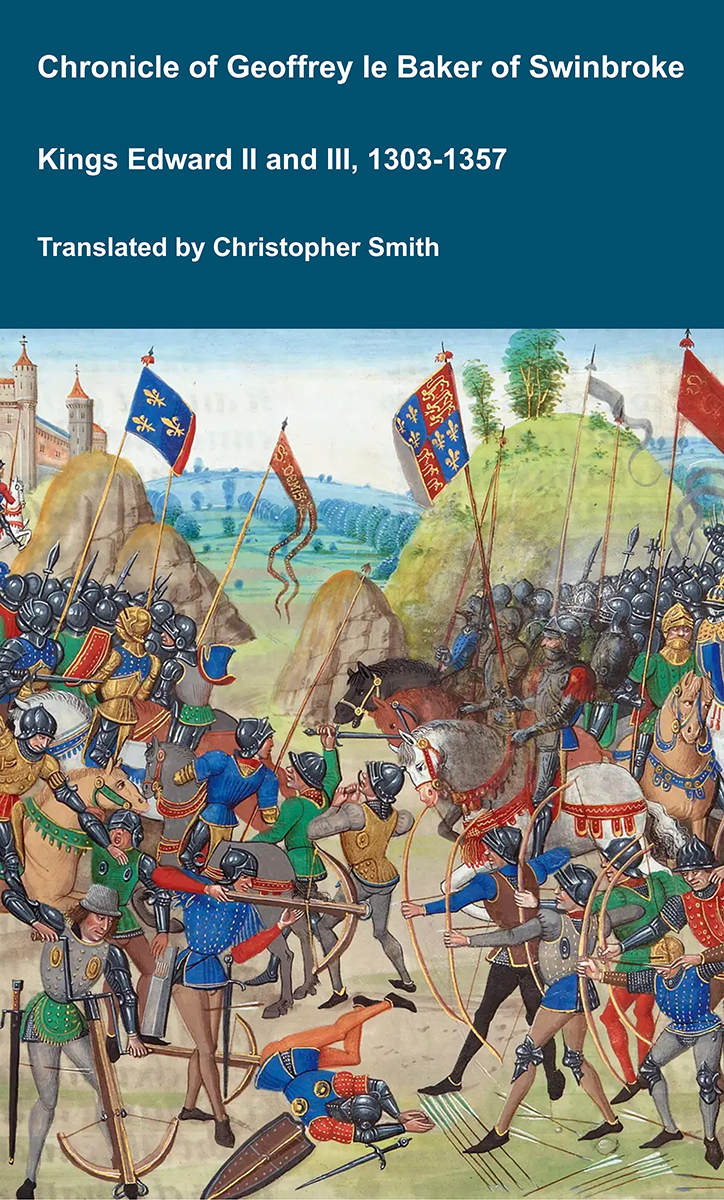
Chronicle of Geoffrey le Baker of Swinbroke
Baker was a secular clerk from Swinbroke, now Swinbrook, an Oxfordshire village two miles east of Burford. His Chronicle describes the events of the period 1303-1356: Gaveston, Bannockburn, Boroughbridge, the murder of King Edward II, the Scottish Wars, Sluys, Crécy, the Black Death, Winchelsea and Poitiers. To quote Herbert Bruce 'it possesses a vigorous and characteristic style, and its value for particular events between 1303 and 1356 has been recognised by its editor and by subsequent writers'. The book provides remarkable detail about the events it describes. Baker's text has been augmented with hundreds of notes, including extracts from other contemporary chronicles, such as the Annales Londonienses, Annales Paulini, Murimuth, Lanercost, Avesbury, Guisborough and Froissart to enrich the reader's understanding. The translation takes as its source the 'Chronicon Galfridi le Baker de Swynebroke' published in 1889, edited by Edward Maunde Thompson.
Available at Amazon in eBook and Paperback format.
In 1455 Henry Holland 3rd Duke Exeter [aged 24] was imprisoned at Wallingford Castle [Map].
Around 1465 John de la Pole 2nd Duke of Suffolk [aged 22] was appointed Constable of Wallingford Castle.
After 14th April 1471 Margaret of Anjou Queen Consort England [aged 41] was imprisoned at Wallingford Castle [Map] then the Tower of London [Map].
In 1482 Richard Grey [aged 25] was appointed Constable of Wallingford Castle.
xvijo Maij [17th May 1483]. Item an openelettre to alle thofficers of (thonnour) Thonor of Wallingford aswel within the Castelle [Map] as without / shewing thaim that the kinges grace hathe graunted unto the vicount Lovelle [aged 27] during the kinges pleasure the keping of the said Castelle and the hole Rule & oversight of the said honor with putting out contynueng or making of new officers in the same etc
In 1536 Francis Bryan [aged 46] was appointed Constable of Wallingford Castle.
In 1642 Thomas Blagge [aged 29] was appointed Governor of Wallingford Castle.