Anne Boleyn. Her Life as told by Lancelot de Carle's 1536 Letter.
In 1536, two weeks after the execution of Anne Boleyn, her brother George and four others, Lancelot du Carle, wrote an extraordinary letter that described Anne's life, and her trial and execution, to which he was a witness. This book presents a new translation of that letter, with additional material from other contemporary sources such as Letters, Hall's and Wriothesley's Chronicles, the pamphlets of Wynkyn the Worde, the Memorial of George Constantyne, the Portuguese Letter and the Baga de Secrets, all of which are provided in Appendices.
Available at Amazon in eBook and Paperback format.
Wayland's Smithy Long Barrow is in Ashbury, Berkshire, South England Neolithic Burials.
The Ridgeway Path is an ancient footpath that extends from Knap Hill [Map], on the south of the Avebury Plateau, or The Sanctuary [Map], to Ivinghoe Beacon, Buckinghamshire [Map] - a distance of more than eighty miles following the scarp slopes. From Knap Hill [Map] the Ridgeway Path passes The Sanctuary [Map], Avebury Ridgeway Path [Map] where a path leads to the Avebury Henge East Entrance [Map], Barbury Castle [Map], Liddington Castle [Map], Wayland's Smithy Long Barrow [Map], Uffington Castle and White Horse [Map], Segsbury Camp [Map], Scutchamer Knob, Oxfordshire [Map], Goring, Oxfordshire [Map], Swyncome, Oxfordshire [Map], Chinnor, Oxfordshire [Map], Princes Risborough, Buckinghamshire [Map], Boddington Hill Fort, Buckinghamshire [Map], Tring, Hertfordshire [Map], Ivinghoe Beacon, Buckinghamshire [Map].
3600BC. Wayland's Smithy Long Barrow [Map] is Severn Cotswolds type in Oxfordshire on the Ridgeway Path.
It was first constructed in wood around 3570BC then as a stone monument around 3430BC.
Carbon Date. 2770BC. Late Neolithic Carbon Dates
Report: Wood, id as branch, from clearance just before building, Barrow II at Wayland's Smithy [Map], Ashbury, Berkshire, England. [Ed: discrepancy noted in lab nos: some sources give I-2328 for this determination; but that appears to clash with dates for Stonehenge.]
ID: 4388, C14 ID: I-1468 Date BP: 4770 +/- 130, Start Date BP: 4640, End BP: 4900
OS Letter: SU, OS East: 281, OS North: 854
Archaeologist Name: R J C Atkinson
Reference Name: Antiquity, 39, 1965, 126-33; Proc Prehist Soc, 57(2), 1991, 61-101
Council for British Archaeology (2012) Archaeological Site Index to Radiocarbon Dates from Great Britain and Ireland [data-set]. York: Archaeology Data Service [distributor] https://doi.org/10.5284/1017767
Charter s564. A.D. 955. King Eadred to Ælfheah, his kinsman and minister; grant of 8 hides (cassati) at Compton Beauchamp, Berks. Latin with English bounds
Archive: Abingdon
MSS: 1. London, British Library, Cotton Claudius B. VI, ff. 40v-41r (s. xiii in.)
Printed: K, 1172; Stevenson, Chron. Abingdon, i. 158-9; B, 908; Earle, pp. 383-4; PN Berks., iii. 692, bounds only; Kelly, Abingdon, no. 50
Comments: Stenton 1913, p. 41, cited; Grundy, Berks., III, pp. 87-9, on bounds; PN Berks., i. 3-4, ii. 346-7, 360, iii. 677, 692-4, bounds cover western part of parish of Compton Beauchamp; Hart, ECNE, pp. 19-22, discusses charter-type, which he terms 'Dunstan B'; Gelling, ECTV, no. 65, authentic; Keynes 1980, pp. 46-8, on charter-type; Keynes 1994, on charter-type, esp. pp. 174, 188; Abrams 1996, pp. 93-4, on possible links with Gl 77 (S 1735a); Kelly, Abingdon, no. 50, authentic
In the year of the Incarnation of our Lord Jesus Christ 855, I, Eadred, by the favour of divine grace, king and chief ruler of all Albion, have most willingly granted a small portion of land, measured at eight cassati, to my minister Ælfheah, who is related to me by kinship, in the place called æt Cumtune, near the hill known as Æces dune.
I bestow this gift with the condition that after his death, he may leave it in perpetuity to whichever heir he chooses. If anyone—though we do not wish it—attempts to violate this donation, may he, unless duly punished in this world, suffer eternal torment in the next.
The boundaries of this piece of land are outlined as follows: These are the land boundaries at Cumtune: First, from Hricg weg to the wide gate, from the wide gate to Æþelmes hlinc at the edge of the hill, from Æþelmes hlinc to Icenhilde weg, from Icenhilde weg to Bican dic, from Bican dic into Swyn broc, from Swyn broc to the broad thorn west of the mere, from that thorn to the red ditch, along the ditch to Hildes hlæw, from Hildes hlæw to Blæc pytt, from Blæc pytt along the western rush row into Swyn broc, from Swyn broc to Read, from Read to Hwittuces hlæw at Icenhilde weg, from Icenhilde weg to Mæres crundel, from Mæres crundel to Dinra beorh, from Dinra beorh to Hricg weg, from Hricg weg to Fearn hylles slæde, from Fearn hylles slæde southward to Hæsl hyll, from Hæsl hyll westward to the green way, along the road to the trampled thicket, along the thicket until it reaches the wide gate east of Waysland Smithy [Map].
The names of those who confirm this grant are recorded below: I, Oda, Archbishop, have given my consent. I, Wulfstan, Archbishop, have confirmed it. I, Ælfsige, Bishop, have confirmed it. I, Alfwold, Bishop, have corroborated it. I, Wulfsige, Bishop, have approved it. I, Osulf, Bishop, have agreed. I, Byrhtelm, Bishop, have established it. I, Cenwold, Bishop, have inspected it. I, Cynsige, Bishop, have subscribed to it. I, Leofwine, Bishop, have consented. I, Æþelstan, Duke. I, Eadmund, Duke. I, Ælfsige, Duke. I, Æþelsige, Minister. I, Ælfnoð, Minister. I, Ælfgar, Minister. I, Byrhferð, Minister."
Anno ab incarnatione Domini nostri Iesu Christi .dcccclv. Ego Eadred diuina gratia fauente rex et primicerius totius Albionis aliquantulam particulam Ælfheho ministro meo, mihi propinquitate coniuncto, sub estimatione .viii. cassatorum in loco qui dicitur æt Cumtune iuxta montem qui uocatur Æces dune libenter admodum concessi, eo tenore huius munificentie donum perstringens ut post obitum suum in perpetuum ius cuicumque uoluerit heredi derelinquat. Quod si quisque quod non optamus huiusce donationis cartulam infringere temptauerit, ni prius in hoc seculo digne castigetur, in futuro perenni cruciatu prematur. Et his limitibus hec telluris particula circumgirari uidetur. Ðis sint þæs landes gemære æt Cumtune. Ærest of Hricg wege on þæt wide geat, of þan widan geate on æþelmes hlinc on forwerde dune, of æþelmes hlince on Icen hilde weg, of Icenhilde wege on bican dic, of bicandice inon swyn broc, of swyn broce on þone bradan þorn be westan mere, of þan þorne on þa readan dic, 7lang þære dic on Hildes hlæw, of Hildes hlæwe on blæc pytt, of blæc pytte 7langes þære westran risc ræwe innan swynbroc, of swynbroce on read, of ræde on hwittuces hlæwe on Icen hilde weg, of Icenhilde wege on mæres crundel, of mæres crundelle on dinra beorh, of dinra beorge on Hricg weg, of Hricg wege on fearn hylles slæde, of fearn hylles slæde to hæsl hylle suþe weardre, of hæsl hylle west on þone grenan weg, 7lang weges to þære gedrifonan fyrh, andlang fyrh oþ hit cymð on þæt wide geat be eastan Welandes smiððan. Huius doni constipulatorum nomina inferius notata uidentur. + Ego Oda archiepiscopus consensi. + Ego Wulfstan archiepiscopus roboraui. + Ego Ælfsige episcopus roboraui. + Ego Alfwold episcopus corroboraui. + Ego Wulfsige episcopus suppressi. + Ego Osulf episcopus annui. + Ego Byrhtelm episcopus constitui. + Ego Cenwold episcopus conspexi. + Ego Cynsige episcopus subscripsi. + Ego Leofwine episcopus consensi. + Ego Æþelstan dux. + Ego Eadmund dux. + Ego Ælfsige dux. + Ego Æþelsige minister. + Ego Ælfnoð minister. + Ego Ælfgar minister. + Ego Byrhferð minister.
Rubric: Carta regis Eadredi de Cumtune. Anno ab incarnatione Domini nostri Iesu Christi .dcccclv. Ego Eadred diuina gratia fauente rex et primicerius totius Albionis aliquantulam particulam Ælfheho ministro meo, mihi propinquitate coniuncto, sub estimatione .viii. cassatorum in loco qui dicitur æt Cumtune iuxta montem qui uocatur Æces dune libenter admodum concessi, eo tenore huius munificentie donum perstringens ut post obitum suum in perpetuum ius cuicumque uoluerit heredi derelinquat. Quod si quisque quod non optamus huiusce donationis cartulam infringere temptauerit, ni prius in hoc seculo digne castigetur, in futuro perenni cruciatu prematur. Et his limitibus hec telluris particula circumgirari uidetur. ˘is sint ˇæs landes gemære æt Cumtune. Ærest of Hricg wege on ˇæt wide geat, of ˇan widan geate on æˇelmes hlinc on forwerde dune, of æˇelmes hlince on Icenhilde weg, of Icenhilde wege on bican dic, of bican dice inon swyn broc, of swyn broce on ˇone bradan ˇorn be westan mere, of ˇan ˇorne on ˇa readan dic, 7lang ˇære dic on hildes hlæw, of hildes hlæwe on blæc pytt, of blæc pytte 7langes ˇære westran risc ræwe innan swynbroc, of swynbroce on read, of rædea on hwittuces hlæwe on Icenhilde weg, of Icenhilde wege on mæres crundel, of mæres crundelle on dinra beorh, of dinra beorge on Hricg weg, of Hricg wege on fearn hylles slæde, of fearn hylles slæde to hæsl hylle suˇe weardre, of hæsl hylle west on ˇone grenan weg, 7lang weges to ˇære gedrifonan fyrh, andlang fyrh oþ hit cym∂ on þæt wide geat be eastan Welandes smi∂∂an. Huius doni constipulatorum nomina inferius notata uidentur. + Ego Oda archiepiscopus consensi. + Ego Wulfstan archiepiscopus roboraui. + Ego Ælfsige episcopus roboraui. + Ego Alfwold episcopus corroboraui. + Ego Wulfsige episcopus suppressi. + Ego Osulf episcopus annui. + Ego Byrhtelm episcopus constitui. + Ego Cenwold episcopus conspexi. + Ego Cynsige episcopus subscripsi. + Ego Leofwine episcopus consensi. + Ego Æˇelstan dux. + Ego Eadmund dux. + Ego Ælfsige dux. + Ego Æˇelsige minister. + Ego Ælfno∂ minister. + Ego Ælfgar minister. + Ego Byrhfer∂ minister.
Life of Merlin. Goblets that Wayland [Map] carved in the city of Sigen.
Pocula que sculpsit guielandus in urbe sigeni

1670. John Aubrey (age 43). Plan of Wayland's Smithy Long Barrow [Map].
The Antiquities of Berkshire Volume 2. At Ashbury Park1, in this Parish, is a Camp of an oblong Figure [Wayland's Smithy Long Barrow [Map]], about an 100 Paces Diameter, and the Works single, which is an Evidence of its Danish Original. It is now almost deſtroyed, by digging for the Sarseden Stones, to build a House for the Right Honourable Proprietor the Lord Craven
Note 1. Ashdown Park.
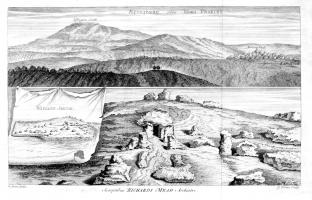
Letter to Dr Mead by Francis Wise. On the eastside of the Southern extremity, stand Three Squarish flat stones [Wayland's Smithy Long Barrow [Map]] of about four or five feet over each way, sat on edge, and supporting a Fourth of much larger dimensions, lying flat upon them. These altogether form a Cavern or sheltring place, resembling pretty exactly those described by Wormius, Bartholine, and others, except in the dimensions of the stones; for whereas this may shelter only ten or a dozen sheep from a storm Wormius mentions one in Denmark, that would shelter a hundred.
I know of no other monument of this fort in England: but ina Wales, and the, Isle of Anglesey there are several, not unlike it, called by the natives Cranlechs. The Isle of Anglefey having been the chief seat of the Druids, induced it's learnedb antiquary to ascribe them to the ancient Britains, an assertion that I will not take upon me to contradict; but shall only at this time observe, that I find sufficient, authorities to convince me that Ours must be Danish. The northern antiquaries agree to call them ALTARS; and Bartholine saith They usually bore the name of the person buried under them. He tells us likewise, that They were raifed by the Sons, Grandsons or other friends of the deceased. And that these burial monuments were applied to the purpose of sacrificing, is not improbable; it was the custom of the Pagan Danes to deify their great men. In Denmark Three of these Altars are commonly found together, designed, as is supposed, for the service of their Three chief Deities, Thor, Woden, and Frea, but Wormius lays it down as a rule, that where we meet with a Single one as in the present case we are to look upon it as a Sepulchral Altar where sacrifices were to be annually performed in honour of the defunH. The Welch word Cromlech too, according to their Antiquaries, is only; the Hebrew, Cherem-luach, i.e. The devoted or Altar Stone. I must not here forget to mention, that there seem to have been two approaches to our Altar, through Rows of large stones set on edge, One from the South, The Other from the West, the latter leading directly into the Cavern.
Note a. See Mr Lloyd's Additions to the Britannia in Pembrokeshire, and Mr Rowland's Mona Antiqua Restauranta. 410. Dublin.1723. p.92,93,213.
Note b. Rowland's Mona Antiqua Rest. Pag. 69. & 213
Diary of William Stukeley. Whitehorse Hill.
Oct. 3, 1758. My daughter [Anna] Fairchild having been in Barkshire, gave me an account of Whitehorse-hill, and the places thereabouts; the remains of a round temple23 of the Druids called Wayland Smith [Map]. Here the country people have a notion of an invisible smith living there; and if a traveller's horse happens to lose a shoe, leave him there, and a penny, and your horse shall be well shooed. I have often taken notice of these magic notions affixed to Druid temples. The figure of the horse24 on the side of the hill is poorly dravi'n, though of an immense bulk: but, she says, very much in the scheme of the Brittish horses on the reverse of their coins. They found a quantity of gold Brittish coins near there lately, hollow, and like of Cunobeline. Near the white horse, upon the hill, is a large tumulus, which they call pendragon. I believe this hill was one of their places of horse and chariot races at the midsummer sacrifice in the times of the Brittish kings, like that of black Hameldon in Yorkshire, it being a fine down. — Diary, vol. xviii., 12.
Note 23. A chambered round barrow, with formerly a ring of stones at the base of the mound. The chamber is cruciform in plan.
Note 24. Near Uffington Castle, a rude figure of a horse, formed by cutting away the turf upon the side of the chalk hill, of great antiquity; supposed by some to have been a work of the Britons, and by others to be a memorial of Alfred's victory over the Danes. Just under whitehorse-hill is a round hill called dragon-hill, but whether artificial or not. is held to be doubtful. The ancient figure of the horse gives its name to the adjoining vale. — Lysons' Magn. Brit, vol. i.. 215,301.
The History of William Marshal was commissioned by his son shortly after William’s death in 1219 to celebrate the Marshal’s remarkable life; it is an authentic, contemporary voice. The manuscript was discovered in 1861 by French historian Paul Meyer. Meyer published the manuscript in its original Anglo-French in 1891 in two books. This book is a line by line translation of the first of Meyer’s books; lines 1-10152. Book 1 of the History begins in 1139 and ends in 1194. It describes the events of the Anarchy, the role of William’s father John, John’s marriages, William’s childhood, his role as a hostage at the siege of Newbury, his injury and imprisonment in Poitou where he met Eleanor of Aquitaine and his life as a knight errant. It continues with the accusation against him of an improper relationship with Margaret, wife of Henry the Young King, his exile, and return, the death of Henry the Young King, the rebellion of Richard, the future King Richard I, war with France, the death of King Henry II, and the capture of King Richard, and the rebellion of John, the future King John. It ends with the release of King Richard and the death of John Marshal.
Available at Amazon in eBook and Paperback format.

Magna Britannica Volume 1. Camps and Earth Works. — This county having been frequently the scene of military operations in remote times, exhibits the remains of many ancient camps. It is not an easy matter to determine by what people they have all been formed: it is probable, however, that those of an irregular shape, upon the Downs, as Letcombe and Uffington castles, both in very commanding situations, were originally British, and afterwards used by the Romans. The former, which is almost circular, has a double vallum, and incloses an area of nearly 26 acres: there is an entrance on the east fide. The entrenchments and ditches of this camp contain eight acres and a half. Uffington castle, a large camp on the White-Horse Hill, just above the village, from which it takes its name, nearly resembles that already described: it is about 700 feet in diameter, from east to west, and 500 from north to south, and is surrounded with a high vallum, and a slighter one on the outside. The views from the inner vallum are very extensive in every direction.
[Some text not included]
A little way to the westward of Uffington castle before-mentioned, near the ridgeway leading over the Downs, there is a considerable tumulus, commonly called Wayland-Smith; over which are, irregularly scattered, several of the large stones called Sarsden Stones, found in that neighbourhood; three of the largest have a fourth laid on them in the manner of the British cromlechs. It is most probable that this tumulus is British.
Near Uffington castle is also the rude figure of a horse which gives name to the hill, formed by cutting away the turf; this appears to be of great antiquity, and more likely to have been a work of the Britons than, as it has been usually supposed, a memorial for Alfred's victory over the Danes: the figure of a horse, a good deal resembling that above-mentioned, frequently occurs on the British coins. Just under the White-Horse hill there is a round hill called Dragon-hill, which Mr. Aubrey and others have supposed to be the tumulus of some British chief; it is not however by any means certain that it is an artificial mount. Many tumuli are dispersed on the Berkshire downs, especially in the way from Uffington to Lambourn, where a groupe of them has obtained the name of the Seven Barrows.
a and d. Uffington Castle and White Horse [Map].
d. Wayland's Smithy Long Barrow [Map].

Archaeologia Volume V32 1847 Section XXIII. Observations on the celebrated Monument at Ashbury, in the county of Berks, called "Wayland Smith's Cave [Map]" by John Yonge Akerman (age 40), Esq. F.S.A. in a Letter to Capt. W. H. Smyth, R.N. Director. Read, 4th March, 1847.
Journal of the British Archaeological Association 1860. On The Legendary History Of Wayland Smith [Map] by Thom. Wright (age 49), Esq., M.A., F.S.A., Etc.

Wiltshire Archaeological Magazine 1860 V7 Pages 315-320. Wayland Smith's Cave or Cromlech [Map], near Lambourn, Berks. By Professor T. L. Donaldson, Architect, Ph. D.
Wiltshire Archaeological Magazine 1860 V7 Pages 321-333. On Wayland's Smithy [Map], and on the Traditions connected with it by John Thurnam (age 51), M.D., F.S.A.
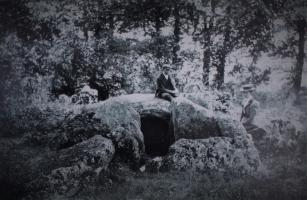
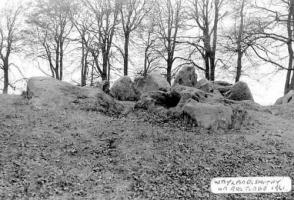
Wayland's Smithy Long Barrow [Map] in late 19th century, before the tomb was excavated and reconstructed.
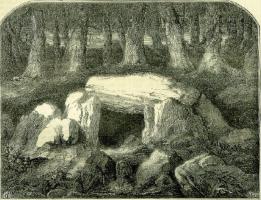
Chambers' Book of Days July 19. WAYLAND SMITHS CAVE [Map]
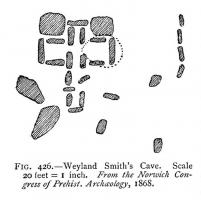
Dolmens of Ireland Volume 2. The English example of this cruciform arrangement meets us in the case of no less noteworthy a monument than that called "Weyland Smith's Cave [Map]," in the county of Berkshire, a plan of which I have given above (Fig. 426).
Antiquaries Journal V1 1921 Page 183. Wayland's Smithy [Map], Berkshire. By C. R. Peers, Secretary, and Reginald A. Smith, F.S.A. [Read 16th December 1920]

Long Barrows of the Cotswolds. Wayland's Smithy Long Barrow [Map]
Chronicle of a Bourgeois of Valenciennes
Récits d’un bourgeois de Valenciennes aka The Chronicle of a Bourgeois of Valenciennes is a vivid 14th-century vernacular chronicle written by an anonymous urban chronicler from Valenciennes in the County of Hainaut. It survives in a manuscript that describes local and regional history from about 1253 to 1366, blending chronology, narrative episodes, and eyewitness-style accounts of political, military, and social events in medieval France, Flanders, and the Low Countries. The work begins with a chronological framework of events affecting Valenciennes and its region under rulers such as King Philip VI of France and the shifting allegiances of local nobility. It includes accounts of conflicts, sieges, diplomatic manoeuvres, and the impact of broader struggles like the Hundred Years’ War on urban life in Hainaut. Written from the perspective of a burgher (bourgeois) rather than a monastery or royal court, the chronicle offers a rare lay viewpoint on high politics and warfare, reflecting how merchants, townspeople, and civic institutions experienced the turbulence of the 13th and 14th centuries. Its narrative style combines straightforward reporting of events with moral and civic observations, making it a valuable source for readers interested in medieval urban society, regional politics, and the lived experience of war and governance in pre-modern Europe.
Available at Amazon in eBook and Paperback format.
Around 1935. Wayland's Smithy Long Barrow [Map] before restoration.
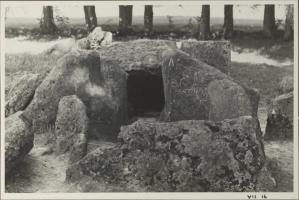
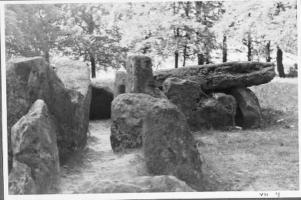
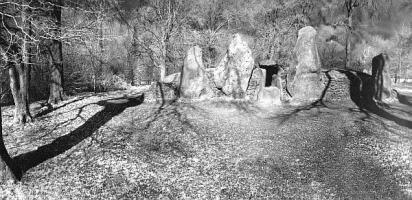
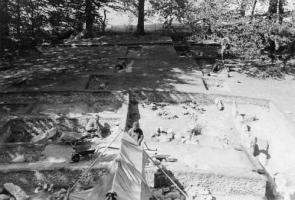
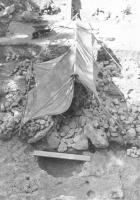
In 1963 academic staff and students from Edinburgh and Cardiff Universities began careful and patient archaeological work, sanctioned by the Ministry of Works, at Wayland's Smithy Long Barrow [Map].The dig revealed that the site originally comprised an unchambered earthern long barrow of the type found on the chalk downs. A generation or so later the site was remodelled. The skeletal remains of about 10 people were unearthed together with broken pottery of the Neolithic type (about 2500 B.C.). The various stages of the investigations are illustrated below. At the end of the 2 year dig the site was restored, as shown in the photograph above.