

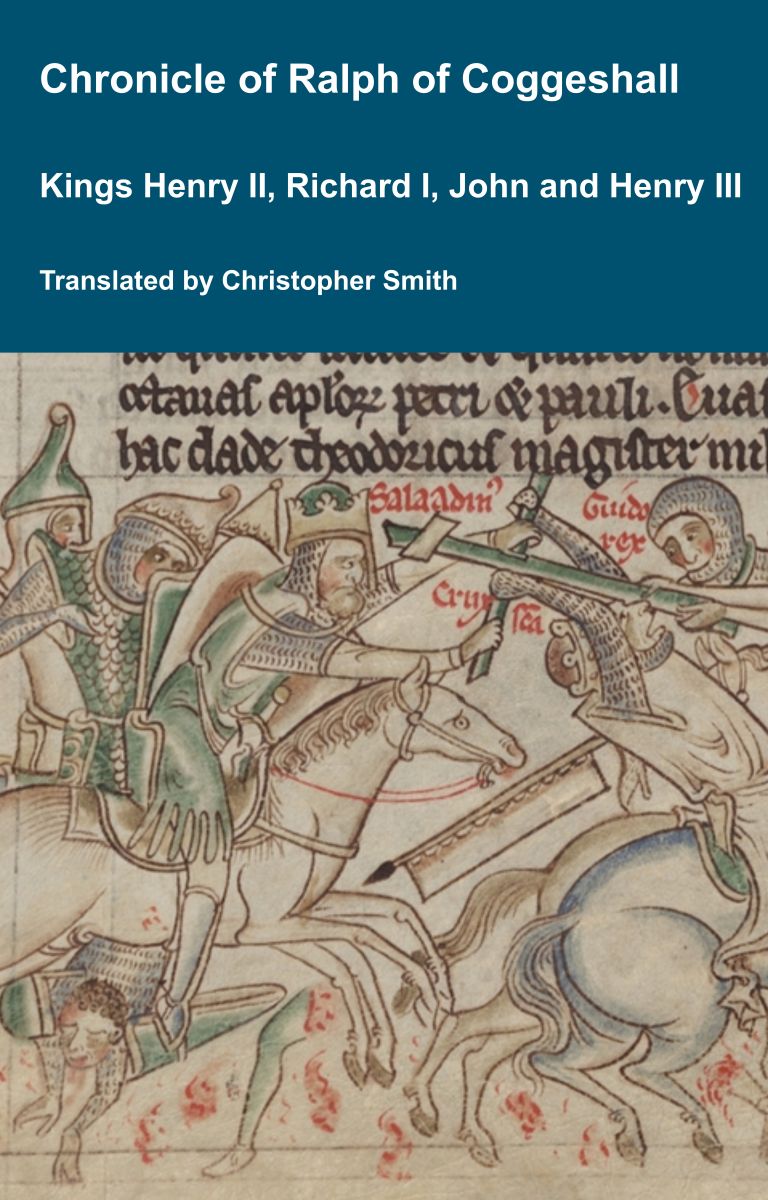
Chronicle of Abbot Ralph of Coggeshall
The Chronicle of Abbot Ralph of Coggeshall (Chronicon Anglicanum) is an indispensable medieval history that brings to life centuries of English and European affairs through the eyes of a learned Cistercian monk. Ralph of Coggeshall, abbot of the Abbey of Coggeshall in Essex in the early 13th century, continued and expanded his community’s chronicle, documenting events from the Norman Conquest of 1066 into the tumultuous reign of King Henry III. Blending eyewitness testimony, careful compilation, and the monastic commitment to record-keeping, this chronicle offers a rare narrative of political intrigue, royal power struggles, and social upheaval in England and beyond. Ralph’s work captures the reigns of pivotal figures such as Richard I and King John, providing invaluable insights into their characters, decisions, and the forces that shaped medieval rule. More than a simple annal, Chronicon Anglicanum conveys the texture of medieval life and governance, making it a rich source for scholars and readers fascinated by English history, monastic authorship, and the shaping of the medieval world.
Available at Amazon in eBook and Paperback format.
Wells Cathedral is in Wells, Somerset [Map], Cathedrals in England.
In 909 Archbishop Athelm was appointed Bishop Wells. The first Bishop of Wells.
In 973 or 974 Bishop Cyneweard was consecrated Bishop of Wells.
Around 998 Archbishop Ælfstan aka Lyfing was appointed Bishop of Bath and Wells.
On 11th June 1033 Bishop Duduc was appointed Bishop of Bath and Wells.
In 1060 Bishop Giso was consecrated Bishop of Bath and Wells.
In 1088 Bishop John of Tours was appointed Bishop of Bath and Wells.
Chronicon ex Chronicis by Florence and John of Worcester. 3rd June 1123. Henry, king of England, went over sea after the feast of Whitsuntide [3rd June]. William (age 53), archbishop of Canterbury, having received the pallium from pope Calixtus, and Thurstan (age 53), archbishop of York, with their companions, on their return from Rome, paid a visit to the king, who was still in Normandy: after a short stay, archbishop William came back to England, and, on the eleventh of the calends of August [22nd July], at Canterbury, consecrated Alexander as bishop of Lincoln; and, on the seventh of the calends of September [26th August], in the church of St. Paul the Apostle, at London, consecrated Godfrey, the queen's chancellor, to the bishopric of Bath.
Around March 1136 Bishop Robert of Lewes was consecrated Bishop of Bath and Wells.
In April 1173 Reginald Fitz Jocelin 1192 was appointed Bishop of Bath.
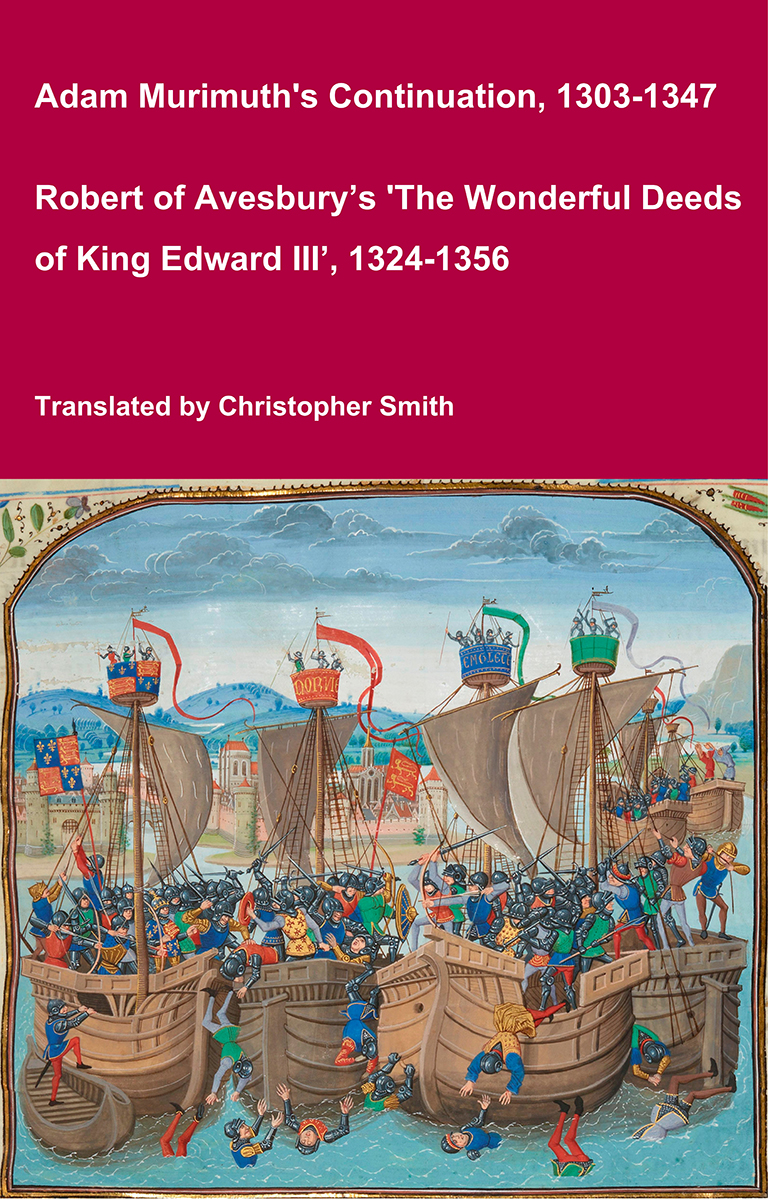
Adam Murimuth's Continuation and Robert of Avesbury’s 'The Wonderful Deeds of King Edward III'
This volume brings together two of the most important contemporary chronicles for the reign of Edward III and the opening phases of the Hundred Years’ War. Written in Latin by English clerical observers, these texts provide a vivid and authoritative window into the political, diplomatic, and military history of fourteenth-century England and its continental ambitions. Adam Murimuth Continuatio's Chronicarum continues an earlier chronicle into the mid-fourteenth century, offering concise but valuable notices on royal policy, foreign relations, and ecclesiastical affairs. Its annalistic structure makes it especially useful for establishing chronology and tracing the development of events year by year. Complementing it, Robert of Avesbury’s De gestis mirabilibus regis Edwardi tertii is a rich documentary chronicle preserving letters, treaties, and official records alongside narrative passages. It is an indispensable source for understanding Edward III’s claim to the French crown, the conduct of war, and the mechanisms of medieval diplomacy. Together, these works offer scholars, students, and enthusiasts a reliable and unembellished account of a transformative period in English and European history. Essential for anyone interested in medieval chronicles, the Hundred Years’ War, or the reign of Edward III.
Available at Amazon in eBook and Paperback format.
On 23rd June 1174 Reginald Fitz Jocelin 1192 was consecrated Bishop of Bath.
In December 1191 Savaric FitzGeldewin was elected Bishop of Bath and Glasstonbury.
On 22nd May 1264 Archbishop Walter Giffard (age 39) was elected Bishop of Bath and Wells.
On 4th January 1265 Archbishop Walter Giffard (age 40) was consecrated as Bishop of Bath and Wells at Notre Dame de Paris Cathedral [Map].
On 23rd January 1275 Bishop Robert Burnell (age 36) was elected Bishop of Bath and Wells.
On 25th December 1308 King Edward II of England (age 24) opposed Bishop John Droxford aka Drokensford for election as Bishop of Bath and Wells. He received the temporalities of the see on 15 May 1309.
On 9th May 1329 Bishop John Droxford aka Drokensford died at his episcopal manor-house at Dogmersfield, Hampshire. He was buried in St Katherine's Chapel, Wells Cathedral [Map].
In February 1333 Bishop Richard de Bury (age 46) was appointed Dean of Wells.
On 12th May 1400 Bishop Richard Clifford was elected Bishop of Bath and Wells; he was never consecrated since he was instead translated to Worcester.
In 1423 Archbishop John Stafford was appointed Dean of Wells which position he held until 1424.
Adam Murimuth's Continuation and Robert of Avesbury’s 'The Wonderful Deeds of King Edward III'
This volume brings together two of the most important contemporary chronicles for the reign of Edward III and the opening phases of the Hundred Years’ War. Written in Latin by English clerical observers, these texts provide a vivid and authoritative window into the political, diplomatic, and military history of fourteenth-century England and its continental ambitions. Adam Murimuth Continuatio's Chronicarum continues an earlier chronicle into the mid-fourteenth century, offering concise but valuable notices on royal policy, foreign relations, and ecclesiastical affairs. Its annalistic structure makes it especially useful for establishing chronology and tracing the development of events year by year. Complementing it, Robert of Avesbury’s De gestis mirabilibus regis Edwardi tertii is a rich documentary chronicle preserving letters, treaties, and official records alongside narrative passages. It is an indispensable source for understanding Edward III’s claim to the French crown, the conduct of war, and the mechanisms of medieval diplomacy. Together, these works offer scholars, students, and enthusiasts a reliable and unembellished account of a transformative period in English and European history. Essential for anyone interested in medieval chronicles, the Hundred Years’ War, or the reign of Edward III.
Available at Amazon in eBook and Paperback format.
On 18th December 1424 Archbishop John Stafford was appointed Bishop of Bath and Wells.
On 27th May 1425 Archbishop John Stafford was consecrated Bishop of Bath and Wells.
On 13th October 1443 Bishop Thomas Beckington (age 53) was consecrated Bishop of Bath and Wells.
Patent Rolls. 20th January 1465. Grant to Master Robert Stillyngton (age 45), king's clerk, keeper of the privy Westminster, seal, by mainprise of John Brewester of London, 'gentilman,' and Thomas Wode of Farnham, co. Essex, 'gentilman,' of the custody of all the temporalities of the Bishopric of Bath and Wells, in the king's hands by the death of Thomas, late bishop (deceased), so long as they remain in the king's hands, rendering as much as may be agreed upon between him and the treasurer before Midsummer and supporting all charges, and also all advowsons belonging to the king by reason of the said temporalities. By K.
On 30th October 1465 Bishop Robert Stillington (age 45) was appointed Bishop of Bath and Wells.
In 1467 William Witham was appointed Dean of Wells which post he held until 1472.
In 1472 Thomas Boleyn (age 72) died. He was buried at Wells Cathedral [Map].
In May 1491 Bishop Robert Stillington (age 71) died. He was buried at Wells Cathedral [Map].
In 1492 Bishop Richard Foxe (age 44) was elected Bishop of Bath and Wells.
On 6th November 1495 Bishop Oliver King (age 63) was translated to Bishop of Bath and Wells.
In 1502 Bishop Thomas Ruthall (age 30) was appointed Prebendary of Wells Cathedral.
In 1523 Bishop John Clerk was appointed Bishop of Bath and Wells.
Chronicle of Walter of Guisborough
A canon regular of the Augustinian Guisborough Priory, Yorkshire, formerly known as The Chronicle of Walter of Hemingburgh, describes the period from 1066 to 1346. Before 1274 the Chronicle is based on other works. Thereafter, the Chronicle is original, and a remarkable source for the events of the time. This book provides a translation of the Chronicle from that date. The Latin source for our translation is the 1849 work edited by Hans Claude Hamilton. Hamilton, in his preface, says: 'In the present work we behold perhaps one of the finest samples of our early chronicles, both as regards the value of the events recorded, and the correctness with which they are detailed; Nor will the pleasing style of composition be lightly passed over by those capable of seeing reflected from it the tokens of a vigorous and cultivated mind, and a favourable specimen of the learning and taste of the age in which it was framed.'
Available at Amazon in eBook and Paperback format.
In 1548 Bishop William Barlow (age 50) was consecrated Bishop of Bath and Wells.
On 1st April 1554 the Lord Chancellor Bishop Edmund "Bloody" Bonner of London (age 54), assisted by Bishop Stephen Gardiner (age 71), Bishop Nicholas Ridley (age 54) and Bishop Cuthbert Tunstall (age 80), consecrated seven bishops at Southwark Cathedral [Map]:
Bishop George Cotes was consecrated Bishop of Chester.
Bishop Gilbert Bourne was consecrated Bishop of Bath and Wells.
Bishop James Brooks (age 41) was consecrated Bishop of Gloucester.
Bishop Maurice Griffiths (age 47) was consecrated Bishop of Rochester.
Bishop Henry Morgan was consecrated Bishop of St David's.
Bishop John White (age 44) was consecrated Bishop of Lincoln.
Bishop Robert Parfew aka Warton was consecrated Bishop of Hereford.
Henry Machyn's Diary. 1st April 1554. [The first day of April my lord chancellor (age 54) did consecrate six new bishops at St. Mary Overy's [Map], before the high altar; and a goodly mass was said. And when all] was done thay yede unto my lord ch[ancellor's,] for ther was as grett a dener as youe ha[ve seen.] Thes be the bysshopes names that wher consecrated, [doctor] Whyt (age 44), warden of Wynchastur, the bysshope of Ly[ncoln]; doctur Borne, bysshope of Bathe; doctur Morgan, bishop of sant Davys; doctur Brokes (age 41), bysshope of Gloss [ter]; doctur Cottes, bysshope of Westtchastur; bysshope of sant Asse changyd to be bysshope of Arfford; master [Griffith] (age 47) parsun of sant Magnus bysshope of Rochastur.
On 29th January 1560 Bishop Gilbert Berkeley (age 59) was elected Bishop of Bath and Wells. Royal assent was given on 20th March 1560.
On 24th March 1560 Bishop Gilbert Berkeley (age 59) was consecrated Bishop of Bath and Wells at Lambeth Palace [Map].
In 1593 Bishop John Still (age 59) was appointed Bishop of Bath and Wells.
On 29th March 1608 Bishop James Montagu (age 40) was elected Bishop of Bath and Wells.
On 14th May 1608 Bishop James Montagu (age 40) was enthroned Bishop of Bath and Wells at Wells Cathedral [Map].
On 17th October 1616 Bishop Arthur Lake (age 47) was elected Bishop of Bath and Wells.
On 4th May 1626 Bishop Arthur Lake (age 56) died. He was buried at Wells Cathedral [Map].
On 18th September 1626 Archbishop William Laud (age 52) was appointed Bishop of Bath and Wells.


In 1660 Bishop William Piers (age 80) was appointed Bishop of Bath and Wells.
On 25th May 1670 Bishop Robert Crichton (age 77) was elected Bishop of Bath and Wells.
In 1672 Bishop Peter Mews (age 52) was elected Bishop of Bath and Wells.
On 2nd May 1674 Robert Crichton (age 35) was appointed Canon Wells and installed as Precentor Wells.
William of Worcester's Chronicle of England
William of Worcester, born around 1415, and died around 1482 was secretary to John Fastolf, the renowned soldier of the Hundred Years War, during which time he collected documents, letters, and wrote a record of events. Following their return to England in 1440 William was witness to major events. Twice in his chronicle he uses the first person: 1. when writing about the murder of Thomas, 7th Baron Scales, in 1460, he writes '… and I saw him lying naked in the cemetery near the porch of the church of St. Mary Overie in Southwark …' and 2. describing King Edward IV's entry into London in 1461 he writes '… proclaimed that all the people themselves were to recognize and acknowledge Edward as king. I was present and heard this, and immediately went down with them into the city'. William’s Chronicle is rich in detail. It is the source of much information about the Wars of the Roses, including the term 'Diabolical Marriage' to describe the marriage of Queen Elizabeth Woodville’s brother John’s marriage to Katherine, Dowager Duchess of Norfolk, he aged twenty, she sixty-five or more, and the story about a paper crown being placed in mockery on the severed head of Richard, 3rd Duke of York.
Available at Amazon in eBook and Paperback format.
After April 1684 Bishop Thomas Ken (age 46) was appointed Bishop of Bath and Wells.
On 11th June 1691 Bishop Richard Kidder (age 58) was elected Bishop of Bath and Wells.
On 30th August 1691 Bishop Richard Kidder (age 58) was consecrated Bishop of Bath and Wells.
In 1727 Bishop John Wynne (age 60) was appointed Bishop of Bath and Wells which office he held until his death in 1743.
Around November 1733 Bishop Isaac Maddox (age 36) was appointed Dean of Wells.
In 1744 Bishop Edward Willes (age 50) was appointed Bishop of Bath and Wells.
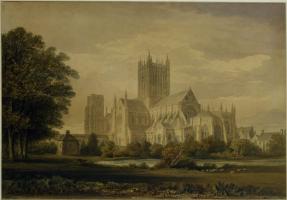
1821. John Buckler (age 50). Wells Cathedral [Map].
In 1824 Bishop George Henry Law (age 62) was appointed Bishop of Bath and Wells.
In or before 1826 Roger Frankland was appointed Canon Wells.
In 1845 Bishop Richard Bagot (age 62) was appointed Bishop of Bath and Wells.
On 25th March 1848 Harry Mengden Scarth (age 33) was appointed Prebendary of Wells Cathedral.

Chronicle of a Bourgeois of Valenciennes
Récits d’un bourgeois de Valenciennes aka The Chronicle of a Bourgeois of Valenciennes is a vivid 14th-century vernacular chronicle written by an anonymous urban chronicler from Valenciennes in the County of Hainaut. It survives in a manuscript that describes local and regional history from about 1253 to 1366, blending chronology, narrative episodes, and eyewitness-style accounts of political, military, and social events in medieval France, Flanders, and the Low Countries. The work begins with a chronological framework of events affecting Valenciennes and its region under rulers such as King Philip VI of France and the shifting allegiances of local nobility. It includes accounts of conflicts, sieges, diplomatic manoeuvres, and the impact of broader struggles like the Hundred Years’ War on urban life in Hainaut. Written from the perspective of a burgher (bourgeois) rather than a monastery or royal court, the chronicle offers a rare lay viewpoint on high politics and warfare, reflecting how merchants, townspeople, and civic institutions experienced the turbulence of the 13th and 14th centuries. Its narrative style combines straightforward reporting of events with moral and civic observations, making it a valuable source for readers interested in medieval urban society, regional politics, and the lived experience of war and governance in pre-modern Europe.
Available at Amazon in eBook and Paperback format.

On 2nd June 1854 Bishop Robert Eden 3rd Baron Auckland (age 54) was appointed Bishop of Bath and Wells.
On 6th September 1869 Bishop Robert Eden 3rd Baron Auckland (age 70) resigned his position as Bishop of Bath and Wells.
On 18th November 1869 Bishop Arthur Hervey (age 61) was appointed Bishop of Bath and Wells.


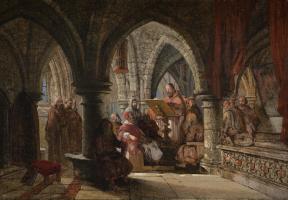
Before 1879. Samuel Rayner (age 72). "The Crypt, Wells Cathedral [Map]".
In 1943 Bishop John William Wand (age 57) was appointed Bishop of Bath and Wells.
Kingsbury Episcopi, Somerset [Map] is a village in Somerset. Episcopi, meaning Bishop, refers to it having been owned by the Bishop of Bath and Wells.
On 29th April 1870 Bishop Robert Eden 3rd Baron Auckland (deceased) was buried in the Palm Churchyard, Wells Cathedral.