

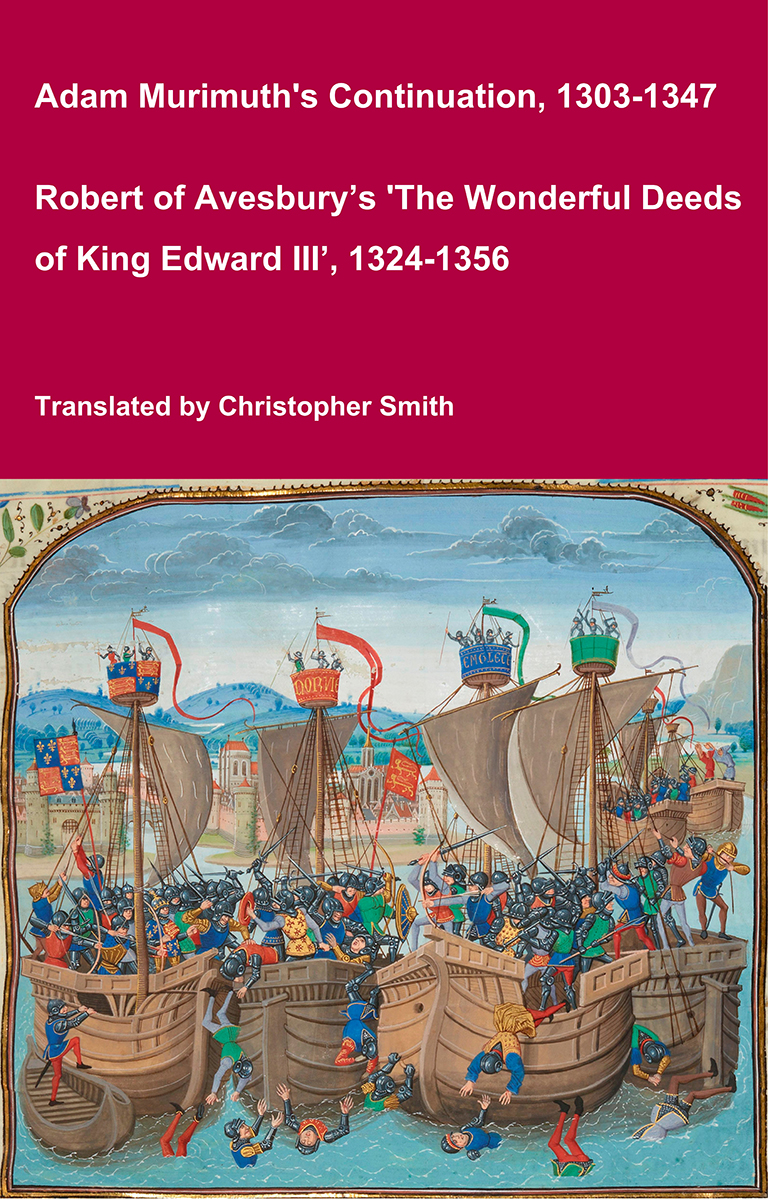
Adam Murimuth's Continuation and Robert of Avesbury’s 'The Wonderful Deeds of King Edward III'
This volume brings together two of the most important contemporary chronicles for the reign of Edward III and the opening phases of the Hundred Years’ War. Written in Latin by English clerical observers, these texts provide a vivid and authoritative window into the political, diplomatic, and military history of fourteenth-century England and its continental ambitions. Adam Murimuth Continuatio's Chronicarum continues an earlier chronicle into the mid-fourteenth century, offering concise but valuable notices on royal policy, foreign relations, and ecclesiastical affairs. Its annalistic structure makes it especially useful for establishing chronology and tracing the development of events year by year. Complementing it, Robert of Avesbury’s De gestis mirabilibus regis Edwardi tertii is a rich documentary chronicle preserving letters, treaties, and official records alongside narrative passages. It is an indispensable source for understanding Edward III’s claim to the French crown, the conduct of war, and the mechanisms of medieval diplomacy. Together, these works offer scholars, students, and enthusiasts a reliable and unembellished account of a transformative period in English and European history. Essential for anyone interested in medieval chronicles, the Hundred Years’ War, or the reign of Edward III.
Available at Amazon in eBook and Paperback format.
 West Everleigh Down Barrows 1
 West Everleigh Down Barrows 2
 West Everleigh Down Barrows 3
 West Everleigh Down Barrows 4
 West Everleigh Down Barrows 5
 West Everleigh Down Barrows 6
 West Everleigh Down Barrows 7
West Everleigh Down Barrows is in Elstub Hundred, Wiltshire, Wiltshire Bronze Age Barrows.
Wiltshire Archaeological Magazine 1885 V22 Pages 234-238. "Friday, 9 October [1807]. Fine and mild day. From Marlborough to Everley in a chaise, where I met my "Magnus Apollo," Mr. Cunnington. Mounted my horse and rode with him thus— see large map of Wilts. To the right between East and West Everley, a group of three barrows, viz., a finely formed Druid barrow between two bowl-shaped. A little beyond them on the declivity of a hill is a square earthen work, very perfect on three sides, and corners apparently rounded. In a northerly direction is a very interesting group of eight tumuli — very rude and possessing some novelty in their forms— particularly that of a long barrow within a circle. To the west of these, and a little on the left of the track leading to Pewsey, are two circles connected with each other by a ditch or hollow way [Map]. (The blackness of the soil, and the irregularity of the ground give me good reason to suppose that on digging I shall find the site of a British settlement here.) Turned off to the right, and skirted the ridge of hills, enjoying a most enchanting view of the richly wooded and cultivated vale beneath, terminated by the abrupt and bold Martinshall. On the declivity of the down see an immense irregular long barrow, called vulgarly the Giant's Grave [Map]. Beyond this tumulus and between it and Milton Farm-house, we evidently found the site of British habitations, and picked up a great deal of pottery. From hence crossed over to Easton Hill, where we discovered irregular earthen works, and excavations denoting ancient habitation. Returned to Milton Hill — a group of five tumuli very near each other, and another on the declivity of the hill [Map]. In our way back to Everley saw several others detached, but no earthen works or excavations exciting curiosity.
"A most interesting ride, full of novelty and information.