

Henrici Quinti, Angliæ Regis, Gesta, is a first-hand account of the Agincourt Campaign, and subsequent events to his death in 1422. The author of the first part was a Chaplain in King Henry's retinue who was present from King Henry's departure at Southampton in 1415, at the siege of Harfleur, the battle of Agincourt, and the celebrations on King Henry's return to London. The second part, by another writer, relates the events that took place including the negotiations at Troye, Henry's marriage and his death in 1422.
Available at Amazon in eBook and Paperback format.
Whitchurch, Shropshire is in Shropshire.
On 13th January 1332 John Strange 4th Baron Strange Blackmere was born to John Strange 2nd Baron Strange Blackmere (age 25) and Ankaret Boteler Baroness Strange Blackmere (age 23) at Whitchurch, Shropshire. He a great x 4 grandson of King John of England. He married in or before 1353 his fourth cousin once removed Mary Fitzalan Baroness Strange Blackmere, daughter of Edmund Fitzalan 2nd or 9th Earl of Arundel and Alice Warenne Countess Arundel, and had issue.
Around 1335 Hamon Strange was born to John Strange 2nd Baron Strange Blackmere (age 28) and Ankaret Boteler Baroness Strange Blackmere (age 26) at Whitchurch, Shropshire. He a great x 4 grandson of King John of England.
On 28th July 1397 John Strange 6th Baron Strange Knockin (age 46) died at Whitchurch, Shropshire. His son Richard (age 15) succeeded 7th Baron Strange Knockin.
In 1510 Henry Vernon (age 65) commissioned the Golden Chapel to be constructed on the south side of St Bartholemew's Church, Tong [Map]. 'Golden' referred to the gilding of the fan-vaulted ceiling with three pendants. The memorial on the wall is to Arthur Vernon (age 28) Rector of Whitchurch, Shropshire.
Arthur Vernon: In 1482 he was born to Henry Vernon and Anne Talbot. In 1517 Arthur Vernon died.


On 16th August 1517 Gilbert Talbot (age 65) died. He was buried at Whitchurch, Shropshire.
In 1643 Thomas Salusbury 2nd Baronet (age 30) died. He was buried at Whitchurch, Shropshire. His son Thomas succeeded 3rd Baronet Salusbury of Lleweni in Denbighshire.
Black Mere Castle, Whitchurch is also in Castles in Shropshire.
In 1383 John "Old Talbot" Talbot 1st Earl of Shrewsbury was born to Richard Talbot 7th Baron Strange Blackmere 4th Baron Talbot (age 22) and Ankaret Strange 7th Baroness Strange Blackmere, Baroness Talbot (age 22) at Black Mere Castle, Whitchurch [Map]. He a great x 3 grandson of King Edward I of England. He married (1) before 12th March 1407 his third cousin once removed Maud Neville 6th Baroness Furnivall, daughter of Thomas Neville Baron Furnivall and Joan Furnival 5th Baroness Furnivall, and had issue (2) 6th September 1425 his second cousin twice removed Margaret Beauchamp Countess Shrewsbury and Waterford, daughter of Richard Beauchamp 13th Earl Warwick and Elizabeth Berkeley Countess Warwick, and had issue.
Around 1320 Matilda Strange was born to John Strange 2nd Baron Strange Blackmere (age 13) and Ankaret Boteler Baroness Strange Blackmere (age 11) at Black Mere, Whitchurch. She a great x 4 granddaughter of King John of England.
On 23rd January 1324 Fulk Strange 1st Baron Strange Blackmere (age 57) died at Black Mere, Whitchurch. His son John (age 17) succeeded 2nd Baron Strange Blackmere. Ankaret Boteler Baroness Strange Blackmere (age 15) by marriage Baroness Strange Blackmere.
On 12th May 1361 John Strange 4th Baron Strange Blackmere (age 29) died at Black Mere, Whitchurch. His son John (age 8) succeeded 5th Baron Strange Blackmere.
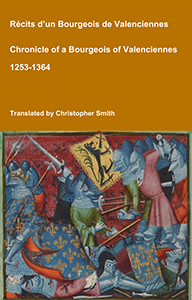
Chronicle of a Bourgeois of Valenciennes
Récits d’un bourgeois de Valenciennes aka The Chronicle of a Bourgeois of Valenciennes is a vivid 14th-century vernacular chronicle written by an anonymous urban chronicler from Valenciennes in the County of Hainaut. It survives in a manuscript that describes local and regional history from about 1253 to 1366, blending chronology, narrative episodes, and eyewitness-style accounts of political, military, and social events in medieval France, Flanders, and the Low Countries. The work begins with a chronological framework of events affecting Valenciennes and its region under rulers such as King Philip VI of France and the shifting allegiances of local nobility. It includes accounts of conflicts, sieges, diplomatic manoeuvres, and the impact of broader struggles like the Hundred Years’ War on urban life in Hainaut. Written from the perspective of a burgher (bourgeois) rather than a monastery or royal court, the chronicle offers a rare lay viewpoint on high politics and warfare, reflecting how merchants, townspeople, and civic institutions experienced the turbulence of the 13th and 14th centuries. Its narrative style combines straightforward reporting of events with moral and civic observations, making it a valuable source for readers interested in medieval urban society, regional politics, and the lived experience of war and governance in pre-modern Europe.
Available at Amazon in eBook and Paperback format.
Roger Whitley's Diary. 11th February 1690. Tuesday, we set out past 8; dined at the Swan in Newport; lay at Whitchurch (at the Red Lyon) that night; there Mr Cotton, Mr Taylor, Captain Mainwaring, Goldsmith, Delves, Savage, &c. met us; (the 3 first retorned that night after supper) one Eddows & another townesman came to see G.Mainwaring (age 47). I left them past 9.