

William of Worcester's Chronicle of England
William of Worcester, born around 1415, and died around 1482 was secretary to John Fastolf, the renowned soldier of the Hundred Years War, during which time he collected documents, letters, and wrote a record of events. Following their return to England in 1440 William was witness to major events. Twice in his chronicle he uses the first person: 1. when writing about the murder of Thomas, 7th Baron Scales, in 1460, he writes '… and I saw him lying naked in the cemetery near the porch of the church of St. Mary Overie in Southwark …' and 2. describing King Edward IV's entry into London in 1461 he writes '… proclaimed that all the people themselves were to recognize and acknowledge Edward as king. I was present and heard this, and immediately went down with them into the city'. William’s Chronicle is rich in detail. It is the source of much information about the Wars of the Roses, including the term 'Diabolical Marriage' to describe the marriage of Queen Elizabeth Woodville’s brother John’s marriage to Katherine, Dowager Duchess of Norfolk, he aged twenty, she sixty-five or more, and the story about a paper crown being placed in mockery on the severed head of Richard, 3rd Duke of York.
Available at Amazon in eBook and Paperback format.
Winterbourne Basset Stone Circle is in Winterbourne Basset, Wiltshire [Map], Avebury Stone Circles.
Avebury by William Stukeley. If we descend the Hakpen-hill [Map], westward from hence towards Winterburn-basset, upon the declivity of the Hakpen, is another Druid's house, called too Old Chapel. 'Tis a square, double ditched, but small ditches, in the middle a broad oblong square bank. Before it a sort of court, nearly as big as the other. Near it, they say, they have found much old iron and pewter. It seems to have been set round with stones [Winterbourne Basset Stone Circle [Map]].
Avebury by William Stukeley. At Winterburn-basset, a little north of Abury, in a field north-west of the church, upon elevated ground, is a double circle of stones concentric, 60 cubits diameter. The two circles [Winterbourne Basset Stone Circle [Map]] are near one another, so that one may walk between. Many of the stones have of late been carryed away. West of it is a single, broad, flat, and high stone, standing by itself. And about as far northward from the circle, in a ploughed field, is a barrow set round with, or rather composed of large stones. I take this double circle to have been a family-chapel, as we may call it, to an archdruid dwelling near thereabouts, whilst Abury was his cathedral.
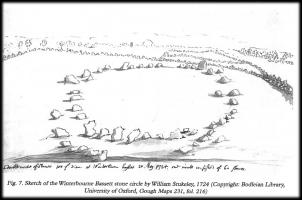
1724. An unpublished pen and ink wash sketch of Winterbourne Basset Stone Circle [Map] by Stukeley, archived amongst the Gough Maps at the Bodleian Library, Oxford (Gough Maps 231 Fol 216).
Wiltshire Archaeological Magazine 1857 V4 Pages 307-363. "At Winterbourne Basset, (about three miles) north of Abury, a field north west of the church, upon elevated ground, is a double circle of stones [Winterbourne Basset Stone Circle [Map]], concentric, 60 cubits diameter. The two circles are near one another, so that one may walk between. Many of the stones have of late been carried away. West of it is a single, broad, flat, and high stone, standing by itself; and about as far northward from the circle, in a ploughed field, is a barrow set round with, or rather composed of large stones."1 "By the above description, I was enabled," says Sir R. Hoare, "to find the remains of this circle, which is situated in a pasture ground at the angle of a road leading to Broad Hinton, and consists at present only of a few inconsiderable stones."2
Note 1. Stukeley's Abury, p. 45.
Note 2. Hoare's Ancient Wiltshire, ii. p. 95.
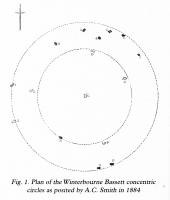
Winterbourne Basset Stone Circle [Map]. 1884 plan by A C Smith.