

Henrici Quinti, Angliæ Regis, Gesta, is a first-hand account of the Agincourt Campaign, and subsequent events to his death in 1422. The author of the first part was a Chaplain in King Henry's retinue who was present from King Henry's departure at Southampton in 1415, at the siege of Harfleur, the battle of Agincourt, and the celebrations on King Henry's return to London. The second part, by another writer, relates the events that took place including the negotiations at Troye, Henry's marriage and his death in 1422.
Available at Amazon in eBook and Paperback format.
Winterbourne Monton Bronze Age Barrow is in Winterbourne Monkton, Wiltshire [Map].
Winterbourne Monkton 24a is also in Avebury North Bronze Age Barrows.

Diary of a Dean by Merewether. No. 24a [Map]. In the small mound on the north side were teeth of deer, oxen, and bones, small fragments of charred wood, and a small sarsen stone partially rubbed.
No. 25b In the opposite mound were similar remains, and in very considerable quantities; and in this was a sarsen (U) 3 inches in diameter rubbed down to a cylindrical form, and the front teeth of an ox.
No. 26c - Five different openings had been made in this long mound, which were afterwards conjoined, and formed one continuous cutting throughout. At 7 was a large half of the os frontis of an ox, and some fragments of horns of deer, one small tip of an ox's horn.
Note d. Here, at about a foot from the surface, was found the head of apparently a greyhound (V), and close by the side a fragment of a small ampulla of Koman form, but somewhat coarse pottery; below was a flat sarsen (W) rounded at the edge and slightly convex.
Winterbourne Monkton 25 is also in Avebury North Bronze Age Barrows.
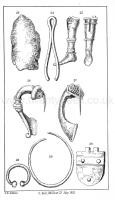
Diary of a Dean by Merewether. 25 [Map]. Side and front view of a singular bronze leg, having a groove to make a joint at the knee, and riveted to either limb. These bronze articles were found very near the line of the Roman road (Via Badonica). Could this be part of such a figure as we read of in Petronius? "Larvam argenteam attulit servus, sic aptatam ut articuli ejus vertebreeque laxatse in omnem partem verterentur," &c., pp. 115, 116. [The servant brought a silver skeleton, so fitted that its joints and vertebrae were loosened and turned in every direction]
Winterbourne Monkton 28 is also in Avebury North Bronze Age Barrows.
Diary of a Dean by Merewether. No. 28 [Map]. On removing the three sarsen stones from the apex, about a foot deep, appeared the fragments of a small ornamental urn (X) of unbaked and very fragile clay, containing the skull-bones principally of a very young person, the sutures not being joined or knit; near the top was a sarsen, rounded, and about 2 inches in diameter. The material of which this barrow was composed was chalk rubble, very coarse, and not mixed with other substances, as was generally the case, nor were there fragments of bones, or urns, or pottery, as observed in others. At the depth of 5 feet were (Y) the heads of two oxen laid side by side, and in very perfect condition, but very brittle on removal; from the pole to the nose-bone one measured 20 inches, the other 19; from one orbit of the eye to the other 9 inches; in each the centre of the forehead had been fractured in a circular hole. Below these the same hollow character of the chalk continued, and the sides of the chamber, 6 feet in length by 4 feet in breadth, had been carefully cut in the natural chalk. The heads of the oxen were laid across the chamber north-east. At a depth of 5 feet below these, and 10 feet from the top, was the skeleton of an adult (Z), in many parts much decayed, but in the crouched position, lying on the left side; behind the head was a small ornamented urn of unbaked clay (aa) or at least only fire-baked, and not in a kiln; the thigh-bone was 19 inches in length; at the right foot was a small well-chipped flint arrow-head (bb) and a flint spear-head (cc). A second also was subsequently found near the same spot (dd),though not so well formed.

