

Abbot John Whethamstede’s Chronicle of the Abbey of St Albans
Abbot John Whethamstede's Register aka Chronicle of his second term at the Abbey of St Albans, 1451-1461, is a remarkable text that describes his first-hand experience of the beginning of the Wars of the Roses including the First and Second Battles of St Albans, 1455 and 1461, respectively, their cause, and their consequences, not least on the Abbey itself. His text also includes Loveday, Blore Heath, Northampton, the Act of Accord, Wakefield, and Towton, and ends with the Coronation of King Edward IV. In addition to the events of the Wars of the Roses, Abbot John, or his scribes who wrote the Chronicle, include details in the life of the Abbey such as charters, letters, land exchanges, visits by legates, and disputes, which provide a rich insight into the day-to-day life of the Abbey, and the challenges faced by its Abbot.
Available at Amazon in eBook and Paperback format.
Winterbourne Stoke Barrow 25 G8 is in Winterbourne Stoke Barrows.
Colt Hoare 1812. No. 25 [Winterbourne Stoke Barrow 25 G8 [Map]] is a large and rude bowl-shaped barrow, 107 feet in diameter, and 6 in elevation. Its surface being uneven, we were led to suppose it had been opened. In making a large section into it, the workmen threw out the bones of several dogs, and some of deer, and on the floor found a human skeleton, which had been originally interred from north to south, but many of the bones had been displaced, probably owing to a recent interment of burned bones, which had been deposited near the feet of this skeleton. On the right side of its head were two small earthen cups, one of which was broken; the other preserved entire; the first, though of rude materials, and scarcely half burned, was very neatly ornamented; the other, is of a singular form and pattern: it is of a yellowish colour, and perforated in several places. Near these, cups was a curious ring or bracelet of bone or ivory, stained with red, which was unfortunately broken into several pieces. With the above articles were two oblong beads made from bone, and two whetstones; one of the silicious kind, almost as fine as a hone, and neatly formed; the other, of a fine grained white silicious stone. Near the above were brass pin, a pair of petrified fossil cockle shells, a piece of stalactite, and a hard fiat stone of the pebble kind, such as we frequently find both in the towns; as well as in the tumuli of the Britons.
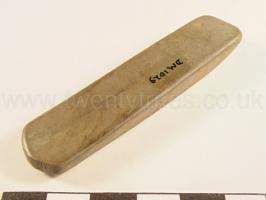
Wiltshire Museum. DZSWS:STHEAD.49. 1 flat whetstone of green Siliceous Stone (fine grained) found with a primary inhumation in bowl barrow Winterbourne Stoke G8 [Map], excavated by William Cunnington.
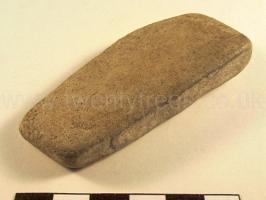
Wiltshire Museum. DZSWS:STHEAD.49a. 1 flat white quartzite whetstone found with a primary inhumation in bowl barrow Winterbourne Stoke G8 [Map], excavated by William Cunnington.
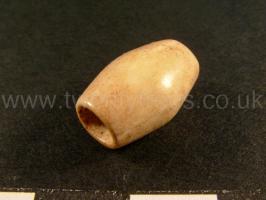
Wiltshire Museum. DZSWS:STHEAD.49b. 1 bi-conical bone bead found with a primary inhumation in bowl barrow Winterbourne Stoke G8 [Map], excavated by William Cunnington.

Wiltshire Museum. DZSWS:STHEAD.187. 1 incense or 'grape cup' of rough yellow ware (broken) with nodules around the lower half and some perforations between them, found with a primary inhumation in bowl barrow Winterbourne Stoke G8 [Map], excavated by William Cunnington.
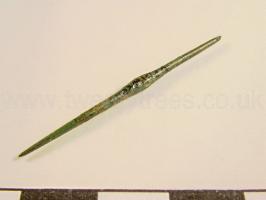
Wiltshire Museum. DZSWS:STHEAD.187a. 1 bronze awl, shaped like a javelin with both ends pointed (one broken), found with a primary inhumation in bowl barrow Winterbourne Stoke G8 [Map], excavated by William Cunnington.
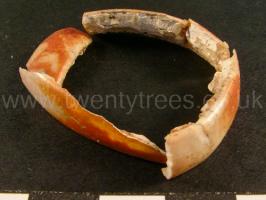
Wiltshire Museum. DZSWS:STHEAD.187b. 1 pair of beaver incisors (made into a ring?) found with a primary inhumation in bowl barrow Winterbourne Stoke G8 [Map], excavated by William Cunnington.
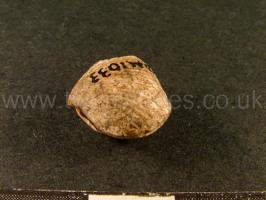
Wiltshire Museum. DZSWS:STHEAD.226. 1 fossil shell (Rhynconella) (of two found - one lost) found with a primary inhumation in bowl barrow Winterbourne Stoke G8 [Map], excavated by William Cunnington.