

Henrici Quinti, Angliæ Regis, Gesta, is a first-hand account of the Agincourt Campaign, and subsequent events to his death in 1422. The author of the first part was a Chaplain in King Henry's retinue who was present from King Henry's departure at Southampton in 1415, at the siege of Harfleur, the battle of Agincourt, and the celebrations on King Henry's return to London. The second part, by another writer, relates the events that took place including the negotiations at Troye, Henry's marriage and his death in 1422.
Available at Amazon in eBook and Paperback format.
Bishop of Exeter is in Bishop. See Exeter Cathedral [Map].
On 11th August 1107 Bishop William Warelwast was elected Bishop of Exeter.
On 10th February 1194 Bishop Henry Marshal (age 46) was appointed Bishop of Exeter.
Around 13th April 1214 Bishop Simon Apulia was elected Bishop of Exeter.
On 5th October 1214 Bishop Simon Apulia was consecrated as Bishop of Exeter.
Around 1220 Bishop Walter Branscombe was elected Bishop of Exeter.
On 23rd February 1258 Bishop Walter Branscombe (age 38) was elected Bishop of Exeter.
On 10th March 1258 Bishop Walter Branscombe (age 38) was ordained priest and was consecrated Bishop of Exeter by Archbishop Boniface Savoy (age 51).
On 14th April 1258 Bishop Walter Branscombe (age 38) was enthroned Bishop of Exeter at Exeter Cathedral [Map].
In 1308 Bishop Walter Stapledon (age 46) was appointed Bishop of Exeter.
On 5th December 1326 Bishop James Berkeley was appointed Bishop of Exeter; see 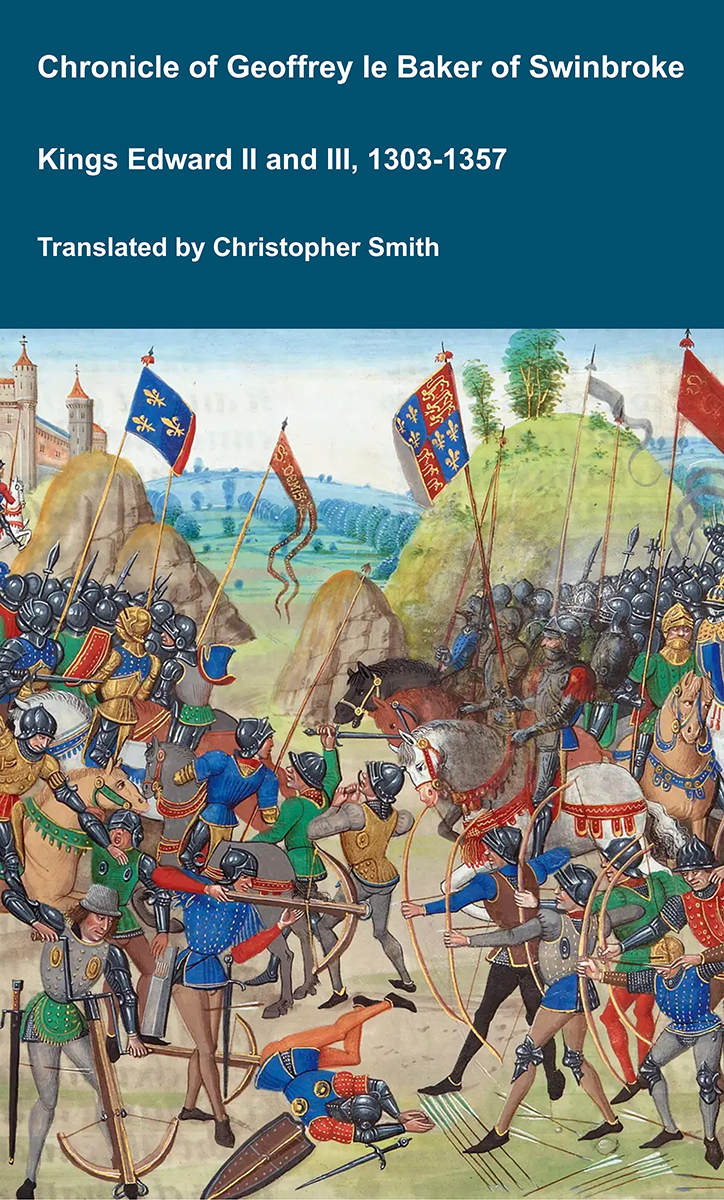 Chronicle of Geoffrey le Baker.
On 10th August 1327 Bishop John Grandison 3rd Baron Grandison (age 35) was appointed Bishop of Exeter.
Chronicle of Walter of Guisborough
A canon regular of the Augustinian Guisborough Priory, Yorkshire, formerly known as The Chronicle of Walter of Hemingburgh, describes the period from 1066 to 1346. Before 1274 the Chronicle is based on other works. Thereafter, the Chronicle is original, and a remarkable source for the events of the time. This book provides a translation of the Chronicle from that date. The Latin source for our translation is the 1849 work edited by Hans Claude Hamilton. Hamilton, in his preface, says: 'In the present work we behold perhaps one of the finest samples of our early chronicles, both as regards the value of the events recorded, and the correctness with which they are detailed; Nor will the pleasing style of composition be lightly passed over by those capable of seeing reflected from it the tokens of a vigorous and cultivated mind, and a favourable specimen of the learning and taste of the age in which it was framed.'
Available at Amazon in eBook and Paperback format.
On 18th October 1327 Bishop John Grandison 3rd Baron Grandison (age 35) was consecrated Bishop of Exeter.
On 5th March 1370 Bishop Thomas de Brantingham was appointed Bishop of Exeter.
On 12th May 1370 Bishop Thomas de Brantingham was consecrated Bishop of Exeter.
On 15th January 1395 Bishop Edmund Stafford (age 51) was appointed Bishop of Exeter.
In 1458 Archbishop George Neville (age 26) was appointed Bishop of Exeter.
On 3rd December 1458 Archbishop George Neville (age 26) was consecrated as Bishop of Exeter.
On 15th March 1465 Bishop John Booth was appointed Bishop of Exeter.
In 1478 Bishop Peter Courtenay was appointed Bishop of Exeter.
On 29th January 1487 Bishop Richard Foxe (age 39) was elected Bishop of Exeter. He was consecrate on 8th April 1487.
On 1st October 1492 Bishop Oliver King (age 60) was appointed Bishop of Exeter.
On 1st October 1492 Bishop William Smyth (age 32) was appointed Bishop of Lichfield and Coventry.
The History of William Marshal was commissioned by his son shortly after William’s death in 1219 to celebrate the Marshal’s remarkable life; it is an authentic, contemporary voice. The manuscript was discovered in 1861 by French historian Paul Meyer. Meyer published the manuscript in its original Anglo-French in 1891 in two books. This book is a line by line translation of the first of Meyer’s books; lines 1-10152. Book 1 of the History begins in 1139 and ends in 1194. It describes the events of the Anarchy, the role of William’s father John, John’s marriages, William’s childhood, his role as a hostage at the siege of Newbury, his injury and imprisonment in Poitou where he met Eleanor of Aquitaine and his life as a knight errant. It continues with the accusation against him of an improper relationship with Margaret, wife of Henry the Young King, his exile, and return, the death of Henry the Young King, the rebellion of Richard, the future King Richard I, war with France, the death of King Henry II, and the capture of King Richard, and the rebellion of John, the future King John. It ends with the release of King Richard and the death of John Marshal.
Available at Amazon in eBook and Paperback format.
On 3rd February 1493 Bishop Oliver King (age 61) was consecrated Bishop of Exeter.
On 6th November 1495 Bishop Richard Redman was translated to Bishop of Exeter.
On 24th November 1504 Bishop Hugh Oldham (age 52) was elected Bishop of Exeter.
On 12th January 1505 Bishop Hugh Oldham (age 53) was consecrated Bishop of Exeter.
In 1519 Bishop John Vesey aka Harman (age 57) was appointed Bishop of Exeter.
On 4th September 1555 Bishop Edmund "Bloody" Bonner of London (age 55) consecrated an Archbishop and two Bishops at St Paul's Cathedral [Map]:
Archbishop Hugh Curwen (age 55) was consecrated Archbishop of Dublin.
Bishop James Turbeville was consecrated Bishop of Exeter.
Bishop William Glynne (age 51) was consecrated Bishop of Bangor.
On 20th May 1560 Bishop William Alley (age 50) was elected Bishop of Exeter on the recommendation of Queen Elizabeth I of England and Ireland (age 26). Henry Machyn in his diary of 02 Apr 1560 refers to Bishop William Alley as being 'bishop elect of Exeter'.




On 14th July 1560 Bishop William Alley (age 50) was consecrated Bishop of Exeter.
In 1627 Bishop Joseph Hall (age 52) was appointed Bishop of Exeter.
On 3rd November 1660 Bishop John Gauden was elected Bishop of Exeter.
On 2nd December 1660 Bishop John Gauden was consecrated Bishop of Exeter.
In 1667 Anthony Sparrow (age 55) was appointed Bishop of Exeter.
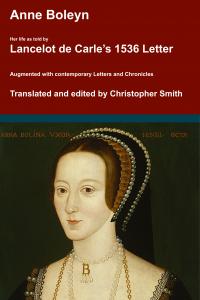
Anne Boleyn. Her Life as told by Lancelot de Carle's 1536 Letter.
In 1536, two weeks after the execution of Anne Boleyn, her brother George and four others, Lancelot du Carle, wrote an extraordinary letter that described Anne's life, and her trial and execution, to which he was a witness. This book presents a new translation of that letter, with additional material from other contemporary sources such as Letters, Hall's and Wriothesley's Chronicles, the pamphlets of Wynkyn the Worde, the Memorial of George Constantyne, the Portuguese Letter and the Baga de Secrets, all of which are provided in Appendices.
Available at Amazon in eBook and Paperback format.
In 1676 Archbishop Thomas Lamplugh (age 61) was appointed Bishop of Exeter.

In 1689 Bishop Jonathan Trelawny 3rd Baronet (age 38) was appointed Bishop of Exeter.
In 1717 Archdeacon Lancelot Blackburne (age 58) was appointed Bishop of Exeter.

In 1724 Bishop Stephen Weston (age 59) was appointed Bishop of Exeter.
In 1762 Bishop Frederick Keppel (age 33) was appointed Bishop of Exeter.
In 1792 Bishop William Buller (age 57) was elected Bishop of Exeter.
In March 1797 Bishop Reginald Courtenay (age 55) was appointed Bishop of Exeter.

In 1803 Bishop John Fisher (age 55) was consecrated Bishop of Exeter.
In 1807 Bishop George Pelham (age 40) was translated to Bishop of Exeter.
In 1820 Bishop William Carey (age 50) was appointed Bishop of Exeter.
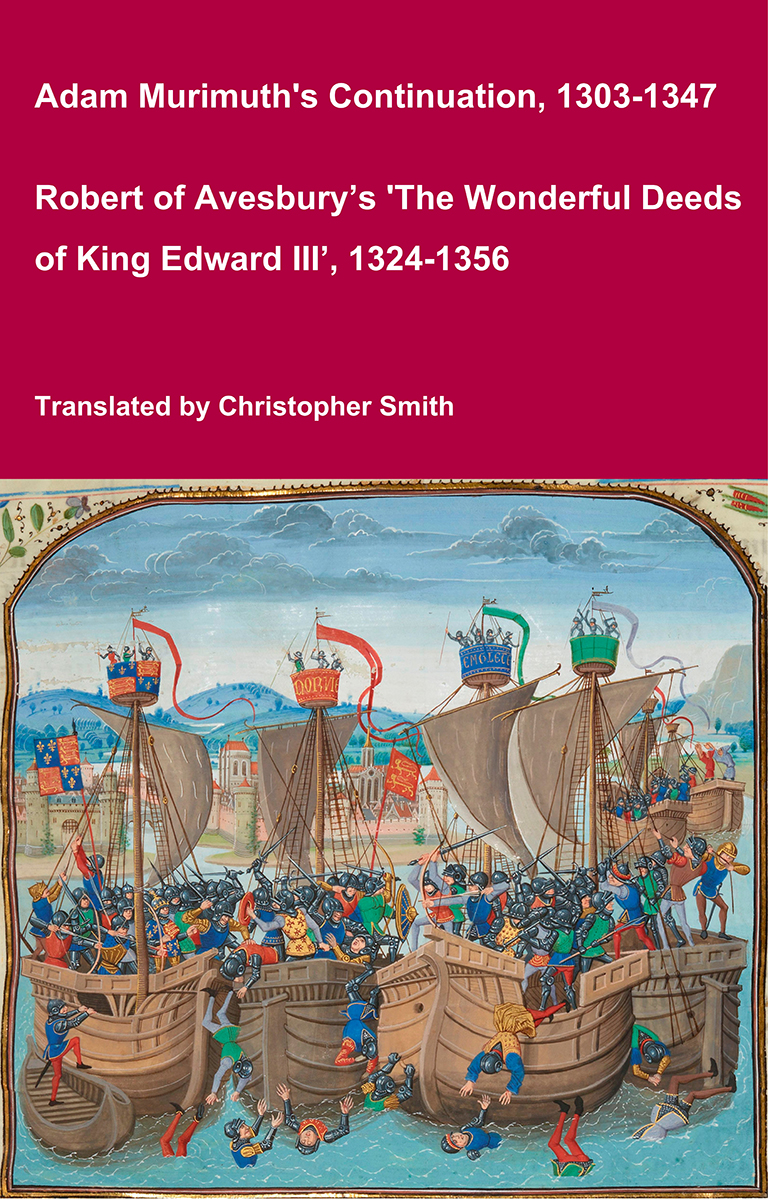
Adam Murimuth's Continuation and Robert of Avesbury’s 'The Wonderful Deeds of King Edward III'
This volume brings together two of the most important contemporary chronicles for the reign of Edward III and the opening phases of the Hundred Years’ War. Written in Latin by English clerical observers, these texts provide a vivid and authoritative window into the political, diplomatic, and military history of fourteenth-century England and its continental ambitions. Adam Murimuth Continuatio's Chronicarum continues an earlier chronicle into the mid-fourteenth century, offering concise but valuable notices on royal policy, foreign relations, and ecclesiastical affairs. Its annalistic structure makes it especially useful for establishing chronology and tracing the development of events year by year. Complementing it, Robert of Avesbury’s De gestis mirabilibus regis Edwardi tertii is a rich documentary chronicle preserving letters, treaties, and official records alongside narrative passages. It is an indispensable source for understanding Edward III’s claim to the French crown, the conduct of war, and the mechanisms of medieval diplomacy. Together, these works offer scholars, students, and enthusiasts a reliable and unembellished account of a transformative period in English and European history. Essential for anyone interested in medieval chronicles, the Hundred Years’ War, or the reign of Edward III.
Available at Amazon in eBook and Paperback format.

In 1885 Bishop Edward Bickersteth (age 59) was appointed Bishop of Exeter.
In 1916 Bishop Rupert Gascoyne-Cecil (age 52) was appointed Bishop of Exeter.