

William of Worcester's Chronicle of England
William of Worcester, born around 1415, and died around 1482 was secretary to John Fastolf, the renowned soldier of the Hundred Years War, during which time he collected documents, letters, and wrote a record of events. Following their return to England in 1440 William was witness to major events. Twice in his chronicle he uses the first person: 1. when writing about the murder of Thomas, 7th Baron Scales, in 1460, he writes '… and I saw him lying naked in the cemetery near the porch of the church of St. Mary Overie in Southwark …' and 2. describing King Edward IV's entry into London in 1461 he writes '… proclaimed that all the people themselves were to recognize and acknowledge Edward as king. I was present and heard this, and immediately went down with them into the city'. William’s Chronicle is rich in detail. It is the source of much information about the Wars of the Roses, including the term 'Diabolical Marriage' to describe the marriage of Queen Elizabeth Woodville’s brother John’s marriage to Katherine, Dowager Duchess of Norfolk, he aged twenty, she sixty-five or more, and the story about a paper crown being placed in mockery on the severed head of Richard, 3rd Duke of York.
Available at Amazon in eBook and Paperback format.
Captain of Calais is in Captain.
In 1348 John Beauchamp 1st Baron Beauchamp Warwick [aged 32] was appointed Captain of Calais.
In 1353 Reginald Cobham 1st Baron Cobham [aged 58] was appointed Captain of Calais.
In 1390 Philip Vache [aged 42] was appointed Captain of Calais.
In January 1455 Edmund Beaufort 1st or 2nd Duke of Somerset [aged 49] was appointed Captain of Calais.
After 25th May 1455 Richard "Kingmaker" Neville Earl Warwick, 6th Earl Salisbury [aged 26] was appointed Captain of Calais.
After November 1459 Henry Beaufort 2nd or 3rd Duke of Somerset [aged 23] was appointed Captain of Calais.
The History of King Richard the Third by Thomas More. King Edward in his life, although this dissension between his friends somewhat irked him, yet in his good health he somewhat the less regarded it because he thought whatsoever business should fall between them, he should always be able to rule both parties. But in his last sickness, when he perceived his natural strength so sore enfeebled that he despaired all recovery, then he, considering the youth of his children, suspecting nothing less than what would happen, and well foreseeing that many harms might grow by family debates while the youth of his children lacked discretion of themselves, and good counsel of their friends-because either party should counsel for their own advantage and by pleasant advice win themselves favor, rather than by profitable advertisement do the children good-he called some of them before him who were at variance, and especially, the Lord Marquis Dorset [aged 30], the Queen's [aged 48] son by her first husband, and Lord Hastings [Note. Text says Richard? Should be William!], a noble man, then Lord Chamberlain, against whom the Queen specially grudged for that great favour the King showed him, and also because she thought him secretly familiar with the King in wanton company. Her kindred also bore him dislike, as well for that the King had made him Captain of Calais (which office the Lord Rivers, brother to the Queen, claimed because of the King's former promise), and for diverse other great gifts which he received that they looked for.
On 11th March 1485 John York [aged 14] was appointed Captain of Calais.
In 1519 Edward Guildford [aged 45] was appointed Marshall of Calais.
John Pole was appointed Captain of Calais.
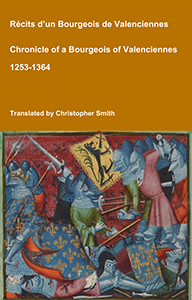
Chronicle of a Bourgeois of Valenciennes
Récits d’un bourgeois de Valenciennes aka The Chronicle of a Bourgeois of Valenciennes is a vivid 14th-century vernacular chronicle written by an anonymous urban chronicler from Valenciennes in the County of Hainaut. It survives in a manuscript that describes local and regional history from about 1253 to 1366, blending chronology, narrative episodes, and eyewitness-style accounts of political, military, and social events in medieval France, Flanders, and the Low Countries. The work begins with a chronological framework of events affecting Valenciennes and its region under rulers such as King Philip VI of France and the shifting allegiances of local nobility. It includes accounts of conflicts, sieges, diplomatic manoeuvres, and the impact of broader struggles like the Hundred Years’ War on urban life in Hainaut. Written from the perspective of a burgher (bourgeois) rather than a monastery or royal court, the chronicle offers a rare lay viewpoint on high politics and warfare, reflecting how merchants, townspeople, and civic institutions experienced the turbulence of the 13th and 14th centuries. Its narrative style combines straightforward reporting of events with moral and civic observations, making it a valuable source for readers interested in medieval urban society, regional politics, and the lived experience of war and governance in pre-modern Europe.
Available at Amazon in eBook and Paperback format.
Edmund de la Pole was appointed Captain of Calais.
Richard Carew was appointed Captain of Calais.
Richard Woodville was appointed High Sheriff of Kent and Captain of Calais.