

The History of William Marshal was commissioned by his son shortly after William’s death in 1219 to celebrate the Marshal’s remarkable life; it is an authentic, contemporary voice. The manuscript was discovered in 1861 by French historian Paul Meyer. Meyer published the manuscript in its original Anglo-French in 1891 in two books. This book is a line by line translation of the first of Meyer’s books; lines 1-10152. Book 1 of the History begins in 1139 and ends in 1194. It describes the events of the Anarchy, the role of William’s father John, John’s marriages, William’s childhood, his role as a hostage at the siege of Newbury, his injury and imprisonment in Poitou where he met Eleanor of Aquitaine and his life as a knight errant. It continues with the accusation against him of an improper relationship with Margaret, wife of Henry the Young King, his exile, and return, the death of Henry the Young King, the rebellion of Richard, the future King Richard I, war with France, the death of King Henry II, and the capture of King Richard, and the rebellion of John, the future King John. It ends with the release of King Richard and the death of John Marshal.
Available at Amazon in eBook and Paperback format.
Chief Justice of the King's Bench is in King's Bench.
In 1338 Richard Willoughby (age 48) was appointed Chief Justice of the King's Bench.
On 24th July 1340 Robert Parning was appointed Chief Justice of the King's Bench.
In 1372 John Cavendish (age 26) was appointed Chief Justice of the King's Bench.
In 1381 Robert Tresilian was appointed Chief Justice of the King's Bench.
On 31st January 1388 Walter Clopton was appointed Chief Justice of the King's Bench which position he held for life.
On 15th November 1400 William Gascoigne (age 50) was appointed Chief Justice of the King's Bench.
In 1413 William Hankford (age 63) was appointed Chief Justice of the King's Bench.
Around 13th April 1440 John Hody was appointed Chief Justice of the King's Bench by patent dated 13 April 1440.
After 13th May 1461 John Markham was appointed Chief Justice of the King's Bench.
Chronicle of Walter of Guisborough
A canon regular of the Augustinian Guisborough Priory, Yorkshire, formerly known as The Chronicle of Walter of Hemingburgh, describes the period from 1066 to 1346. Before 1274 the Chronicle is based on other works. Thereafter, the Chronicle is original, and a remarkable source for the events of the time. This book provides a translation of the Chronicle from that date. The Latin source for our translation is the 1849 work edited by Hans Claude Hamilton. Hamilton, in his preface, says: 'In the present work we behold perhaps one of the finest samples of our early chronicles, both as regards the value of the events recorded, and the correctness with which they are detailed; Nor will the pleasing style of composition be lightly passed over by those capable of seeing reflected from it the tokens of a vigorous and cultivated mind, and a favourable specimen of the learning and taste of the age in which it was framed.'
Available at Amazon in eBook and Paperback format.
On 23rd January 1468 Thomas Billing was appointed Chief Justice of the King's Bench.
On 7th May 1481 William Hussey (age 38) was appointed Chief Justice of the King's Bench.
On 24th November 1495 John Fineux aka Fyneux (age 54) was appointed Chief Justice of the King's Bench.
In 1539 Edward Montagu (age 54) was appointed Chief Justice of the King's Bench.
In 1552 Roger Cholmeley (age 57) was appointed Chief Justice of the King's Bench which position he held until 1553.
In 1554 William Portman was appointed Chief Justice of the King's Bench.

On 8th November 1574 Christopher Wray (age 50) was appointed Chief Justice of the King's Bench.
In 1616 Henry Montagu 1st Earl Manchester (age 53) was appointed Chief Justice of the King's Bench.
The Manuscripts of His Grace the Duke of Rutland 1640. 4th January 1640. Savoy.
F. Lord Willoughby to his uncle, the Earl of Rutland (age 60), at Belvoir Castle [Map].
When we ate your venison my wife and I drank your health and my Lady's and did not forget little Mr. George, whom, I am glad to hear, grows towards a man. "There hath beene a marriage at the court betweene one of my Lord of Corcke (age 73) sonnse (age 21) and my Lady Elizabeth Feelding, about which there is a greate stur, for it seemes he did not prove eoe rite as a man should be to goo about such a business. For the report goese that his manly part had lost something in his former serviocesse, and beside that he was soe full of severall disceases ... as that it was tould the Queene (age 30), whoe sent for my Lady Elizabeth, and tould her that she must desier her not to lett her husband lye with her that night, whoe put of, modilestly making little answere, but she seemed so lothe to understand the Queene, as that she tould her she must command her not to come in a pair of sheets with him, and tould her the reasons; soe as that he is gone out of the way some say into France, others thinks he is in London under cower. It was discovered by his sister (age 30) Mr. Goring's (age 31) wife, to whom he had imparted his grevancess, and she had plotted it soe, to make an excuse for him, that he should falie downe stares that day, and she would come and take him up, and soe he should complane how he had breused himselfe and strained his back with the fale, that he should be soe ill he was not fitt to goe to bed to his wife that night. But could not keepe her counsel but must tell her husband Jorge Goring, and he presently ran and tould the Queene, and soe it was discovered and then it was presently in every buddy's mouth.".
My Lord Keeper is so ill that the physicians think he cannot recover. My Lord Chief Justice Bramstone is talked of to be Lord Keeper, and Bishop Wren (age 54). It is known to be between those two. My Lord Finch (age 12) will be Chief Justice of the King's Bench and the Attorney General to be Chief Justice of the Common Pleas. Signet.


On 21st November 1665 John Kelynge (age 58) was appointed Chief Justice of the King's Bench.
On 21st November 1665 John Kelyng (age 58) was appointed Chief Justice of the King's Bench.
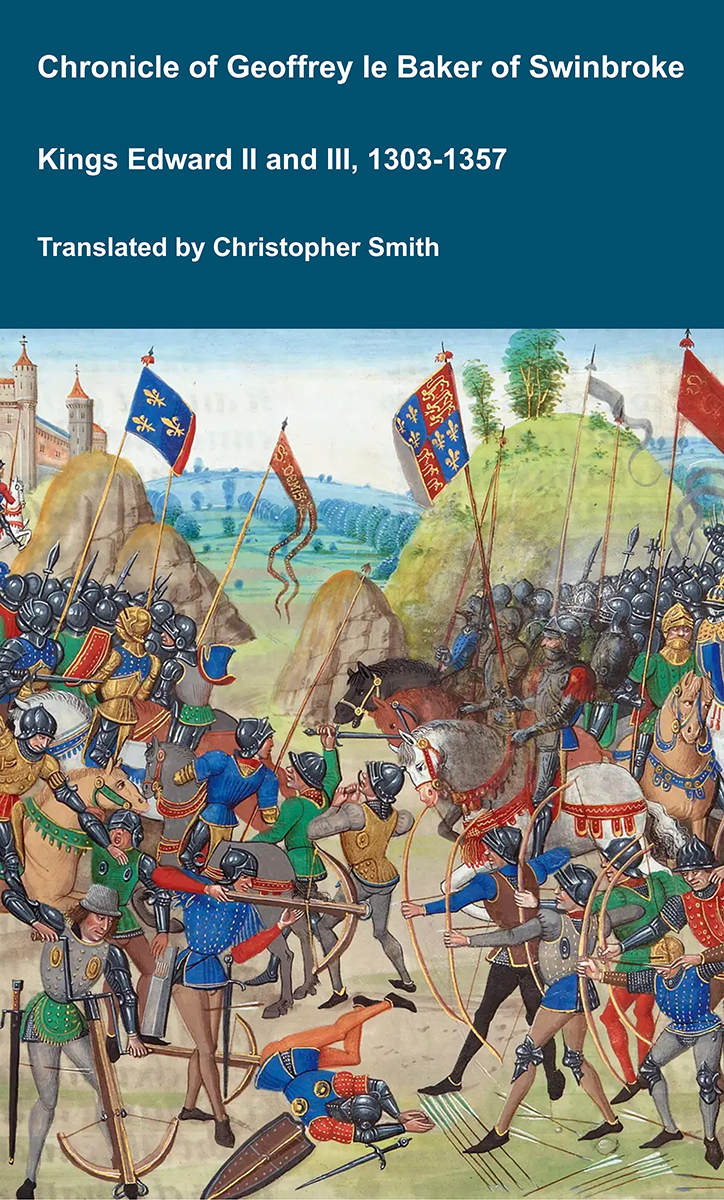
Chronicle of Geoffrey le Baker of Swinbroke
Baker was a secular clerk from Swinbroke, now Swinbrook, an Oxfordshire village two miles east of Burford. His Chronicle describes the events of the period 1303-1356: Gaveston, Bannockburn, Boroughbridge, the murder of King Edward II, the Scottish Wars, Sluys, Crécy, the Black Death, Winchelsea and Poitiers. To quote Herbert Bruce 'it possesses a vigorous and characteristic style, and its value for particular events between 1303 and 1356 has been recognised by its editor and by subsequent writers'. The book provides remarkable detail about the events it describes. Baker's text has been augmented with hundreds of notes, including extracts from other contemporary chronicles, such as the Annales Londonienses, Annales Paulini, Murimuth, Lanercost, Avesbury, Guisborough and Froissart to enrich the reader's understanding. The translation takes as its source the 'Chronicon Galfridi le Baker de Swynebroke' published in 1889, edited by Edward Maunde Thompson.
Available at Amazon in eBook and Paperback format.
On 18th May 1671 Matthew Hale (age 61) was appointed Chief Justice of the King's Bench.
In 1818 Charles Abbott 1st Baron Tenterden (age 55) was appointed Chief Justice of the King's Bench.