

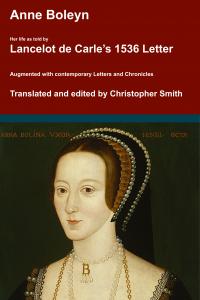
Anne Boleyn. Her Life as told by Lancelot de Carle's 1536 Letter.
In 1536, two weeks after the execution of Anne Boleyn, her brother George and four others, Lancelot du Carle, wrote an extraordinary letter that described Anne's life, and her trial and execution, to which he was a witness. This book presents a new translation of that letter, with additional material from other contemporary sources such as Letters, Hall's and Wriothesley's Chronicles, the pamphlets of Wynkyn the Worde, the Memorial of George Constantyne, the Portuguese Letter and the Baga de Secrets, all of which are provided in Appendices.
Available at Amazon in eBook and Paperback format.
Lord Chancellor is in Offices of State.
In 1070 Bishop Osmund 1st Earl Dorset was appointed Lord Chancellor.
Around 1078 Bishop Maurice was appointed Lord Chancellor.
In 1085 Archbishop Gerard was appointed Lord Chancellor.
Before January 1091 Bishop Roger Bloet was appointed Lord Chancellor.
In 1162 Bishop Geoffrey Ridel was appointed Lord Chancellor which office he held until 1173.
In 1189 Bishop William Longchamp was appointed Lord Chancellor for which office he had paid £3000.
In 1226 Bishop Ralph Neville was appointed Lord Chancellor.
In 1260 Bishop Nicholas Ely was appointed Lord Chancellor.
On 25th February 1264 Bishop Thomas Cantilupe [aged 46] was appointed Lord Chancellor.
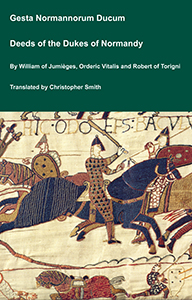
The Deeds of the Dukes of Normandy
The Gesta Normannorum Ducum [The Deeds of the Dukes of Normandy] is a landmark medieval chronicle tracing the rise and fall of the Norman dynasty from its early roots through the pivotal events surrounding the Norman Conquest of England. Originally penned in Latin by the monk William of Jumièges shortly before 1060 and later expanded at the behest of William the Conqueror, the work chronicles the deeds, politics, battles, and leadership of the Norman dukes, especially William’s own claim to the English throne. The narrative combines earlier historical sources with firsthand information and oral testimony to present an authoritative account of Normandy’s transformation from a Viking settlement into one of medieval Europe’s most powerful realms. William’s history emphasizes the legitimacy, military prowess, and governance of the Norman line, framing their expansion, including the conquest of England, as both divinely sanctioned and noble in purpose. Later chroniclers such as Orderic Vitalis and Robert of Torigni continued the history, extending the coverage into the 12th century, providing broader context on ducal rule and its impact. Today this classic work remains a foundational source for understanding Norman identity, medieval statesmanship, and the historical forces that reshaped England and Western Europe between 800AD and 1100AD.
Available at Amazon in eBook and Paperback format.
After 10th August 1265 Archbishop Walter Giffard [aged 40] was appointed Lord Chancellor.
In 1266 Godfrey Giffard Bishop of Worcester [aged 31] was appointed Lord Chancellor.
In 1274 Bishop Robert Burnell [aged 35] was appointed Lord Chancellor.
In 1292 Bishop John Langton was appointed Lord Chancellor.
In 1302 Archbishop William Greenfield was appointed Lord Chancellor.
In 1307 Bishop John Langton was appointed Lord Chancellor.
On 30th April 1307 Bishop Ralph Baldock was appointed Lord Chancellor.
On 6th July 1310 Archbishop Walter Reynolds was appointed Lord Keeper of the Great Seal and Lord Chancellor.
On 20th August 1323 Robert de Baldock was appointed Lord Chancellor.
In 1328 Bishop Henry Burghesh [aged 36] was appointed Lord Chancellor.
The Deeds of the Dukes of Normandy
The Gesta Normannorum Ducum [The Deeds of the Dukes of Normandy] is a landmark medieval chronicle tracing the rise and fall of the Norman dynasty from its early roots through the pivotal events surrounding the Norman Conquest of England. Originally penned in Latin by the monk William of Jumièges shortly before 1060 and later expanded at the behest of William the Conqueror, the work chronicles the deeds, politics, battles, and leadership of the Norman dukes, especially William’s own claim to the English throne. The narrative combines earlier historical sources with firsthand information and oral testimony to present an authoritative account of Normandy’s transformation from a Viking settlement into one of medieval Europe’s most powerful realms. William’s history emphasizes the legitimacy, military prowess, and governance of the Norman line, framing their expansion, including the conquest of England, as both divinely sanctioned and noble in purpose. Later chroniclers such as Orderic Vitalis and Robert of Torigni continued the history, extending the coverage into the 12th century, providing broader context on ducal rule and its impact. Today this classic work remains a foundational source for understanding Norman identity, medieval statesmanship, and the historical forces that reshaped England and Western Europe between 800AD and 1100AD.
Available at Amazon in eBook and Paperback format.
On 28th November 1330 John de Straford [aged 55] was appointed Lord Chancellor.
On 6th June 1335 John de Straford [aged 60] was appointed Lord Chancellor for the second time.
In March 1338 Bishop Robert de Strafford [aged 46] was appointed Lord Chancellor which office he held until July 1338.
On 6th July 1338 Bishop Richard de Wentworth was appointed Lord Chancellor.
On 28th April 1340 John de Straford [aged 65] was appointed Lord Chancellor for the third time.
On 14th December 1340 Robert Bourchier 1st Baron Bourchier was appointed Lord Chancellor.
On 15th December 1340 Robert Parning was appointed Lord Chancellor.
In 1349 Cardinal John of Thoresby was appointed Lord Chancellor.
In 1356 Bishop William Evendon was appointed Lord Chancellor.
In 1367 Bishop William of Wykeham [aged 47] was appointed Lord Chancellor which post he resigned in 1371.
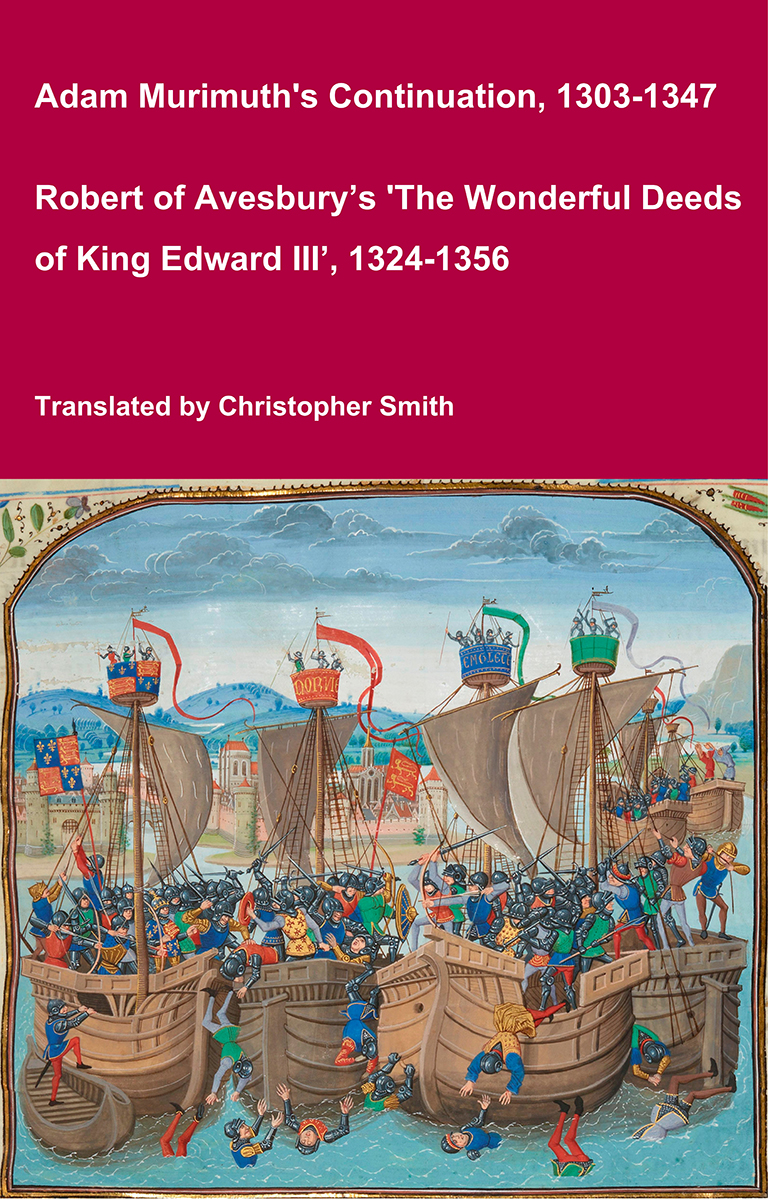
Adam Murimuth's Continuation and Robert of Avesbury’s 'The Wonderful Deeds of King Edward III'
This volume brings together two of the most important contemporary chronicles for the reign of Edward III and the opening phases of the Hundred Years’ War. Written in Latin by English clerical observers, these texts provide a vivid and authoritative window into the political, diplomatic, and military history of fourteenth-century England and its continental ambitions. Adam Murimuth Continuatio's Chronicarum continues an earlier chronicle into the mid-fourteenth century, offering concise but valuable notices on royal policy, foreign relations, and ecclesiastical affairs. Its annalistic structure makes it especially useful for establishing chronology and tracing the development of events year by year. Complementing it, Robert of Avesbury’s De gestis mirabilibus regis Edwardi tertii is a rich documentary chronicle preserving letters, treaties, and official records alongside narrative passages. It is an indispensable source for understanding Edward III’s claim to the French crown, the conduct of war, and the mechanisms of medieval diplomacy. Together, these works offer scholars, students, and enthusiasts a reliable and unembellished account of a transformative period in English and European history. Essential for anyone interested in medieval chronicles, the Hundred Years’ War, or the reign of Edward III.
Available at Amazon in eBook and Paperback format.
In 1375 Robert Assheton was appointed Lord Chancellor.
In January 1380 Archbishop Simon Sudbury [aged 64] was appointed Lord Chancellor.
On 20th September 1382 Bishop Robert Braybrooke was appointed Lord Chancellor.
In 1383 Michael de la Pole 1st Earl Suffolk [aged 53] was appointed Lord Chancellor.
In 1386 Archbishop Thomas Fitzalan aka Arundel [aged 33] was appointed Lord Chancellor.
After 4th March 1389 Bishop Edmund Stafford [aged 45] was appointed Lord Chancellor.
In 1391 Archbishop Thomas Fitzalan aka Arundel [aged 38] was appointed Lord Chancellor.
In 1403 Cardinal Henry Beaufort [aged 28] was appointed Lord Chancellor.
In 1407 Archbishop Thomas Fitzalan aka Arundel [aged 54] was appointed Lord Chancellor.
In 1424 Cardinal Henry Beaufort [aged 49] was appointed Lord Chancellor.
William of Worcester's Chronicle of England
William of Worcester, born around 1415, and died around 1482 was secretary to John Fastolf, the renowned soldier of the Hundred Years War, during which time he collected documents, letters, and wrote a record of events. Following their return to England in 1440 William was witness to major events. Twice in his chronicle he uses the first person: 1. when writing about the murder of Thomas, 7th Baron Scales, in 1460, he writes '… and I saw him lying naked in the cemetery near the porch of the church of St. Mary Overie in Southwark …' and 2. describing King Edward IV's entry into London in 1461 he writes '… proclaimed that all the people themselves were to recognize and acknowledge Edward as king. I was present and heard this, and immediately went down with them into the city'. William’s Chronicle is rich in detail. It is the source of much information about the Wars of the Roses, including the term 'Diabolical Marriage' to describe the marriage of Queen Elizabeth Woodville’s brother John’s marriage to Katherine, Dowager Duchess of Norfolk, he aged twenty, she sixty-five or more, and the story about a paper crown being placed in mockery on the severed head of Richard, 3rd Duke of York.
Available at Amazon in eBook and Paperback format.
In 1432 Archbishop John Stafford was appointed Lord Chancellor which position he held until 1450.
On 27th March 1454 Richard Plantagenet 3rd Duke of York [aged 42] was appointed Lord Protector. Richard Neville Earl Salisbury [aged 54] was appointed Lord Chancellor.
Around 1455 Thomas Browne [aged 53] was appointed Lord Chancellor.
In January 1455 Richard Neville Earl Salisbury [aged 55] resigned as Lord Chancellor.
In March 1455 Cardinal Thomas Bourchier [aged 37] was appointed Lord Chancellor.
On 25th July 1460 Archbishop George Neville [aged 28] was appointed Lord Chancellor.
On 20th June 1467 Bishop Robert Stillington [aged 47] was appointed Lord Chancellor.
After 14th April 1471 Bishop Robert Stillington [aged 51] was appointed Lord Chancellor.
On 18th June 1473 Bishop Robert Stillington [aged 53] resigned as Lord Chancellor.
On 27th July 1473 Archbishop Lawrence Booth [aged 53] was appointed Lord Chancellor serving until May 1474.
Anne Boleyn. Her Life as told by Lancelot de Carle's 1536 Letter.
In 1536, two weeks after the execution of Anne Boleyn, her brother George and four others, Lancelot du Carle, wrote an extraordinary letter that described Anne's life, and her trial and execution, to which he was a witness. This book presents a new translation of that letter, with additional material from other contemporary sources such as Letters, Hall's and Wriothesley's Chronicles, the pamphlets of Wynkyn the Worde, the Memorial of George Constantyne, the Portuguese Letter and the Baga de Secrets, all of which are provided in Appendices.
Available at Amazon in eBook and Paperback format.
In 1475 Archbishop Thomas Rotherham [aged 51] was appointed Lord Chancellor.
In June 1475 Bishop John Alcock [aged 45] was appointed Lord Chancellor which office he held until Sep 1475.
On 13th May 1483 Bishop John Russell was appointed Lord Chancellor. He replaced Archbishop Thomas Rotherham [aged 59].
In October 1485 Bishop John Alcock [aged 55] was appointed Lord Chancellor which office he held until Mar 1487.
In 1487 Cardinal John Morton [aged 67] was appointed Lord Chancellor.
In October 1529 Thomas More [aged 51] was appointed Lord Chancellor by King Henry VIII of England and Ireland [aged 38].


In 1533 Bishop Stephen Gardiner [aged 50] was appointed Lord Chancellor.

On 26th January 1533 Thomas Audley 1st Baron Audley Walden [aged 45] was appointed Lord Keeper of the Great Seal. and Lord Chancellor as well.

In 1547 Richard Rich 1st Baron Rich [aged 50] was appointed Lord Chancellor.
On 20th December 1551 Bishop Thomas Goodrich was appointed Lord Chancellor.
In 1555 Archbishop Nicholas Heath [aged 54] was appointed Lord Chancellor.
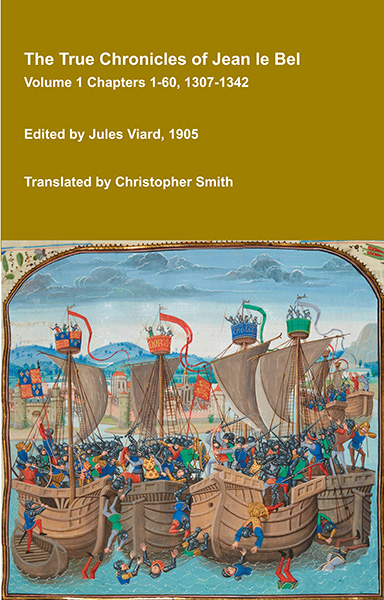
The True Chronicles of Jean le Bel Volume 1 Chapters 1-60 1307-1342
The True Chronicles of Jean le Bel offer one of the most vivid and immediate accounts of 14th-century Europe, written by a knight who lived through the events he describes, and experienced some of them first hand. Covering the early decades of the Hundred Years’ War, this remarkable chronicle follows the campaigns of Edward III of England, the politics of France and the Low Countries, and the shifting alliances that shaped medieval warfare. Unlike later historians, Jean le Bel writes with a strong sense of eyewitness authenticity, drawing on personal experience and the testimony of fellow soldiers. His narrative captures not only battles and sieges, but also the realities of military life, diplomacy, and the ideals of chivalry that governed noble society. A key source for Jean Froissart, Le Bel’s chronicle stands on its own as a compelling and insightful work, at once historical record and literary achievement. This translation builds on the 1905 edition published in French by Jules Viard, adding extensive translations from other sources Rymer's Fœdera, the Chronicles of Adam Murimuth, William Nangis, Walter of Guisborough, a Bourgeois of Valenciennes, Geoffrey le Baker of Swinbroke and Richard Lescot to enrich the original text and Viard's notes.
Available at Amazon in eBook and Paperback format.
In 1579 Thomas Bromley [aged 49] was appointed Lord Chancellor.
In 1603 Thomas Egerton 1st Viscount Brackley [aged 63] was appointed Lord Chancellor.
On 21st February 1637 Philip Yorke 1st Earl of Hardwicke was appointed Lord Chancellor which position he held until 19th November 1756.


John Evelyn's Diary. 2nd March 1665. I went with his Majesty [aged 34] into the lobby behind the House of Lords, where I saw the King and the rest of the Lords robe themselves, and got into the House of Lords in a corner near the woolsack, on which the Lord Chancellor sits next below the throne: the King sat in all the regalia, the crown-imperial on his head, the sceptre and globe, etc. The Duke of Albemarle [aged 56] bore the sword, the Duke of Ormond [aged 54], the cap of dignity. The rest of the Lords robed in their places:-a most splendid and august convention. Then came the Speaker and the House of Commons [aged 48], and at the bar made a speech, and afterward presented several bills, a nod only passing them, the clerk saying, Le Roy le veult, as to public bills, as to private, Soit faite commeil est desirè. Then, his Majesty made a handsome but short speech, commanding my Lord Privy Seal [aged 59] to prorogue the Parliament, which he did, the Chancellor [aged 56] being ill and absent. I had not before seen this ceremony.

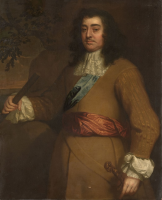


John Evelyn's Diary. 15th August 1673. Came to visit me my Lord Chancellor, the Earl of Shaftesbury [aged 52].


In 1675 Heneage Finch 1st Earl Nottingham [aged 53] was appointed Lord Chancellor.
John Evelyn's Diary. 23rd January 1683. Sir Francis North [aged 45], son to the Lord North, and Lord Chief Justice, being made Lord Keeper on the death of the Earl of Nottingham, the Lord Chancellor, I went to congratulate him. He is a most knowing, learned, and ingenious man, and, besides being an excellent person, of an ingenious and sweet disposition, very skillful in music, painting, the new philosophy, and politer studies.


John Evelyn's Diary. 31st October 1685. I din'd at our greate Lord Chancellor Jefferies [aged 40], who us'd me with much respect. This was the late Chief Justice who had newly ben the Western Circuit to try the Monmouth conspirators, and had formerly don such severe justice amongst the obnoxious in Westmr Hall [Map], for which his Ma* [aged 52] dignified him by creating him first a Baron, and now Lord Chancellor. He had some years past ben conversant at Deptford; is of an assur'd and undaunted spirit, and has serv'd the Court interest on all the hardiest occasions; is of nature cruel and a slave of the Court.


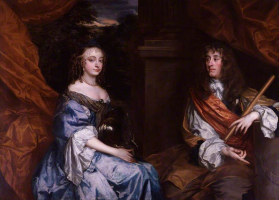


John Evelyn's Diary. 24th April 1700. This week there was a great change of State officers. The Duke of Shrewsbury [aged 39] resigned his Lord Chamberlainship to the Earl of Jersey [aged 44], the Duke's indisposition requiring his retreat. Mr. Vernon [aged 54], Secretary of State, was put out. The Seal was taken from the Lord Chancellor Somers [aged 49], though he had been acquitted by a great majority of votes for what was charged against him in the House of Commons. This being in term time, put some stop to business, many eminent lawyers refusing to accept the office, considering the uncertainty of things in this fluctuating conjuncture. It is certain that this Chancellor was a most excellent lawyer, very learned in all polite literature, a superior pen, master of a handsome style, and of easy conversation; but he is said to make too much haste to be rich, as his predecessor, and most in place in this age did, to a more prodigious excess than was ever known. But the Commons had now so mortified the Court party, and property and liberty were so much invaded in all the neighbouring kingdoms, that their jealousy made them cautious, and every day strengthened the law which protected the people from tyranny.


On 1st June 1725 Peter King 1st Baron King [aged 56] was appointed Lord Chancellor. He
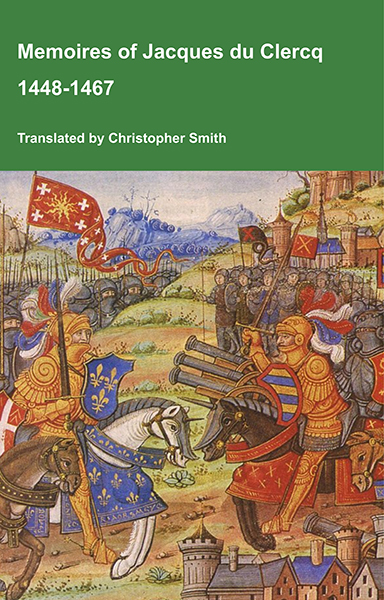
This is a translation of the 'Memoires of Jacques du Clercq', published in 1823 in two volumes, edited by Frederic, Baron de Reissenberg. In his introduction Reissenberg writes: 'Jacques du Clercq tells us that he was born in 1424, and that he was a licentiate in law and a counsellor to Philip the Good, Duke of Burgundy, in the castellany of Douai, Lille, and Orchies. It appears that he established his residence at Arras. In 1446, he married the daughter of Baldwin de la Lacherie, a gentleman who lived in Lille. We read in the fifth book of his Memoirs that his father, also named Jacques du Clercq, had married a lady of the Le Camelin family, from Compiègne. His ancestors, always attached to the counts of Flanders, had constantly served them, whether in their councils or in their armies.' The Memoires cover a period of nineteen years beginning in in 1448, ending in in 1467. It appears that the author had intended to extend the Memoirs beyond that date; no doubt illness or death prevented him from carrying out this plan. As Reissenberg writes the 'merit of this work lies in the simplicity of its narrative, in its tone of good faith, and in a certain air of frankness which naturally wins the reader’s confidence.' Du Clercq ranges from events of national and international importance, including events of the Wars of the Roses in England, to simple, everyday local events such as marriages, robberies, murders, trials and deaths, including that of his own father in Book 5; one of his last entries.
Available at Amazon in eBook and Paperback format.
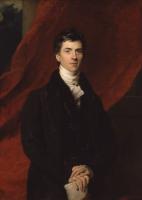
In 1830 Henry Brougham 1st Baron Brougham and Vaux [aged 51] was appointed Lord Chancellor.