

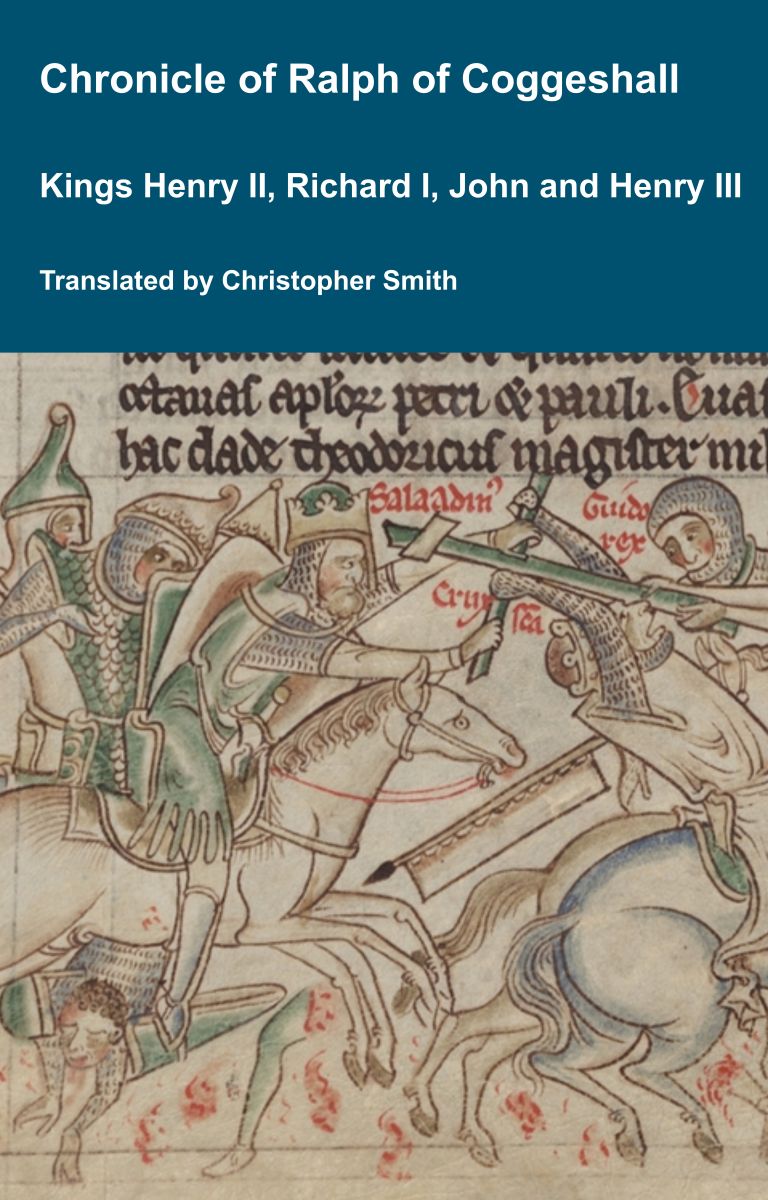
Chronicle of Abbot Ralph of Coggeshall
The Chronicle of Abbot Ralph of Coggeshall (Chronicon Anglicanum) is an indispensable medieval history that brings to life centuries of English and European affairs through the eyes of a learned Cistercian monk. Ralph of Coggeshall, abbot of the Abbey of Coggeshall in Essex in the early 13th century, continued and expanded his community’s chronicle, documenting events from the Norman Conquest of 1066 into the tumultuous reign of King Henry III. Blending eyewitness testimony, careful compilation, and the monastic commitment to record-keeping, this chronicle offers a rare narrative of political intrigue, royal power struggles, and social upheaval in England and beyond. Ralph’s work captures the reigns of pivotal figures such as Richard I and King John, providing invaluable insights into their characters, decisions, and the forces that shaped medieval rule. More than a simple annal, Chronicon Anglicanum conveys the texture of medieval life and governance, making it a rich source for scholars and readers fascinated by English history, monastic authorship, and the shaping of the medieval world.
Available at Amazon in eBook and Paperback format.
Lord Chief Justice is in England.
On 21st March 1324 Geoffrey Scrope was appointed Lord Chief Justice.
On 26th October 1350 William de Shareshull was appointed Lord Chief Justice.
In 1592 John Popham was appointed Lord Chief Justice which post he held for life.
In 1640 Robert Heath was appointed Lord Chief Justice by King Charles I of England, Scotland and Ireland.


In 1678 William Scroggs was appointed Lord Chief Justice on the recommendation of Thomas Osborne 1st Duke Leeds.
In 1681 Francis Pemberton was appointed Lord Chief Justice.
John Evelyn's Diary. 23rd January 1683. Sir Francis North, son to the Lord North, and Lord Chief Justice, being made Lord Keeper on the death of the Earl of Nottingham, the Lord Chancellor, I went to congratulate him. He is a most knowing, learned, and ingenious man, and, besides being an excellent person, of an ingenious and sweet disposition, very skillful in music, painting, the new philosophy, and politer studies.


John Evelyn's Diary. 5th December 1683. I was this day invited to a wedding of one Mrs. Castle, to whom I had some obligation, and it was to her fifth husband, a lieutenant-colonel of the city. She was the daughter of one Burton, a broom-man, by his wife, who sold kitchen stuff in Kent Street, whom God so blessed that the father became a very rich, and was a very honest man; he was Sheriff of Surrey, where I have sat on the bench with him. Another of his daughters was married to Sir John Bowles; and this daughter was a jolly friendly woman. There was at the wedding the Lord Mayor, the Sheriff, several Aldermen and persons of quality; above all, Sir George Jeffreys, newly made Lord Chief Justice of England, with Mr. Justice Withings, danced with the bride, and were exceedingly merry. These great men spent the rest of the afternoon, till eleven at night, in drinking healths, taking tobacco, and talking much beneath the gravity of judges, who had but a day or two before condemned Mr. Algernon Sidney, who was executed the 7th on Tower Hill, on the single witness of that monster of a man, Lord Howard of Escrick, and some sheets of paper taken in Mr. Sidney's study, pretended to be written by him, but not fully proved, nor the time when, but appearing to have been written before his Majesty's Restoration, and then pardoned by the Act of Oblivion; so that though Mr. Sidney was known to be a person obstinately averse to government by a monarch (the subject of the paper was in answer to one by Sir E. Filmer), yet it was thought he had very hard measure. There is this yet observable, that he had been an inveterate enemy to the last king, and in actual rebellion against him; a man of great courage, great sense, great parts, which he showed both at his trial and death; for, when he came on the scaffold, instead of a speech, he told them only that he had made his peace with God, that he came not thither to talk, but to die; put a paper into the sheriff's hand, and another into a friend's; said one prayer as short as a grace, laid down his neck, and bid the executioner do his office.


John Evelyn's Diary. 8th December 1700. Great alterations of officers at Court, and elsewhere, - Lord Chief Justice Treby died; he was a learned man in his profession, of which we have now few, never fewer; the Chancery requiring so little skill in deep law-learning, if the practicer can talk eloquently in that Court; so that probably few care to study the law to any purpose. Lord Marlborough Master of the Ordnance, in place of Lord Romney made Groom of the Stole. The Earl of Rochester goes Lord Lieutenant of Ireland.


In 1741 Thomas Marlay was appointed Lord Chief Justice of the King's Bench in Ireland.