


Chronicle of Walter of Guisborough
A canon regular of the Augustinian Guisborough Priory, Yorkshire, formerly known as The Chronicle of Walter of Hemingburgh, describes the period from 1066 to 1346. Before 1274 the Chronicle is based on other works. Thereafter, the Chronicle is original, and a remarkable source for the events of the time. This book provides a translation of the Chronicle from that date. The Latin source for our translation is the 1849 work edited by Hans Claude Hamilton. Hamilton, in his preface, says: 'In the present work we behold perhaps one of the finest samples of our early chronicles, both as regards the value of the events recorded, and the correctness with which they are detailed; Nor will the pleasing style of composition be lightly passed over by those capable of seeing reflected from it the tokens of a vigorous and cultivated mind, and a favourable specimen of the learning and taste of the age in which it was framed.'
Available at Amazon in eBook and Paperback format.
Lord Treasurer is in Offices of State.
In 1295 Bishop Walter Langton was appointed Lord Treasurer which office he held until 1307.
After 22nd August 1307 Archbishop Walter Reynolds was appointed Lord Treasurer.
In 1327 Bishop Henry Burghesh (age 35) was appointed Lord Treasurer.
In 1330 Archbishop William Melton (age 55) was appointed Lord Treasurer.
In 1334 Bishop Henry Burghesh (age 42) was appointed Lord Treasurer which office he held until 1337.
In February 1334 Bishop Richard de Bury (age 47) was appointed Lord Treasurer.
From 27th June 1369 to 1371 Bishop Thomas de Brantingham was appointed Lord Treasurer to King Edward III of England (age 56).
From 1377 to 1381 Bishop Thomas de Brantingham was appointed Lord Treasurer to King Richard II of England (age 9).


On 10th August 1381 Hugh Segrave (age 85) was appointed Lord Treasurer.
In 1389 Bishop Thomas de Brantingham was appointed Lord Treasurer to King Richard II of England (age 21).
Around 1402 William Ros 6th Baron Ros Helmsley (age 32) was appointed Lord Treasurer.
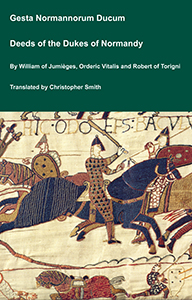
The Deeds of the Dukes of Normandy
The Gesta Normannorum Ducum [The Deeds of the Dukes of Normandy] is a landmark medieval chronicle tracing the rise and fall of the Norman dynasty from its early roots through the pivotal events surrounding the Norman Conquest of England. Originally penned in Latin by the monk William of Jumièges shortly before 1060 and later expanded at the behest of William the Conqueror, the work chronicles the deeds, politics, battles, and leadership of the Norman dukes, especially William’s own claim to the English throne. The narrative combines earlier historical sources with firsthand information and oral testimony to present an authoritative account of Normandy’s transformation from a Viking settlement into one of medieval Europe’s most powerful realms. William’s history emphasizes the legitimacy, military prowess, and governance of the Norman line, framing their expansion, including the conquest of England, as both divinely sanctioned and noble in purpose. Later chroniclers such as Orderic Vitalis and Robert of Torigni continued the history, extending the coverage into the 12th century, providing broader context on ducal rule and its impact. Today this classic work remains a foundational source for understanding Norman identity, medieval statesmanship, and the historical forces that reshaped England and Western Europe between 800AD and 1100AD.
Available at Amazon in eBook and Paperback format.
In 1432 John Scrope 4th Baron Scrope of Masham (age 44) was appointed Lord Treasurer.
Around June 1433 Ralph Cromwell 3rd Baron Cromwell (age 30) was appointed Lord Treasurer.
Around 1450 Thomas Browne (age 48) was appointed Lord Treasurer.
On 29th May 1455 Henry Bourchier 2nd Count of Eu 1st Earl Essex (age 51) was appointed Lord Treasurer.
On 24th June 1463 Edmund Grey 1st Earl Kent (age 46) was appointed Lord Treasurer.
In March 1466 Richard Woodville 1st Earl Rivers (age 61) was appointed Lord Treasurer.
In 1468 John Howard (age 43) was appointed Lord Treasurer.
On 25th October 1469 Bishop William Grey was appointed Lord Treasurer.
In 1484 John Tuchet 6th Baron Audley, 3rd Baron Tuchet (age 58) was appointed Lord Treasurer.
In 1486 John Dynham 1st Baron Dynham (age 53) was appointed Lord Treasurer.

On 4th December 1522 Thomas Howard 3rd Duke of Norfolk (age 49) was appointed Lord Treasurer.
Henry Machyn's Diary. 5th August 1553. And the Qwene (age 37) grace mad ser Edward Hastyngs (age 32) master of the horse, and ser Thomas Jernyngham [Note. Mistake for Henry made before.] vysse-chamburlayne and captayn of the gard, and master Rochastur (age 59) master controller; my lord marqwes of Wynchaster (age 70) lord tresorer of England, and dyvers odur offeserse, and dyvers odur.


In 1599 Thomas Sackville 1st Earl Dorset (age 63) was appointed Lord Treasurer.



In 1618 Thomas Edmondes (age 55) was appointed Lord Treasurer.
Abbot John Whethamstede’s Chronicle of the Abbey of St Albans
Abbot John Whethamstede's Register aka Chronicle of his second term at the Abbey of St Albans, 1451-1461, is a remarkable text that describes his first-hand experience of the beginning of the Wars of the Roses including the First and Second Battles of St Albans, 1455 and 1461, respectively, their cause, and their consequences, not least on the Abbey itself. His text also includes Loveday, Blore Heath, Northampton, the Act of Accord, Wakefield, and Towton, and ends with the Coronation of King Edward IV. In addition to the events of the Wars of the Roses, Abbot John, or his scribes who wrote the Chronicle, include details in the life of the Abbey such as charters, letters, land exchanges, visits by legates, and disputes, which provide a rich insight into the day-to-day life of the Abbey, and the challenges faced by its Abbot.
Available at Amazon in eBook and Paperback format.
In 1620 Henry Montagu 1st Earl Manchester (age 57) was appointed Lord Treasurer.
Before November 1621 Lionel Cranfield 1st Earl Middlesex (age 46) was appointed Lord Treasurer.


In 1643 Francis Cottington 1st Baron Cottington (age 64) was appointed Lord Treasurer.
John Evelyn's Diary. 13th March 1661. I went to Lambeth, with Sir R. Browne's (age 56) pretense to the Wardenship of Merton College, Oxford, to which, as having been about forty years before a student of that house, he was elected by the votes of every Fellow except one; but the statutes of the house being so that, unless every Fellow agree, the election devolves to the Visitor, who is the Archbishop of Canterbury (Dr. Juxon (age 79)), his Grace gave his nomination to Sir T. Clayton, resident there, and the Physic Professor: for which I was not at all displeased, because, though Sir Richard missed it by much ingratitude and wrong of the Archbishop (Clayton being no Fellow), yet it would have hindered Sir Richard from attending at Court to settle his greater concerns, and so have prejudiced me, though he was much inclined to have passed his time in a collegiate life, very unfit for him at that time, for many reasons. So I took leave of his Grace, who was formerly Lord Treasurer in the reign of Charles I.

John Evelyn's Diary. 19th June 1673. Congratulated the new Lord Treasurer, Sir Thomas Osborne (age 41), a gentleman with whom I had been intimately acquainted at Paris, and who was every day at my father-in-law's (age 68) house and table there; on which account I was too confident of succeeding in his favor, as I had done in his predecessor's; but such a friend shall I never find, and I neglected my time, far from believing that my Lord Clifford (age 42) would have so rashly laid down his staff, as he did, to the amazement of all the world, when it came to the test of his receiving the Communion, which I am confident he forbore more from some promise he had entered into to gratify the Duke, than from any prejudice to the Protestant religion, though I found him wavering a pretty while.
John Evelyn's Diary. 25th July 1673. I went to Tunbridge Wells, Kent [Map], to visit my Lord Clifford (age 42), late Lord Treasurer, who was there to divert his mind more than his body; it was believed that he had so engaged himself to the Duke (age 39), that rather than take the Test, without which he was not capable of holding any office, he would resign that great and honorable station. This, I am confident, grieved him to the heart, and at last broke it; for, though he carried with him music, and people to divert him, and, when I came to see him, lodged me in his own apartment, and would not let me go from him, I found he was struggling in his mind; and being of a rough and ambitious nature, he could not long brook the necessity he had brought on himself, of submission to this conjuncture. Besides, he saw the Dutch war, which was made much by his advice, as well as the shutting up of the Exchequer, very unprosperous. These things his high spirit could not support. Having stayed here two or three days, I obtained leave of my Lord to return.


In 1770 Charles Townshend 1st Baron Bayning (age 40) was appointed Lord of the Treasury which position he held until 1777.