

William of Worcester's Chronicle of England
William of Worcester, born around 1415, and died around 1482 was secretary to John Fastolf, the renowned soldier of the Hundred Years War, during which time he collected documents, letters, and wrote a record of events. Following their return to England in 1440 William was witness to major events. Twice in his chronicle he uses the first person: 1. when writing about the murder of Thomas, 7th Baron Scales, in 1460, he writes '… and I saw him lying naked in the cemetery near the porch of the church of St. Mary Overie in Southwark …' and 2. describing King Edward IV's entry into London in 1461 he writes '… proclaimed that all the people themselves were to recognize and acknowledge Edward as king. I was present and heard this, and immediately went down with them into the city'. William’s Chronicle is rich in detail. It is the source of much information about the Wars of the Roses, including the term 'Diabolical Marriage' to describe the marriage of Queen Elizabeth Woodville’s brother John’s marriage to Katherine, Dowager Duchess of Norfolk, he aged twenty, she sixty-five or more, and the story about a paper crown being placed in mockery on the severed head of Richard, 3rd Duke of York.
Available at Amazon in eBook and Paperback format.
MP Leicestershire is in Member Parliament.
In 1542 Richard Manners (age 33) was elected MP Leicestershire.
In 1601 William Skipwith (age 37) was elected MP Leicestershire.

The Huntingdon Peerage Chapter IX Ferdinando Sixth Earl of Huntingdon. FERDINANDO, sixth Earl of Huntingdon, heir and successor of Henry the fifth Earl (age 21), was born at Ashby [Map], January 11th, 1608. In March, 1627, he was returned to serve in Parliament for the county of Leicester, and two years after was joined with his father in the Lieutenancy of the counties of Leicester and Rutland. By indenture, dated May, 1638, he and his brother Henry, in consideration of the sum of 4,50l. granted, to John Earl of Bridgewater (age 29) and Thomas Davies, a moiety of the rectory of Mould, otherwise Mouldesdale, in Flintshire. On the 13th of November, 1641, his father being then still living, he had summons to Parliament amongst the barons of the realm; and in 1643 he succeeded to the family honours. He married Lucy, daughter and sole heir to Sir John Davys (age 38), of Englefield, Berks, Knt. (Premier Serjeant at Law to James the First, and Charles the First, as also Solicitor, and afterwards Attorney General in Ireland, and finally Lord Chief Justice of the King's Bench,) by his wife Lady Eleanor (age 18), youngest daughter of George Lord Audley, Earl of Castlehaven (age 57), and, settling at Donnington Park, had by her four sons; Henry, John, Ferdinando, and Theophilus, born after the decease of his three brothers; and likewise six daughters, Alice, Eleanor, both of whom died young; Elizabeth, married to Sir James Laughan, of Cottesbroke, in Nottinghamshire, Bart, being his second wife, and dying without issue; Lucy, who died unmarried; Mary, espoused to Sir William Joliffe, of Caverswell Castle in Staffordshire, Knt.; and lastly Christiana.
In 1614 George Hastings (age 24) was elected MP Leicestershire.
In 1614 Thomas Haselrigge 1st Baronet (age 50) was elected MP Leicestershire.
On 9th February 1621 George Hastings (age 31) was elected MP Leicestershire.
In 1624 Thomas Haselrigge 1st Baronet (age 60) was elected MP Leicestershire.
In 1653 Edward Smith 1st Baronet (age 23) was elected MP Leicestershire.
In 1654 Thomas Beaumont 1st Baronet was elected MP Leicestershire which seat he held until 1659.
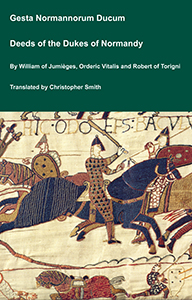
The Deeds of the Dukes of Normandy
The Gesta Normannorum Ducum [The Deeds of the Dukes of Normandy] is a landmark medieval chronicle tracing the rise and fall of the Norman dynasty from its early roots through the pivotal events surrounding the Norman Conquest of England. Originally penned in Latin by the monk William of Jumièges shortly before 1060 and later expanded at the behest of William the Conqueror, the work chronicles the deeds, politics, battles, and leadership of the Norman dukes, especially William’s own claim to the English throne. The narrative combines earlier historical sources with firsthand information and oral testimony to present an authoritative account of Normandy’s transformation from a Viking settlement into one of medieval Europe’s most powerful realms. William’s history emphasizes the legitimacy, military prowess, and governance of the Norman line, framing their expansion, including the conquest of England, as both divinely sanctioned and noble in purpose. Later chroniclers such as Orderic Vitalis and Robert of Torigni continued the history, extending the coverage into the 12th century, providing broader context on ducal rule and its impact. Today this classic work remains a foundational source for understanding Norman identity, medieval statesmanship, and the historical forces that reshaped England and Western Europe between 800AD and 1100AD.
Available at Amazon in eBook and Paperback format.
In 1679 Henry Beaumont 2nd Baronet (age 40) was elected MP Leicestershire which seat he held until his death in 1689.
In 1690 Thomas Haselrigge 4th Baronet (age 26) was elected MP Leicestershire which seat he held until 1695.
In 1701 Bennet Sherard 1st Earl Harborough (age 26) was elected MP Leicestershire.
In 1702 George Beaumont 4th Baronet (age 38) was elected MP Leicestershire which seat he held until his death in 1737.
In 1710 Geoffrey Palmer 3rd Baronet (age 54) was elected MP Leicestershire.
On 5th August 1714 Geoffrey Palmer 3rd Baronet (age 59) was elected MP Leicestershire at a by-election.
On 7th December 1719 William Manners (age 22) was elected MP Leicestershire.
In 1722 William Manners (age 24) was elected MP Leicestershire.
In 1747 Wrightson Mundy (age 32) was elected MP Leicestershire.
In 1754 Thomas Palmer 4th Baronet (age 52) was elected MP Leicestershire which seat he held until 1765.
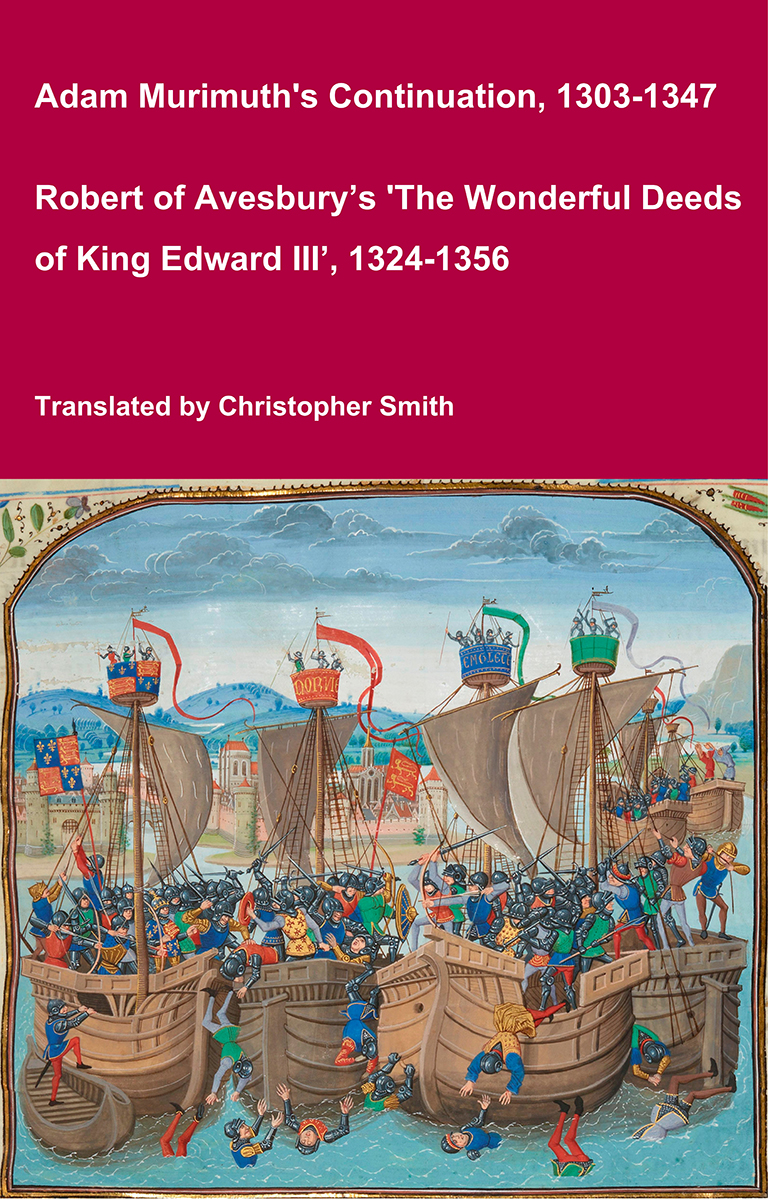
Adam Murimuth's Continuation and Robert of Avesbury’s 'The Wonderful Deeds of King Edward III'
This volume brings together two of the most important contemporary chronicles for the reign of Edward III and the opening phases of the Hundred Years’ War. Written in Latin by English clerical observers, these texts provide a vivid and authoritative window into the political, diplomatic, and military history of fourteenth-century England and its continental ambitions. Adam Murimuth Continuatio's Chronicarum continues an earlier chronicle into the mid-fourteenth century, offering concise but valuable notices on royal policy, foreign relations, and ecclesiastical affairs. Its annalistic structure makes it especially useful for establishing chronology and tracing the development of events year by year. Complementing it, Robert of Avesbury’s De gestis mirabilibus regis Edwardi tertii is a rich documentary chronicle preserving letters, treaties, and official records alongside narrative passages. It is an indispensable source for understanding Edward III’s claim to the French crown, the conduct of war, and the mechanisms of medieval diplomacy. Together, these works offer scholars, students, and enthusiasts a reliable and unembellished account of a transformative period in English and European history. Essential for anyone interested in medieval chronicles, the Hundred Years’ War, or the reign of Edward III.
Available at Amazon in eBook and Paperback format.
On 26th December 1765 John Palmer 5th Baronet (age 30) was elected MP Leicestershire at a by-election. He was returned again in 1768 and 1774.
In September 1774 Thomas Noel 2nd Viscount Wentworth (age 28) was elected MP Leicestershire. Within in a month he resigned his seat since he had become 2nd Viscount Wentworth following the death of his father.