


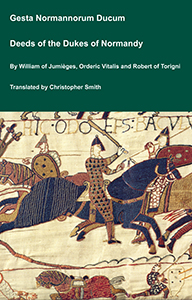
The Deeds of the Dukes of Normandy
The Gesta Normannorum Ducum [The Deeds of the Dukes of Normandy] is a landmark medieval chronicle tracing the rise and fall of the Norman dynasty from its early roots through the pivotal events surrounding the Norman Conquest of England. Originally penned in Latin by the monk William of Jumièges shortly before 1060 and later expanded at the behest of William the Conqueror, the work chronicles the deeds, politics, battles, and leadership of the Norman dukes, especially William’s own claim to the English throne. The narrative combines earlier historical sources with firsthand information and oral testimony to present an authoritative account of Normandy’s transformation from a Viking settlement into one of medieval Europe’s most powerful realms. William’s history emphasizes the legitimacy, military prowess, and governance of the Norman line, framing their expansion, including the conquest of England, as both divinely sanctioned and noble in purpose. Later chroniclers such as Orderic Vitalis and Robert of Torigni continued the history, extending the coverage into the 12th century, providing broader context on ducal rule and its impact. Today this classic work remains a foundational source for understanding Norman identity, medieval statesmanship, and the historical forces that reshaped England and Western Europe between 800AD and 1100AD.
Available at Amazon in eBook and Paperback format.
Privy Council is in Offices of Parliament.
In 1381 Aubrey de Vere 10th Earl of Oxford [aged 43] was appointed Privy Council.
In 1404 Thomas Rempston was appointed Privy Council.
In 1422 Ralph Cromwell 3rd Baron Cromwell [aged 19] was appointed Privy Council.
On 17th July 1433 John Cornwall 1st Baron Fanhope 1st Baron Milbroke [aged 69] was appointed Privy Council.
In 1454 Edward Neville 1st Baron Abergavenny [aged 41] was appointed to the Privy Council.
Before December 1462 Thomas Burgh 1st Baron Burgh of Gainsborough [aged 31] was appointed Esquire to the Body to King Edward IV of England [aged 20], and to the Privy Council.
In 1471 John Tuchet 6th Baron Audley, 3rd Baron Tuchet [aged 45] was appointed Privy Council.
In 1483 Thomas Howard 2nd Duke of Norfolk [aged 40] was appointed Privy Council.
The Deeds of the Dukes of Normandy
The Gesta Normannorum Ducum [The Deeds of the Dukes of Normandy] is a landmark medieval chronicle tracing the rise and fall of the Norman dynasty from its early roots through the pivotal events surrounding the Norman Conquest of England. Originally penned in Latin by the monk William of Jumièges shortly before 1060 and later expanded at the behest of William the Conqueror, the work chronicles the deeds, politics, battles, and leadership of the Norman dukes, especially William’s own claim to the English throne. The narrative combines earlier historical sources with firsthand information and oral testimony to present an authoritative account of Normandy’s transformation from a Viking settlement into one of medieval Europe’s most powerful realms. William’s history emphasizes the legitimacy, military prowess, and governance of the Norman line, framing their expansion, including the conquest of England, as both divinely sanctioned and noble in purpose. Later chroniclers such as Orderic Vitalis and Robert of Torigni continued the history, extending the coverage into the 12th century, providing broader context on ducal rule and its impact. Today this classic work remains a foundational source for understanding Norman identity, medieval statesmanship, and the historical forces that reshaped England and Western Europe between 800AD and 1100AD.
Available at Amazon in eBook and Paperback format.
In 1505 Rhys ap Thomas Deheubarth [aged 56] was appointed Privy Council.
In 1512 George Talbot 4th Earl of Shrewsbury [aged 44] was appointed Privy Council.
After 1523 Thomas Grey 2nd Marquess Dorset [aged 45] was appointed Privy Council.
Before 15th February 1526 Ralph Neville 4th Earl of Westmoreland [aged 27] was appointed Privy Council.
Before 22nd March 1531 John de Vere 15th Earl of Oxford [aged 60] was appointed Privy Council.
In 1536 John Russell 1st Earl Bedford [aged 51] was appointed Privy Council.
In 1540 Thomas Cheney [aged 55] was appointed Privy Council.
On 10th June 1540 Thomas Cromwell 1st Earl Essex [aged 55] attended a Meeting of the Privy Council where he was arrested. It isn't entirely clear why he was arrested but his role in the King's recent failed marriage to Anne of Cleves Queen Consort England [aged 24] is likely to have played a part. Thomas Howard 3rd Duke of Norfolk [aged 67] tore off Cromwell's St George of the Order of the Garter. He was imprisoned in the Tower of London [Map] and executed on the 28th of July 1540. See Spanish Chronicle and Marillac's letter to Montmorency.


On 12th November 1549 Walter Mildmay [aged 28] was ordered by the Privy Council to examine the Westminster Palace [Map] which had been in the custody of Edward Seymour 1st Duke of Somerset [aged 49].

After 1550 George Brooke 9th Baron Cobham [aged 53] was appointed Privy Council.
On 24th January 1550 Thomas Darcy 1st Baron Darcy [aged 43] was appointed Privy Council.
Around 1552 Henry Neville 5th Earl of Westmoreland [aged 27] was appointed Privy Council.
In March 1552 John Cock [aged 46] was appointed Privy Council.
In 1553 Thomas Howard 3rd Duke of Norfolk [aged 80] was appointed Privy Council.
The History of William Marshal was commissioned by his son shortly after William’s death in 1219 to celebrate the Marshal’s remarkable life; it is an authentic, contemporary voice. The manuscript was discovered in 1861 by French historian Paul Meyer. Meyer published the manuscript in its original Anglo-French in 1891 in two books. This book is a line by line translation of the first of Meyer’s books; lines 1-10152. Book 1 of the History begins in 1139 and ends in 1194. It describes the events of the Anarchy, the role of William’s father John, John’s marriages, William’s childhood, his role as a hostage at the siege of Newbury, his injury and imprisonment in Poitou where he met Eleanor of Aquitaine and his life as a knight errant. It continues with the accusation against him of an improper relationship with Margaret, wife of Henry the Young King, his exile, and return, the death of Henry the Young King, the rebellion of Richard, the future King Richard I, war with France, the death of King Henry II, and the capture of King Richard, and the rebellion of John, the future King John. It ends with the release of King Richard and the death of John Marshal.
Available at Amazon in eBook and Paperback format.
On 16th August 1553 Richard Morgan was appointed to the Privy Council.
In 1558 William Howard 1st Baron Howard [aged 48] was appointed Privy Council.
In 1558 Edward Rogers [aged 60] was appointed Vice-Chamberlain of the Household, Captain of the Yeoman of the Guard and Privy Council.
In 1577 Henry Carey 1st Baron Hunsdon [aged 50] was appointed Privy Council.
Before 12th February 1586 William Brooke 10th Baron Cobham [aged 58] was appointed Privy Council.
In 1587 Thomas Heneage [aged 55] was appointed Privy Council.
In 1593 Robert Devereux 2nd Earl Essex [aged 27] was appointed Privy Council.


In 1601 Robert Killigrew [aged 21] was appointed Privy Council.
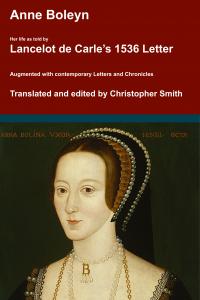
Anne Boleyn. Her Life as told by Lancelot de Carle's 1536 Letter.
In 1536, two weeks after the execution of Anne Boleyn, her brother George and four others, Lancelot du Carle, wrote an extraordinary letter that described Anne's life, and her trial and execution, to which he was a witness. This book presents a new translation of that letter, with additional material from other contemporary sources such as Letters, Hall's and Wriothesley's Chronicles, the pamphlets of Wynkyn the Worde, the Memorial of George Constantyne, the Portuguese Letter and the Baga de Secrets, all of which are provided in Appendices.
Available at Amazon in eBook and Paperback format.
In 1603 Edward Zouche 11th Baron Zouche Harringworth [aged 46] was appointed Privy Council.
In 1603 Edward Bruce 1st Lord Kinloss [aged 55] was appointed Privy Council.
In 1603 Henry Howard 1st Earl of Northampton [aged 62] was appointed Privy Council.


On 24th March 1611 Robert Carr 1st Earl Somerset [aged 24] was created 1st Viscount Rochester and admitted to the Privy Council. Robert Carr 1st Earl Somerset was now the Kings [aged 44] favourite.


After 24th March 1611 Robert Devereux 3rd Earl Essex [aged 20] was appointed Privy Counciller.

In 1617 Henry Carey 1st Viscount Falkland [aged 42] was appointed Comptroller of the Household and to the Privy Council.
On 6th April 1617 Francis Manners 6th Earl of Rutland [aged 39] was appointed Privy Council.
In 1639 George Goring 1st Earl Norwich [aged 53] was appointed Privy Council.
In 1639 William Cavendish 1st Duke Newcastle upon Tyne [aged 46] was appointed Privy Council.
Chronicle of Walter of Guisborough
A canon regular of the Augustinian Guisborough Priory, Yorkshire, formerly known as The Chronicle of Walter of Hemingburgh, describes the period from 1066 to 1346. Before 1274 the Chronicle is based on other works. Thereafter, the Chronicle is original, and a remarkable source for the events of the time. This book provides a translation of the Chronicle from that date. The Latin source for our translation is the 1849 work edited by Hans Claude Hamilton. Hamilton, in his preface, says: 'In the present work we behold perhaps one of the finest samples of our early chronicles, both as regards the value of the events recorded, and the correctness with which they are detailed; Nor will the pleasing style of composition be lightly passed over by those capable of seeing reflected from it the tokens of a vigorous and cultivated mind, and a favourable specimen of the learning and taste of the age in which it was framed.'
Available at Amazon in eBook and Paperback format.
On 27th January 1641 Richard Browne 1st Baronet [aged 36] was appointed Clerk-in-Ordinary to the Privy Council.
On 8th August 1641 Henry Bourchier 5th Earl Bath [aged 54] was appointed to the Privy Council.
In 1645 Henry Pierrepont 1st Marquess Dorchester [aged 38] was appointed Privy Council.
In 1660 Henry Pierrepont 1st Marquess Dorchester [aged 53] was appointed Privy Council.
In 1668 Francis Newport 1st Earl Bradford [aged 47] was appointed Privy Council.
John Evelyn's Diary. 26th May 1671. The Earl of Bristol's [aged 58] house in Queen's Street was taken for the Commissioners of Trade and Plantations, and furnished with rich hangings of the King's [aged 40]. It consisted of seven rooms on a floor, with a long gallery, gardens, etc. This day we met the Duke of Buckingham [aged 43], Earl of Lauderdale [aged 55], Lord Culpeper, Sir George Carteret [aged 61], Vice-Chamberlain, and myself, had the oaths given us by the Earl of Sandwich [aged 45], our President. It was to advise and counsel his Majesty, to the best of our abilities, for the well-governing of his Foreign Plantations, etc., the form very little differing from that given to the Privy Council. We then took our places at the Board in the Council-Chamber, a very large room furnished with atlases, maps, charts, globes, etc. Then came the Lord Keeper, Sir Orlando Bridgeman [aged 65], Earl of Arlington [aged 53], Secretary of State, Lord Ashley, Mr. Treasurer [aged 40], Sir John Trevor [aged 34], the other Secretary, Sir John Duncomb [aged 49], Lord Allington [aged 31], Mr. Grey, son to the Lord Grey, Mr. Henry Broncher, Sir Humphrey Winch [aged 49], Sir John Finch, Mr. Waller [aged 65], and Colonel Titus [aged 48], of the bedchamber, with Mr. Slingsby, Secretary to the Council, and two Clerks of the Council, who had all been sworn some days before. Being all set, our Patent was read, and then the additional Patent, in which was recited this new establishment; then, was delivered to each a copy of the Patent, and of instructions: after which, we proceeded to business.

On 17th April 1672 Henry Somerset 1st Duke Beaufort [aged 43] was appointed Privy Council.
John Evelyn's Diary. 18th August 1673. My Lord Clifford [aged 43], being about this time returned from Tunbridge [Map], and preparing for Devonshire, I went to take my leave of him at Wallingford House; he was packing up pictures, most of which were of hunting wild beasts and vast pieces of bull-baiting, bear-baiting, etc. I found him in his study, and restored to him several papers of state, and others of importance, which he had furnished me with, on engaging me to write the "History of the Holland War", with other private letters of his acknowledgments to my Lord Arlington [aged 55], who from a private gentleman of a very noble family, but inconsiderable fortune, had advanced him from almost nothing. The first thing was his being in Parliament, then knighted, then made one of the Commissioners of sick and wounded, on which occasion we sat long together; then, on the death of Hugh Pollard, he was made Comptroller of the Household and Privy Councillor, yet still my brother Commissioner; after the death of Lord Fitz-Harding, Treasurer of the Household, he, by letters to Lord Arlington, which that Lord showed me, begged of his Lordship to obtain it for him as the very height of his ambition. These were written with such submissions and professions of his patronage, as I had never seen any more acknowledging. The Earl of Southampton then dying, he was made one of the Commissioners of the Treasury. His Majesty [aged 43] inclining to put it into one hand, my Lord Clifford, under pretense of making all his interest for his patron, my Lord Arlington, cut the grass under his feet, and procured it for himself, assuring the King that Lord Arlington did not desire it. Indeed, my Lord Arlington protested to me that his confidence in Lord Clifford made him so remiss and his affection to him was so particular, that he was absolutely minded to devolve it on Lord Clifford, all the world knowing how he himself affected ease and quiet, now growing into years, yet little thinking of this go-by. This was the great ingratitude Lord Clifford showed, keeping my Lord Arlington in ignorance, continually assuring him he was pursuing his interest, which was the Duke's [aged 39] into whose great favour Lord Clifford was now gotten; but which certainly cost him the loss of all, namely, his going so irrevocably far in his interest.




 Become a Member via our Buy Me a Coffee page to read more.
William of Worcester's Chronicle of England
William of Worcester, born around 1415, and died around 1482 was secretary to John Fastolf, the renowned soldier of the Hundred Years War, during which time he collected documents, letters, and wrote a record of events. Following their return to England in 1440 William was witness to major events. Twice in his chronicle he uses the first person: 1. when writing about the murder of Thomas, 7th Baron Scales, in 1460, he writes '… and I saw him lying naked in the cemetery near the porch of the church of St. Mary Overie in Southwark …' and 2. describing King Edward IV's entry into London in 1461 he writes '… proclaimed that all the people themselves were to recognize and acknowledge Edward as king. I was present and heard this, and immediately went down with them into the city'. William’s Chronicle is rich in detail. It is the source of much information about the Wars of the Roses, including the term 'Diabolical Marriage' to describe the marriage of Queen Elizabeth Woodville’s brother John’s marriage to Katherine, Dowager Duchess of Norfolk, he aged twenty, she sixty-five or more, and the story about a paper crown being placed in mockery on the severed head of Richard, 3rd Duke of York.
Available at Amazon in eBook and Paperback format.

In 1679 Henry Cavendish 2nd Duke Newcastle upon Tyne [aged 48] was appointed Privy Council.
In 1679 John Egerton 2nd Earl Bridgewater [aged 55] was appointed Privy Council.
John Evelyn's Diary. 1st April 1679. My friend, Mr. Godolphin [aged 33], was now made one of the Lords Commissioners of the Treasury, and of the Privy Council.
John Evelyn's Diary. 2nd June 1681. I went to Hampton Court [Map], when the Surrey gentlemen presented their addresses to his Majesty [aged 51], whose hand I kissed, introduced by the Duke of Albemarle [aged 27]. Being at the Privy Council, I took another occasion of discoursing with Sir Stephen Fox [aged 54] about his daughter [aged 12] and to revive that business, and at least brought it to this: That in case the young people liked one the other, after four years, he first desiring to see a particular of my Lord's [aged 39] present estate if I could transmit it to him privately, he would make her portion £14,000, though to all appearance he might likely make it £50,000 as easily, his eldest son [aged 15] having no child and growing very corpulent.


Before 1685 Daniel Finch 2nd Earl Nottingham 7th Earl Winchilsea [aged 37] was appointed Privy Council.

In 1686 Roger Palmer 1st Earl Castlemaine [aged 52] was appointed Privy Council.
In 1688 Christopher Vane 1st Baron Barnard [aged 34] was appointed Privy Council.
In 1689 Henry Howard 7th Duke of Norfolk [aged 33] was appointed Privy Council.
Chronicle of Walter of Guisborough
A canon regular of the Augustinian Guisborough Priory, Yorkshire, formerly known as The Chronicle of Walter of Hemingburgh, describes the period from 1066 to 1346. Before 1274 the Chronicle is based on other works. Thereafter, the Chronicle is original, and a remarkable source for the events of the time. This book provides a translation of the Chronicle from that date. The Latin source for our translation is the 1849 work edited by Hans Claude Hamilton. Hamilton, in his preface, says: 'In the present work we behold perhaps one of the finest samples of our early chronicles, both as regards the value of the events recorded, and the correctness with which they are detailed; Nor will the pleasing style of composition be lightly passed over by those capable of seeing reflected from it the tokens of a vigorous and cultivated mind, and a favourable specimen of the learning and taste of the age in which it was framed.'
Available at Amazon in eBook and Paperback format.
In 1689 Robert Howard [aged 62] was appointed Privy Council.

In 1689 Richard, Baron Lumley [aged 39] was appointed Privy Council.

In 1689 John Hay 1st Marquess Tweeddale [aged 63] was appointed Privy Council.
In 1689 Francis Newport 1st Earl Bradford [aged 68] was appointed Privy Council.
On 14th February 1689 William Russell 1st Duke Bedford [aged 72] was appointed Privy Council.


John Evelyn's Diary. 12th April 1689. King James [aged 55] was now certainly in Ireland with the Marshal d'Estrades, whom he made a Privy Councillor; and who caused the King to remove the Protestant Councillors, some whereof, it seems, had continued to sit, telling him that the King of France [aged 50], his master, would never assist him if he did not immediately do it; by which it is apparent how the poor Prince is managed by the French.

In 1702 George Compton 4th Earl of Northampton [aged 37] was appointed Privy Council.
On 21st April 1702 John Grubyham Howe [aged 45] was appointed Privy Council.

On 18th July 1702 Thomas Thynne 1st Viscount Weymouth [aged 62] was appointed Privy Council.
Jean de Waurin's Chronicle of England Volume 6 Books 3-6: The Wars of the Roses
Jean de Waurin was a French Chronicler, from the Artois region, who was born around 1400, and died around 1474. Waurin’s Chronicle of England, Volume 6, covering the period 1450 to 1471, from which we have selected and translated Chapters relating to the Wars of the Roses, provides a vivid, original, contemporary description of key events some of which he witnessed first-hand, some of which he was told by the key people involved with whom Waurin had a personal relationship.
Available at Amazon in eBook and Paperback format.
In 1704 Henry Grey 1st Duke Kent [aged 33] was appointed Privy Council.
In 1708 Peregrine Bertie 2nd Duke Ancaster and Kesteven [aged 21] was appointed Privy Council.

In 1708 Thomas Coke [aged 33] was appointed Privy Council.
In 1708 Henry Howard 6th Earl Suffolk [aged 38] was appointed Privy Council.
On 2nd June 1709 John Holland 2nd Baronet [aged 40] was appointed to the Privy Council.
In 1710. John James Baker. Known as "Whig Junto". From www.tate.org ... This is a portrait of a political group named the Whig Junto and a Black servant, whose identity is unknown. It is the only known portrait of the Junto, which was an ideologically close-knit group of political peers who formed the leadership of the Whig party in the late seventeenth and early eighteenth centuries. The members of the group are shown gathered together on a grand terrace, while a vista onto a garden is revealed by the Black servant, who holds back a heavy velvet curtain. The grand architectural setting is imagined, and is deliberately evocative of power and status. The picture was commissioned by Edward Russell, 1st Earl of Orford [aged 57], who stands on the right, as if welcoming the company. It is not known if Orford had a Black servant in his household or whether the individual was included to emphasise Orford's wealth and social standing. At the time, Britain was profiting heavily from the trade of enslaved people from West Africa. The presence of Black servants, many of whom were enslaved, in both aristocratic and merchant households had come to symbolise property and wealth. This reflected the dehumanising view of enslaved Black people held by the British elite.
The scene conjures one of the Junto's country house meetings where, in between parliamentary sessions, policy and party strategy were formulated. From left to right the sitters round the table can be identified as Charles Spencer, 3rd Earl of Sunderland [aged 34]; Thomas Wharton, 1st Marquess of Wharton [aged 61]; John Somers, 1st Baron Somers (1C 1697) [aged 58]; Charles Montagu, 1st Earl of Halifax [aged 48]; and William Cavendish, 2nd Duke of Devonshire [aged 38]. The lavish surroundings probably represent Orford's house, Chippenham, where Junto meetings sometimes took place. It was also ideally located for the nearby Newmarket horse races, which the members of the Junto frequently attended when parliament was not sitting.
The portrait is dated 1710, before the crushing electoral defeat of the Whigs in October of that year. It shows the political allies while in power, when Sunderland was Secretary of State, Wharton Lord Lieutenant of Ireland, Somers Lord President of the Privy Council, Devonshire Lord Steward and a member of the Privy Council, and Orford First Lord of the Admiralty. On the surface the portrait shows a relaxed gathering of fellow connoisseurs, seated round a table consulting antique medals and books of prints. Fittingly, Somers and Halifax sit at the centre of the company, holding a book and handling a medal respectively. Both were known collectors and antiquarians - Somers was one of the founders of the Whig Kit-Cat Club, a convivial drinking and dining club, but which also had a political propagandist agenda; he had also purchased the Resta collection of drawings from Italy in 1709. Halifax had a celebrated library and a collection of antique medals (sold in 1740), to which those being consulted presumably allude. Behind this exterior of cultural appreciation, however, the portrait advertises Whig policy in 1709-10, which supported the continuation of war against France in opposition to Tory calls for peace. The two visible prints are friezes from Trajan's column showing episodes from the Dacian wars, with the Roman army crossing the Danube. The viewer is invited to make parallels between the valour and victories of the Roman emperors and the current military greatness achieved for Britain by the Duke of Marlborough's campaigns. The globe, showing the Pacific, presumably alludes to Whig foreign policy ambitions beyond Europe. By defeating France in Europe, they aimed to gain commercial access to Spanish American trade routes. It reflects the competitive European colonial pursuit of new markets, including the selling of enslaved West African people to Spanish territories overseas.
John James Baker (or Backer, or Bakker) is thought to have been Flemish, from Antwerp. He was Godfrey Kneller's [aged 63] (1646-1723) long-time studio assistant and drapery painter, and this is his largest, most ambitious and complex work. The symbolic programme was presumably devised by Orford in discussion with Baker. The Duke of Devonshire was not a regular member of the Junto, although an increasingly important Whig peer, but his inclusion here is presumably because of his kinship relationship with Orford. The picture is thus a demonstration of Orford's private as well as professional networks, and also his pride and ambition. It would have been displayed at Chippenham in the newly appointed, fashionable interiors, alongside other works that Orford commissioned to advertise his public achievement and the private and professional networks that sustained his power and influence.



Become a Member via our Buy Me a Coffee page to read more.
In 1710 William Berkeley 4th Baron Berkeley [aged 46] was appointed Privy Council.

In 1712 Francis North 2nd Baron Guildford [aged 38] was appointed Privy Council.
The Deeds of the Dukes of Normandy
The Gesta Normannorum Ducum [The Deeds of the Dukes of Normandy] is a landmark medieval chronicle tracing the rise and fall of the Norman dynasty from its early roots through the pivotal events surrounding the Norman Conquest of England. Originally penned in Latin by the monk William of Jumièges shortly before 1060 and later expanded at the behest of William the Conqueror, the work chronicles the deeds, politics, battles, and leadership of the Norman dukes, especially William’s own claim to the English throne. The narrative combines earlier historical sources with firsthand information and oral testimony to present an authoritative account of Normandy’s transformation from a Viking settlement into one of medieval Europe’s most powerful realms. William’s history emphasizes the legitimacy, military prowess, and governance of the Norman line, framing their expansion, including the conquest of England, as both divinely sanctioned and noble in purpose. Later chroniclers such as Orderic Vitalis and Robert of Torigni continued the history, extending the coverage into the 12th century, providing broader context on ducal rule and its impact. Today this classic work remains a foundational source for understanding Norman identity, medieval statesmanship, and the historical forces that reshaped England and Western Europe between 800AD and 1100AD.
Available at Amazon in eBook and Paperback format.

In 1715 Charles Fitzroy 2nd Duke Grafton [aged 31] was appointed Privy Council.
The 1715 Battle of Preston was the final action of the 1715 Jacobite Rebellion. It commenced on 9th November 1715 when Jacobite cavalry entered Preston, Lancashire [Map]. Royalist troops arrived in number over the next few days surrounding Preston forcing the Jacocobite surrender. 1463 were taken prisoner of which 463 were English. The Scottish prisoners included:
George Seton 5th Earl of Winton [aged 38]. The only prisoner to plead not guilty, sentenced to death, escaped from the Tower of London [Map] on 4th August 1716 around nine in the evening. Travelled to France then to Rome.
On 24th February 1716 William Gordon 6th Viscount Kenmure [aged 44] was beheaded on Tower Hill [Map].
On 9th February 1716 William Maxwell 5th Earl Nithsale was sentenced to be executed on 24th February 1716. The night before his wife [aged 36] effected his escape from the Tower of London [Map] by exchanging his clothes with those of her maid. They travelled to Paris then to Rome where the court of James "Old Pretender" Stewart [aged 27] was.
James Radclyffe 3rd Earl Derwentwater [aged 26] was imprisoned in the Tower of London [Map]. He was examined by the Privy Council on 10th January 1716 and impeached on 19th January 1716. He pleaded guilty in the expectation of clemency. He was attainted and condemned to death. Attempts were made to procure his pardon. His wife Anna Maria Webb Countess Derwentwater [aged 24], her sister Mary Webb [aged 21] [Note. Assumed to be her sister Mary], their aunt Anne Brudenell Duchess Richmond [aged 45], Barbara Villiers 1st Duchess of Cleveland appealed to King George I [aged 55] in person without success.
On 24th February 1716 James Radclyffe 3rd Earl Derwentwater was beheaded on Tower Hill [Map]. Earl Derwentwater, Baronet Radclyffe of Derwentwater in Cumberland forfeit.
William Murray 2nd Lord Nairne was tried on 9th February 1716 for treason, found guilty, attainted, and condemned to death. He survived long enough to benefit from the Indemnity Act of 1717.
General Thomas Forster of Adderstone [aged 31] was attainted. He was imprisoned at Newgate Prison, London [Map] but escaped to France.
On 14th May 1716 Henry Oxburgh was hanged, drawn and quartered at Tyburn [Map]. He was buried at Church of St Gile's in the Fields. His head was spiked on Temple Bar.
The trials and sentences were overseen by the Lord High Steward William Cowper 1st Earl Cowper [aged 50] for which he subsequently received his Earldom.
Become a Member via our Buy Me a Coffee page to read more.
In 1716 Spencer Compton 1st Earl Wilmington [aged 43] was appointed Privy Council.
In 1716 Charles Bennet 1st Earl Tankerville [aged 42] was appointed Privy Council.
On 30th March 1716 Thomas Newport 1st Baron Torrington [aged 61] was appointed Privy Council.
On 26th May 1723 Francis Godolphin 2nd Earl Godolphin [aged 44] was appointed Privy Council.


In 1735 William Flower 1st Baron Castle Durrow [aged 49] was appointed Privy Council.
In 1735 Benjamin Mildmay 1st Earl Fitzwalter [aged 62] was appointed to the Privy Council and as First Lord of Trade.
In 1740 Sidney Beauclerk [aged 36] was appointed Privy Council.
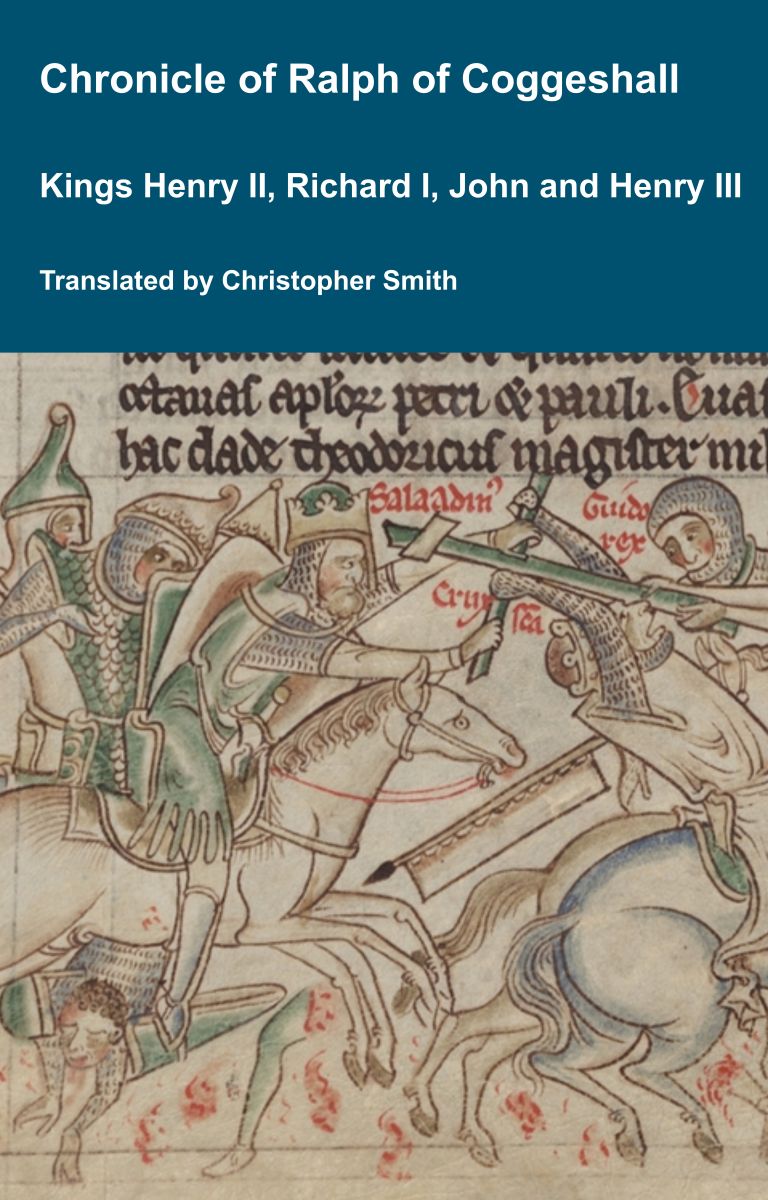
Chronicle of Abbot Ralph of Coggeshall
The Chronicle of Abbot Ralph of Coggeshall (Chronicon Anglicanum) is an indispensable medieval history that brings to life centuries of English and European affairs through the eyes of a learned Cistercian monk. Ralph of Coggeshall, abbot of the Abbey of Coggeshall in Essex in the early 13th century, continued and expanded his community’s chronicle, documenting events from the Norman Conquest of 1066 into the tumultuous reign of King Henry III. Blending eyewitness testimony, careful compilation, and the monastic commitment to record-keeping, this chronicle offers a rare narrative of political intrigue, royal power struggles, and social upheaval in England and beyond. Ralph’s work captures the reigns of pivotal figures such as Richard I and King John, providing invaluable insights into their characters, decisions, and the forces that shaped medieval rule. More than a simple annal, Chronicon Anglicanum conveys the texture of medieval life and governance, making it a rich source for scholars and readers fascinated by English history, monastic authorship, and the shaping of the medieval world.
Available at Amazon in eBook and Paperback format.
On 6th June 1746 William Fitzwilliam 1st and 3rd Earl Fitzwilliam [aged 26] was appointed Privy Council.
In 1752 James Waldegrave 2nd Earl Waldegrave [aged 36] was appointed Privy Council.
In 1757 Thomas Osborne 4th Duke Leeds [aged 43] was appointed Privy Council.
In 1761 William Talbot 1st Earl Talbot [aged 50] was appointed Privy Council.

In 1761 Anthony Ashley-Cooper 4th Earl Shaftesbury [aged 49] was appointed Privy Council.

In 1762 James Stanley "Lord Strange" [aged 46] was appointed to the Privy Council.

In 1762 Hugh Percy 1st Duke Northumberland [aged 46] was appointed Privy Council.

In 1762 John Cust 3rd Baronet [aged 43] was appointed Privy Council.

In 1763 Stephen Fox-Strangways 1st Earl of Ilchester [aged 58] was appointed Privy Council.
William of Worcester's Chronicle of England
William of Worcester, born around 1415, and died around 1482 was secretary to John Fastolf, the renowned soldier of the Hundred Years War, during which time he collected documents, letters, and wrote a record of events. Following their return to England in 1440 William was witness to major events. Twice in his chronicle he uses the first person: 1. when writing about the murder of Thomas, 7th Baron Scales, in 1460, he writes '… and I saw him lying naked in the cemetery near the porch of the church of St. Mary Overie in Southwark …' and 2. describing King Edward IV's entry into London in 1461 he writes '… proclaimed that all the people themselves were to recognize and acknowledge Edward as king. I was present and heard this, and immediately went down with them into the city'. William’s Chronicle is rich in detail. It is the source of much information about the Wars of the Roses, including the term 'Diabolical Marriage' to describe the marriage of Queen Elizabeth Woodville’s brother John’s marriage to Katherine, Dowager Duchess of Norfolk, he aged twenty, she sixty-five or more, and the story about a paper crown being placed in mockery on the severed head of Richard, 3rd Duke of York.
Available at Amazon in eBook and Paperback format.
In 1765 Richard Lumley-Saunderson 4th Earl Scarborough [aged 39] was appointed Privy Council.
In 1770 Henry Carteret 1st Baron Carteret [aged 35] was appointed Privy Council.
On 12th February 1779 Robert Bertie 4th Duke Ancaster and Kesteven [aged 22] was appointed to the Privy Council and as Lord Lieutenant of Lincolnshire.
On 12th February 1779 Brownlow Bertie 5th Duke Ancaster and Kesteven [aged 49] was appointed Lord Lieutenant of Lincolnshire and to the Privy Council.
In 1782 Augustus Keppel 1st Viscount Keppel [aged 56] was appointed Privy Council.


In 1782 Peter Ludlow 1st Earl Ludlow [aged 51] was appointed Privy Council.

In 1785 Thomas Orde-Powlett 1st Baron Bolton [aged 44] was appointed Privy Council.
In 1793 Charles Spencer [aged 52] was appointed Privy Council.
Abbot John Whethamstede’s Chronicle of the Abbey of St Albans
Abbot John Whethamstede's Register aka Chronicle of his second term at the Abbey of St Albans, 1451-1461, is a remarkable text that describes his first-hand experience of the beginning of the Wars of the Roses including the First and Second Battles of St Albans, 1455 and 1461, respectively, their cause, and their consequences, not least on the Abbey itself. His text also includes Loveday, Blore Heath, Northampton, the Act of Accord, Wakefield, and Towton, and ends with the Coronation of King Edward IV. In addition to the events of the Wars of the Roses, Abbot John, or his scribes who wrote the Chronicle, include details in the life of the Abbey such as charters, letters, land exchanges, visits by legates, and disputes, which provide a rich insight into the day-to-day life of the Abbey, and the challenges faced by its Abbot.
Available at Amazon in eBook and Paperback format.
On 26th April 1797 Charles Henry Somerset [aged 29] was appointed Privy Council.

On 17th March 1801 George Legge 3rd Earl Dartmouth [aged 45] was appointed to the Privy Council.
In 1817 Charles Chetwynd-Talbot 2nd Earl Talbot [aged 39] was appointed Privy Council.


In 1827 George William Frederick Osborne 6th Duke Leeds [aged 51] was appointed Privy Council.
In 1828 Thomas Peregrine Courtenay [aged 45] was appointed Privy Council.
In 1833 William Feilding 6th Earl Desmond 7th Earl Denbigh [aged 36] was appointed Privy Council.
In 1835 Charles Fitzroy [aged 43] was appointed Privy Council.
In 1846 Edward George Fitzalan Howard 1st Baron Howard [aged 27] was appointed Privy Council.
In October 1851 Edward Adolphus Seymour 12th Duke of Somerset [aged 46] was appointed Privy Council.

On 2nd February 1852 Henry Richard Charles Wellesley 1st Earl Cowley [aged 47] was appointed Privy Council.
In 1866 William Alleyne Cecil 3rd Marquess Exeter [aged 40] was appointed Privy Council.
In 1874 Charles Chetwynd-Talbot 19th Earl of Shrewsbury 4th Earl Talbot [aged 43] was appointed Privy Council.
In 1876 Henry Frederick Thynne [aged 43] was appointed Privy Council.

The London Gazette 26320. At the Court at Osborne House, Isle of Wight, the 25th day of August, 1892.
PRESENT, The Queen's [aged 73] Most Excellent Majesty in Council.
This day the Right Honourable George William Henry, Lord Vernon [aged 38], was, by Her Majesty's command, sworn of Her Majesty's Most Honourable Privy Council, and took his place at the Board accordingly
In December 1901 Henry Aubrey-Fletcher 4th Baronet [aged 66] was appointed to the Privy Council.

In 1906 John Brunner 1st Baronet [aged 63] was appointed to the Privy Council.
The History of William Marshal was commissioned by his son shortly after William’s death in 1219 to celebrate the Marshal’s remarkable life; it is an authentic, contemporary voice. The manuscript was discovered in 1861 by French historian Paul Meyer. Meyer published the manuscript in its original Anglo-French in 1891 in two books. This book is a line by line translation of the first of Meyer’s books; lines 1-10152. Book 1 of the History begins in 1139 and ends in 1194. It describes the events of the Anarchy, the role of William’s father John, John’s marriages, William’s childhood, his role as a hostage at the siege of Newbury, his injury and imprisonment in Poitou where he met Eleanor of Aquitaine and his life as a knight errant. It continues with the accusation against him of an improper relationship with Margaret, wife of Henry the Young King, his exile, and return, the death of Henry the Young King, the rebellion of Richard, the future King Richard I, war with France, the death of King Henry II, and the capture of King Richard, and the rebellion of John, the future King John. It ends with the release of King Richard and the death of John Marshal.
Available at Amazon in eBook and Paperback format.

Edward Smith-Stanley 14th Earl of Derby was appointed Privy Council.
Thomas Stanley 1st Baron Stanley was appointed Privy Council.
Thomas Cheney was appointed Privy Council.
On 19th April 1550 William Thomas was appointed Clerk to the Privy Council.