


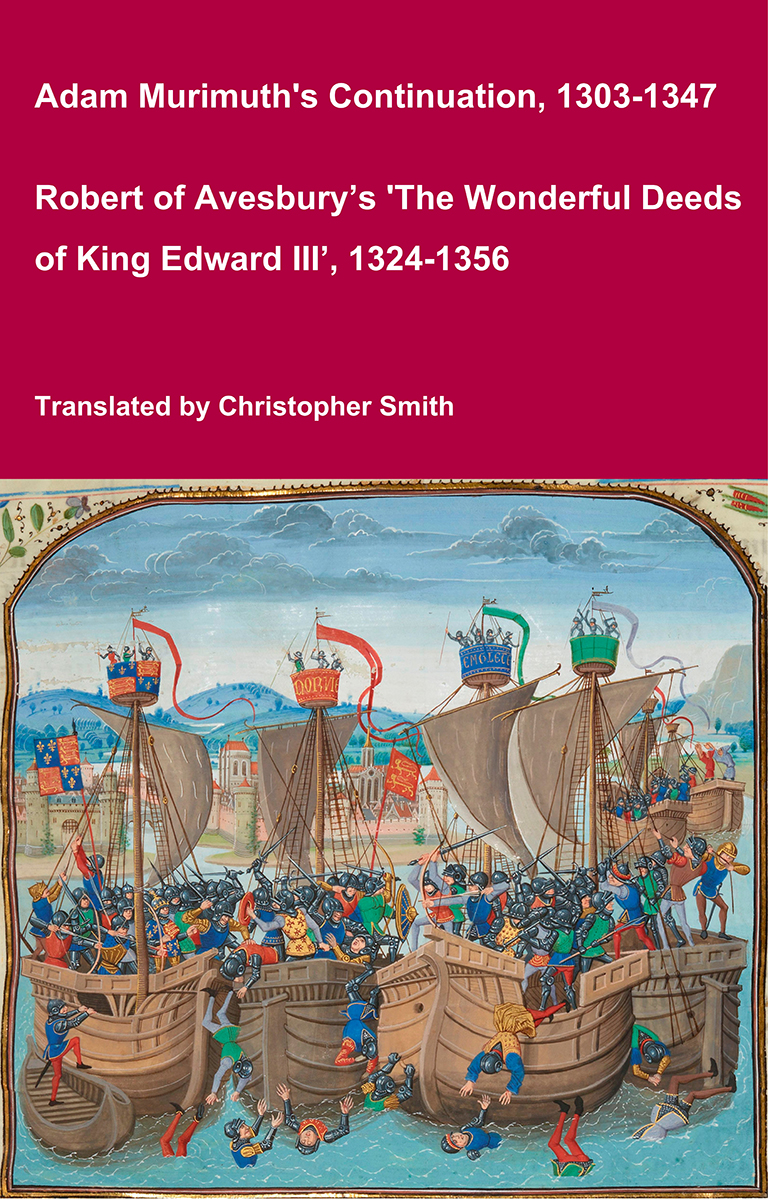
Adam Murimuth's Continuation and Robert of Avesbury’s 'The Wonderful Deeds of King Edward III'
This volume brings together two of the most important contemporary chronicles for the reign of Edward III and the opening phases of the Hundred Years’ War. Written in Latin by English clerical observers, these texts provide a vivid and authoritative window into the political, diplomatic, and military history of fourteenth-century England and its continental ambitions. Adam Murimuth Continuatio's Chronicarum continues an earlier chronicle into the mid-fourteenth century, offering concise but valuable notices on royal policy, foreign relations, and ecclesiastical affairs. Its annalistic structure makes it especially useful for establishing chronology and tracing the development of events year by year. Complementing it, Robert of Avesbury’s De gestis mirabilibus regis Edwardi tertii is a rich documentary chronicle preserving letters, treaties, and official records alongside narrative passages. It is an indispensable source for understanding Edward III’s claim to the French crown, the conduct of war, and the mechanisms of medieval diplomacy. Together, these works offer scholars, students, and enthusiasts a reliable and unembellished account of a transformative period in English and European history. Essential for anyone interested in medieval chronicles, the Hundred Years’ War, or the reign of Edward III.
Available at Amazon in eBook and Paperback format.
River Yare is in East Anglia Rivers.
The River Yare rises around Thuxton, Norfolk [Map] from where it flows past Coston, Norfolk [Map], Brandon Parva, Norfolk [Map], Barnham Broom, Norfolk [Map] after which it is joined by the River Tiffey before flowing past Marlingford, Norfolk [Map], Bawburgh, Norfolk [Map], Bowthorpe, Norfolk [Map], Colney, Norfolk [Map], Earlham Park [Map], Eaton [Map] to Old Lakenham [Map] after which it is joined by the River Wensum. Thereafter it flows past Thorpe St Andrew, Norfolk [Map], SurlIngham, Norfolk [Map], Brundall, Norfolk [Map], Buckenham, Norfolk [Map], Cantley, Norfolk [Map], Reedham, Norfolk [Map] to Berney Arms, Norfolk [Map] after which it is joined by the River Waveney then flows through Great Yarmouth, Norfolk [Map] where it is joined by the River Bure then meets the North Sea at Gorleston on Sea, Norfolk [Map].
Burgh Castle Roman Fort, Norfolk [Map] is a Roman shore fort where the River Waveney meets the River Yare. One of nine constructed around 250AD to hold troops as a defence against Saxon raids up the rivers of the east and south coasts of southern Britain.
It was possibly known as Gariannonum, although the single record, the Notitia Dignitatum, a Roman Army "order of battle", may perhaps be referring to the Roman site at Caister-on-Sea [Map].
