

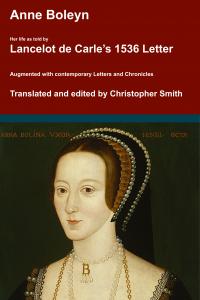
Anne Boleyn. Her Life as told by Lancelot de Carle's 1536 Letter.
In 1536, two weeks after the execution of Anne Boleyn, her brother George and four others, Lancelot du Carle, wrote an extraordinary letter that described Anne's life, and her trial and execution, to which he was a witness. This book presents a new translation of that letter, with additional material from other contemporary sources such as Letters, Hall's and Wriothesley's Chronicles, the pamphlets of Wynkyn the Worde, the Memorial of George Constantyne, the Portuguese Letter and the Baga de Secrets, all of which are provided in Appendices.
Available at Amazon in eBook and Paperback format.
Speaker of the House of Commons is in Crown.
In January 1377 Thomas Hungerford was appointed Speaker of the House of Commons.
In 1399 William Dorward of Dorward Hall in Bocking in Essex was appointed Speaker of the House of Commons.
In 1404 William Sturmey [aged 48] was elected Speaker of the House of Commons.
In 1406 John Tiptoft 1st Baron Tiptoft was appointed Speaker of the House of Commons.
In 1407 Thomas Chaucer [aged 40] was appointed Speaker of the House of Commons.
In 1413 William Dorward of Dorward Hall in Bocking in Essex was appointed Speaker of the House of Commons.
In May 1414 the Fire and Faggot Parliament at Greyfriars Priory, Leicester [Map]. Walter Hungerford 1st Baron Hungerford [aged 35] was appointed Speaker of the House of Commons. It was named for the Suppression of Heresy Act which called for burning the Lollards with bundles of sticks known as faggots.
In 1415 Richard Redman [aged 65] was appointed Speaker of the House of Commons.
Around April 1416 Walter Beauchamp [aged 52] was appointed Speaker of the House of Commons.
In 1421 John Tyrrell [aged 39] was appointed Speaker of the House of Commons.
Chronicle of Walter of Guisborough
A canon regular of the Augustinian Guisborough Priory, Yorkshire, formerly known as The Chronicle of Walter of Hemingburgh, describes the period from 1066 to 1346. Before 1274 the Chronicle is based on other works. Thereafter, the Chronicle is original, and a remarkable source for the events of the time. This book provides a translation of the Chronicle from that date. The Latin source for our translation is the 1849 work edited by Hans Claude Hamilton. Hamilton, in his preface, says: 'In the present work we behold perhaps one of the finest samples of our early chronicles, both as regards the value of the events recorded, and the correctness with which they are detailed; Nor will the pleasing style of composition be lightly passed over by those capable of seeing reflected from it the tokens of a vigorous and cultivated mind, and a favourable specimen of the learning and taste of the age in which it was framed.'
Available at Amazon in eBook and Paperback format.
In 1426 Richard Vernon aka Pembridge [aged 37] was appointed Speaker of the House of Commons.
In 1429 John Tyrrell [aged 47] was appointed Speaker of the House of Commons.
In 1437 John Hody was elected Speaker of the House of Commons.
In 1437 John Tyrrell [aged 55] was appointed Speaker of the House of Commons.
On 26th September 1439 William Tresham was appointed Speaker of the House of Commons.
On 3rd December 1441 William Tresham was appointed Speaker of the House of Commons.
On 14th December 1446 William Tresham was appointed Speaker of the House of Commons.
In 1455 John Wenlock 1st Baron Wenlock [aged 55] was appointed Speaker of the House of Commons.
On 9th October 1459 Thomas Tresham [aged 39] was elected Speaker of the House of Commons at Coventry, Warwickshire [Map]. The primary purpose of the Parliament was to attaint the Yorkist leaders:
Richard Plantagenet 3rd Duke of York [aged 48], his sons Edward Earl of March [aged 17], Edmund Earl of Rutland [aged 16] were attainted, as were Richard Neville Earl Salisbury [aged 59] and his sons Richard "Kingmaker" Neville Earl Warwick, 6th Earl Salisbury [aged 30] and John Neville 1431-1471 [aged 28].
On 24th January 1484 William Catesby [aged 34] was appointed Speaker of the House of Commons.
On 7th November 1485 Thomas Lovell was elected Speaker of the House of Commons.
On 10th November 1487 John Mordaunt [aged 31] was appointed Speaker of the House of Commons.
Jean de Waurin's Chronicle of England Volume 6 Books 3-6: The Wars of the Roses
Jean de Waurin was a French Chronicler, from the Artois region, who was born around 1400, and died around 1474. Waurin’s Chronicle of England, Volume 6, covering the period 1450 to 1471, from which we have selected and translated Chapters relating to the Wars of the Roses, provides a vivid, original, contemporary description of key events some of which he witnessed first-hand, some of which he was told by the key people involved with whom Waurin had a personal relationship.
Available at Amazon in eBook and Paperback format.
On 18th October 1491 Richard Empson [aged 41] was appointed Speaker of the House of Commons.
On 15th October 1495 Robert Drury [aged 41] was appointed Speaker of the House of Commons during the 5th Parliament of Henry VII.
In 1497 Thomas Englefield was elected Knight of the Shire Bedfordshire. Thomas Englefield was elected Speaker of the House of Commons.
In 1504 Edmund Dudley [aged 42] was elected Speaker of the House of Commons.
In 1510 Thomas Englefield was elected Knight of the Shire Bedfordshire. Thomas Englefield was elected Speaker of the House of Commons.
In 1512 Robert Sheffield [aged 51] was appointed Speaker of the House of Commons.
In 1514 Thomas Neville [aged 39] was appointed Speaker of the House of Commons.
In 1523 Thomas More [aged 44] was elected Speaker of the House of Commons on the recommendation of Cardinal Thomas Wolsey [aged 49].


In 1533 Humphrey Wingfield was appointed Speaker of the House of Commons.
In 1539 Nicholas Hare [aged 55] was elected Speaker of the House of Commons.
In 1553 John Pollard was appointed Speaker of the House of Commons.
Abbot John Whethamstede’s Chronicle of the Abbey of St Albans
Abbot John Whethamstede's Register aka Chronicle of his second term at the Abbey of St Albans, 1451-1461, is a remarkable text that describes his first-hand experience of the beginning of the Wars of the Roses including the First and Second Battles of St Albans, 1455 and 1461, respectively, their cause, and their consequences, not least on the Abbey itself. His text also includes Loveday, Blore Heath, Northampton, the Act of Accord, Wakefield, and Towton, and ends with the Coronation of King Edward IV. In addition to the events of the Wars of the Roses, Abbot John, or his scribes who wrote the Chronicle, include details in the life of the Abbey such as charters, letters, land exchanges, visits by legates, and disputes, which provide a rich insight into the day-to-day life of the Abbey, and the challenges faced by its Abbot.
Available at Amazon in eBook and Paperback format.
In 1553 James Dyer [aged 43] was elected Speaker of the House of Commons.
In 1554 Robert Broke was appointed Speaker of the House of Commons.
In 1555 John Pollard was appointed Speaker of the House of Commons.

In 1571 Christopher Wray [aged 47] was appointed Speaker of the House of Commons.
In 1572 Robert Bell [aged 33] was appointed Speaker of the House of Commons.
In 1580 John Popham [aged 49] was appointed Speaker of the House of Commons which post he held for three years.
On 23rd November 1585 John Puckering [aged 41] was elected Speaker of the House of Commons.
On 24th November 1597 Christopher Yelverton [aged 61] was appointed Speaker of the House of Commons.
In October 1601 John Croke [aged 48] was appointed Speaker of the House of Commons.
On 19th March 1604 Edward Phelips [aged 47] was elected Speaker of the House of Commons which office he held until 1611.
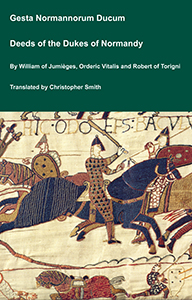
The Deeds of the Dukes of Normandy
The Gesta Normannorum Ducum [The Deeds of the Dukes of Normandy] is a landmark medieval chronicle tracing the rise and fall of the Norman dynasty from its early roots through the pivotal events surrounding the Norman Conquest of England. Originally penned in Latin by the monk William of Jumièges shortly before 1060 and later expanded at the behest of William the Conqueror, the work chronicles the deeds, politics, battles, and leadership of the Norman dukes, especially William’s own claim to the English throne. The narrative combines earlier historical sources with firsthand information and oral testimony to present an authoritative account of Normandy’s transformation from a Viking settlement into one of medieval Europe’s most powerful realms. William’s history emphasizes the legitimacy, military prowess, and governance of the Norman line, framing their expansion, including the conquest of England, as both divinely sanctioned and noble in purpose. Later chroniclers such as Orderic Vitalis and Robert of Torigni continued the history, extending the coverage into the 12th century, providing broader context on ducal rule and its impact. Today this classic work remains a foundational source for understanding Norman identity, medieval statesmanship, and the historical forces that reshaped England and Western Europe between 800AD and 1100AD.
Available at Amazon in eBook and Paperback format.
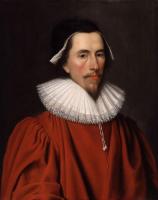
In 1626 Heneage Finch [aged 46] was appointed Speaker of the House of Commons.
In 1640 William Lenthall [aged 48] was appointed Speaker of the House of Commons.
On 20th February 1640 Henry Berkeley of Bruton [aged 61] was elected MP Ilchester
John Glanville [aged 54] was elected Speaker of the House of Commons.
In September 1651 John Temple [aged 19] was appointed Speaker of the House of Commons.
In 1661 Edward Turnour [aged 44] was appointed Speaker of the House of Commons.
In 1673 Edward Seymour 4th Baronet [aged 40] was appointed Speaker of the House of Commons.
In 1678 Robert Sawyer [aged 45] was elected Speaker of the House of Commons but resigned a month later due to health.
In 1680 and 1681 William Williams 1st Baronet [aged 46] was elected Speaker of the House of Commons.
In 1698 Thomas Littleton 3rd Baronet [aged 50] was elected Speaker of the House of Commons.
In February 1701 Robert Harley 1st Earl of Oxford and Earl Mortimer [aged 39] was appointed Speaker of the House of Commons.


On 25th November 1710 William Bromley [aged 47] was appointed Speaker of the House of Commons which office he held until 1732
In 1714 Thomas Hanmer 4th Baronet [aged 36] was appointed Speaker of the House of Commons.
The History of William Marshal was commissioned by his son shortly after William’s death in 1219 to celebrate the Marshal’s remarkable life; it is an authentic, contemporary voice. The manuscript was discovered in 1861 by French historian Paul Meyer. Meyer published the manuscript in its original Anglo-French in 1891 in two books. This book is a line by line translation of the first of Meyer’s books; lines 1-10152. Book 1 of the History begins in 1139 and ends in 1194. It describes the events of the Anarchy, the role of William’s father John, John’s marriages, William’s childhood, his role as a hostage at the siege of Newbury, his injury and imprisonment in Poitou where he met Eleanor of Aquitaine and his life as a knight errant. It continues with the accusation against him of an improper relationship with Margaret, wife of Henry the Young King, his exile, and return, the death of Henry the Young King, the rebellion of Richard, the future King Richard I, war with France, the death of King Henry II, and the capture of King Richard, and the rebellion of John, the future King John. It ends with the release of King Richard and the death of John Marshal.
Available at Amazon in eBook and Paperback format.
In 1715 Spencer Compton 1st Earl Wilmington [aged 42] was appointed Speaker of the House of Commons.

On 23rd January 1728 Arthur Onslow [aged 36] was elected Speaker of the House of Commons unanimously.
In 1735 Arthur Onslow [aged 43] was elected Speaker of the House of Commons unanimously.
In 1741 Arthur Onslow [aged 49] was elected Speaker of the House of Commons unanimously.
In 1747 Arthur Onslow [aged 55] was elected Speaker of the House of Commons unanimously.
In 1754 Arthur Onslow [aged 62] was elected Speaker of the House of Commons unanimously.

In 1761 John Cust 3rd Baronet [aged 42] was elected Speaker of the House of Commons.

In 1789 Charles Wolfram Cornwall [aged 53] was appointed Speaker of the House of Commons which position he held until his death in 1789.
In 1802 Charles Abbot 1st Baron Colchester [aged 44] was appointed Speaker of the House of Commons.


In 1839 Charles Shaw-Lefevre 1st Viscount Eversley [aged 44] was appointed Speaker of the House of Commons.

On 20th June 1928 Edward Fitzroy [aged 58] was elected Speaker of the House of Commons.
James Strangeways was appointed Speaker of the House of Commons.
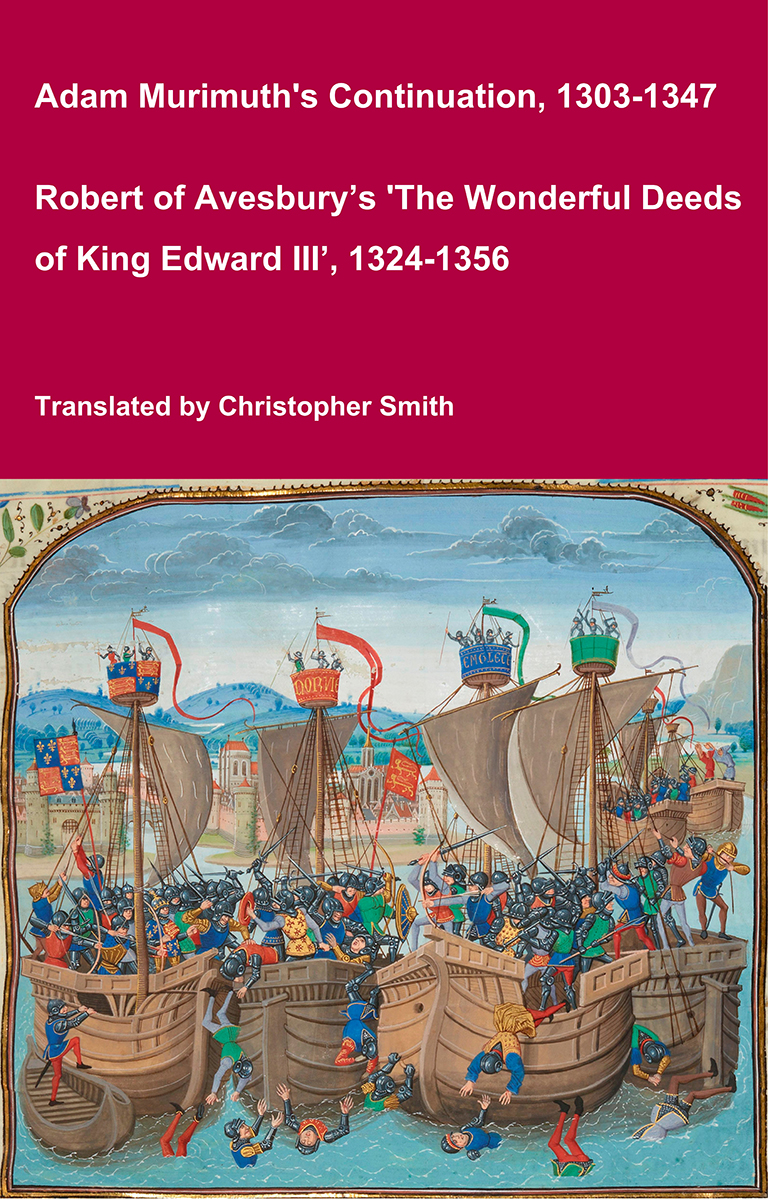
Adam Murimuth's Continuation and Robert of Avesbury’s 'The Wonderful Deeds of King Edward III'
This volume brings together two of the most important contemporary chronicles for the reign of Edward III and the opening phases of the Hundred Years’ War. Written in Latin by English clerical observers, these texts provide a vivid and authoritative window into the political, diplomatic, and military history of fourteenth-century England and its continental ambitions. Adam Murimuth Continuatio's Chronicarum continues an earlier chronicle into the mid-fourteenth century, offering concise but valuable notices on royal policy, foreign relations, and ecclesiastical affairs. Its annalistic structure makes it especially useful for establishing chronology and tracing the development of events year by year. Complementing it, Robert of Avesbury’s De gestis mirabilibus regis Edwardi tertii is a rich documentary chronicle preserving letters, treaties, and official records alongside narrative passages. It is an indispensable source for understanding Edward III’s claim to the French crown, the conduct of war, and the mechanisms of medieval diplomacy. Together, these works offer scholars, students, and enthusiasts a reliable and unembellished account of a transformative period in English and European history. Essential for anyone interested in medieval chronicles, the Hundred Years’ War, or the reign of Edward III.
Available at Amazon in eBook and Paperback format.
William Bromley was appointed Speaker of the House of Commons.