

The Deeds of the Dukes of Normandy
The Gesta Normannorum Ducum [The Deeds of the Dukes of Normandy] is a landmark medieval chronicle tracing the rise and fall of the Norman dynasty from its early roots through the pivotal events surrounding the Norman Conquest of England. Originally penned in Latin by the monk William of Jumièges shortly before 1060 and later expanded at the behest of William the Conqueror, the work chronicles the deeds, politics, battles, and leadership of the Norman dukes, especially William’s own claim to the English throne. The narrative combines earlier historical sources with firsthand information and oral testimony to present an authoritative account of Normandy’s transformation from a Viking settlement into one of medieval Europe’s most powerful realms. William’s history emphasizes the legitimacy, military prowess, and governance of the Norman line, framing their expansion, including the conquest of England, as both divinely sanctioned and noble in purpose. Later chroniclers such as Orderic Vitalis and Robert of Torigni continued the history, extending the coverage into the 12th century, providing broader context on ducal rule and its impact. Today this classic work remains a foundational source for understanding Norman identity, medieval statesmanship, and the historical forces that reshaped England and Western Europe between 800AD and 1100AD.
Available at Amazon in eBook and Paperback format.
Viscount Montagu is in Viscountcies of England Alphabetically.

On 2nd September 1554 Anthony Browne 1st Viscount Montagu [aged 25] was created 1st Viscount Montagu. Magdalen Dacre Viscountess Montague [aged 16] by marriage Viscountess Montagu. See Complete peerage of England, Scotland, Ireland, Great Britain and the United Kingdom by George Cockayne, Volume 9, Page 340.
Henry Machyn's Diary. 6th September 1554. The vj day of September wher creatyd ser Antony Browne [aged 25] creatyd vyconte lord Montyguw.
In 1591 Anthony Maria Browne 2nd Viscount Montagu [aged 16] and Jane Sackville Viscountess Montague [aged 18] were married. She by marriage Viscountess Montagu. She the daughter of Thomas Sackville 1st Earl Dorset [aged 55] and Cicely Baker Countess Dorset [aged 56]. They were fourth cousin once removed.
On 19th October 1592 Anthony Browne 1st Viscount Montagu [aged 63] died. His grandson Anthony [aged 18] succeeded 2nd Viscount Montagu.
On 23rd October 1629 Anthony Maria Browne 2nd Viscount Montagu [aged 55] died. His son Francis [aged 19] succeeded 3rd Viscount Montagu.
On 6th July 1637 Francis Browne 3rd Viscount Montagu [aged 27] and Elizabeth Somerset Viscountess Montague [aged 19] were married. She by marriage Viscountess Montagu. She the daughter of Henry Somerset 1st Marquess Worcester [aged 60] and Anne Russell Countess Worcester [aged 59]. They were fourth cousins.
On 2nd November 1682 Francis Browne 3rd Viscount Montagu [aged 72] died. His son Francis succeeded 4th Viscount Montagu. Mary Herbert Viscountess Montague [aged 21] by marriage Viscountess Montagu.


In or before 1686 Henry Browne 5th Viscount Montagu and Barbara Walsingham Viscountess Montague were married. She by marriage Viscountess Montagu.
In 1708 Francis Browne 4th Viscount Montagu died. His brother Henry succeeded 5th Viscount Montagu.
On 25th June 1717 Henry Browne 5th Viscount Montagu died. His son Anthony [aged 31] succeeded 6th Viscount Montagu.
On 28th July 1720 Anthony Browne 6th Viscount Montagu [aged 34] and Barbara Webb Viscountess Montague [aged 23] were married. She by marriage Viscountess Montagu. They were second cousin once removed.
Before 1730 Barbara Webb Viscountess Montague [aged 32] by marriage Viscountess Montagu.
The Deeds of the Dukes of Normandy
The Gesta Normannorum Ducum [The Deeds of the Dukes of Normandy] is a landmark medieval chronicle tracing the rise and fall of the Norman dynasty from its early roots through the pivotal events surrounding the Norman Conquest of England. Originally penned in Latin by the monk William of Jumièges shortly before 1060 and later expanded at the behest of William the Conqueror, the work chronicles the deeds, politics, battles, and leadership of the Norman dukes, especially William’s own claim to the English throne. The narrative combines earlier historical sources with firsthand information and oral testimony to present an authoritative account of Normandy’s transformation from a Viking settlement into one of medieval Europe’s most powerful realms. William’s history emphasizes the legitimacy, military prowess, and governance of the Norman line, framing their expansion, including the conquest of England, as both divinely sanctioned and noble in purpose. Later chroniclers such as Orderic Vitalis and Robert of Torigni continued the history, extending the coverage into the 12th century, providing broader context on ducal rule and its impact. Today this classic work remains a foundational source for understanding Norman identity, medieval statesmanship, and the historical forces that reshaped England and Western Europe between 800AD and 1100AD.
Available at Amazon in eBook and Paperback format.
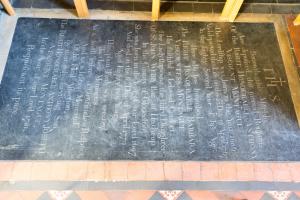
On 23rd April 1767 Anthony Browne 6th Viscount Montagu [aged 81] died. His son Anthony [aged 37] succeeded 7th Viscount Montagu. Frances Falconer Mackworth Viscountess Montague [aged 35] by marriage Viscountess Montagu.
Grave slab to Anthony Browne 6th Viscount Montagu and Barbara Webb Viscountess Montague [aged 70] in St Mary's Church, Easebourne, Sussex [Map].
On 9th April 1787 Anthony Joseph Browne 7th Viscount Montagu [aged 57] died. His son George [aged 17] succeeded 8th Viscount Montagu.
In October 1793 George Samuel Browne 8th Viscount Montagu [aged 24] was drowned whilst trying to ride the Rhine Falls, Schaffhausen with his friend Charles Sedley Burdett with whom he was travelling. Given the Rhine Falls is 150 feet wide and 75 feet high, attempting to ride the falls in a fishing boat was not one of George's best ideas. His third cousin twice removed Mark [aged 48] succeeded 9th Viscount Montagu.
On 13th November 1797 Reverend Mark Browne 9th Viscount Montagu [aged 52] died. Viscount Montagu extinct.