

Henrici Quinti, Angliæ Regis, Gesta, is a first-hand account of the Agincourt Campaign, and subsequent events to his death in 1422. The author of the first part was a Chaplain in King Henry's retinue who was present from King Henry's departure at Southampton in 1415, at the siege of Harfleur, the battle of Agincourt, and the celebrations on King Henry's return to London. The second part, by another writer, relates the events that took place including the negotiations at Troye, Henry's marriage and his death in 1422.
Available at Amazon in eBook and Paperback format.
Echo is an Oread who resided on Mount Cithaeron.
Metamorphoses Book 3. 339. Tiresias' fame of prophecy was spread through all the cities of Aonia, for his unerring answers unto all who listened to his words. And first of those that harkened to his fateful prophecies, a lovely Nymph, named Liriope, came with her dear son, who then fifteen, might seem a man or boy-he who was born to her upon the green merge of Cephissus' stream-that mighty River-God whom she declared the father of her boy. - she questioned him. Imploring him to tell her if her son, unequalled for his beauty, whom she called Narcissus, might attain a ripe old age. To which the blind seer answered in these words, "If he but fail to recognize himself, a long life he may have, beneath the sun,"-so, frivolous the prophet's words appeared; and yet the event, the manner of his death, the strange delusion of his frenzied love, confirmed it. Three times five years so were passed. Another five-years, and the lad might seem a young man or a boy. And many a youth, and many a damsel sought to gain his love; but such his mood and spirit and his pride, none gained his favour.
359. Once a noisy Nymph, (who never held her tongue when others spoke, who never spoke till others had begun) mocking Echo, spied him as he drove, in his delusive nets, some timid stags.-For Echo was a Nymph, in olden time,-and, more than vapid sound,-possessed a form: and she was then deprived the use of speech, except to babble and repeat the words, once spoken, over and over. Juno confused her silly tongue, because she often held that glorious goddess with her endless tales, till many a hapless Nymph, from Jove's embrace, had made escape adown a mountain. But for this, the goddess might have caught them. Thus the glorious Juno, when she knew her guile; "Your tongue, so freely wagged at my expense, shall be of little use; your endless voice, much shorter than your tongue." At once the Nymph was stricken as the goddess had decreed;-and, ever since, she only mocks the sounds of others' voices, or, perchance, returns their final words.
370. One day, when she observed Narcissus wandering in the pathless woods, she loved him and she followed him, with soft and stealthy tread.-The more she followed him the hotter did she burn, as when the flame flares upward from the sulphur on the torch. Oh, how she longed to make her passion known! To plead in soft entreaty! to implore his love! But now, till others have begun, a mute of Nature she must be. She cannot choose but wait the moment when his voice may give to her an answer. Presently the youth, by chance divided from his trusted friends, cries loudly, "Who is here?" and Echo, "Here!" Replies. Amazed, he casts his eyes around, and calls with louder voice, "Come here!" "Come here!" She calls the youth who calls.-He turns to see who calls him and, beholding naught exclaims, "Avoid me not!" "Avoid me not!" returns. He tries again, again, and is deceived by this alternate voice, and calls aloud; "Oh let us come together!" Echo cries, "Oh let us come together!" Never sound seemed sweeter to the Nymph, and from the woods she hastens in accordance with her words, and strives to wind her arms around his neck. He flies from her and as he leaves her says, "Take off your hands! you shall not fold your arms around me. Better death than such a one should ever caress me!" Naught she answers save, "Caress me!" Thus rejected she lies hid in the deep woods, hiding her blushing face with the green leaves; and ever after lives concealed in lonely caverns in the hills. But her great love increases with neglect; her miserable body wastes away, wakeful with sorrows; leanness shrivels up her skin, and all her lovely features melt, as if dissolved upon the wafting winds-nothing remains except her bones and voice-her voice continues, in the wilderness; her bones have turned to stone. She lies concealed in the wild woods, nor is she ever seen on lonely mountain range; for, though we hear her calling in the hills, 'tis but a voice, a voice that lives, that lives among the hills.
402. Thus he deceived the Nymph and many more, sprung from the mountains or the sparkling waves; and thus he slighted many an amorous youth.-and therefore, some one whom he once despised, lifting his hands to Heaven, implored the Gods, "If he should love deny him what he loves!" and as the prayer was uttered it was heard by Nemesis, who granted her assent.
407. There was a fountain silver-clear and bright, which neither shepherds nor the wild she-goats, that range the hills, nor any cattle's mouth had touched-its waters were unsullied-birds disturbed it not; nor animals, nor boughs that fall so often from the trees. Around sweet grasses nourished by the stream grew; trees that shaded from the sun let balmy airs temper its waters. Here Narcissus, tired of hunting and the heated noon, lay down, attracted by the peaceful solitudes and by the glassy spring. There as he stooped to quench his thirst another thirst increased. While he is drinking he beholds himself reflected in the mirrored pool-and loves; loves an imagined body which contains no substance, for he deems the mirrored shade a thing of life to love. He cannot move, for so he marvels at himself, and lies with countenance unchanged, as if indeed a statue carved of Parian marble. Long, supine upon the bank, his gaze is fixed on his own eyes, twin stars; his fingers shaped as Bacchus might desire, his flowing hair as glorious as Apollo's, and his cheeks youthful and smooth; his ivory neck, his mouth dreaming in sweetness, his complexion fair and blushing as the rose in snow-drift white. All that is lovely in himself he loves, and in his witless way he wants himself:-he who approves is equally approved; he seeks, is sought, he burns and he is burnt. And how he kisses the deceitful fount; and how he thrusts his arms to catch the neck that's pictured in the middle of the stream! Yet never may he wreathe his arms around that image of himself. He knows not what he there beholds, but what he sees inflames his longing, and the error that deceives allures his eyes. But why, O foolish boy, so vainly catching at this flitting form? The cheat that you are seeking has no place. Avert your gaze and you will lose your love, for this that holds your eyes is nothing save the image of yourself reflected back to you. It comes and waits with you; it has no life; it will depart if you will only go.
 Become a Member via our Buy Me a Coffee page to read more.
1850 to 1853. Alfred Gatley (age 33). "Echo", 1850 1853, Gawsworth Hall, Cheshire [Map]. Gatley sculpted at least three versions of Echo on request from clients. One of these is at Gawsworth, another is thought to be in Ireland, and the present whereabouts of the third is not known. One copy was sold at Christies in 1993, and sold on in 1997 by Lord & Lady White of Hull to an unidentified buyer for $29,900.

1874. Alexandre Cabanel (age 50). "Echo".
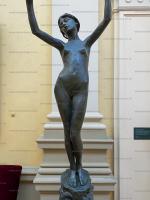
1895. "Echo" by Edward Onslow Ford (age 42). In the collection of the Lady Lever Art Gallery [Map].

1903. John William Waterhouse (age 53). "Echo and Narcissus".