

Adam Murimuth's Continuation and Robert of Avesbury’s 'The Wonderful Deeds of King Edward III'
This volume brings together two of the most important contemporary chronicles for the reign of Edward III and the opening phases of the Hundred Years’ War. Written in Latin by English clerical observers, these texts provide a vivid and authoritative window into the political, diplomatic, and military history of fourteenth-century England and its continental ambitions. Adam Murimuth Continuatio's Chronicarum continues an earlier chronicle into the mid-fourteenth century, offering concise but valuable notices on royal policy, foreign relations, and ecclesiastical affairs. Its annalistic structure makes it especially useful for establishing chronology and tracing the development of events year by year. Complementing it, Robert of Avesbury’s De gestis mirabilibus regis Edwardi tertii is a rich documentary chronicle preserving letters, treaties, and official records alongside narrative passages. It is an indispensable source for understanding Edward III’s claim to the French crown, the conduct of war, and the mechanisms of medieval diplomacy. Together, these works offer scholars, students, and enthusiasts a reliable and unembellished account of a transformative period in English and European history. Essential for anyone interested in medieval chronicles, the Hundred Years’ War, or the reign of Edward III.
Available at Amazon in eBook and Paperback format.
Hamlet Act IV Scene 7 Part IV. [Enter Queen.]
How now, sweet queen?
Gertrude. One woe doth tread upon another's heel,
So fast they follow. Your sister's drown'd, Laertes.
Laertes. Drown'd! O, where?
Gertrude. There is a willow grows aslant a brook,
That shows his hoar leaves in the glassy stream.
There with fantastic garlands did she come
Of crowflowers, nettles, daisies, and long purples,
That liberal shepherds give a grosser name,
But our cold maids do dead men's fingers call them.
There on the pendant boughs her coronet weeds
Clamb'ring to hang, an envious sliver broke,
When down her weedy trophies and herself
Fell in the weeping brook. Her clothes spread wide
And, mermaid-like, awhile they bore her up;
Which time she chaunted snatches of old tunes,
As one incapable of her own distress,
Or like a creature native and indued
Unto that element; but long it could not be
Till that her garments, heavy with their drink,
Pull'd the poor wretch from her melodious lay
To muddy death.
Laertes. Alas, then she is drown'd?
Gertrude. Drown'd, drown'd.
Laertes. Too much of water hast thou, poor Ophelia,
And therefore I forbid my tears; but yet
It is our trick; nature her custom holds,
Let shame say what it will. When these are gone,
The woman will be out. Adieu, my lord.
I have a speech of fire, that fain would blaze
But that this folly douts it. Exit.
Claudius. Let's follow, Gertrude.
How much I had to do to calm his rage I
Now fear I this will give it start again;
Therefore let's follow.
Exeunt.
 Become a Member via our Buy Me a Coffee page to read more.

Samuel Pepys' Diary. 13th February 1661. At the office all the morning; dined at home, and poor Mr. Wood with me, who after dinner would have borrowed money of me, but I would lend none. Then to Whitehall by coach with Sir W. Pen [aged 39], where we did very little business, and so back to Mr. Rawlinson's [aged 47], where I took him and gave him a cup of wine, he having formerly known Mr. Rawlinson, and here I met my uncle Wight, and he drank with us, and with him to Sir W. Batten's [aged 60], whither I sent for my wife, and we chose Valentines against to-morrow1, my wife chose me, which did much please me; my Lady Batten Sir W. Pen, &c. Here we sat late, and so home to bed, having got my Lady Batten to give me a spoonful of honey for my cold.
Note 1. The observation of St. Valentine's day is very ancient in this country. Shakespeare makes Ophelia sing "To-morrow is Saint Valentine's day, All in the morning betime, And I a maid at your window To be your Valentine". Hamlet, act iv. sc. 5.-M. B.
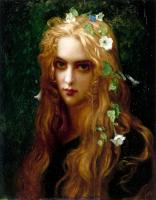
1850. Ernest Hébert [aged 32]. "Ophelia".

Around 1851. John Everett Millais 1st Baronet [aged 21]. Study for Ophelia. Model Elizabeth Siddal [aged 21].

1851 to 1852. John Everett Millais 1st Baronet [aged 21]. "Ophelia". Hamlet Act IV Scene 7 Part IV in which Queen Gertrude describes Ophelia's death to Laertes. Millais painted the scene near Tolworth, Surrey [Map] using the River Hogsmill. Elizabeth Siddal [aged 21] modelled in a bath-tub at 7 Gower Street, Camden [Map]. The initials PRB bottom right next to his signature. See Ophelia by John Everett MIllais.
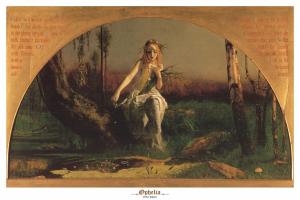
1852. Arthur Hughes [aged 19]. "Ophelia". The quote from Hamlet Act IV Scene 7 Part IV: "There is a willow grows aslant a brook, That shows his hoar leaves in the glassy stream. There with fantastic garlands did she come, Of crowflowers, nettles, daisies, and long purples, That liberal shepherds give a grosser name, But our cold maids do dead men's fingers call them. There on the pendant boughs her coronet weeds, Clamb'ring to hang, an envious sliver broke, When down her weedy trophies and herself, Fell in the weeping brook."

1863. George Frederick Watts [aged 45]. Portrait of Ophelia. Model Ellen Terry [aged 15]. Re-worked in 1877.
The painting itself presents the moment just before Ophelia meets her watery death in Hamlet, Act IV, scene vii, a moment which is reported but not enacted on stage:
There is a willow grows aslant a brook
That shows his hoar leaves in the glassy stream,
Therewith fantastic garlands did she come,
Of crowflowers, nettles, daisies, and long purples…

April 1864. Dante Gabriel Rossetti [aged 35]. "The First Madness of Ophelia".
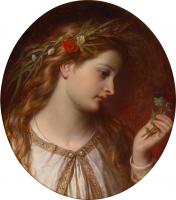
1865. Thomas Francis Dicksee [aged 45]. "Ophelia".
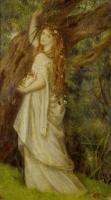
1865. Arthur Hughes [aged 32]. "Ophelia". It illustrates the scene in Shakespeare's 'Hamlet' (Act IV, scene 7) in which Ophelia picks flowers to make garlands shortly before she drowns.

1866. Dante Gabriel Rossetti [aged 37]. Watercolour "Hamlet and Ophelia".
Chronicle of Geoffrey le Baker of Swinbroke
Baker was a secular clerk from Swinbroke, now Swinbrook, an Oxfordshire village two miles east of Burford. His Chronicle describes the events of the period 1303-1356: Gaveston, Bannockburn, Boroughbridge, the murder of King Edward II, the Scottish Wars, Sluys, Crécy, the Black Death, Winchelsea and Poitiers. To quote Herbert Bruce 'it possesses a vigorous and characteristic style, and its value for particular events between 1303 and 1356 has been recognised by its editor and by subsequent writers'. The book provides remarkable detail about the events it describes. Baker's text has been augmented with hundreds of notes, including extracts from other contemporary chronicles, such as the Annales Londonienses, Annales Paulini, Murimuth, Lanercost, Avesbury, Guisborough and Froissart to enrich the reader's understanding. The translation takes as its source the 'Chronicon Galfridi le Baker de Swynebroke' published in 1889, edited by Edward Maunde Thompson.
Available at Amazon in eBook and Paperback format.
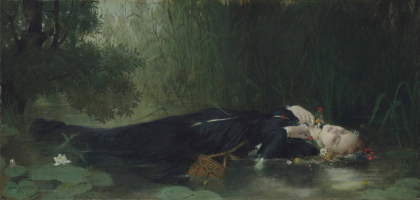
1872. Jean-Baptiste Bertrand [aged 48]. "Death of Ophelia".
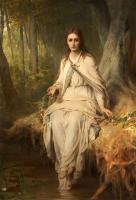
1873. Thomas Francis Dicksee [aged 53]. "Ophelia".
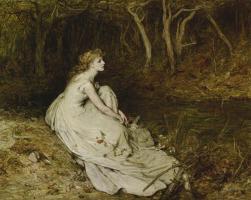
1874. William Quiller Orchardson [aged 41]. "Ophelia".
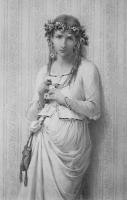
1876. Jean-Baptiste Bertrand [aged 52]. "Ophelia".
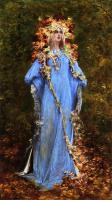
1876. Georges Clairin [aged 32]. Actress in the role of Ophelia.
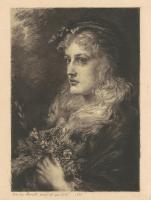
1880. Anne Lea aka Merritt [aged 35]. "Ophelia".

1883. Alexandre Cabanel [aged 59]. "Ophelia".
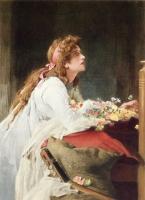
1888. Marcus Stone [aged 47]. "Ophelia".
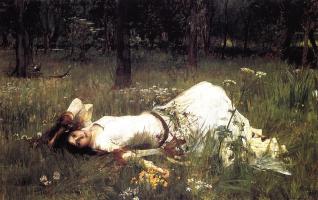
1889. John William Waterhouse [aged 39]. "Ophelia".

1890. Jules Joseph Lefebvre [aged 53]. "Ophelia".
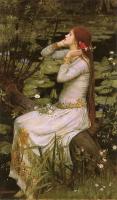
1894. John William Waterhouse [aged 44]. "Ophelia".
Henrici Quinti, Angliæ Regis, Gesta, is a first-hand account of the Agincourt Campaign, and subsequent events to his death in 1422. The author of the first part was a Chaplain in King Henry's retinue who was present from King Henry's departure at Southampton in 1415, at the siege of Harfleur, the battle of Agincourt, and the celebrations on King Henry's return to London. The second part, by another writer, relates the events that took place including the negotiations at Troye, Henry's marriage and his death in 1422.
Available at Amazon in eBook and Paperback format.
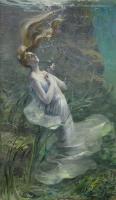
1895. Paul Albert Steck [aged 28]. "Ophelia".
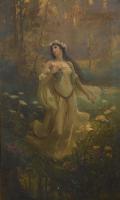
1896. Joseph Kirkpatrick [aged 24]. "Ophelia".
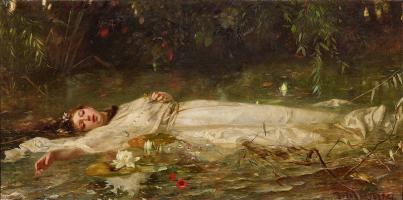
Around 1900. Friedrich Heyser [aged 42]. "Ophelia".
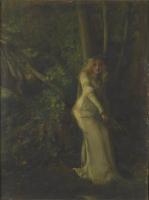
Around 1900. Pascal Dagnan-Bouveret [aged 47]. "Ophelia".
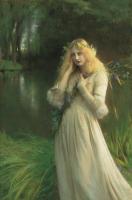
1900. Pascal Dagnan-Bouveret [aged 47]. "Ophelia".
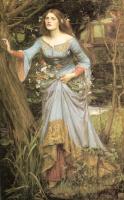
1910. John William Waterhouse [aged 60]. "Ophelia".

1942. Gerald Leslie Brockhurst [aged 51]. "Ophelia". Portrait of Kathleen Woodward [aged 29].