

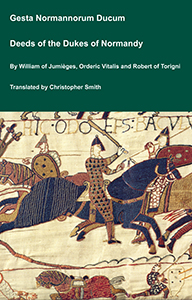
The Deeds of the Dukes of Normandy
The Gesta Normannorum Ducum [The Deeds of the Dukes of Normandy] is a landmark medieval chronicle tracing the rise and fall of the Norman dynasty from its early roots through the pivotal events surrounding the Norman Conquest of England. Originally penned in Latin by the monk William of Jumièges shortly before 1060 and later expanded at the behest of William the Conqueror, the work chronicles the deeds, politics, battles, and leadership of the Norman dukes, especially William’s own claim to the English throne. The narrative combines earlier historical sources with firsthand information and oral testimony to present an authoritative account of Normandy’s transformation from a Viking settlement into one of medieval Europe’s most powerful realms. William’s history emphasizes the legitimacy, military prowess, and governance of the Norman line, framing their expansion, including the conquest of England, as both divinely sanctioned and noble in purpose. Later chroniclers such as Orderic Vitalis and Robert of Torigni continued the history, extending the coverage into the 12th century, providing broader context on ducal rule and its impact. Today this classic work remains a foundational source for understanding Norman identity, medieval statesmanship, and the historical forces that reshaped England and Western Europe between 800AD and 1100AD.
Available at Amazon in eBook and Paperback format.
Around Bishop Birinus of Dorchester was born.
In 634 Bishop Birinus of Dorchester came to England landing at Hamwic where he founded St Mary's Church, Southampton. He was appointed Bishop of Dorchester.
Anglo-Saxon Chronicle. 634. This year Osric, whom Paulinus baptized, succeeded to the government of King of Deira. He was the son of Elfric, the uncle of Edwin. And to Bernicia succeeded Eanfrith (age 44), son of Ethelfrith. This year also Bishop Birinus first preached baptism to the West-Saxons, under King Cynegils. The said Birinus went thither by the command of Pope Honorius; and he was bishop there to the end of his life. Oswald (age 30) also this year succeeded to the government of the King Northumbrians, and reigned nine winters. The ninth year was assigned to him on account of the heathenism in which those lived who reigned that one year betwixt him and Edwin.
Anglo-Saxon Chronicle. 635. This year King Cynegils was baptized by Bishop Birinus at Dorchester [Map]; and Oswald (age 31), king of the Northumbrians, was his sponsor.
In 635 Bishop Birinus of Dorchester was given permission to preach by King Cynegils of Wessex. He baptised King Cynegils of Wessex who then gave him Dorchester Abbey, Oxfordshire [Map] for his episcopal see.
In 636 Bishop Birinus of Dorchester baptised King Cynegils' son Cwichelm King of Wessex.
Anglo-Saxon Chronicle. 639. This year Birinus baptized King Cuthred at Dorchester [Map], and received him as his son.
In 639 Bishop Birinus of Dorchester baptised King Cynegils' grandson Cuthred King of Wessex to whom he was godfather.
On 3rd December 649 or 3rd December 650 Bishop Birinus of Dorchester died.
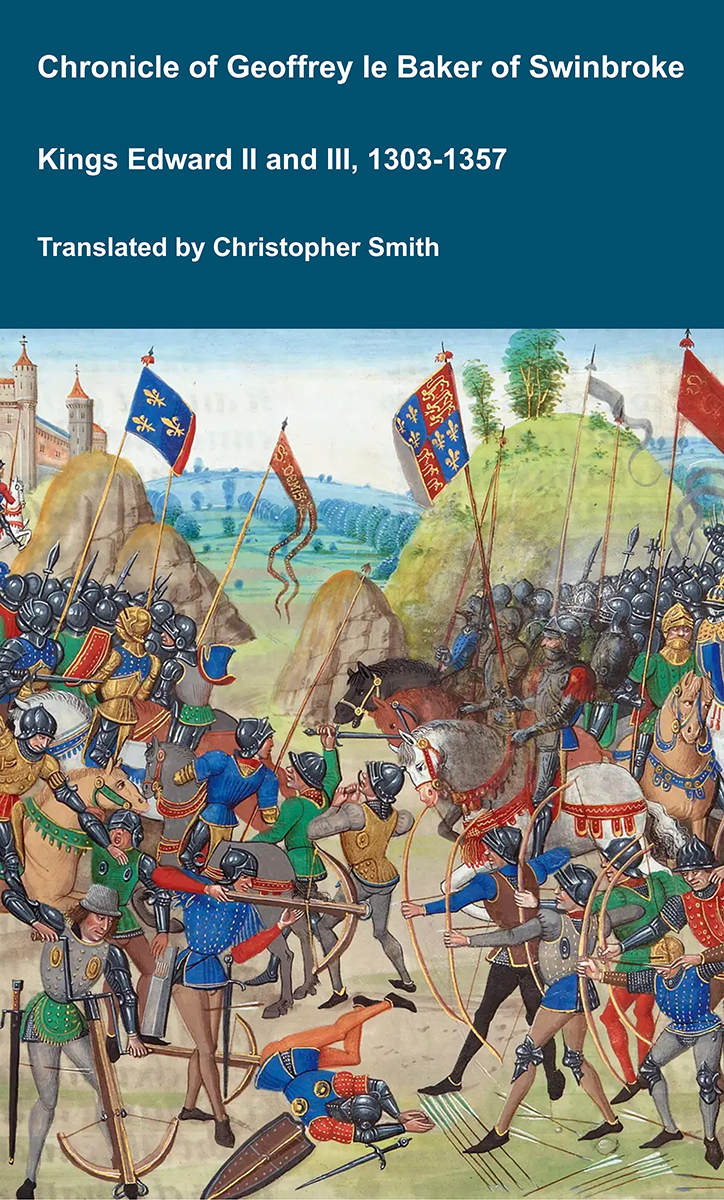
Chronicle of Geoffrey le Baker of Swinbroke
Baker was a secular clerk from Swinbroke, now Swinbrook, an Oxfordshire village two miles east of Burford. His Chronicle describes the events of the period 1303-1356: Gaveston, Bannockburn, Boroughbridge, the murder of King Edward II, the Scottish Wars, Sluys, Crécy, the Black Death, Winchelsea and Poitiers. To quote Herbert Bruce 'it possesses a vigorous and characteristic style, and its value for particular events between 1303 and 1356 has been recognised by its editor and by subsequent writers'. The book provides remarkable detail about the events it describes. Baker's text has been augmented with hundreds of notes, including extracts from other contemporary chronicles, such as the Annales Londonienses, Annales Paulini, Murimuth, Lanercost, Avesbury, Guisborough and Froissart to enrich the reader's understanding. The translation takes as its source the 'Chronicon Galfridi le Baker de Swynebroke' published in 1889, edited by Edward Maunde Thompson.
Available at Amazon in eBook and Paperback format.
Anglo-Saxon Chronicle. 650. This year Egelbert (age 25), from Gaul, after Birinus the Romish bishop, obtained the bishopric of the West-Saxons.
Bede. 673. Eleutherius was the fourth bishop of the West Saxons; for Birinus was the first, Agilbert the second, and Wine the third. When Coinwalch, in whose reign the said Eleutherius was made bishop, died, his under-rulers took upon them the kingdom of the people, and dividing it among themselves, held it ten years; and during their rule he died, and Heddi succeeded him in the bishopric, having been consecrated by Theodore (age 71), in the city of London; during whose prelacy, Cadwalla (age 14), having subdued and removed those rulers, took upon him the government. When he had reigned two years, and whilst the same bishop still governed the church, he quitted his sovereignty for the love of the heavenly kingdom, and, going away to Rome, ended his days there, as shall be said more fully hereafter.