

This is a translation of the 'Memoires of Jacques du Clercq', published in 1823 in two volumes, edited by Frederic, Baron de Reissenberg. In his introduction Reissenberg writes: 'Jacques du Clercq tells us that he was born in 1424, and that he was a licentiate in law and a counsellor to Philip the Good, Duke of Burgundy, in the castellany of Douai, Lille, and Orchies. It appears that he established his residence at Arras. In 1446, he married the daughter of Baldwin de la Lacherie, a gentleman who lived in Lille. We read in the fifth book of his Memoirs that his father, also named Jacques du Clercq, had married a lady of the Le Camelin family, from Compiègne. His ancestors, always attached to the counts of Flanders, had constantly served them, whether in their councils or in their armies.' The Memoires cover a period of nineteen years beginning in in 1448, ending in in 1467. It appears that the author had intended to extend the Memoirs beyond that date; no doubt illness or death prevented him from carrying out this plan. As Reissenberg writes the 'merit of this work lies in the simplicity of its narrative, in its tone of good faith, and in a certain air of frankness which naturally wins the reader’s confidence.' Du Clercq ranges from events of national and international importance, including events of the Wars of the Roses in England, to simple, everyday local events such as marriages, robberies, murders, trials and deaths, including that of his own father in Book 5; one of his last entries.
Available at Amazon in eBook and Paperback format.
In or before 1306 [his father] Jean de Charny and [his mother] Marguerite de Joinville were married.
Around 1306 Geoffrey de Charny was born to [his father] Jean de Charny and [his mother] Marguerite de Joinville.
Bourgeois de Valenciennes. It happened about the first day of July in the year 1348 that a Lombard named Aimery of Pavia, who was on behalf of the King of England castellan of the castle of Calais, went to Lille to Sir Geoffrey de Charny [aged 42], who was staying there, and negotiated with him to deliver Calais on a certain day for the sum of fifteen thousand gold écus. Afterward Aimery returned to Calais. Sir Geoffrey then went to the King of France and reported the agreement, which gave the king great joy. He told Sir Geoffrey to press on with the matter and to go well provided with men and money, "so that you may have the town and castle of Calais, which I so greatly desire." Sir Geoffrey departed and went to Tournai, where he had the payment prepared; then he went to Saint-Omer, where he secretly summoned men-at-arms. But the King of England was well informed of the exact day and hour when the enterprise was to take place. He therefore came to Calais and entered it quietly, well prepared to defend the town against his enemies. Sir Geoffrey de Charny left Saint-Omer and rode through the night until he reached Ruminghem, leading about five thousand men arranged in three divisions; others were at Licques, Fiennes, and Guînes, and all assembled at the appointed time. With Sir Geoffrey were Sir Jean de Landas, Sir Morel de Fiennes, Sir Eustace de Ribemont, Sir Waleran his son, Sir Oudart de Renty, Sir Guy du Bos, Sir Pépin de Werre, Sir Hector of Bailleul, and many others. They lay in ambush in a valley near Calais.
Il avint environ le premier jour de jullet mil CCC et XLVIII, que ung Lombart nommé Aymery de Pavie, qui estoit de par le roy d'Engleterre chastelain du chasteau de Calais, vint à Lille par devers monseigneur Joffroy de Carny, qui y demoroit, et traita et marchanda avoec luy de livrer Calais à certain jour pour la somme de XV mille vies escus d'or, puis s'en râla Aymery à Calais. Et monseigneur Joffroy s'en ala par devers le roy de France, et luy recorda celuy traictiet, dont il eult grant joye, et dist à monseigneur Joffroy de Carny qu'il esploitast la besongne etqu'ily alast sy bien pourveu de gens et de monnoye "que vous rayés la ville et le chastel de Calais, que tant je désire." Et se party monseigneur Joffroy et vint à Tournay où il fist forgier le payement; puis vint à Saint-Omer, où il fist sa semonse de gens d'armes secrètement. De laquelle chose et paction faite, le roy d'Engleterre fut bien informés de point de jour et d'heure que l'emprise se devoit faire; sy vint à Calais et y entra tout quoyement, bien pourveu pour deffendre la ville contre ses ennemis. Et monseigneur Joffroy de Carny se party de Saint-Omer, et avoit tant chevauchiet la nuit devant qu'il estoit venus jusques à Ragnies, et menoit bien Vm hommes ordonnés en III connestablies, car il en y avoit à Licques et à Fiennes et à Guines, et tous au jour nommé se racordèrent-ils et trouvèrent ensarable. Et estoit avoec monseigneur Joffroy de Carny: monseigneur Jehan de Landas, monseigneur Morel de Fiennes, monseigneur Witasse de Ribeumont, monsei gneur Walerant son âls, monseigneur Oudart de Renty, monseigneur Guy du Bos, monseigneur Pépin de Werre et monseigneur Hector de Bailleul et moult d'aultres, et s'embuchèrent en une vallée assés près de Calais.
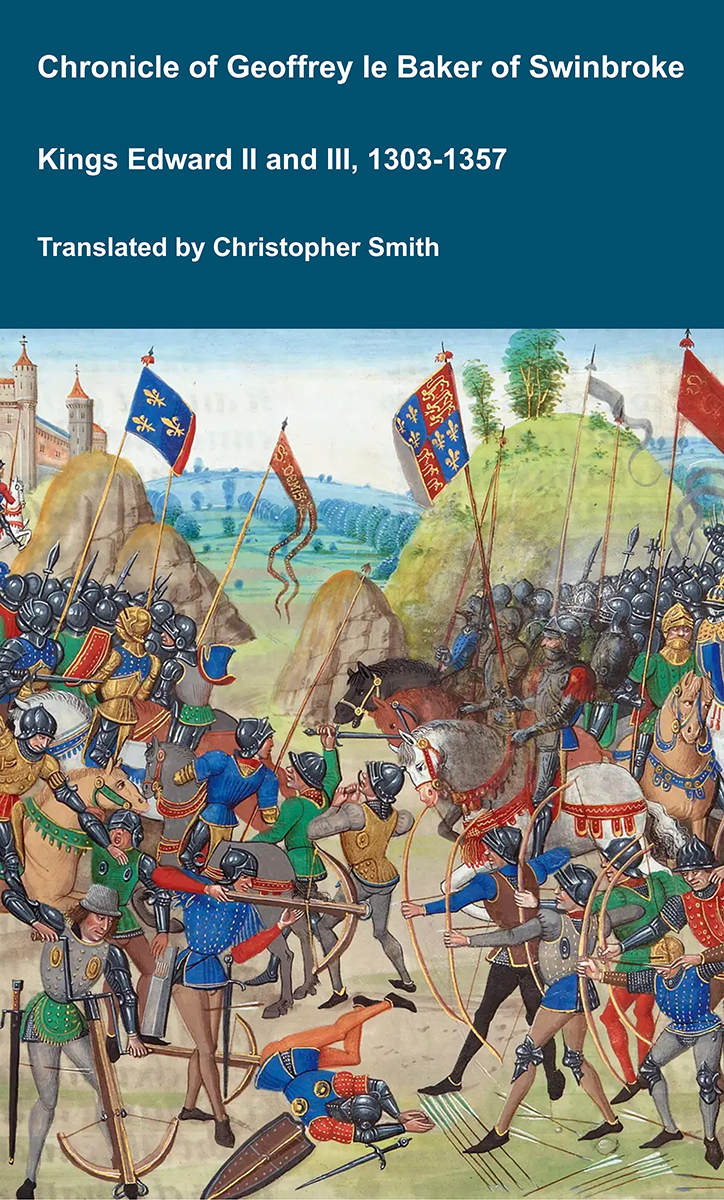 Chronicle of Geoffrey le Baker of Swinbroke. In this year, after the feast of Saint Martin, there assembled at Calais1 the Bishop of Norwich [aged 50], the Earl of Lancaster, the Earl of Suffolk [aged 50], and Lord Walter Mauny [aged 38] on the part of the English; and on the part of the French, the Bishop of Lyon, the Duke of Bourbon, the Duke of Dauphiné, the Count of Guînes, the Lord of Tancarville, and Lord Geoffrey de Charny [aged 42], for the purpose of renewing the truces. But the Earl of Lancaster refused to give his assent until two fortifications at Calais, which were harmful and built contrary to the terms of the previous truces, had been demolished. Once that had been done, the truces were renewed, set to last until the first day of December of the following year.
Isto anno, post festum sancti Martini, convenerunt apud Calesiam episcopus Norwycensis, comes Lancastrie, comes Suthfolchie, et dominus Walterus Magne, ex parte Anglorum; item, episcopus Lugdunensis, dux de Burbone et dux Dactenes et comes de Gynes et dominus de Tankerville et dominus Galfridus de Charny, ex parte Francorum, pro treugis renovandis; quibus noluit comes Lancastrie assentire, quousque duo fortalicia Calesie nociva et contra formam pristinarum treugarum edificata fuerant diruta. Quo facto, renovate sunt treuge, usque ad primum diem Decembris anni proximo futuri durature.
Note 1. The commission to the English envoys is dated 25th September 1348. The French envoys were Hugues, bishop of Laon, Jean de Nesle, sire d'Offemont, Geoffroi de Charny, and the master of the crossbowmen. The prolongation of the truce to the 1st September (not December) of the following year was agreed to on the 13th November. Rymer's Fœdera 3.173, 177. Baker appears to have confused the negotiations of this and the next year.
Chronicle of Geoffrey le Baker of Swinbroke. In this year,1 on the feast of Saint Nicholas [6th December 1352], Pope Clement VI died, and was succeeded by Pope Innocent, also the sixth of that name. This Pope Innocent, out of a deep desire for peace, sent the Cardinal of Bologna to Calais, to hear discussions of a final peace between the kingdoms of England and France. There, councils from both kingdoms gathered with full authority to negotiate and establish terms of the said peace. Eventually, they came to an agreement: that the King of England would renounce all his rights to the Kingdom of France, and would give up the royal title of "King of France". In return, he would hold the Duchy of Aquitaine, along with the Counties of Artois and Guînes, for himself and his successors, as kings of England, without owing fealty or homage to the King of France in any way whatsoever. To these conditions, the pious King Edward, King of England and France, gave his devout and willing assent, for the sake of peace in Christendom. Then, to secure the validity of these agreements, solemn envoys from both kingdoms were sent to the Apostolic See. On behalf of the King of England were the Bishop of Norwich, the Duke of Lancaster, the Earl of Arundel, and several knights. After they arrived in Avignon, they were joined by: the Archbishop of Rouen, the Duke of Bourbon, Geoffrey de Charny [aged 46], and other members of the French council. All the envoys were received with great honour. The Duke of Lancaster, in particular, was met by many cardinals and bishops, who escorted him for two miles to the city and the Pope's palace. At last, in the consistory of the Supreme Pontiff, in the presence of the Pope, the cardinals, and the envoys of both kingdoms, the matters were presented. After hearing them, the English envoys requested that the agreements previously made at Calais, between themselves and the French envoys present, be confirmed. The French replied that while they willingly desired peace, as for Aquitane and the named counties, the King of France, and they themselves, could not and would not consent to their being separated from the integrity of the kingdom, to which they were sworn, and to which those lands rightfully belonged. However, they would agree that useful lordship over those territories could be granted to the King of England, as his ancestors had held Aquitaine, provided that the royal sovereignty of the French crown was preserved. The English, considering that this retained sovereignty had historically caused war, through disputes over homage and fealty, insisted that for a true and lasting peace, the said territories should be granted absolutely and unconditionally to their king, as had previously been agreed at Calais and, according to the Cardinal of Bologna, confirmed by authorized parties. Yet at Avignon, this request was firmly denied. The English responded to the French concern about their oath of loyalty to the integrity of the realm, arguing that the Pope could, if he so chose, absolve them from that oath for the sake of peace, at least regarding the specific articles in question. And that it would be wise to do so. Nevertheless, the Pope did not change or enact anything that would notably advance the peace of the Church or the kingdoms. As a result, the envoys, who had been sent to Avignon at great expense, returned with nothing achieved, except that: The Bishop of Norwich, a man of great wisdom, died and was buried there. He was succeeded by Lord Thomas de Percy, by papal appointment and at the request of the envoys.
Isto anno, in die sancti Nicholai obiit Clemens papa sextus, cui successit Innocencius papa, eciam sextus. Iste papa Innocencius, pro magno pacis desiderio, misit Calesiam cardinalem Bononiensem, auditurum tractatum de pace finali inter regna Anglie et Francie, cui confluxerunt concilia duorum regnorum cum plena autoritate tractandi et constituendi condiciones pacis prefate; et in hoc tandem consenserunt, quod rex Anglie resignaret totum ius suum quod habuit in regnum Francie et dimitteret nomen regium Francorum, et haberet pro tanto ducatum Aquitannie et comitatus Dartoys et de Gynes, pro se et suis successoribus regibus Anglorum, absque hoc quod de rege Francie illa teneret quomodocumque. Istis condicionibus pius Edwardus, rex Anglie et Francie, pium et benevolum prebuit assensum, pro devocione pacis Christianitatis. Tandem pro assecuritacione tantarum convencionum mittuntur ad sedem apostolicam nuncii solempnes utriusque regni. Quippe a latere regis Anglie fungebantur ista legacione episcopus Norwicensis, dux Lancastrie, comes Darundel, et alii milites; quibus profectis Avinionam accesserunt archiepiscopus Rotomagensis, dux Borbonie, Galfridus de Charny et alii de concilio Francorum. Omnes nuncii fuerunt in honoure magno recepti; duci quidem Lancastrie obviaverunt multi cardinales et episcopi, qui a duobus miliaribus ipsum conduxerant ad civitatem et pallacium domini pape. Tandem in consistorio summi pontificis ipso et cardinalibus atque nunciis utriusque presentibus, fuerunt exposite cause nunciorum; quibus auditis, Anglici pecierunt convenciones confirmari, dudum apud Calesiam inter seipsos et nuncios Francie ibidem presentes constitutas Anglicis Gallici responderunt, quod libenter vellent pacem; set de Aquitannia et de prefatis comitatibus, ut dixerunt, non posset rex Francie, set nec ipsi assentirent, quod de integritate regni, ad quam rex et ipsi fuerant iurati, forent, cum omni iure quo predicto regno pertinebant, alienata; bene tamen consentirent quod utile dominium predictorum ducatus et comitatuum regi Anglie devolveretur sicud habuerunt Aquitanniam sui antecessores, ita tamen quod regalitas regie corone Francie reservaretur. Anglici vero, considerantes quod regalitas predicta pro dilacione homagiorum et liganciarum solebat antiquos reges Anglie et Francie ad discrimina guerrarum commovere, pecierunt, pro habenda pace perpetua, quod prefata dominia forent absolute et sine condicione suo regi concessa, ut premittitur. Que peticio, quamvis nuper apud Calesiam, ut testabatur cardinalis Bononiensis, fuerat admissa et per habentes autoritatem confirmata, tamen ibi fuit pertinaciter denegata, Fuit eciam responsum racioni Gallicorum de sui regis et suo iuramento, quo videlicet fuerunt obligati ad conservandam integritatem honouris regni et illi pertinencium, quod scilicet dominus papa, si eii placeret, posset pro bono pacis eos absolvere a predicto iuramento, et hoc quoad certos articulos premissos foret consulte faciendum. Attamen per papam nihil fuit innovatum neque reformatum, quod ad pacem ecclesie et regnorum notabiliter valeret. Propterea nuncii ad graves expensas illuc destinati sine effectu revertebantur, dempto quod episcopo Norwycensi, viro magne sapientie ibidem obeunti et sepulto, successit dominus Thomas de Percy, provisione domini pape et instancia nunciorum.
Note 1. Clement died on the 6th December 1352. Baker at once plunges into the negotiations of 1354. The cardinal of Boulogne was Guidon de Boulogne, archbishop of Lyons, who was made cardinal in 1342, and bishop of Porto in 1350; he died in 1373. A truce was agreed to on the 6th April (Rymer's Fœdera 3.276), to last for a year, and it was arranged that both sides should send ambassadors to negotiate a peace in presence of the pope. The English ambassadors, the bishops of Norwich and London, the duke of Lancaster, the earl of Arundel, and others were appointed on the 28th August (Rymer's Fœdera 3.283). The French ambassadors were Pierre, due de Bourbon, and Pierre de la Foret, archbishop of Rouen.
On 19th September 1356 Geoffrey de Charny [aged 50] died.
Chronicle of Henry Knighton. 19th September 1356. And they divided themselves into three battalions. The Earl of Warwick commanded the first battalion, and on the side of the French, the two Marshals of France commanded the first battalion. The second battalion was commanded by Lord Dauphin of Vienne, with his brother the Duke of Orléans, and it was the strongest. In the third battalion was the King of France, with 2,000 of the most select armed men in all France. Lord Geoffrey de Charny [aged 50] bore the red banner, which was the sign of death. The King of France issued an order that no Englishman was to be spared, except for the Prince himself. The Cardinals, before the battle, climbed up a certain hill nearby to watch the outcome of the battle. Now the first French battalion engaged with the Earl of Warwick, but was quickly subdued by the English archers. Marshal Clermont was killed, along with many others, as will be mentioned below. The Earl of Warwick pursued the fleeing enemies, killing some and capturing others. Meanwhile, the second French battalion arrived and joined battle with the Prince of Wales, fighting very fiercely through a hedge. The English became very weary due to the intensity of the combat, and their weapons were badly damaged. The fighting was so strong and hard that the archers, having run out of arrows, picked up stones, and with swords and lances, and whatever they could grab, they fought on. They defended themselves with clever and courageous hearts, and it is astonishing to tell. But finally, as God willed, the French took to flight. And while the English stood tired, catching their breath and hoping they had won victory over all their enemies, King John of France suddenly arrived with a huge force, leading a battalion against the Prince, who at that moment had only a few men with him, as the others were chasing the fleeing enemies. As the French began to engage the Prince's line, the Earl of Warwick returned from the pursuit with his full force, and attacked the flank of the French king's army, and fought bravely. And thus, by the grace of God and not by human strength, the victory was granted to the Prince, and he emerged victorious from the battle, capturing the King of France and his younger son Philip, the Count of Poitiers, and many other nobles.
Et diviserunt se in tres acies. Comes de Warwych habuit primam aciem et ex parte Francorum duo marescalli Franciæ habuerunt primam aciem. Secundam aciem dominus Dolfynus de Vienna cum fratre suo duce de Orlyons cum majori fortitudine. In tertia acie erat rex Francie cum IJ mille de electioribus armatis totius Franciæ. Dominus Galfridus Charneys bajulavit vexillum rubium quod erat mortis signiferum. Rex Franciæ edidit præceptum ne quis Anglicus vitæ reservaretur solo principe excepto. Cardinales ante prælium ascenderunt in quendam montem prope ut viderent eventum belli. Jam prima acies Franciæ congreditur cum comite Warwych, sed cito per sagittarios subpeditati sunt. Et Marescallus Clermont occisus est et multi alii ut infra dicetur Comes de Warwych insequebatur fugientes et quosdam occidit et quosdam cepit prisonarios. Medio tempore venit secunda acies Francorum et miscuerunt cum principe Walliæ, et pugnaverunt nimis! acriter infra unam sepem, et Anglici devenerunt multum lassi præ gravedine certaminis, et arma eorum nimis laceratn. Et tam fortis et dura extitit pugna quod sagittarii pra defectu sagittarum sustulerunt lapides, et cum gladiis et lanceis, et quicquid possent arripere pugnaverunt, et sic se corde sagaci mirabile dictu defenderunt; sed tandem sicut deus voluit Franci fugam arripuerunt, et dum Anglici starent lassi se refocillantes et sperantes victoriam reportasse de suis inimicis omnibus, supervenit Johannes rex Franciæ cum ingenti fortitudine aciem dirigens versus principem qui paucos ea hora secum habebat, quia laborabant super inimicos fugientes. Dum igitur ccepissent Franci aciem miscere supervenit comes de Warewych rediens de fugatione inimicorum cum integro exercitu suo, et opposuit se a latere exercitus regis Francim et strenue pugnaverunt, et sic per gratiam dei et non humana virtute victoria. cessit principi et prælii reportavit principatum, et rex captus est et filius ejus Philippus, junior, comes de Peyters et magnates plurimi.
There were there first Sir Raoul1, Constable of Eu and Count of France; the Count of Guînes2, his son; the Viscount Aimery of Narbonne; Sir Aymard of Poitiers; Sir Geoffroy de Charny3; Sir Girard de Montfaucon4; Sir Godemart du Fay, governor of the city of Tournai5; the Marshal of the King of France, Sir Robert Bertrand6; the Seneschal of Poitou7; and the Lord of Cayeu8. All these were noble men, counts and banneret knights, and with them was the flower of the squires of France, of Poitou, of Gascony, and of many other lands. They bore themselves most honorably, whatever hardship or shortage they endured within the city, and they very often made fine skirmishes against those of the host when they saw their opportunity.
II y estoit premierement messire Raoul, connestable d'Ew et conte de France, le conte de Ghines son filz, le viconte Aymery de Nerbonne, messire Aymard de Poitiers, messire Jeffroy de Charny, messire Gerard de Montfaucon, messire Godemart du Fay, gouverneur de la cité de Tournay, le mareschal du roy de France, messire Robert Bertran, le senechal de Poytou, le sire de Kayeu. Ceulx estoient tous nobles gens, contes, chevaliers banerès, et avecq ce y estoit la flour des escuiers de France, de Poitou, de Gascongne et de tous aultres païs, qui moult honnourablement se maintindrent, quelque meschief ou deffaulte qu'ilz eussent dedens la cité, et faisoient moult souvent de belles escharmuches sur ceulx de l'ost, quant ilz veoyent leur point.
Note 1. In the manuscript the reading Baons appears by mistake. In the accounts of Barthélemy du Drach (Bibliothèque nationale, ms. fr. nouv. acq. 9238, fol. 140), the following entry concerning Raoul, Count of Eu, is found: "The division of my lord Raoul, Count of Eu, Constable of France, lieutenant of our lord the king on the frontiers of Flanders and Hainaut, both of the men-at-arms who served under his command before the coming of my lord the Duke of Normandy to the said frontiers, and of those who remained of his division after the arrival of the said lord duke before Thun-l’Évêque, and who were enclosed within the city of Tournai while the enemy’s siege lay before the said town, from the ninth day of March 1339 until the first day of October 1340."
1. Dans le manuscrit on a par erreur Baons. Dans les comptes de Barthélemy du Drach (Bibl. nat., ms. fr. nouv. acq. 9238, fol. 140), on relève cette mention relative à Raoul, comte d'Eu: «La bataille de monseigneur Raoul, conte de Eu, connestable de France, lieutenant du roy nostre sire sur les frontieres de Flandres et de Haynaut, tant des gens d'armes qui servirent souz son gouvernement avant la venue monseigneur le duc de Normandie sur lesdictes frontieres, comme de ceulz qui demourerent de sa bataille après la venue dudit monseigneur le duc devant Thun-l'Evesque, et enclos dedens la ville de Tournay, le siege des annemis estant devant ladicte ville, du IXe jour de mars CCCXXXIX jusques au premier jour d'octobre CCCXL.»
Note 2. Raoul, Count of Guînes, son of the Constable and a banneret knight, served in his father’s division with twenty-nine squires during the siege. (Ibid., fol. 140v.)
2. Raoul, comte de Guines, fils du connétable, chevalier banneret, servait dans sa bataille avec vingt-neuf écuyers pendant le siège. (Ibid., fol. 140 ve.)
Note 3. Geoffroi de Charny, a bachelor knight, served in the division of Raoul, Count of Eu, with six squires from 27 April to 1 August, and then during the siege from 1 August to 1 October. They had come from Pierrepont-sous-Vézelay (now Pierre-Perthuis, Yonne, arrondissement of Avallon, canton of Vézelay) to Arras. They returned from Tournai to Pierre-Perthuis and received compensation for twenty-three days. (Ibid., fol. 141r.)
3. Geoffroi de Charny, chevalier bachelier, servit dans la bataille de Raoul, comte d'Eu, avec six écuyers, du 27 avril au 1er août, puis pendant le siège, du 1er août au 1er octobre. Ils étaient venus de Pierrepont-sous-Vézelay (auj. Pierre-Perthuis, Yonne, arr. d'Avallon, cant. de Vézelay) à Arras. Ils retournèrent de Tournai à Pierre-Perthuis et touchèrent une indemnité de vingt-trois jours. (Ibid., fol. 141 ro.)
Note 4. Girard de Montfaucon served under Godemar du Fay. (Ibid., fol. 66.) This folio is missing in the manuscript, and this information is known only from the table of contents.
4. Girard de Montfaucon servit sous Godemar du Fay. (Ibid., fol. 66.) Ce folio manque dans le ms., et on n'a cette indication que par la table.
Note 5. In the same manuscript, the following entries concerning Godemar du Fay are found: "Men-at-arms who served at Lille and at Tournai under the command of my lord Godemart du Fay, knight, lord of Bouthion, governor of Tournaisis, captain general in the said towns and on the frontiers of Flanders and Hainaut, from the 28th day of October 1339 until the first day of October 1340; and there is reckoned to the said men-at-arms, for the time that they were enclosed within the said town of Tournai while the enemy’s siege lay before it, that is to say, from the first day of August until the said first day of October, the wages in Paris currency which they previously received in tournois currency, by order of the king." (Ibid., fol. 54v.) During the siege, Godemar du Fay’s company consisted of five bachelor knights, thirty-seven squires, two gentlemen, and ten foot sergeants. Most of them had come from Savoy and from Franche-Comté. (Ibid., fol. 55v.)
5. Dans le même ms., on trouve ces mentions relatives à Godemar du Fay: «Gens d'armes qui servirent à Lille et à Tournay souz le gouvernement monseigneur Godemart du Fay, chevalier, sire de Bouthion, gouverneur de Tournesis, capitainne general es dictes villes et sur les frontieres de Flandres et de Haïnnaut, du XXVIIIe jour d'octobre CCCXXXIX jusques au premier jour d'octobre CCCXL; et compte l'en ausdictes genz d'armes, tant qu'il furent enclos en la dicte ville de Tournay, le siege des anemis estant devant, c'est assavoir du premier jour d'aoust jusques audit premier jour d'octobre, les gaiges aus parisis qu'il prenoient par devant à tournois, par mandement du roy.» (Ibid., fol. 54 vo.) La compagnie de Godemar du Fay se composait, pendant le siège, de cinq chevaliers bacheliers, trente-sept écuyers, deux gentilshommes et dix sergents de pied. La plupart étaient venus de Savoie et de Franche-Comté. (Ibid., fol. 55 vo.)
Note 6. Here are the entries concerning Robert Bertrand found in the accounts of Barthélemy du Drach: "The division of my lord Mahieu de Trie, lord of Araines, and my lord Robert Bertram, lord of Briquebec, marshals of France, sent to the frontiers of Flanders and Hainaut in the company of my lord the Constable of France, lieutenant of our lord the king on the said frontiers, both of the men-at-arms whom they received under their command for the chevauchée of Vervins and of Marle, and to remain with them on the said frontiers before the coming of my lord the Duke of Normandy, as well as of their division after the arrival of the said lord duke, from the second day of March 1339 until the twenty-seventh day of September and the first day of October following, 1340. And there is reckoned to the said lord Marshal Bertran and to the other men-at-arms who were with him in his company, enclosed in the town of Tournai while the enemy’s siege lay before the said town, their wages in Paris currency, which they received in tournois currency." (Bibliothèque nationale, ms. fr. nouv. acq. 9238, fol. 160r.) The marshal had sixteen squires with him. They received an allowance for eight days for their journey "from the Cotentin region to Paris," and for eleven days for their "return from Tournai to the said region." (Ibid., fol. 161r.)
6. Voici les mentions concernant Robert Bertrand, qui se trouvent dans les comptes de Barthélemy du Drach: «La bataille de monseigneur Mahieu de Trie, sire d'Araines, et monseigneur Robert Bertram, sire de Briquebec, mareschaux de France, envoiez sur les frontières de Flandres et de Haynaut, en la compaignie monseigneur le connestable de France, lieutenant du roy nostre sire seur lesdictes frontieres, tant des gens d'armes qu'il reçurent souz leur gouvernement pour la chevauchiée de Vervin, de Malle (Marle), et pour estre avecques eulz sur lesdictes frontieres avant la venue de monseigneur le duc de Normandie comme de leur bataille après la venue dudit monseigneur le duc, du secont jour de mars CCCXXXIX jusques au XXVIIe jour de septembre et premier jour d'octobre ensuivant CCCXL. Et compte l'en, audit monseigneur le marechal Bertran et aux autres genz d'armes qui furent avec lui en sa compaignie, enclos en la ville de Tournay, le siege des anemis estant devant ladicte ville, leurs gaiges aus parisis qui prennent aus tournois.» (Bibl. nat., ms. fr. nouv. acq. 9238, fol. 160 ro.) Le maréchal avait seize écuyers avec lui. Ils eurent une indemnité de huit jours pour venue «du païs de Costentin à Paris» et de onze jours pour «retour de Tournay audit pays.» (Ibid., fol. 161 ro.)
Note 7. The Seneschal of Poitou at that time was Jourdain de Loubert, a bachelor knight. He was at Tournai, with four squires, in the division of Raoul, Count of Eu. They received an allowance of twelve days for their journey "from the regions of Poitou to Tournai," and an equal allowance for their return from Tournai to the said place. (Bibliothèque nationale, ms. fr. nouv. acq. 9238, fols. 143r and 145r.)
7. Le sénéchal de Poitou était alors Jourdain de Loubert, chevalier bachelier. Il était à Tournai, avec quatre écuyers, dans la bataille de Raoul, comte d'Eu. Ils eurent une indemnité de douze jours pour venir «des parties de Poitou à Tournay», et une indemnité égale pour leur retour de Tournai audit lieu. (Bibl. nat., ms. fr. nouv. acq. 9238, fol. 143 ro et 145 ro.)
Note 8. Jean de Cayeu, a banneret knight, served with twelve squires in the division of Raoul, Count of Eu. They had come from Sénarpont (Somme, arrondissement of Amiens, canton of Oisemont) to Arras, and they returned from Tournai to Sénarpont. They received an allowance of three days both for the outward journey and for the return. (Ibid., fol. 441r.)
8. Jean de Cayeu, chevalier banneret, servit avec douze écuyers dans la bataille de Raoul, comte d'Eu. Ils étaient venus de Sénarpont (Somme, arr. d'Amiens, cant. d'Oisemont) à Arras, et ils retournèrent de Tournai à Sénarpont. Ils eurent une indemnité de trois jours tant à l'aller qu'au retour. Ibid., fol. 441 re.)
Froissart Book 4: 1346-1356. [317] The noble King of England had pity on the Lombard, whom he had greatly loved, for he had raised him from childhood. So he said: 'Aymeri, if you will do what I tell you, I will pardon my anger against you.' Aymeri, much comforted by these words, said: 'My lord, yes. Whatever it may cost me, I will do all that you command.' — 'I wish,' said the king, 'that you pursue your bargain; and I shall be so strong within the town of Calais, on the day appointed, that the French shall not have it, as they believe. And to help you excuse yourself, so God help me, I hold Sir Geoffrey de Charny more to blame than you, for he has schemed this thing during a good truce.'
Li gentilz rois d'Engleterre eut pité dou Lombart, que moult avoit amet, car il l'avoit nouri d'enfance; si dist: "Aymeri, se tu voes faire ce que je te dirai, je te pardonrai mon mautalent." Aymeris, qui grandement se reconforta de ceste parole, dist: "Monsigneur, oil. Je ferai, quoique couster me doie, tout ce que vous me commanderés."—"Je voeil, dist li rois, que tu poursieves ton marchiet; et je serai si fors en le ville de Calais, à le journée, que li François ne l'aront mies, ensi qu'il cuident. Et pour toy aidier à escuser, se Diex me vaille, j'en sçai pieur gré messire Joffroy de Chargni que toy, qui en bonnes triewes a ce pourchaciet."
Chronicle of Geoffrey le Baker of Swinbroke. With both armies drawn up and dawn breaking on Sunday morning, a certain cardinal from Périgord1 came to the prince and solemnly urged him, by the honour of God crucified, by the love of His Virgin Mother, by reverence for ecclesiastical peace, and by the desire to spare the shedding of Christian blood, to delay the battle for a time, so that he might attempt to negotiate a peace. He promised that such peace would be honourable, provided he was allowed to act as mediator. The prince, untouched by any tyrannical impulse, neither feared battle nor rejected peace. He modestly consented to the holy father's request. Thus, throughout that entire day, which was designated for peace talks, the French army increased by a thousand men-at-arms and a vast multitude of commoners. On the following day, Monday, the cardinal returned and, on behalf of the crowned king [of France], requested a truce lasting a full year. This the prince refused. However, at the cardinal's strong insistence, he agreed to a truce lasting until Christmas. The cardinal then returned to the crowned king and asked that he grant the truce matching the prince's offer. Although the marshal of Clermont advised the king to accept, the request was opposed by Marshal d'Audenham, Geoffrey de Charny, and William Douglas the Scot, toward whose counsel the king strongly inclined.
Utriusque dispositis aciebus, aurora Dominice lucis rutilante, venit ad principem quidam cardinalis Petragorisensis, et adiuravit eum per honourem Dei passi crucifixi et amorem Virginis matris eius reverenciamque pacis ecclesiastice atque parcitatem effusionis sanguinis Christiani, quod placeret sibi bellum suspendere per tempus quo posset tractare de pace; quam promisit futuram honourabilem per suam intercessionem, si tamen intercedere permitteretur. Princeps vero, nulla penitus tyrranide tactus, nec bellum timuit nec pacem recusavit, set prefati sancti patris peticioni modeste condescendit. Unde per totam illam diem, reparacioni pacis assignatam, crevit exercitus Francigenum mille viris armorum et popularium ingenti multitudine. In crastino, scilicet die Lune, rediit cardinalis petens ex parte coronati treugam annalem, quam negavit princeps; tamen ad cardinalis magnam instanciam concessit treugas adusque festum Natalis Christi duraturas. Reversus itaque cardinalis poposcit a coronato pacis inducias, iuxta concessionem domini principis concedendas; cuius peticioni, marescallo de Claromonte concessum coronati admonente, obiecerunt se marescallus Dawdenam, Galfridus de Charny et Dowglas Scotus, quibus coronatus veementer animum inclinavit.
Note 1. Talleyrand de Perigord, sometime bishop of Auxerre, became cardinal in 1331; died in 1364. See the account of his indefatigable endeavours to prevent the battle, as given in Jean Le Bel 233.
Chronicle of Geoffrey le Baker of Swinbroke
Baker was a secular clerk from Swinbroke, now Swinbrook, an Oxfordshire village two miles east of Burford. His Chronicle describes the events of the period 1303-1356: Gaveston, Bannockburn, Boroughbridge, the murder of King Edward II, the Scottish Wars, Sluys, Crécy, the Black Death, Winchelsea and Poitiers. To quote Herbert Bruce 'it possesses a vigorous and characteristic style, and its value for particular events between 1303 and 1356 has been recognised by its editor and by subsequent writers'. The book provides remarkable detail about the events it describes. Baker's text has been augmented with hundreds of notes, including extracts from other contemporary chronicles, such as the Annales Londonienses, Annales Paulini, Murimuth, Lanercost, Avesbury, Guisborough and Froissart to enrich the reader's understanding. The translation takes as its source the 'Chronicon Galfridi le Baker de Swynebroke' published in 1889, edited by Edward Maunde Thompson.
Available at Amazon in eBook and Paperback format.
Froissart Book 5: 1356-1360. When it came to Sunday morning, the king of France, who had a great desire to fight the English, had mass sung very solemnly before him in his pavilion, and he communicated, as did his four sons. After mass, the greatest and nearest of his lineage came before him: the Duke of Orléans, his brother; the Duke of Bourbon; Sir James of Bourbon; the Count of Ponthieu; the Duke of Athens, constable of France; the Count of Eu; the Count of Tancarville; the Count of Salebruges; the Count of Dammartin; the Count of Mont Ventadour, and several other great barons of France and of the neighboring lordships, such as Sir Jean de Clermont and Sir Arnoul d'Audrehem, marshal of France; the lord of Saint-Venant; Sir Jean de Landas; Sir Eustace de Ribemont; the lord of Fiennes; Sir Geoffrey de Charny; the lord of Châtillon; the lord of Sully; the lord of Nielle; Sir Robert de Duras; and many others who had been summoned there. There they were in council and parliament for a long time, to decide how they should conduct themselves. And it was then ordained that all the men should go out into the fields, and each lord should unfurl his banner and set it forward, in the name of God and of Saint Denis, and that they should draw themselves up in order of battle, as if to fight at once.
Quant ce vint le dimence au matin, li rois de France, qui grant desir avoit de combatre les Englès, fist en son pavillon chanter messe moult solennelment devant lui, et se acumenia, et si quatre fil. Apriès messe, se traisent devers li li plus grant et li plus proçain de son linage, li dus d'Orliens ses frères, li dus de Bourbon, messires Jakemes de Bourbon, contes de Pontieu, li dus d'Athènes, connestables de France, li contes d'Eu, li contes de Tankarville, li contes de Sallebruce, li contes de Dammartin, li contes de Mont Ventadour, et pluiseur [aultre] grant baron de France et des tenures voisines, telz que messires Jehans de Clermont et messires Ernoulz d'Audrehen, mareschal de France, li sires de Saint Venant, messires Jehans de Landas, messires Eustasses de Ribeumont, li sires de Fiennes, messires Joffrois de Chargni, li sires de Chastillon, li sires de Sulli, li sires de Nielle, messires Robers de Duras et moult d'aultres qui y furent appellet. Là furent en conseil et en parlement un grant temps, à savoir comment il se maintenroient. Si fu adonc ordonné que toutes gens se traissent sus les camps, et cescuns sires desvolepast se banière et mesist avant, ou nom de Dieu et de saint Denis, et que on se mesist en ordenance de bataille, ensi que pour tantost combatre.
Deeds of King Edward III by Robert of Avesbury. Those Slain at the Battle of Poitiers the Duke of Bourbon: Sir Robert de Duras, the Duke of Athens, Constable of France, the Bishop of Châlons, the Marshal of Clermont, the Viscount of Bruse, Sir Guichard de Beaujeu, Sir Renaud de Pons, Sir Geoffrey de Charny, the Lord of Mathas, the Viscount of Rochechouart, the Lord of Baudon, Sir Eustache de Ripemont, Sir André de Charny, Sir Jean de l'Isle, Sir Guillaume de Narbonne, Sir Robert d'Angest, the Lord of Châtel-Villain, the Lord of Montreuil-Hamelin, the Lord of Argenton, Sir Jean de Sancerre, Sir Louis de Brich, the son of the Lord of Montagu And others, in all, 2,000 men-at-arms and over 800 additional men fell.
Le duyk de Burboun. Mounsire Robert Duras. Le duyk de Athenes, le conestable de Fraunce. Le evesqe de Chalouns. Le mareschal Clermound. Le viscounte de Bruse. Mounsire Gichard de Beauge. Mounsire Reynaud de Pountz. Mounsire Geffray Charny, le sire de Mathas. Le viscounte de Richouware. Le seignur de Baundos. Mounsire Eustas de Riplemound. Mounsire Andreu de Charny. Mounsire Johan de Lysle. Mounsire Gilliam de Nerbon. Mounsire Robert de Angest. Le sire de Chastel Vilayn. Le sire de Mountreham. Le sire Dargentyn. Mounsire Johan de Sawcer. Mounsire Lowys de Bryche. Le filtz au seignur de Mountagu. Et aultres. MM hommes darmes et aultres a nombre de DCCC et plusours.
Le Prince Noir. 1409. The following copy of a letter from Sir Bartholomew Burghersh to Sir John Montagu upon the resuit of the action at Poitiers, from a Ms. written but a very few years after the battle, is valuable as throwing great light on those lists already fumished by the Black Prince himself, printed by Sir Harris Nicolas at the end of the Chronicle of London, and Robert d'Avesbury, p. 252-255:
Be it remembered that the Prince departed from Bordeaux the day after St. John's Day in August, in the year of our Lord 1356, and rode through Agenais, Limousin, Auvergne, and Berry, and along the river Loire near Nevers, intending to pass into France through Tours; but all the bridges had been broken, so he was unable to cross. And throughout his march, he found no resistance until he came to a castle called Romorantin, which he surrounded. Before arriving there, he had already captured 120 men-at-arms. Inside that castle were the Lord of Craon, one of the great lords of France, and Sir Jean de Boussac (Bussegault TBC), with fifty men-at-arms. The Prince besieged the castle for eight days, and on the first day took the outer defences, except for a large strong tower, and captured 40 men-at-arms. The Lord of Craon and Bussegault retreated into the tower, but through fire, mines, and siege engines, they eventually surrendered and were made prisoners. Afterward, the Prince stayed four days before the city of Tours, where the Count of Poitiers, son of the King of France, was present with a large force, but none dared to come out. On the following Saturday, the Prince came to a castle called Chauvigny in Poitou, where the King of France had lodged the night before. There, the Count of Auxerre, the Count of Joigny, and the Marshal of Burgundy were captured as they came to join the King's host; 240 men-at-arms were also taken or killed. On the next Monday, the 19th of September, the armies met near Poitiers and formed into battle. There, the following were captured: The King of France, Prince Philip, his younger son, Count of Poitiers, The Count of Pontieu, James de Bourbon, The Counts of Eu, Aumale, Tankerville, Ventadour, Salbrisse, Vendôme (and his brother), Roucy, Vendôme-Maine, Dammartin, and Nesle, the Archbishop of Sens, the Castellan of Compiègne, the Marshal of Oudenham, Guichard d'Angle, Moris Maignet, captain of Poitiers, Lords of La Tour, Erval, Creil (and his brother), Villehermald, Mauges, Amald de Montverain, Jean de Blanc, Aubigny, Sully, the Count of Alençon, the Viscount of Narbonne. And in total, 2,500 persons were taken, of whom 2,000 were men-at-arms. Among those killed in the battle were: the Duke of Bourbon, Robert de Duras, of royal blood, the Duke of Athens, constable of France, the Archbishop of Châlons, the Marshal of Clermont, the Viscounts of Bourges and Richerandus, Reynaud de Pons, Geoffrey de Charny, Geoffrey de Mate. And in total, 2,800 people were killed, including 2,000 men-at-arms. Also, among the aforementioned dead and men-at-arms were one thousand knights, both banner-bearers and pennon-bearers. The King of France had at that battle 8,000 men-at-arms and 3,000 foot soldiers, while the Prince had 3,000 men-at-arms, 2,000 archers, and 1,000 servants. This is the entire text of the letter that Sir Bartholomew Burghersh sent to Sir John Beauchamp, via Sir John de Collandesbergh, a prisoner of the said Bartholomew. The Prince, at the moment of battle, was only accompanied by 60 people, of whom only 4 were men-at-arms.
Fait à remembrer que le Prince se parti de Burdeux lendemayn de SayntJohan en Auguste, Tan de nostre Seignur MCCCLVI chivacha par Agenès, Limosyn, Alvem et Beryu et sur la river de Leyre de Nivers, qu'est rentré de Beryndun parce tanque à la cité de Tours pur passer en Fraunce ; mes touts les pountz furent rumputz issin qu'il ne pooit passer. Et tut le chymyn il ne trova reste avance, tanque il vient à une chastelle appelliz Romorentyne, qu'est envirun, et deveaunt ceo qu'il vient illoges si avoit pris VIxx hommes d'armes, et deyns ledit chastelle furent le seignoures de Crone, un de graunt seignoures de Fraunce, et mons. Bussigaunde oue L hommes d'armes, et monsieur le Prince adsege ledit chastel per VIIJ jours, et li primer jour prit tote le force dudit chastel forspris un grosse tour, et auxi prist XL hommes d'armes, et ledit seignour de Crone et Bussigaunde se mysterent deyns ledit tour, et per force de feu et de myne et d'engyne il se renderent prisoners. Item le Prince demorra devaunt ledit cité de Tours, ou fuist le count de Poyters, filtz à roi de Fraunce, ou la graunt power de gentz par IIIJ joures, et nule de ladit cité n'osast isser. Item le samadi procheyn ensuaunt vient ledit Prince à un chastelle appelliz Chabutorie en Peytowe, là où le roy de Fraunce avoit cuché le nut devaunt, et là furent pris le count de Assure, le counte de Junye et le marshalle de Burgoyne, que veignent al host le roi de Fraunce ; et là furent mortz et pris CCxl hommes d'armes. Item le lundi prochein ensuaunt le XIX jour de Septembre, li assemblerent les bataills d'un part et d'autre decost Poiters à un dileu, et là furent pris le roi de Fraunce ; monsieur Philippe, son fitz puisné, count de Poyters; le count de Pountif ; mons. Jakes de Burbonnie ; le count de Ewe; le count de Aubeville ; le count de Tankerville; le count de Ventadourun; le count de Salbirys; le count de Vendome et son frere ; le count de Russi; le count de Vendemende; le count de Danmartyn ; le count de Nesson ; l'erscevesque de Seyns; le chastelayne de Compost; le marshal de Oudenham ; mons. Guichard de Aratz; mons. Moris Maynet, captayne de Poyters; le seignour de la Toure; le seignour d'Erualle; le seignour de Crew et son frere ; le seignour Vilehernalde ; le seigneur de Maugeler ; mons. Amald de Mounteuerye ; mons. Johan de Blaunk; le seigneur d'Aubeney ; le seigneur de Sully; le count d'Ausor; le viscount de Nerboun ; et outre ceo furent pris IJ mille V C persones, desqueux furent IJ mille hommes d'armes, des mortz. Item à mesme le bataille furent mortz le duke de Burboun, mons. Robert Durasce, del saunc de Fraunce; le duk d'Athenes, conestable de Fraunce; Percevesque de Chalouns ; le marshal de Clermound ; le viscount de Boures ; le viscount de Richohardus ; mons. Raynald de Pount ; mons. Geffray Charny ; mons. Geflrey Matas; et outre ceo furent mortz IJ mille et VIIJ cent persones, desqueux furent IJ mille hommes d'armes. Item des avantditz mortz et serjentz furent mille chivalers, que porters-baners et poynouns. Item le roy de Fraunce avoit à la journé VIIIJ mille hommes d'armes et IIJ mille hommes a pié, et le Prince avoit à ladit journé IIJ mille hommes d'armes, IJ mille archers et mille servaunt. Item c'este tote le copie de la letter que mons. Berthilmew Burwas envoia à mons. Johanne Beaucham, par Sir John de Collandesbergh, prison audite Bertilmew. Item ledit Prince ne paroit a la journé de toet maner de gentz, mes LX persones, desqueus furent IIIJ hommes d'armes.
A Chronicle of London. To the reverend Father in God, the Bishop of Worcester, these are the names of those who were taken at the Battle of Poitiers by the Prince of Wales, son of the noble King of England, Edward III: Royalty and High Clergy John of Valois, King of France Monsieur Philip, his son The Archbishop of Reims.
Counts: Counts Monsieur James of Bourbon, Count of Ponthieu Monsieur John of Artois, Count of Eu Monsieur Charles of Artois, Count of Longueville, Count of Tancarville, Count of Ventadour, Count of Sancerre, Count of Salebruges, Count of Vendôme, Count of Vaudémont, Count of Dammartin, Count John of Nassau, Count of Salerplok, the Castellan of Compiègne.
The Lord of Sully
Viscounts: the Viscount of Narbonne, the Viscount of Rochechouart, the Viscount of Vaudemont, the Viscount of Beaumont.
Bannerets: Sir Arnold Dawdenham, Sir Ralph de Coucy, the Lord of Daubigny, the Lord of Denain, the Lord of Saint-Dizier, the Lord de la Tour, the Lord of Damboise, the Lord of Derval, the Lord of Manhales, the Lord of Planche, the Lord of Montagu, the Lord of Beaufremont, the Lord of Plomory.
Monsieur Guichard d'Angle, Seneschal of Saintonge, Monsieur Maurice Mauvinet, Seneschal of Tours in Touraine, Monsieur Renaud de Guilhon, Seneschal of Poitou, Monsieur Pierre de Créon, Monsieur Guichard d'Arx, Monsieur Walter de Castillon, Monsieur Guichard de Béarn,the Lord of Bassigny
Those who fought in the skirmish before the battle at Remorantin:
Bannerets: The Lord of Acon Sir Buzignault, Sir Guy Turpin Bachelors
Bachelors: Sir Guillaume de Lorac, Sir Folles de Forsela, Sir Jakelin de Ponsay
In addition to the named prisoners above, there were taken in total among the men-at-arms: 1,933.
Rejoice in the Lord always.
The names of those who were killed in the said battle are as follows:
Dukes: the Duke of Bourbon, the Duke of Athens, the Bishop of Châlons
Lords and Knights: Sir Robert de Duras, the Marshal of Clermont, the Viscount of Brienne, Sir Geoffrey de Charny, Sir Renaud de Pons, the Lord of Landas, the Lord of Châtel-Villain, the Lord of Argenton, the Lord of Montguyon, the Lord of Malavaler, Sir John de Sancerre, Sir Louis de Broce, Sir Guillaume de Viel, Sir John de Joigny, Sir Andrew de Chaveny, Sir Eustace de Kirpemont.
And in addition to the above-named, there were killed among the men-at-arms: 2,426.
Again I say: rejoice.
Rev'ent Piere en Dieux Evesqe de Worcester, ces sont les noms de ceaux q' estoient pris a la battaile de Poyters p' le Prince de Gales fitz a noble Roi de Engleterre Edward Tierts. John de Valoys, Roy de France. Mons. Philip son fitz. Arcevesque de Leyens.
Counts: Mons. Jakes de Bourbonn, Counte de Pountois. Mons. John d'Artoys, Counte d'Eu. Mons. Charles de Artoys, Counte de Souggevil. Le Counte de Tankervill. Le Counte de Ventadour. Le Counte de Saussier. Le Counte de Salesberg. Le Counte de Vendome. Le Counte de Wademont. Le Counte de Dammartyn. Le Counte de John de Nasso. Le Counte de Salerplok. Le Chatelaine de Composta.
Le S. de Sully.
Viscountes: Le Visconte de Narbone. Le Visconte de Vychichoart. Le Visconte de Walemont. Le Visconte de Beaumont.
Bannerets: Mess. Arnold Doudinham. Mess. Rauf de Coussy. Le S. de Danbeney. Le S. de Denyn. Le S. de Saint Dyser. Le S. de la Tour. Le S. Damboisa. Le S. de Derval. Le S. de Manhales. Le S. de Planuche. Le S. de Montagu. Le S. de Beaufremont. Le S. de Plamory. Mons. Giscard D'Angle Seneschal de Sentonge. Mons. Moris Mauvinct Sen. de Tours en Toreyne. Mons. Renaud de Guilhon Sen. de Peyton. Mons. Pierres de Creon. Mons. Giscard de Arx. Mons. Gauter de Castellion. Mons. Giscard de Beanyon. Le S. de Basentin.
Ceaux furent ceaux dessoutz p's devant la battaile a Remoartin.
Bannerets: Le S. de Acon. Mons. Busignaut. Mons. Guy Turpin.
Bachelers: Mons. Guilliaume de Lorak. Mons. Folles de Forsela. Mons. Jakelyn de Ponsey.
Et sont pris outre les noms dessus escptz des gentz darmes. M. IXe XXXIII
Gaudete in Domino semper.
Les nomes de ceaux q'furent mortz a la dite battaile sont ceux.
Ducs: Le Due de Bourbon. Le Due Datermes. Le Evesque de Chalons.
Mons. Rob de Duras. Le Marischal de Clermont. Le Visconte de Vrons. Mons. Geffrei de Charsey. Mons. Renaud de Pointz. Le S. de Landas. Le S. de Chastel Vileyn. Le S. de Argenton. Le S. de Mountgay. Le S.de Malevrer. Mons. John de Sausar. Mons. Lewis de Broyse. Mons. Guilliem de Viele. Mons. John de Jole. Mons. Andrew de Chaveny. Mons. Eustas de Kirpemont.
Et outre le noms surnometz sont mortz des gentz d'armes M.M. ccccxxvi. Iterum dico gaudete.
Chronicle of Geoffrey le Baker of Swinbroke. On the day following the battle, the prisoners were counted:1 the one called by his own people the King of the French; likewise, Lord Philip, his son; also the Archbishop of Sens; the Count of Ponthieu; the Count of Eu; the Count of Longueville; the Count of Tancarville; the Count of Auxerre; the Count of Ventadour; the Count of Sancerre; the Count of Vaudémont; the Count of Vendôme; the Count of Joinville; the Count of Dammartin; the Count of Salabruges; the Count of La Marche; the Viscount of Narbonne; Lord Daubigny; Marshal d'Audenham; Lord Guinchard of Angle; the Seneschal of Saintonge; Lord Maurice Mawmynet; Lord Reginald de Gouilloy; the Seneschal of Poitou; the Grand Preceptor or Master of the Hospital in Spain; Lord de Saint-Tiger; Lord d'Aubois; the Seneschal of Auvergne; Lord de la Tour; Lord d'Arz; Lord d'Urval; Lord de la Ville Ernal de Maungeler; Lord de Planques; the Viscount of Beaumont; and Lord de Sully. Also discovered were the bodies of the slain:2 the Duke of Bourbon, the Duke of Athens, the Constable of France, the Marshal of Clermont, Lord Geoffrey de Charny, Lord de Pons, the Bishop of Châlons, Lord de Landas, Lord de Rippemont, Lord de Chaveny, Lord de Joigny, Lord de Néel, Lord d'Aunger, Lord of Mont-Jean, Lord Dargenton, Lord de Broce, Lord de Râs, Lord de Rochechouart, and Lord de Vilain. All the captives were purchased by the prince from those who had taken them, and he brought them to Bordeaux to be held in secure custody.
Proxima die post prelium, connumerati sunt captivi: coronatus, qui vocatur a suis rex Francorum; item, dominus Philippus, filius eius; item, archiepiscopus Senonensis, comes Pontivie, comes Du, comes de Longeville, comes de Tankelville, comes Daunterre, comes de Vendadowr, comes de Sauncerre, comes de Wademont, comes de Vendomsne, comes de Juyny, comes Donmartyn, comes de Salabruse, comes de Sasso, vicecomes Nerbone, dominus Daubyni, marescallus Dawdenam, dominus Guynchard de Angle, senescallus de Centonge, dominus Mauricius Mawmynet, dominus Reginaldus de Guoylhoy, senescallus Pictavie, magnus preceptor sive magister hospitalis Ispanie, dominus de Saint Tyger, dominus Damboyde, senescallus de Auvare, dominus de la Tour, dominus Dars, dominus Durval, dominus de la Ville Ernal de Maungeler, dominus de Plaunke, vicecomes de Bello monte, et dominus de Sully. Corpora quoque reperta fuerunt occisorum, ducis de Burbone, ducis Datenes, constabularii Francie, marescalli de Claro monte, domini Godefridi de Charny, domini de Pouns, episcopi Chalonensis, domini de Laundas, domini de Rippemont, domini de Chaveny, domini de Ioole, domini de Neel, domini de Aunger, domini de Mount Iohan, domini Dargentone, domini de Broose, domini de Raas, domini de Rochechicheward, et domini de Vilem. Omnes captivos a suis magistris princeps emit, et adduxit Burdegalim, custodie secure deputandos.
Note 1. A list of the French killed and prisoners was enclosed in the letter announcing the victory from the prince of Wales to the bishop of Worcester, printed by Sir N. H. Nicolas, Chronicle of London (1827), p. 207.
Another is given by Avesbury 469.
And another is found in the letter of Bartholomew, lord Burghersh, printed by Coxe, The Black Prince, p. 369.
Bouchet, Annales d'Acquitaine, also prints a list of the slain who were buried in churches at Poitiers, reprinted by Buchon in his edition of Froissart 1.355. "The prisoners here named, besides the king and his youngest son Philippe le Hardi, are: Guillaume de Melun, archbishop of Sens; Jacques de Bourbon, comte de la Marche et de Ponthieu; Jean d'Artois, comte d'Eu; Charles d'Artois, comte de Longueville; Jean de Melun, comte de Tancarville; Jean de Chalon, comte d'Auxerre; Bernard, comte de Ventadour; Jean, comte de Sancerre; Henri, sire de Joinville, comte de Vaudemont; Jean, comte de Vendome; Jean de Noyers, comte de Joigny; Charles de Trie, comte de Dammartin; John, count of Saarbruck; John, count of Nassau; Aimeri Manrique de Lara vicomte de Narbonne; Louis d'Aubigny; marshal Arnoul d'Audrehem; Guichard d' Angle, seneschal of Saintogne; Maurice Mauvinet, seneschal of Touraine; Renaud de Guilhon, seneschal of Poitou; Juan Fernandez de Heredia, castellan of Amposta (here called the grand preceptor or master of the Hospitallers in Spain); Geoffroi de Saint-Dizier; Ingerger, sire d'Amboise, seneschal of Auvergne; Bertrand, sire de la Tour; Guichard, sire d'Arx; Bonabès de Rougé, sire de Derval; sire de Ville-Arnoul; Jean de Maignelais; Jean de Plaunche, or Blaunche; Louis de Brienne, vicomte de Beaumont; and Louis, sire de Sully.
The list sent to the bishop of Worcester adds 1933 "men-at-arms"; Avesbury, "more than 2,000 men-at-arms"; and Burghersh, "2,500 persons, of whom 2,000 were men-at-arms."
Note 2. The names of the killed, as here given, are: Pierre, due de Bourbon; Gauthier de Brienne, due d'Athenes, constable; Jean de Clermont, marshal; Geoffroi de Charny, bearer of the oriflamme; Renaud de Pons; Renaud Chauveau, bishop of Chalons-sur-Marne; Jean de Mortagne, sire de Landas; Eustache de Ribemont; Andrd de Chauvigny; Jean de L'Isle; Guillaume de Nesle; Jean de Sancerre; the sire de Montjouan; the sire d'Argenton; Louis de Chauvigny, vicomte de Brosse; Robert de Duras; Jean, vicomte de Rochechouart; Jean de Thil-en-Auxois, sire de Chateau-Vilain.
In addition, the list sent to the bishop of Worcester declares that 2426 'men-at-arms' were slain; Avesbury; and Burghersh.
Chronicle of Geoffrey le Baker of Swinbroke. Also, for the unviolated preservation of these truces, special judges shall be appointed, through whom or through the kings it shall be ensured that, if anything contrary to these truces is attempted by anyone, the truces shall be restored to their proper state; nor shall the truces be considered broken because of any such contrary act, with the articles concerning Scotland remaining in full force. Also, the judges appointed for the restoration of any violation of these truces, should one occur, shall strive to resolve it in locations most suitable for that purpose and chosen with the agreement of both parties. Furthermore, in matters concerning the enforcement of these truces, the appointed judges shall be: the Constable and Marshal of England, the Earl of Lancaster, and Lord Bartholomew de Burghersh, on the part of the King of England; and the Constable and Marshal of France, the Count of Étampes, and Lord Geoffrey de Charny, on the part of the King of France. Moreover, it is ordained that these truces shall be publicly proclaimed in Gascony and Brittany within twenty days, and in Scotland within thirty days, from the date of their confirmation, and shall be valid only until the feast of Saint Barnabas the Apostle next following.
Item, ad intemeratam custodiam istarum treugarum sint iudices specialiter deputati, per quos vel per reges sit precautum quod, si aliquod contrarium istis treugis per aliquem fuerit attemptatum, ad statum debitum treuge sint reformate, nee propter aliquid eiis contrarium factum sint fracte ipse, articulis tamen Scociam tangentibus suo robore permansuris. Item, iudices assignati ad reformacionem violacionis istarum treugarum, si alicam fieri contingat, ipsam in locis ad hoc maxime oportunis et ex assensu parcium electis studeant resarcire. Ceterum in causis istarum treugarum firmitatem concernentibus sint iudices constituti constabularius et marescallus Anglie et comes Lancastrie et dominus Bartholomeus de Bourghasch, ex parte regis Anglie; item, constabularius et marescallus Francie et comes Dactoens et dominus Galfridus de Charny, ex parte regis Francie. Insuper est ordinatum quod treuge iste sint pupplice proclamate in Vasconia et Britannia infra diem vicesimum, et in Scocia infra diem tricesimum, a die confirmacionis earumdem treugarum, ipsis usque ad festum sancti Barnabe Apostoli proximum sequens dumtaxat valituris.
Chronicle of Geoffrey le Baker of Swinbroke. Not long after these events, some scouts reported that the crowned king had advanced his camp toward ours, and they advised the lord prince to choose a site for battle and to organize his army so that the enemy might not find them unprepared while themselves already drawn up in order. Immediately,1 the prince and all those with him, resolved to fight on foot, entrusted their chargers and horses to the care of grooms, to be retrieved only if pursuing the enemy. However, a few among the army remained mounted, ready to engage in combat according to the customs of knightly tournaments. The first division of the prince's army was commanded by the Earls of Warwick and Oxford; the second was under the prince himself; and the third was led by the Earls of Salisbury and Suffolk. In total,2 the prince's army comprised exactly 4,000 men-at-arms, 1,000 servants, and 2,000 archers.
Nec multum post hec asserentes alii discopertores coronatum promovisse castra versus nostros consuluerunt dominum principem locum certaminis eligere et exercitum ordinare, ne inordinatos hostes ordinati reperirent. Statim princeps et omnes alii secum, pedites consteturi, dextrarios et equos tutele garcionum commiserunt, ad hostium venacionem resumendos. Pauci tamen inter exercitus equitarunt, parati secundum morem hastiludiis guerrariis. Prima cohors exercitus nostri comitibus Warewici et Oxonie comittebatur; secunde princeps imperabat; et tercia comitibus Saresburie et Suthfolchie committebatur. In toto exercitu domini principis fuerant precise quatuor milia togatorum, mille servientes, et duo milia sagittariorum.
Note 1. Before reviewing the details of Baker's account of the battle, Stow Annales, 408.
Baker's account of the battle of Poitiers is very valuable. His details are unusually clear. They were evidently supplied by one who had taken part in the action, and they compare very favourably with the somewhat perplexed narrative of Froissart the chief authority upon which all descriptions of the battle have been based. Following the story in our chronicle, one can draw a plan of the battle so well that, on comparing it with the actual surveys of the ground, one is quite satisfied that we have here no mere fanciful picture of what happened. It is seldom that one meets with so precise a description of a battle in the chronicles of the middle ages. The English army was divided into three battles: 1. the vanguard under Warwick and Oxford, 2. the main-guard under the prince, and 3. the rear-guard under Salisbury and Suffolk. The first and third (carelessly called the second) battles were drawn up on ground, which was separated from the open space occupied by the French by a long hedge and ditch. The position was a plateau which sloped down on the right into a valley, the bottom marshy and watered by a stream; the hedge following the slope and running down into the marsh. On this slope Warwick with the first division was posted; higher up, on his left rear, stood the third division, drawn up on level ground and within reach of a gap in the upper part of the hedge. This gap was an opening to allow the passage of carts, and, no doubt, was approached by a road of some sort. It had an important bearing on the fortunes of the day, and its existence has apparently been the main cause why the battle has been so often described as a mere struggle in a deep lane. The prince's division was led across the marshy valley on the right and took possession of a hill on the right front, partly covered with vines and brambles which concealed the movement from the enemy. The horsemen, with the exception of a small body reserved for skirmishing, were dismounted; and archers of the first and third battles were posted in the marshy ground in front of the first division, and along the hedge.
Before proceeding to examine the French attack, let us see how far this statement of the English position agrees with that found in the pages of Froissart. The report brought back to the French king by Eustache de Ribemont, who had been sent out with others to reconnoitre, is put into these words [Froissart 379].
For the moment it may be noted that, reading this passage by the light of another version, as given in the Amiens MS., it would seem that the italicized words voie and haie have been accidentally transposed. The Amiens version is as follows Froissart 379, Note 1.
Although the two versions differ in certain expressions, the second being manifestly the better written, the general meaning cannot be mistaken. Froissart plainly says that the English position could only be approached by a road which was flanked on either side by the archers who lined the hedge. But, although at the beginning of his first version he uses the words "fortified with hedges and bushes," and although, in describing the charge of the French cavalry, he says that they "entered into the lane where the thick and dense hedge was on both sides," he nowhere mentions two distinct hedges bordering the two sides of the road; in other words, he did not mean an ordinary road running between hedges. On the contrary, he distinctly speaks of one single hedge: "alongside a hedge," "that hedge," etc., in agreement with Baker's single "ditched hedges," which covered the English front. This being so, we may reconcile the varying statements of the two chroniclers by assuming that at the gap spoken of by Baker a road entered the field from the country beyond, and that at this point the hedge trended back and so flanked the road on either side for some little distance into the field.
If in Froissart's account we really have the actual words or substance of Ribemont's report, it seems that the French reconnoitring party must have taken their chief view of the English forces through the gap; and that the particulars given of the disposition of the dismounted men-at-arms and archers apply chiefly to Salisbury's division in the rear. The report says that at the crown or end of the road, that is, facing the gap, the men-at-arms were placed, with a double rank of archers in their front, disposed in open formation like the points of a harrow Froissart 379 The occupation of the hill on the right is noticed, and the left flank is said to have been protected with trenches and waggons. Such entrenchments, Froissart tells us in another place, were made during the fruitless negotiations on the Sunday [Froissart 382, Froissart 383].
With regard, however, to the body of horsemen and archers held ready to attack the flank of the duke of Normandy's division, the manoeuvre being almost the same as that described by Baker as executed against king John's division by the captal de Buch, it would seem that Froissart may be describing, though incorrectly, the latter attack; at the same time there may have been, though not probably, two distinct movements.
The French army attacked in three main battles on foot, led by an advanced guard, or rather a forlorn hope of three hundred picked horsemen, chosen, by Ribemont's advice, to ride down the English archers and thus clear the way for the overwhelming weight of the three solid 'battles.' The first of these was commanded by the dauphin Charles, duke of Normandy; the second by Philip, duke of Orleans, the king's brother; and the third by the king in person. The cavalry in advance was led, on the left, by the marshal Arnoul d'Audrehem, and, on the right, by the marshal Jean de Clermont, and was supported by a contingent of German horsemen.
To resume Baker's narrative: The movement of the prince of Wales's division to occupy the hill on the right front led the French to think that the English were retreating. Accordingly, the French cavalry advanced to the attack and some jousting took place between their left and the English knights who rode out in front of Warwick's division. Awaiting the result of this skirmish d'Audrehem kept his men in hand; Clermont on the right made straight for the gap in the hedge with the intention of taking Warwick in rear, but was met by Salisbury's "battle," which was moved forward, the English rear-guard thus coming first into action. Here the English archers ("positioned securely on the mound above the ditch and beyond the hedge") were terribly effective; but those of Warwick's (first) division, posted in the marsh, though out of reach of the enemy, could do little against the armour-clad horsemen, until moved by Oxford into a position (probably on the slope of the hill on the right) whence their arrows could hit the horses' hind-quarters. Thus the French cavalry were repulsed, and driven back upon their own advancing infantry, Clermont being slain and Audrehem a prisoner. Pursuit was restrained, and the English front consolidated by the union of the first and second battles. From this statement we must understand that the prince's division [or the main part of it] was brought down from the hill which it had occupieda and joined to that of Warwick; but four hundred men were held in reserve. Then followed the onset of the second French line, or the first infantry division, under the dauphin, which, after a struggle, was repulsed,b the English again being held well in hand. We hear nothing from Baker of Orleans' division, which, as we learn from Froissart retreated from the field without striking a blow, leaving only king John's "battle" to be accounted for. This division, the largest, now advanced to the attack, and it is said that some of the English began to lose courage at the sight, one of the faint-hearted bringing down upon himself a sharp rebuke from the prince. Then was executed a flank movement by a small body (the numbers here given being apparently too low) of mounted men and archers under the captal de Buch, who was despatched round the hill on the right to fall upon the French rear. This was the moment chosen by the prince for the advance of the English line. His banner was carried forward; and, leading out his reserve, he charged down upon the enemy. The French, thus taken in front and reverse, were broken up; and the battle was won.
Froissart's account differs from this in many points. According to him, the duke of Normandy's division, after being shaken by the recoil of the French cavalry, was attacked in flank by the force posted on the hill on the English right, and was then driven from the field by the prince of Wales's advance; while king John's division marched forward and engaged the first and third 'battles' under Warwick and Suffolk.
Knighton's account of the battle is of little or no value; but he mentions the exhaustion of the English after the repulse of the Dauphin's attack, and also gives a list of the French killed and prisoners: And they divided themselves into three battalions. The Earl of Warwick commanded the first battalion, and on the side of the French, the two Marshals of France commanded the first battalion. The second battalion was commanded by Lord Dauphin of Vienne, with his brother the Duke of Orléans, and it was the strongest. In the third battalion was the King of France, with 2,000 of the most select armed men in all France. Lord Geoffrey de Charny bore the red banner, which was the sign of death. The King of France issued an order that no Englishman was to be spared, except for the Prince himself. The Cardinals, before the battle, climbed up a certain hill nearby to watch the outcome of the battle. Now the first French battalion engaged with the Earl of Warwick, but was quickly subdued by the English archers. Marshal Clermont was killed, along with many others, as will be mentioned below. The Earl of Warwick pursued the fleeing enemies, killing some and capturing others. Meanwhile, the second French battalion arrived and joined battle with the Prince of Wales, fighting very fiercely through a hedge. The English became very weary due to the intensity of the combat, and their weapons were badly damaged. The fighting was so strong and hard that the archers, having run out of arrows, picked up stones, and with swords and lances, and whatever they could grab, they fought on. They defended themselves with clever and courageous hearts, and it is astonishing to tell. But finally, as God willed, the French took to flight. And while the English stood tired, catching their breath and hoping they had won victory over all their enemies, King John of France suddenly arrived with a huge force, leading a battalion against the Prince, who at that moment had only a few men with him, as the others were chasing the fleeing enemies. As the French began to engage the Prince's line, the Earl of Warwick returned from the pursuit with his full force, and attacked the flank of the French king's army, and fought bravely. And thus, by the grace of God and not by human strength, the victory was granted to the Prince, and he emerged victorious from the battle, capturing the King of France and his younger son Philip, the Count of Poitiers, and many other nobles.
The description to be found in the historical poem, "The Black Prince," by Chandos Heraldc.
Here it appears at first sight that the prince was in retreat when the battle began, his rear-guard being first attacked, and his vanguard being already "beyond the river". But, read by the light of Baker's chronicle and the manoeuvres therein so exactly described, the lines of Chandos take a different meaning; and we see that he is only narrating, but not so clearly, the movements whereby Salisbury's division in the rear was brought into action at the gap and the prince of Wales first occupied and then withdrew from the hill across the valley. That the prince drew up his forces with a view either to retreat or fight, he himself announces in his letter to the city of London, Nicolas, Chronicle of London, 206.
The battle of Poitiers was fought in the morning - Froissart 395on "plains of Maupertuis." The spot has been exactly identified. The ancient Maupertuis is now a farm called La Cardinerie, lying on the road between Poitiers and Nouaille, and about two kilometres from this village. The Miausson, a small winding stream flowing into the river Clain which passes by Poitiers, forms, near its source, the southern boundary of the field of battle. A long narrow valley passing from north-east to south-west and debouching on the stream, separates the position of La Cardinerie from a highland or ridge to which tradition has given the name of 'Champ de Bataille.' It was on this ridge that the battle was fought. Recent plans represent the line of the action to run north-west and south-east, the French advancing direct from Poitiers; but, unless the identification of the ground is altogether at fault, Baker's account goes to prove that the direct attack on the English position was made from the north. In support of this view it will be seen that La Chaboterie, the place at which the English came in contact with the French rear-guard on the Saturday before the battle, lies north of La Cardinerie; and again, Froissart tells us that the duke of Normandy retreated on Chauvigny, which he would have had some difficulty in doing, had he advanced direct from Poitiers. The French army being on the Poitiers-Chauvigny road, it would naturally march from that road as its base. Following Baker, then, we may venture to assume that Warwick's division was drawn up facing north, or nearly so, on the western slope of the valley just referred to; and that Salisbury stood on his left rear; their left being protected, as Froissart describes, by entrenchments, traces of which have been discovered. As regards the condition of the valley at the period of the battle, it is not too much to adopt Baker's description of it as marshy; and, although there is now no trace of a stream in it, the 'torrens' of which our chronicle speaks may have been some tiny brook, perhaps not much wider than a ditch, yet sufficiently troublesome for the passage of baggage-waggons. At all events it is quite clear that Baker cannot be speaking of the Miausson, the only stream now laid down near the field. Across the valley is the hill, lying behind La Cardinerie, which the prince's division occupied at the opening of the battle, and round which the captal de Buch led his men. That the prince of Wales, before taking possession of this hill, thought that it was already held by the enemy, and that, when he had taken up position there, he was 'attacking the enemies more vigorously,' is further proof that the French were approaching from the north.
Note a. That this was so, appears from the words
subsequently used below.
Note b. The Frenchmen's '
non fugam set pulcram retraccionem,' p. 149, 1.18, is exactly the modern 'strategic movement to the rear.'.
Note c. Edited, with a translation and notes, by the Rev. H. O. Coxe, for the Roxburghe Club, in 1842. The work was again published by M. Francisque Michel in 1883, with a title in French and English, thus: Le Prince Noir, pome dtt Heraut Chandos, texte critique suivi de notes par Franrisque Michel, correspondant de F Institut de France, etc., etc. The Life and Feats of Arms of Edward the Black Prince, by Chandos Herald. A metrical chronicle with an English translation and notes by Francisque Michel, F.A.S. Load., Scot., and Normandy, etc., etc. It is worth while to quote the title in full, for it would hardly be believed that the introduction, notes, and the bulk of the translation (even misprints included), are bodily, or almost bodily, taken by M. Michel from Mr. Coxe's edition. M. Michel makes the most of presenting a more correct French text. But when he goes on to state that 'in the English rendering I have striven to be literal and to employ the corresponding English word, when possible, as an equivalent,' and even apologizes for want of 'elegance of expression,' one is scarcely prepared to find that the translation is absolutely Mr. Coxe's rendering with a few alterations.
Note 2. Baker's number of 7000, which he says is exact, may be accepted. The Bourgeois de Valenciennes, 290. Froissart 383 and again [Froissart 388]. In all these calculations the light armed men, the bidowers, brigands, and others, do not seem to be included.
Roxburghe Club 1842. The following copy of a letter from Sir Bartholomew Burghersh to Sir John Montagu upon the result of the action at Poitiers, from a MS. written but a very few years after the battle, is valuable as throwing great light on those lists already furnished by the Black Prince himself, printed by Sir Harris Nicolas at the end of the Chronicle of London, and Robert of Avesbury:
It is to be remembered that the Prince departed from Bordeaux the day after the feast of Saint John (i.e., June 25), in the year of our Lord 1356. He passed through Agenais, Limousin, Auvergne, and Berry, and came to the Loire River near Nevers, which marks the entrance to Berrichon [territory], with the aim of crossing into France. But most of the bridges were broken, so he could not cross. And throughout the whole route he found no resistance in advance, until he came to a castle called Romorantin, which lies in Berry. Before arriving there, he had already taken six score (120) men-at-arms. Inside that castle were the Lord of Craon—one of the great lords of France—and Monsieur de Boucicaut, with fifty men-at-arms. The Prince laid siege to the castle for eight days, and on the first day took the entire lower part of the fortress except for one large tower. He also captured forty men-at-arms, and the Lord of Craon and Boucicaut took refuge inside the tower. By means of fire, mining, and siege engines, they were compelled to surrender as prisoners. Later, the Prince came before the city of Tours, where was found the Count of Poitiers, son of the King of France, along with a great force of men. The Prince remained there for four days, and no one from the city dared to come out. On the following Saturday, the Prince arrived at a castle called Chauvigny in Poitou, where the King of France had slept the night before. There were taken the Count of Auxerre, the Count of Joinville, and the Marshal of Burgundy, who had come to join the French host. At that place, 240 men-at-arms were killed or captured. On the following Monday, the 19th of September, the two armies assembled near Poitiers, about a league apart. In that battle were taken: the King of France, Monsieur Philip, his younger son, Count of Poitiers, the Count of Pontieux, Monsieur James de Bourbon, the Count of Eu, the Count of Aubervilliers, the Count of Tankerville, the Count of Ventadour, the Count of Sancerre, the Count of Vendôme and his brother, the Count of Roucy, the Count of Vendremes, the Count of Donmartin, the Count of Nevers, the Archbishop of Sens, the Châtelain of Compiègne, the Marshal of Audenham, Monsieur Guichard d'Angle, Monsieur Maurice Maugnet, captain of Poitiers, the Lord of la Tour, the Lord of Derval, the Lord of Creux and his brother, the Lord of Villehernault, the Lord of Maungeler, Monsieur Arnaud de Montverain, Monsieur Jean de Blanque, the Lord of Daubeney, the Lord of Sully, the Count of Dainseur, the Viscount of Narbonne. In total, 2,500 people were taken prisoner, among whom 2,000 were men-at-arms. Of the Dead: at that same battle, the following were slain: the Duke of Bourbon, Monsieur Robert de Duras, of the royal blood of France, the Duke of Athens, Constable of France, the Archbishop of Châlons, the Marshal of Clermont, the Viscount of Bourges, the Viscount of Rochechouart, Monsieur Renaud de Pons, Monsieur Geoffrey de Charny, Monsieur Geoffrey de Mathas. And besides them, 2,800 men were killed, among whom 2,000 were men-at-arms. Also among the dead and the living were 1,000 knights who bore banners and pennons. Army Numbers: The King of France had with him that day 8,000 men-at-arms and 3,000 foot soldiers. The Prince of Wales had that day 3,000 men-at-arms, 2,000 archers, and 1,000 servants.
This is the full copy of the letter that Monsieur Bartholomew Burghersh sent to Monsieur John Beauchamp, by Sir John de Colunsbergh, prisoner of the said Bartholomew.
At the battle, the Prince was not accompanied by a full army but by only sixty men, of whom forty were men-at-arms.
Fait a remembre qe le Prince se parti de Burdeux lendemayn de saynt Johan en Auguste, lan de nostre Seignur MCCCLVI, chiuacha par Agenes Limosyn, Aluern et Beryn et sur la riuer de Leyre de Niuers qest lentre de Beryndun, parce tanqe a la cite de Tours pur passer en Fraunce, mestouts les pountz furent rumputs issuit qil ne poit passer. Et tut le chymyn il ne troua reste auance, tanqe il vient a vne chastelle appellis Reuerentyne, qest en Birun, et deuaunt ceo qil vient illoqes si auoit pris VI.XX. hommes darmes, et deyns le dit chastelle furent le seignoures de Crone, vn de graunt seignoures de Fraunce, et mons. Bussigande oue L. hommes darmes; et monsieur le Prince ad sege le dit chastel per VIIJ jours et li primer jour prit tote le force du dit chastel fors pris vn grose tour et auxi prist XL hommes darmes, et le dit seignour de Crone et Bussigande se mysterent deyns le dit tour et per force de feu et demyne et dengyne il se renderent prisoners. Item le Prince demorra deuaunt le dit cite de Tours ou fuist le count de Poyters, filt; a roi de Fraunce, ou lagraunt power de gents par IIIJ joures et nule de la dit cite nosast isser. Item le samadi procheyn ensuaunt vient le dit Prince a vn chastelle appellis Chabutorie en Peytowe, la ou le roy de Fraunce auoit cuche le nut deuaunt, et la furent priste count de Assure lecounte de Junye e le marschalle de Burgoyne, qe veignent al host le roi du Fraunce e la furent morts et pris CCXL hommes darmes. Item le lundi prochein ensuaunt le XIX jour de Septembre li assemblerent les baitalls dun part e dautre de cost Poiters a un di leu, e la furent pris le roi de Fraunce; monsieur Philippe son fitz puisne count de Payters; le count de Pountif; mons. Jakes de Burbonnie; le count de Ewe; le count de Aubeville; le count de Tankerville; le count de Ventadourun; le count de Salbirys; le count de Vendoue et son frer; le count de Russi; le count de Vendemende; le count de lan martyn; le count de Nesson; lersceuesqe de Seynes; le chastelayne de Compost; le marschal de Oudenham; mons. Quichard de Arats; mons. Morir Maynet captayne de Poyters; le seignour de la Toure; le seignour Derualle; le seignour de Crew, e son frer; le seign. Vilehernalde; le seign. de Maugeler; mons. Arnald de Mounteuerye; mons. Johan de Blaunk; le seign. Daubeney; le seign. de Sully; le count Dansor; le viscount de Nerboun; et outre ceo furent pris IJ mille VC persones des queux furent IJ mille hommes darmes. Des morts. Item a mesme le bataille furent morts le duke de Burboun, mons. Robert Durasce, del Saunt de France; le duk Dathenes, conestable de Fraunce; Lercevesqe de Chalouns; le marschal de Clermound; le viscount de Boures; le viscount de Richohardus; mons. Raynald de Pount; mons. Geffray Charny; mons. Geffrey Matas; et outre ceo furent mort; IJ mille et VIIJ cent persones, des queux furent IJ milles hommes darmes. Item des auant dit; morts et viuetz fuerent mille chiualers qe porters baners et poynouns. Item le roy de Fraunce auoit ala journe VIIJ mille hommes darmes et IIJ milles hommes a pie, et le Prince auoit a la dit journe IIJ mille hommes darmes IJ milles archers et mille seruaunce. Item ceste tote le copie de la letter qe mons. Berthilmew Burwas enuoia a mons. Johanne Beauchamp, par sir John de Collandesbergh prison a dite Bertilmew. Item le dit Prince ne paroit a la journe de toet maner de gents mes LX persones des queus furent IIJJ hommes darmes.
Bourgeois de Valenciennes. Aimery of Pavia had revealed the whole plot to King Edward. At the appointed hour, Sir Geoffrey de Charny and Sir Oudart de Renty entered the castle of Calais and brought and delivered the agreed sum to Aimery. As soon as he had received it, the gates of the castle were shut behind them, and men who were prepared seized them. A horn was sounded in the castle, and at its signal the English sallied out and attacked the French vigorously, who suspected nothing and were greatly astonished when they saw the King of England and his men charging upon them. Nevertheless, they quickly formed their ranks and battle order, for they were numerous and bold knights. A very cruel battle began and lasted a long time. In it Sir Pépin de Werre, a knight of great renown, was slain, as were Sir de Créqui, Sir du Bos, and many other young knights. Sir Jean de Landas, Sir Morel de Fiennes, and many others escaped. Sir Eustace de Ribemont was captured after defending himself so valiantly that all the English marveled at him; he won the prize and the chaplet as the best defender of that day. His son Sir Waleran was also taken, having been severely wounded in the capture. After this, the King of England departed and left Sir Beauchamp as chief captain of Calais, for the truce between the King of France and the King of England was soon to expire.
Et avoit Aymery, ce Lombart, capitaine du chasteau de Calais, tout conté le fait au roy Édouart, et à l'heure ditte des II pactionneurs, monseigneur Joffroy de Carny et monseigneur Oudart de Renty entrèrent au chastel de Calais et appor tèrent et donnèrent l'argent et somme dessus ditte à Aymery le Lombart. Et tantost qu'il le eust rechupt, on cloy et ferma-on la porte du chastel après eulx, et estoit la gens apparilliés qui les prinrent. Et adont on sonna ung cornet au chastel, et au son du cornet yssoient les Englecqs, et coururent sus vigoreusement aux Franchois, qui de riens ne se doubtoient et furent moult esbahis quant ils virent le roy d'Engleterre et ses gens eulx courir sus. Nonpour quant ils misrent conroy en eulx et ordonnances de batailles, car ils estoient grande quantité de gens et de hardis chevaliers, et là commencha la bataille très-crueuse, et longuement dura. Et en celle bataille y fut tués monseigneur Pépin de Werre, ung chevalier de grant renom, et monseigneur de Crëquy et monseigneur du Bos et moult d'aultres bacelers. Et de celle bataille eschappèrent monseigneur Jehan de Landas et monseigneur Morel de Fiennes et grant plenté d'aultres. Et y fut prins monseigneur Ustasse de Ribeumont en bon contenant et en luy deffen daut sy souffisamment que tous les Englecqs s'en esmervilloient; sy eult le pris et le chappelet au mieuls deffendant celle journée. Et sy fut prins avoecques luy monseigneur Galerant, son fils, qui moult durement fut navrés au pren dre. Et ce fait, le roy d'Engleterre s'en râla et laissa pour souverain capitaine de Calais monseigneur de Beauchamp; car les trêves dévoient assez prochainement fallir entre le roy de France et le roy d'Engleterre.
Chronicle of Geoffrey le Baker of Swinbroke. This stronghold had previously blocked the English from advancing inland, and provided great protection to the country from the raiders of Calais. Therefore, desiring to recover that place or to build another of equal value for the defence of the neighbouring region, the French council sent Geoffrey de Charny,1 recently ransomed from English captivity, with authority to carry out the following actions. Along the road from Guînes to Calais, there was a place on the left that was strong yet devout, having a church in which consecrated virgins served God, and it was called La Bassée. It lay so close to the castle of Guînes that Englishmen standing outside their gate could shoot arrows into it. This monastery could easily be made defensible, for it had walls raised like a castle, and a high and spacious tower that served as a bell tower. Furthermore, it stood on marshland, and with little labour could be surrounded by a watery moat. Though the place was suspect for military use, the devotion to Jesus Christ had always restrained the English, who never harmed it, until the aforementioned Geoffrey, in violation of the truce, besieged Guînes with a strong armed force, expelled the nuns from the church, and attempted to turn the church and its surrounding wall into a fortress with a moat, around Pentecost of that year, when the waters allowed labour to proceed in the marsh. Thus, the garrison in Guînes, now besieged from the front, could barely escape through the water-filled ditches in boats, or through the impassable and swampy marsh, and the men of Calais were unable to send them food in any way due to the blockade and the occupation of La Bassée. The besieged garrison often came out and fought with those stationed at La Bassée, but they only managed to kill a few, sometimes with arrows, other times with other weapons. At last, on an agreed-upon day, the men of Calais joined forces with those from Oye and Marke, and on the other side, the garrison from Guînes came out to meet them. They killed many, put many more to flight, and finally burned all of La Bassée. With its walls torn down, everything was levelled to the ground.
Istud fortalicium solebat Anglicis opturare viam in patriam superiorem, prebens patrie magnam securitatem a forariis Calesie. Volens igitur concilium Francorum locum illum rehabere, aut aliud eiusdem utilitatis edificare pro tuicione patrie vicine, miserunt Galfridum de Charny, nuper redemptum de carcere Anglorum, cum autoritate faciendi que sequuntur. Itinerantibus de Gynes ad Calesiam erat quidam locus a sinistris fortis set devotus, habens ecclesiam in qua virgines consecrate servierunt Deo, et vocabatur Labascie; et ita castro de Gynes fuerat vicinus quod stantes Anglici extra portam sue municionis poterant illuc sagittare. Istud monasterium faciliter poterat fieri defensibile, habuit enim ad instar castri muros erectos et turrim arduam et amplam pro campanili; sedens insuper in marisco, modico labore poterat aquatica fossa concludi. Loco sancto quantumcumque suspecto tamen ob devocionem Iesu Christi omnes Anglici et semper pepercerunt, usque quo Galfridus prenominatus, in violacionem treugarum, cum potenti manu armata Gynes obsessit et moniales ab ecclesia dimovit, castrum de ecclesia et muro barbam ac toti fossam nisus fabricare; et hoc circa Pentecosten illius anni, quo tempore aquis non impedientibus poterant sui in marisco laborare. Itaque anterius obsessi castellani de Gynes vix poterant egredi per fossas aque plenas in cimbis aut per mariscum invium et aquosum, nec Calesienses poterant ipsos quomodocumque egenos victualiare propter obsidionem et custodiam de Labbastie. Pluries exierunt obsessi et dimicabant cum illis de Labbastie, set nimis paucos aliquando sagittis et nonnunquam aliis armis occiderunt. Tandem die constituto convenerunt Calesienses cum illis de Oye et de Merke, ex una parte, occurrentibus castellanis ex adverso, et occiderunt multos, pluresque fugarunt, atque finaliter incenderunt totam Labbastie, et, muris dirutis, omnia solo coequarunt.
Note 1. Probably about August 1351, the French king having aided him in paying his ransom on the 31st July. Froissart ed. Lettenhove, 20.543: "Geoffroi de Charny was part of the garrison at Tournai from 28th April to 30th September 1340. He was taken prisoner before Calais. On 31st July 1351, the king granted him 1,000 gold écus to help him pay his ransom. He was appointed bearer of the Oriflamme (the sacred royal battle standard) on 25th June 1355. He died at the Battle of Poitiers. His remains were transferred from Poitiers to Paris in 1370, and solemnly buried, along with those of Marshal d'Audrehem, in the Church of the Celestines. He was married to Jeanne de Vergy."
The Deeds of the Dukes of Normandy
The Gesta Normannorum Ducum [The Deeds of the Dukes of Normandy] is a landmark medieval chronicle tracing the rise and fall of the Norman dynasty from its early roots through the pivotal events surrounding the Norman Conquest of England. Originally penned in Latin by the monk William of Jumièges shortly before 1060 and later expanded at the behest of William the Conqueror, the work chronicles the deeds, politics, battles, and leadership of the Norman dukes, especially William’s own claim to the English throne. The narrative combines earlier historical sources with firsthand information and oral testimony to present an authoritative account of Normandy’s transformation from a Viking settlement into one of medieval Europe’s most powerful realms. William’s history emphasizes the legitimacy, military prowess, and governance of the Norman line, framing their expansion, including the conquest of England, as both divinely sanctioned and noble in purpose. Later chroniclers such as Orderic Vitalis and Robert of Torigni continued the history, extending the coverage into the 12th century, providing broader context on ducal rule and its impact. Today this classic work remains a foundational source for understanding Norman identity, medieval statesmanship, and the historical forces that reshaped England and Western Europe between 800AD and 1100AD.
Available at Amazon in eBook and Paperback format.
. Afterwards, in the year 1348, it happened that Sir Geoffrey de Charny, a valiant and worthy knight, so pressed upon the Lombard named Aymery, whom King Edward so greatly trusted that he had made him castellan and keeper of Calais, that he bargained with him to deliver the castle by night for the sum of twenty thousand écus. Then it came about that King Edward learned of this agreement — I know not how — and so he summoned the said Lombard, and by persuasion or otherwise caused him to confess the truth. When the king had heard the beginning and the end of the matter, he reflected and said to the Lombard: 'If you are willing to do what I shall tell you, and will pledge yourself to me, I will pardon you everything and will keep you ever after in my counsel.' The Lombard replied that he would very gladly do so. Then the king said: 'This is what you shall do. I will that you take the florins, and that you fulfil your promises; but once you have received your payment, tell him that he must be well provided with a great force of men-at-arms and with plenty of money, for you will seem to hold well to your word, and I shall manage the rest. But do not show to any man in the world that I know anything of it.'"
Aprez, avint l'an mil CCC XLVIII que messire Jeffroy de Charny, vaillant et prœu chevalier, pourchassa tant envers ce Lombard nommé Aymery, de cui le roy Edowart tant se foit qu'il l'avoit fait chastellain et garde de Calais, qu'il luy convenança de luy livrer le chastel par nuit parmi la somme de XX escus. Aprez, avint que le roy Edowart sceut ces convenances, je ne sçay comment ce fut; si manda ledit Lombart et fit Lant par amours ou aultrement que ledit Lombart luy congnut la verité. Quant le roy eust ouy fin et commencement de la besongne, il s'avisa et dit au Lombard : "Se tu vouloyes faire ce que je te diray et m'en vouloyes asseurer, je te pardonneroye tout et te tendroye à tousjours de mon conseil." Le Lombard luy dit que moult voulentiers le feroit : "Doncques dit le roy, je te diray que tu feras. Je vueil que tu gaagnes les florins, tu parferas tes promesses, mais que tu ayes ton payement et luy feras sçavoir qu'il soit appareillié de grande foison de gens d'armes et garny d'argent, car tu luy tendras trés bien ta promesse et tu me lairas chevir du remanant. Mais ne fay nul semblant à homme du monde que je en sache riens."
Kings Wessex: Great x 12 Grand Son of King Edward "Elder" of the Anglo Saxons
Kings Franks: Great x 15 Grand Son of Charles "Charlemagne aka Great" King of the Franks King Lombardy Holy Roman Emperor
Kings France: Great x 10 Grand Son of Hugh I King of the Franks
Kings Duke Aquitaine: Great x 14 Grand Son of Ranulf I Duke Aquitaine
Father: Jean de Charny
Great x 2 Grandfather: Geoffrey IV de Joinville
Great x 1 Grandfather: Simon de Joinville
Great x 4 Grandfather: Thibaut Dampierre 
Great x 3 Grandfather: Guy Dampierre
Great x 4 Grandmother: Isabel Montlhéry
Great x 2 Grandmother: Héluis aka Helvide Dampierre
Great x 4 Grandfather: Andre Baudémont
Great x 3 Grandmother: Helvide Baudémont
GrandFather: Jean de Joinville
Great x 4 Grandfather: William Ivrea III Count Mâcon 
Great x 3 Grandfather: Stephen Ivrea II Count Auxonne
Great x 2 Grandfather: Stephen III Count of Auxonne
Great x 4 Grandfather: Matthias Metz I Duke Lorraine
Great x 3 Grandmother: Judith Metz Countess Auxonne
Great x 4 Grandmother: Bertha aka Judith Hohenstaufen Duchess Lorraine 
Great x 1 Grandmother: Bearice of Auxonne
Mother: Marguerite de Joinville