

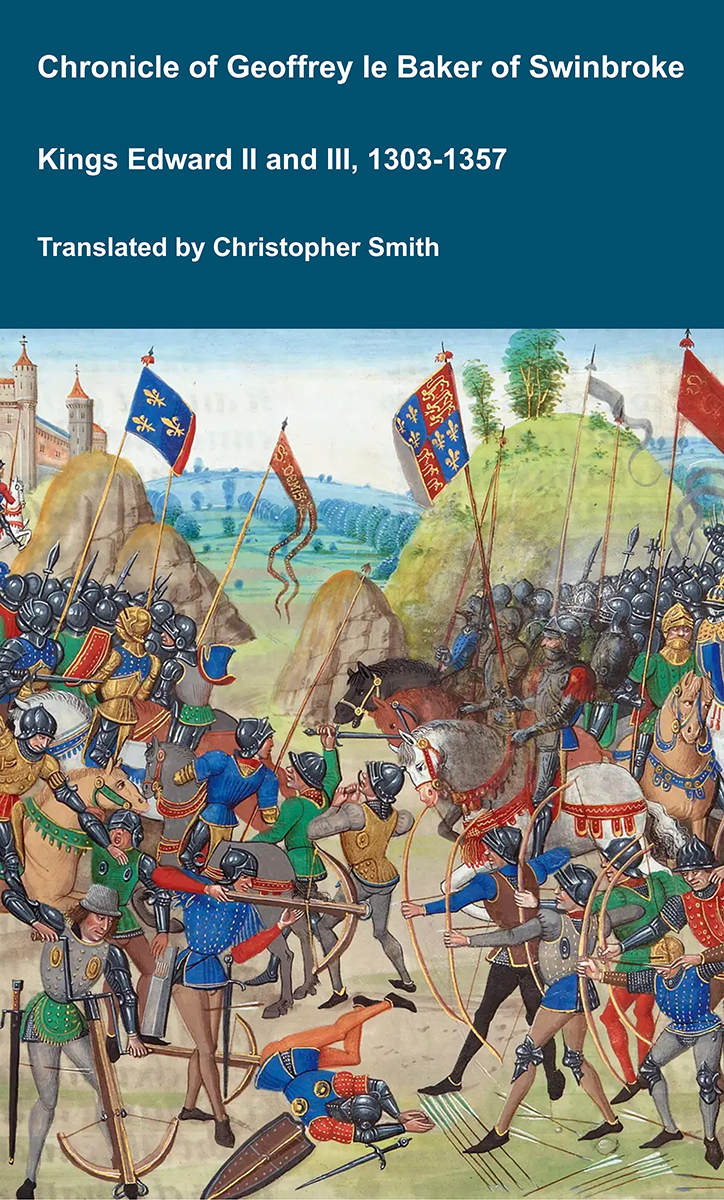
Chronicle of Geoffrey le Baker of Swinbroke
Baker was a secular clerk from Swinbroke, now Swinbrook, an Oxfordshire village two miles east of Burford. His Chronicle describes the events of the period 1303-1356: Gaveston, Bannockburn, Boroughbridge, the murder of King Edward II, the Scottish Wars, Sluys, Crécy, the Black Death, Winchelsea and Poitiers. To quote Herbert Bruce 'it possesses a vigorous and characteristic style, and its value for particular events between 1303 and 1356 has been recognised by its editor and by subsequent writers'. The book provides remarkable detail about the events it describes. Baker's text has been augmented with hundreds of notes, including extracts from other contemporary chronicles, such as the Annales Londonienses, Annales Paulini, Murimuth, Lanercost, Avesbury, Guisborough and Froissart to enrich the reader's understanding. The translation takes as its source the 'Chronicon Galfridi le Baker de Swynebroke' published in 1889, edited by Edward Maunde Thompson.
Available at Amazon in eBook and Paperback format.
In 1279 [her father] Robert II Duke Burgundy and [her mother] Agnes Capet Duchess Burgundy were married. She by marriage Duchess Burgundy. She the daughter of [her grandfather] King Louis IX of France and [her grandmother] Margaret Provence Queen Consort France. He the son of Hugh IV Duke Burgundy and Yolande Capet Duchess Burgundy.
In 1290 Margaret of Burgundy Queen Consort France was born to [her father] Robert II Duke Burgundy and [her mother] Agnes Capet Duchess Burgundy.
On 21st September 1305 Louis X King France I Navarre and Margaret of Burgundy Queen Consort France were married. She the daughter of Robert II Duke Burgundy and Agnes Capet Duchess Burgundy. He the son of King Philip IV of France and Joan Blois I Queen Navarre.
On 21st March 1306 [her father] Robert II Duke Burgundy died. [her brother] Hugh V Duke Burgundy succeeded V Duke Burgundy.
In 1307 [her brother-in-law] Charles IV King France I King Navarre and Blanche of Burgundy Queen Consort France were married. She by marriage Queen Consort of France. She the daughter of Otto Ivrea IV Count Burgundy and Mahaut Artois Countess Burgundy. He the son of [her father-in-law] King Philip IV of France and Joan Blois I Queen Navarre.
On 28th January 1308 King Edward II of England and [her sister-in-law] Isabella of France Queen Consort England were married at Boulogne sur Mer. She the daughter of [her father-in-law] King Philip IV of France and Joan Blois I Queen Navarre. He the son of King Edward I of England and Eleanor of Castile Queen Consort England.
On 25th February 1308 King Edward II of England was crowned II King of England at Westminster Abbey by Henry Woodlock, Bishop of Winchester. [her sister-in-law] Isabella of France Queen Consort England was crowned Queen Consort England.
Piers Gaveston 1st Earl Cornwall carried the Royal Crown.
William Marshal 1st Baron Marshal carried the Gilt Spurs.
Humphrey Bohun 4th Earl Hereford 3rd Earl Essex carried the Royal Sceptre.
Edmund Fitzalan 2nd or 9th Earl of Arundel was Chief Butler, a heriditary office.
Henry Plantagenet 3rd Earl of Leicester 3rd Earl Lancaster carried the Royal Rod.
Thomas Plantagenet 2nd Earl of Leicester, 2nd Earl Lancaster, Earl of Salisbury and Lincoln carried the sword Curtana.
Roger Mortimer 1st Earl March carried the table bearing the Royal Robes.
Thomas Grey and Robert Fitzwalter 1st Baron Fitzwalter attended.
 Become a Member via our Buy Me a Coffee page to read more.
On 28th January 1312 Joan Capet II Queen Navarre was born to Louis X King France I Navarre and Margaret of Burgundy Queen Consort France. There was some doubt over her paternity since her mother had been embroiled in the Aunay Brothers Affair in which one of the brothers admitted under torture to having been Margaret's lover. Her father, however, stated she was his legitimate daughter on his deathbed. She married 18th June 1318 Philip "Noble" III King Navarre, son of Louis I Count Évreux and Margaret Artois Countess Évreux, and had issue.
Murimuth and Avesbury. In the year of our Lord 1314, while the apostolic see was vacant, the year always being reckoned from the feast of Saint Michael [29th September], and in the eighth year of the reign of the same Edward of Caernarfon, around the feast of Saint Nicholas King Philip of France, called the Fair, diedENDNOTE 1. He was succeeded by his son Louis, who had previously been king of Navarre. He was guided by the counsel of his uncle Charles. By that counsel, soon after Easter, Enguerrand de Marigny, who had been the principal counsellor of Philip, father of the said King Louis, was hanged. Also the queen of Navarre, the wife of the said Lord Louis and daughter of the count of Burgundy, was suffocatedENDNOTE 2 on account of adultery alleged against her with Lord Philip d'Aunay. That same Louis, later in that same year, took in marriage the daughter of the king of Hungary, named Clemence, both in name and, as was said, in reality.
Anno Domini millesimo CCCXIIII, apostolica sede vacante, semper in festo sancti Michaelis incipiendo, et ipsius regis Edwardi de Carnervans VIIJ, circa festum sancti Nicholai, fuit mortuus rex Franciæ, Philippus, dictus le Bel, et successit sibi Lodowycus filius suus, qui fuit prius rex Navvarræ; qui ducebatur consilio Karoli avunculi sui. Cujus consilio cito post Pascha suspensus fuit Ingeramus de Maremy, qui fuit principalis consiliarius Philippi, patris ipsius regis Lodowyci. ltem regina Navvarræ, uxor ipsius domini Lodowyci et, filia comitis Burgundiæ, propter adulterium sibi impositum cura domino Philippo Daune, fuit suffocata. Qui quidem Lodowycus, eodem anno, postmodum duxit in uxorem filiam regis Hungariæ, Clemenciam nomine et re, ut dicebatur.
Note 1. King Philip IV of France died on 29th November 1314.
Note 2. The Tour de Nesle Affair in the three daughters-in-law of King Philip IV, Margaret and sisters Blanche and Joan were accused of adultery. Chronicle of William Nangis: "Margaret, the young queen of Navarre, and Blanche, wife of Charles, the king of Navarre's younger brother, for the adultery most shamefully committed and frequently practiced by them with the knight brothers Philip and Walter of Aunay, the former [Margaret] with Philip, the latter [Blanche] with Walter, as their crimes demanded, were repudiated by their own husbands, deprived, not undeservedly, of all temporal honour, and committed to prisons, so that there under strict guard, deprived of all human comfort, they might pass their lives unhappily and end them miserably. The aforesaid two knights, who were not only wicked adulterers but also most vile violators of their lords' marriages, though those lords had placed especial trust in them as highly intimate members of their household, and they were reckoned among their garments and family in full confidence, and who were the worst of traitors; and who were much more culpable in the deed, since they had enticed those young women, still of tender age and of the weaker sex, by their seductions and flatteries. At Pontoise, on the Friday after Quasimodo Sunday, confessed that they had carried on this crime for nearly three years, in many places and sometimes even at sacred seasons. And for the commission of so great a crime, paying the penalty and manner of an ignominious death, in the common square of the Martroi, in the sight of all, they were flayed alive; their virile members together with their genitals were cut off; and, their heads struck off, they were dragged to the common gallows. Completely stripped of skin, they were hanged by the shoulder blades and joints of their arms. Afterwards, near them, a certain doorkeeper, as one who seemed rightly to have been an accomplice and privy to the aforesaid crime, and many others as well, both noble and ignoble, of either sex, who appeared to have consented to or known of the said offense, were subjected to torture; some were drowned in swift waters; many perished by secret deaths; yet several, found innocent, escaped entirely. Among these especially was a certain Dominican friar, called the Bishop of Saint George, who was said to have been a collaborator and accomplice in the aforesaid crime, whether by sorceries that incited people to illicit acts. Some said he was detained in prison at Paris among the Dominican friars; others that, since the apostolic see was then vacant, he had been sent to the cardinals and left to their judgment. Moreover, although Joan, sister of the said Blanche and wife of Philip, Count of Poitiers, was at first strongly regarded as suspect in the matter and was for some time separated from her husband and kept under guard in the castle of Dourdan, nevertheless, after an inquiry made on this account, she was cleared of the said suspicion and judged blameless and entirely innocent in the Parliament at Paris, in the presence of the Count of Valois, the Count of Évreux, and many other nobles. And thus, before a year had passed, she deserved to be reconciled to her husband, the count."
On 29th November 1314 [her father-in-law] King Philip IV of France died. [her husband] Louis X King France I Navarre succeeded X King France: Capet. Margaret of Burgundy Queen Consort France by marriage Queen Consort of France although she was in prison for adultery at the time and died four months later.
In 1315 [her brother] Hugh V Duke Burgundy died.
In 1315 Margaret of Burgundy Queen Consort France died whilst in prison five months after having become de fact Queen of France.
In 1315 [her brother] Odo IV Duke Burgundy succeeded IV Duke Burgundy.
On 5th June 1316 [her former husband] Louis X King France I Navarre died. On 15th November 1316 John "The Posthumous" I King France succeeded posthumously I King France: Capet.
On 19th May 1322 [her former brother-in-law] Charles IV King France I King Navarre and Blanche of Burgundy Queen Consort France marriage annulled as a consequence of her adultery. In 1313 [her former sister-in-law] Isabella of France Queen Consort England gave gifts of coin-purses to her sisters-in-law Blanche of Burgundy Queen Consort France and Margaret of Burgundy Queen Consort France. The coin-purses were subsequently seen by Isabella to be in the possession of the Norman knights Gautier and Philippe d'Aunay. When Isabella visited her father [her former father-in-law] King Philip IV of France again in 1314 she informed him she suspected the two sisters to be having affairs with the two knights. The two knights were arrested, confessed to adultery under torture, and were executed. The two women were sentenced to life imprisonment at Château Gaillard. Margaret's husband Louis X King France I Navarre became King in Nov 1314 whilst she was in prison; she became Queen of France by marriage. Somewhat conveniently she died five months later. Blanche of Burgundy Queen Consort France remained in prison until her husband Charles IV King France I King Navarre became King in 1322 at which time he had their marriage annulled.
Louis X King France I Navarre and Clementia Hungary Queen Consort France were married. She by marriage Queen Consort of France. She the daughter of Charles Martel King Hungary and Clementia Habsburg. He the son of King Philip IV of France and Joan Blois I Queen Navarre.