Chronicle of Walter of Guisborough
A canon regular of the Augustinian Guisborough Priory, Yorkshire, formerly known as The Chronicle of Walter of Hemingburgh, describes the period from 1066 to 1346. Before 1274 the Chronicle is based on other works. Thereafter, the Chronicle is original, and a remarkable source for the events of the time. This book provides a translation of the Chronicle from that date. The Latin source for our translation is the 1849 work edited by Hans Claude Hamilton. Hamilton, in his preface, says: 'In the present work we behold perhaps one of the finest samples of our early chronicles, both as regards the value of the events recorded, and the correctness with which they are detailed; Nor will the pleasing style of composition be lightly passed over by those capable of seeing reflected from it the tokens of a vigorous and cultivated mind, and a favourable specimen of the learning and taste of the age in which it was framed.'
Available at Amazon in eBook and Paperback format.
Aunis is in France.
On 14th March 1424 Archibald Douglas 1st Duke Touraine [aged 52] arrived at La Rochelle with an army following a request from Charles "Victorious" VII King France [aged 21] for aid.
On 16th August 1608 Jean-Louis Raduit Count de Souches was born at La Rochelle.
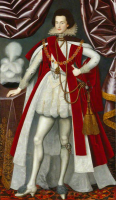
On 12th July 1627 George Villiers 1st Duke of Buckingham [aged 34] led an English force of 100 ships and 6,000 soldiers to capture the city of Saint-Martin-de-Ré on the Île de Ré.
In August 1627 more troops, including the newly promoted Lieutenant John Felton [aged 32], arrived.
On 3rd September 1627 two thousand Irish troops arrived under Ralph Bingley [aged 57]
On 27th October 1627 a final assault was attempted; it failed because the attackers' siege ladders were shorter than the walls of the fortress.
In November 1627 George Villiers 1st Duke of Buckingham retreated and returned to England having lost thousands of his men.