


04 Apr is in April.
Flowers of History. 4th April 1070. On the fourth day of April, king William (age 42), being now become more secure on his throne, violated his promises in many respects; and he caused the monasteries to be searched throughout the whole of England, and commanded the money found in them, and the charters, in the privileges granted by which the nobles of England placed their trust, and which the king, when in a position of difficulty, had sworn to observe himself, to be carried off by force from the churches where they had been deposited, and where they had hitherto lain in security, and to be taken to his own treasury.
Chronicon ex Chronicis by Florence and John of Worcester. 4th April 1070. In the octaves of Easter [4th April] a great synod was held at Winchester, by command of king William (age 42), who was present himself, and with the concurrence of the lord Alexander the pope; his legates, Ermenfrid, bishop of Sion, and John and Peter, cardinal-priests of the apostolic see, representing his authority. In this synod, Stigand, archbishop of Canterbury, was degraded on three charges: first, for having unlawfully held the bishopric of Winchester with the archbishopric; next, for having taken the archbishopric while archbishop Robert was living, and even sometimes, in saying mass, wearing the pallium which Robert left behind him at Canterbury when he was unjustly driven from England; and lastly, for having accepted the pallium from Benedict, who was excommunicated by the Holy Roman Church for having systematically usurped the apostolic see. His brother, Ethelmar;, bishop of the East-Angles, was also degraded; as were also a few abbots, the king doing his utmost to deprive the English of their dignities, that he might appoint persons of his own nation to their preferments, and thus confirm his power in his new kingdom. He also deprived several bishops and abbots, convicted of no open crimes either by the councils or the laws of the realm, and detained them in prison, to the end of their lives on mere suspicion, as we have said, of their being dangerous to his newly-acquired power. In this synod also, while the rest, aware of the king's bias, were trembling at the risk they ran of losing their appointments, Wulfstan (age 62), bishop of Worcester, boldly demanded the restoration of many of the possessions of his see which had been retained in his own power by archbishop Aldred, when he was translated from Worcester to York, and on his death had fallen into the king's hands; and demanded, not only from those who presided at the synod, but from the king himself, that justice should be done him. But as the church of York was silent, not having a pastor to plead her cause, it was decided that the suit should stand over until such time as, by the appointment of an archbishop, there should be some one who could reply to Wulfstan's claims, and after hearing the pleadings on both sides, a clearer and more equitable judgement might be given. Thus the case was adjourned for the present.
 Become a Member via our Buy Me a Coffee page to read more.
Chronicon ex Chronicis by Florence and John of Worcester. 1120. Ralph, archbishop of Canterbury, retựrned to England on Sunday the second of the nones of January [4th January 1120]; and on Sunday the second of the nones of April [4th April 1120], at Westminster, he consecrated to the bishopric of Banger a venerable clerk named David, who was chosen by king Griffyth (age 65) and the clergy and people of Wales. At this consecration he was assisted by Richard, bishop of London, Robert, bishop of Lincoln, Roger of Salisbury, and Urban of Glamorgan (age 44).
Note. Bishop David the Scot was consecrated Bishop of Bangor.
Chronicle of Roger de Hoveden. 4th April 1194. On the fourth day of April, the King of England and the King of Scotland came to Southwell, Nottinghamshire.
Quarta die mensis Aprilis rex Angliæ et rex Scotiæ venerunt apud Suuelle.
Chronicle of Geoffrey le Baker of Swinbroke [-1360]. In this year, the lord king, together with the Bishop of Winchester, Lord William de Montagu (age 30), and a very few others, crossed the sea1 disguised as a merchant, carrying saddlebags and without armour, having with him scarcely fifteen knights. He claimed he was going abroad on pilgrimage, leaving Lord John of Eltham, his brother, as guardian of the realm. Before the end of April, he returned, and a grand tournament was held at Dartford.2 Shortly before the feast of Saint Michael, there were splendid jousts in Cheapside,3 London, where Queen Philippa, with a great company of ladies, watched from newly built pavilions. But the pavilions collapsed, though the ladies were unharmed.4 The most gracious queen did not allow the carpenters to be punished for this, but with prayers and kneeling, so calmed the king and his friends from anger that, reflecting on her compassion, all were moved to greater love for the merciful queen.
Hoc anno dominus rex, cum episcopo Wyntoniensi et domino Willelmo de Monte acuto et aliis admodum paucis, transfretavit, sicut mercator, cum manticis absque hernesiis, vix secum habens xv equites, pretendens se peregre profecturum, domino Ioanne Deltham, germano suo, custode regni relicto; et ante finem mensis Aprilis rediit, et fuit apud Derteford solempne torneamentum. Et parum ante festum sancti Michaelis Londoniis in Chepe pulcherrima hastiludia fuerunt, ubi domina regina Philippa cum magna dominarum comitiva de tentoriis, unde militares actus specularentur, noviter edificatis, ceciderunt, set illese. Carpentarios proinde puniri non permisit illa piissima regina, set ab iracundia regem et amicos regis precibus et genuflexionibus ita revocavit, quod in sui amorem omnes eius pictatem considerantes regina misericors concitavit.
Note 1. Edward sailed from Dover on the 4th April 1331, leaving John of Eltham guardian of the realm during his absence. He returned on the 20th April. Rymer's Fœdera 2.815, 818. The ostensible reason of his journey was the discharge of a vow; the real reason was the adjustment of certain points in dispute with France.
Note 2. This took place on the 2nd May 1331. See the account, in the Annales Paulini 352.
Note 3. On the 22nd September there was a masquerade wherein appeared the king and his companions, Annales Paulini 354.
Note 4. The Annales Paulini 355.
On or before 4th April 1340 Maud Plantagenet Duchess Lower Bavaria was born to Henry of Grosmont 1st Duke Lancaster (age 30) and Isabel Beaumont Duchess Lancaster (age 20) at Bolingbroke Castle, Lincolnshire [Map]. The exact date of her birth uncertain. The Inquisition of her father in May 1361 refers to Blanche being "Maud lady of Henaud [Hainault], aged 21 years on the feast of St. Ambrose last". The Feast of the Ambrose being the 4th of April so Maud was born on or before the 4th of April 1340. She a great x 2 granddaughter of King Henry III of England. She married (1) 1344 her third cousin once removed Ralph Stafford, son of Ralph Stafford 1st Earl Stafford and Margaret Audley Countess Stafford (2) 1352 her fourth cousin once removed William Wittelsbach I Duke Lower Bavaria, son of Louis Wittelsbach IV Holy Roman Emperor and Margaret Hainaut Holy Roman Empress, and had issue.
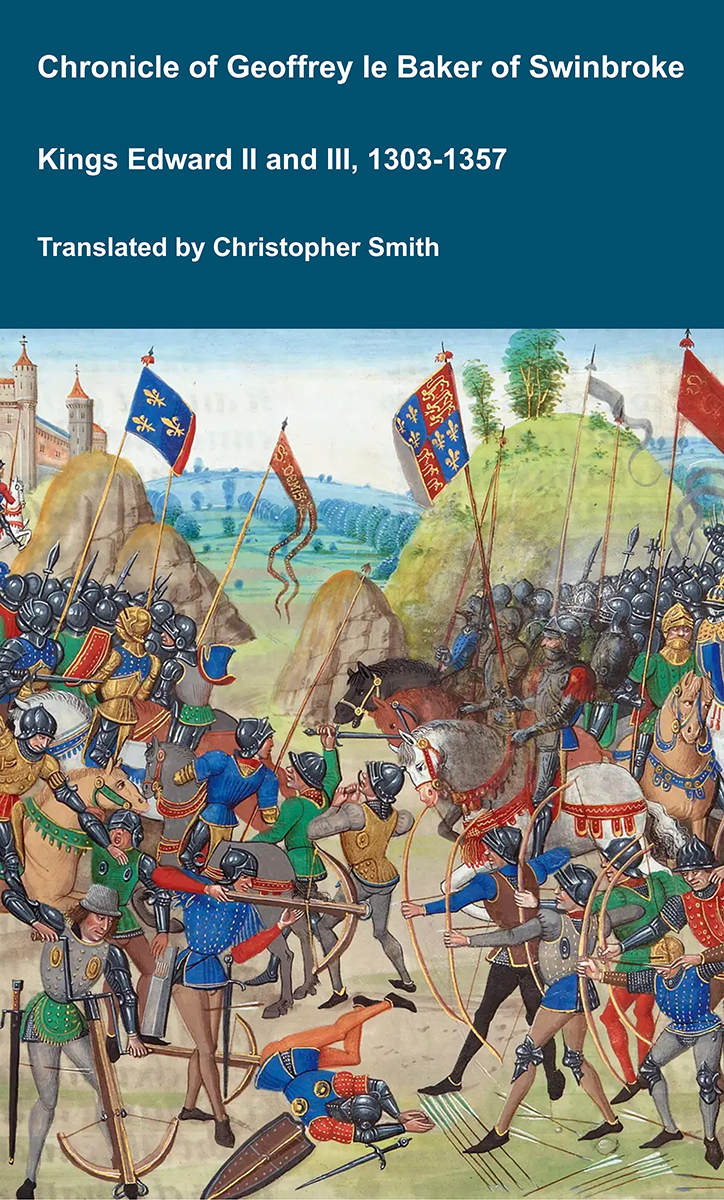
Chronicle of Geoffrey le Baker of Swinbroke
Baker was a secular clerk from Swinbroke, now Swinbrook, an Oxfordshire village two miles east of Burford. His Chronicle describes the events of the period 1303-1356: Gaveston, Bannockburn, Boroughbridge, the murder of King Edward II, the Scottish Wars, Sluys, Crécy, the Black Death, Winchelsea and Poitiers. To quote Herbert Bruce 'it possesses a vigorous and characteristic style, and its value for particular events between 1303 and 1356 has been recognised by its editor and by subsequent writers'. The book provides remarkable detail about the events it describes. Baker's text has been augmented with hundreds of notes, including extracts from other contemporary chronicles, such as the Annales Londonienses, Annales Paulini, Murimuth, Lanercost, Avesbury, Guisborough and Froissart to enrich the reader's understanding. The translation takes as its source the 'Chronicon Galfridi le Baker de Swynebroke' published in 1889, edited by Edward Maunde Thompson.
Available at Amazon in eBook and Paperback format.
On 4th April 1373 John Luxemburg Archbishop of Mainz died.
On 4th April 1406 King Robert III of Scotland (age 69) died at Rothesay Castle, Isle of Bute. His son James (age 11) succeeded I King Scotland. He, James, was a prisoner of King Henry IV having been captured by an English ship two weeks before when attempting to travel to France. He would remain in captivity for eighteen years until 1424.
On 4th April 1444 Cardinal Regnault de Chartres (age 64) died at Tours.
Paston Letters Volume 3 450. 4th April 1461. 3.450. William Paston and John Playters to John Paston (age 39).
To my maister, John Paston, in hast,
Please you to knowe and wete of suche tydyngs as my Lady of York hath by a lettre of credens, under the signe manuel of oure Soverayn Lord King Edward, whiche lettre cam un to oure sayd Lady this same day, Esterne Evyn, at xj. clok, and was sene and red by me, William Paston.
Fyrst, oure Soverayn Lord (age 18) hath wonne the feld, and uppon the Munday next after Palmesunday, he was resseved in to York with gret solempnyte and processyons. And the Mair the Yorkist cause and Comons of the said cite mad ther menys to have grace be Lord Montagu (age 30) and Lord Barenars (age 45), whiche be for the Kyngs coming in to the said cite desyred hym of grace for the said cite, whiche graunted hem grace. On the Kyngs parte is slayn Lord Fitz Water (deceased), and Lord Scrop (age 23) sore hurt; John Stafford, Horne of Kent ben ded; and Umfrey Stafford, William Hastyngs (age 30) mad knyghts with other; Blont is knygth, &c.
Un the contrary part is ded Lord Clyfford (deceased), Lord Nevyle (deceased), Lord Welles (deceased), Lord Wyllouby, Antony Lord Scales, Lord Harry, and be supposyng the Erle of Northumberland, Andrew Trollop, with many other gentyll and comons to the nomber of xx.ml. (20000).
Item, Kyng Harry, the Qwen, the Prince, Duke of Somerset, Duke of Exeter, Lord Roos, be fledde in to Scotteland, and they be chased and folwed, &c. We send no er un to you be cause we had non certynges tyl now; for un to this day London was as sory cite as myght. And because Spordauns had no certeyn tydyngs, we thought ye schuld take them a worthe tyl more certayn.
Item, Thorp Waterfeld is yeldyn, as Spordauns can telle you. And Jesu spede you. We pray you that this tydyngs my moder may knowe.
Be your Broder,
W. Paston.
T. Playters.
Note 1. 'On a piece of paper pinned to the above letter,' says Fenn, 'is a list of the 268 names of the noblemen and knights, and the number of soldiers slain at the above battle of Towton, as follow:—'
Comes Northumbriæ (deceased).
Comes Devon (deceased).
Dominus de Beamunde.
Dominus de Dacre (deceased).
Dominus Henricus de Bokyngham.
Dominus de Scales Antony Revers.
Dominus de Wellugby.
Dominus de Malley Radulfus Bigot Miles.
Millites.
Sir Rauff Gray.
Sir Ric. Jeney.
Sir Harry Bekingham.
Sir Andrew Trollop.
With xxviij.ml. (28000) nomberd by Harralds.
Become a Member via our Buy Me a Coffee page to read more.
On 4th April 1474 Anna Brunswick Grubenhagen Duchess Bavaria (age 60) died.
On 4th April 1496 Bishop Geoffrey Blythe was ordained a priest.
Letters and Papers Foreign and Domestic Henry VIII 1519. 4th April 1519. 160. For Anne Seyntleger (age 64) [St Leger], widow.
Licence to found a perpetual chantry for one chaplain in the chapel of St. Mary, called "Hangfordis Chapell," in the church of St. George, Monklee, Devon, to pray for the King and Queen, and for the said Anne, Sir George Seyntleger (age 35), Thomas Seyntleger, clk., and Margaret Boleyn (age 65), widow, and for the souls of Sir Thomas Ormond, late earl of Ormond, and lady Anne his wife (father and mother of the said Anne Seyntleger), James and John, brothers of the said earl, William Hangford, Richard-Hangford his son, Sir Richard Hangford, son of the said Richard, and James Seyntleger and Ambrose Griseacre, husbands of the said Anne Seyntleger, and James Seyntleger, her son. Also licence to alienate possessions to the annual value of £10 for the said chaplain. Greenwich, 12 March 10 Hen. VIII. Del. Westm., 4 April.
Pat. 10 Hen. VIII. p. 2, m. 32.
Letters and Papers Foreign and Domestic Henry VIII 1529. 4th April 1529. R. O. Burnet, v. 444. 5422. Anne Boleyn (age 28) to Gardiner (age 46).
Thanks him for his letter, showing his willing and faithful mind. Trusts he will not repent it, and that the end of this journey will be more pleasant to her than his first, "for that was but a rejoysyng hope, whiche causyng [the like] of it dose put me to the more payn, and they that ar parta[kers] with me, as you do knowe; and therefore I do trust that this herd begynn[ing] shall make the better endyng." Sends cramp-rings for him, Master Gregory, and Master Peter, to whom she desires to be recommended. Greenwich, 4 April. Signed.


Wriothesley's Chronicle [1508-1562]. The fourth daie of Aprill, 1547, tidinges was brought to London Death of the that Frances the French King (deceased) was deade, and died the first daie of April last, and it was said that he neaver rejoyced synce he had heard of the Kinges Majesties death.


Diary of Edward VI. 4th April 1550. The lord Clinton (age 38), befor captain of Bolein [Boulogne], come to the courte1, where, after thankes, he was mad Admirall of England, upon the surrendre of th'erle's of Warwic patent. He was also taken into the previe counsel, and promised farther reward. The capitaines also and officers of the town wer promised rewardes. Mons. de Brisay2 also passed by the court to Scoteland, where at Grenwich he cam to the King, telling him that the French king wold see that if he laked any commodite that he had, he wold give it him, and likewis wold the constable of Eraunce, who then bar al the swinge.
Note 1. The following is from the Council register:—
"May iiij. The lorde Clynton with the rest of the commissioners from BuUoigne were received and welcomed home by the counsaill, unto whom the lorde Clynton presented the acquittance that he had receaved of the Frenche for the delivery of BuUoigne, and the copie of their commission to receave the same, which the counsaill delivered to sir John Godsalve, knt., to be fair engrossed, and then laid up in the King's threasorie for a memoriall. Whereupon thanks were given to the said lorde Clynton and commissioners, with the rest of their companie, for the faithfull and diligent service they had doon unto his Majestie in his warres on that side the sea; and then the lord Clynton was by the whole counsaill brought to the King's presence, who after like thanks given was pleased he shulde be made High Admirall of Englande, and one of his privye counsaill: insomuch that the lordes retorned with him immediatelye to the counsaiU chambre, and there ministred an oath unto him accordingly. And so this day he sat in counsaill."
Note 2. Artus de Maillé, seigneur de Brézé et de Milly. He had received the young queen of Scots in France in 1548. He was afterwards governor of Anjou, and died in 1592. Anselme, Hist. Geneal. vii. 516.


Become a Member via our Buy Me a Coffee page to read more.
Abbot John Whethamstede’s Chronicle of the Abbey of St Albans
Abbot John Whethamstede's Register aka Chronicle of his second term at the Abbey of St Albans, 1451-1461, is a remarkable text that describes his first-hand experience of the beginning of the Wars of the Roses including the First and Second Battles of St Albans, 1455 and 1461, respectively, their cause, and their consequences, not least on the Abbey itself. His text also includes Loveday, Blore Heath, Northampton, the Act of Accord, Wakefield, and Towton, and ends with the Coronation of King Edward IV. In addition to the events of the Wars of the Roses, Abbot John, or his scribes who wrote the Chronicle, include details in the life of the Abbey such as charters, letters, land exchanges, visits by legates, and disputes, which provide a rich insight into the day-to-day life of the Abbey, and the challenges faced by its Abbot.
Available at Amazon in eBook and Paperback format.
Henry Machyn's Diary. 4th April 1555. The iiij day of Aprell the Kyng('s) (age 27) grace and the Quen (age 39) removyd unto Hamtun [Map] cowrte to kepe Ester ther, and so her grace to her chambur ther.


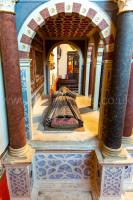
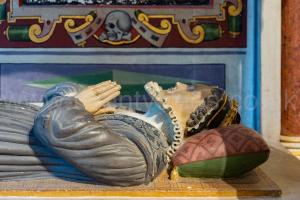
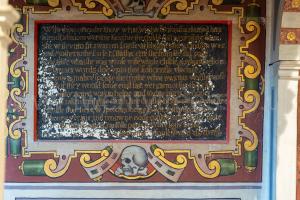
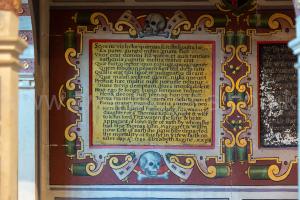
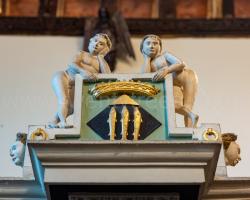
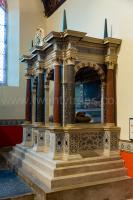
On 4th April 1586 Frances Kitson was buried at St Peter's Church, Tawstock [Map].
Scire ne vis lector quænam suit ista sepulta hic, Ex patre aurato milite quata suit Uxor erat domii Fitzwaren et auia tandem Bathoniæ comitis inclita mater erat. Quæ suit (o lector) quo coniuge quoq parente. Quen sobolem peperit sunt tibi dicta satis. Qualis erat tibi linor et indignatio dicant. Quæ mala si vellent dicere nulla queunt. Prosuit hæc multis nulli nocuisse notatur. Hanc terris demptan dives inopsq dolent. Non ego te longo cupio sermone morari. Plena decore suit plenaq honore suit. Terrea Franciscæ tibi mors, en debita pars est. Fama manet mundo mens animusq deo. Here lieth buried Francis lady Fitzwaren ye daughter of Sr Thomas Kitson Knight & wief to John lord Fitzwaren the sone & heire apparant of John Erle of Bath By whom she had Issue Thomas, John, Margaret & Willm (age 28) now Erle of Bath she patintly departed the mortality of this lyf in ye trew faith on Ester day Ao 1586. Elizabeth Regine XXVIII
Wilte thou o reader know what wighte she was thats buried here even of a famous worthie Knighte the childe and dawghter deare she wife unto fitzwarren Lorde at lengthe and grandam was and Mother to the Earle of Bathe erre she from life did passe O reader what she was whose wife whose childe & whom she bore my former words doe unto she sufficientlie declare. Let spite & malice speake the truthe what was this worthy wife Whoe if they would some will say yet cannot for their life She many noted was to helpe and to doe hurte to none Whom taken from the earth her death bothe riche & poor doe mone To hold thee here wth speaches longe is not ye thinge I crave of honor vertue and renowne none could more plenty have O Death this Frauncis earthlie parte is to they lotte befell In worlde her fame remayne her mind & soule wth God do dwell
On 4th April 1588 Frederick II King of Denmark (age 53) died. His son Christian (age 10) succeeded IV King of Denmark.
On 4th April 1590 Eleonore Oldenburg was born to John "Younger" Oldenburg Duke Schleswig Holstein Sonderburg (age 45) and Agnes Hedwig of Anhalt (age 17).

Diary of Anne Clifford. 4th April 1617. The 4th my Lord (age 28) told me he had as yet passed no finished recoveries of my land, but that my Uncle Cumberland had acknowledged statutes for the payment of the money, and that all the writings were left with my Lord Keeper and Lord Hobart till 21st next term, at which time they were fully to be concluded on. This was strange news to me, for I thought all matters had been finish'd.
This day we began to leave the little room and dine and sup in the great Chamber.
After 4th April 1617. Monument to Charles Cavendish (deceased) and Catherine Ogle 8th Baroness Ogle (age 47) in the St Mary and St Laurence's Church, Bolsover [Map]. Stuart Period. Bongrace. Rush Mat.
Charles Cavendish: On 28th November 1553 he was born to William Cavendish and Bess of Hardwick. Before 6th December 1592 Charles Cavendish and Catherine Ogle 8th Baroness Ogle were married. He the son of William Cavendish and Bess of Hardwick Countess Shrewsbury and Waterford. On 4th April 1617 Charles Cavendish died.


On 4th April 1648 Grinling Gibbons was born.
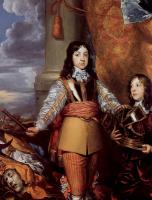
4th April 1660 The Declaration of Breda [Map], written on 04 Apr 1660, was a part of the process of King Charles II of England Scotland and Ireland (age 29) being restored to the English throne written in response to a message sent by George Monck 1st Duke Albemarle (age 51). Initially secret the Declaration was made public on 1st May 1660. The Declaration promised a general pardon, retention of property religious toleration, payment of arrears to the army and continued army service.


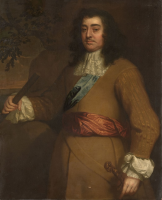

Samuel Pepys' Diary. 4th April 1663. Up betimes and to my office. By and by to Lombard Street [Map] by appointment to meet Mr. Moore, but the business not being ready I returned to the office, where we sat a while, and, being sent for, I returned to him and there signed to some papers in the conveying of some lands mortgaged by Sir Rob. Parkhurst in my name to my Lord Sandwich (age 37), which I having done I returned home to dinner, whither by and by comes Roger Pepys (age 45), Mrs. Turner (age 40) her daughter, Joyce Norton, and a young lady, a daughter of Coll. Cockes, my uncle Wight, his wife and Mrs. Anne Wight. This being my feast, in lieu of what I should have had a few days ago for my cutting of the stone, for which the Lord make me truly thankful. Very merry at, before, and after dinner, and the more for that my dinner was great, and most neatly dressed by our own only maid. We had a fricasee of rabbits and chickens, a leg of mutton boiled, three carps in a dish, a great dish of a side of lamb, a dish of roasted pigeons, a dish of four lobsters, three tarts, a lamprey pie (a most rare pie), a dish of anchovies, good wine of several sorts, and all things mighty noble and to my great content.


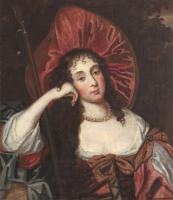
Samuel Pepys' Diary. 4th April 1663. After dinner to Hide Park; my aunt, Mrs. Wight and I in one coach, and all the rest of the women in Mrs. Turner's (age 40); Roger being gone in haste to the Parliament about the carrying this business of the Papists, in which it seems there is great contest on both sides, and my uncle and father staying together behind. At the Park was the King (age 32), and in another coach my Baroness Castlemaine's (age 22), they greeting one another at every tour1. Here about an hour, and so leaving all by the way we home and found the house as clean as if nothing had been done there to-day from top to bottom, which made us give the cook 12d. a piece, each of us.
Note 1. The company drove round and round the Ring in Hyde Park. The following two extracts illustrate this, and the second one shows how the circuit was called the Tour: "Here (1697) the people of fashion take the diversion of the Ring. In a pretty high place, which lies very open, they have surrounded a circumference of two or three hundred paces diameter with a sorry kind of balustrade, or rather with postes placed upon stakes but three feet from the ground; and the coaches drive round this. When they have turned for some time round one way they face about and turn t'other: so rowls the world!"-Wilson's Memoirs, 1719, p. 126.




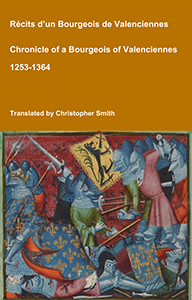
Chronicle of a Bourgeois of Valenciennes
Récits d’un bourgeois de Valenciennes aka The Chronicle of a Bourgeois of Valenciennes is a vivid 14th-century vernacular chronicle written by an anonymous urban chronicler from Valenciennes in the County of Hainaut. It survives in a manuscript that describes local and regional history from about 1253 to 1366, blending chronology, narrative episodes, and eyewitness-style accounts of political, military, and social events in medieval France, Flanders, and the Low Countries. The work begins with a chronological framework of events affecting Valenciennes and its region under rulers such as King Philip VI of France and the shifting allegiances of local nobility. It includes accounts of conflicts, sieges, diplomatic manoeuvres, and the impact of broader struggles like the Hundred Years’ War on urban life in Hainaut. Written from the perspective of a burgher (bourgeois) rather than a monastery or royal court, the chronicle offers a rare lay viewpoint on high politics and warfare, reflecting how merchants, townspeople, and civic institutions experienced the turbulence of the 13th and 14th centuries. Its narrative style combines straightforward reporting of events with moral and civic observations, making it a valuable source for readers interested in medieval urban society, regional politics, and the lived experience of war and governance in pre-modern Europe.
Available at Amazon in eBook and Paperback format.
Samuel Pepys' Diary. 4th April 1664. Afterwards I spoke with my Lord Barkeley (age 62) and my Lord Peterborough (age 42) about it. And so staid without a good while, and saw my Lady Peters, an impudent jade, soliciting all the Lords on her behalf.
Samuel Pepys' Diary. 4th April 1664. Up, and walked to my Lord Sandwich's (age 38); and there spoke with him about W. Joyce, who told me he would do what was fit in so tender a point. I can yet discern a coldness in him to admit me to any discourse with him.
Samuel Pepys' Diary. 4th April 1664. And at last W. Joyce was called in; and by the consequences, and what my Lord Peterborough (age 42) told me, I find that he did speak all he said to his disadvantage, and so was committed to the Black Rod: which is very hard, he doing what he did by the advice of my Lord Peters' (age 38) own steward. But the Sergeant of the Black Rod did direct one of his messengers to take him in custody, and so he was peaceably conducted to the Swan with two Necks, in Tuttle Street, to a handsome dining-room; and there was most civilly used, my uncle Fenner, and his brother Anthony, and some other friends being with him. But who would have thought that the fellow that I should have sworn could have spoken before all the world should in this be so daunted, as not to know what he said, and now to cry like a child. I protest, it is very strange to observe.
Samuel Pepys' Diary. 4th April 1666. After done several businesses at the 'Change [Map] I home, and being washing day dined upon cold meate, and so abroad by coach to Hales's (age 66), and there sat till night, mightily pleased with my picture, which is now almost finished.
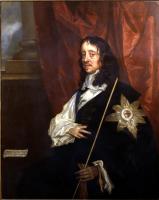
Samuel Pepys' Diary. 4th April 1667. Thence with him to my Lord Treasurer's (age 60), and there walked during Council sitting with Sir Stephen Fox (age 40), talking of the sad condition of the King's purse, and affairs thereby; and how sad the King's life must be, to pass by his officers every hour, that are four years behind-hand unpaid. My Lord Barkeley (age 65) [of Stratton] I met with there, and fell into talk with him on the same thing, wishing to God that it might be remedied, to which he answered, with an oath, that it was as easy to remedy it as anything in the world; saying, that there is himself and three more would venture their carcasses upon it to pay all the King's debts in three years, had they the managing his revenue, and putting £300,000 in his purse, as a stock. But, Lord! what a thing is this to me, that do know how likely a man my Lord Barkeley of all the world is, to do such a thing as this. Here I spoke with Sir W. Coventry (age 39), who tells me plainly that to all future complaints of lack of money he will answer but with the shrug of his shoulder; which methought did come to my heart, to see him to begin to abandon the King's affairs, and let them sink or swim, so he do his owne part, which I confess I believe he do beyond any officer the King (age 36) hath, but unless he do endeavour to make others do theirs, nothing will be done. The consideration here do make me go away very sad, and so home by coach, and there took up my wife and Mercer, who had been to-day at White Hall to the Maundy1, it being Maundy Thursday; but the King did not wash the poor people's feet himself, but the Bishop of London did it for him, but I did not see it, and with them took up Mrs. Anne Jones at her mother's door, and so to take the ayre to Hackney, where good neat's tongue, and things to eat and drink, and very merry, the weather being mighty pleasant; and here I was told that at their church they have a fair pair of organs, which play while the people sing, which I am mighty glad of, wishing the like at our church at London, and would give £50 towards it. So very pleasant, and hugging of Mercer in our going home, we home, and then to the office to do a little business, and so to supper at home and to bed.
Note 1. The practice of giving alms on Maundy Thursday to poor men and women equal in number to the years of the sovereign's age is a curious survival in an altered form of an old custom. The original custom was for the King to wash the feet of twelve poor persons, and to give them a supper in imitation of Christ's last supper and his washing of the Apostles' feet. James II was the last sovereign to perform the ceremony in person, but it was performed by deputy so late as 1731. The Archbishop of York was the King's deputy on that occasion. The institution has passed through the various stages of feet washing with a supper, the discontinuance of the feet washing, the substitution of a gift of provisions for the supper, and finally the substitution of a gift of money for the provisions. The ceremony took place at the Chapel Royal, Whitehall; but it is now held at Westminster Abbey. Maundy is derived from the Latin word 'maudatum', which commences the original anthem sung during the ceremony, in reference to Christ's command.


Become a Member via our Buy Me a Coffee page to read more.
Samuel Pepys' Diary. 4th April 1667. So to the office till noon, busy, and then (which I think I have not done three times in my life) left the board upon occasion of a letter of Sir W. Coventry (age 39), and meeting Balty (age 27) at my house I took him with me by water, and to the Duke of Albemarle (age 58) to give him an account of the business, which was the escaping of some soldiers for the manning of a few ships now going out with Harman (age 42) to the West Indies, which is a sad consideration that at the very beginning of the year and few ships abroad we should be in such want of men that they do hide themselves, and swear they will not go to be killed and have no pay. I find the Duke of Albemarle at dinner with sorry company, some of his officers of the Army; dirty dishes, and a nasty wife at table, and bad meat, of which I made but an ill dinner. Pretty to hear how she talked against Captain Du Tell, the Frenchman, that the Prince and her husband put out the last year; and how, says she, the Duke of York (age 33) hath made him, for his good services, his Cupbearer; yet he fired more shot into the D. Gawden's ship, and others of the King's ships, than of the enemy. And the Duke of Albemarle did confirm it, and that somebody in the fight did cry out that a little Dutchman, by his ship, did plague him more than any other; upon which they were going to order him to be sunk, when they looked and found it was Du Tell, who, as the Duke of Albemarle says, had killed several men in several of our ships. He said, but for his interest, which he knew he had at Court, he had hanged him at the yard's-arm, without staying for a Court-martiall. One Colonel Howard, at the table, magnified the Duke of Albemarle's fight in June last, as being a greater action than ever was done by Caesar. The Duke of Albemarle, did say it had been no great action, had all his number fought, as they should have done, to have beat the Dutch; but of his 55 ships, not above 25 fought. He did give an account that it was a fight he was forced to: the Dutch being come in his way, and he being ordered to the buoy of the Nore, he could not pass by them without fighting, nor avoid them without great disadvantage and dishonour; and this Sir G. Carteret (age 57), I afterwards giving him an account of what he said, says that it is true, that he was ordered up to the Nore. But I remember he said, had all his captains fought, he would no more have doubted to have beat the Dutch, with all their number, than to eat the apple that lay on his trencher. My Lady Duchesse, among other things, discoursed of the wisdom of dividing the fleete; which the General said nothing to, though he knows well that it come from themselves in the fleete, and was brought up hither by Sir Edward Spragge (age 47). Colonel Howard, asking how the Prince did, the Duke of Albemarle answering, "Pretty well"; the other replied, "But not so well as to go to sea again".-"How!" says the Duchess, "what should he go for, if he were well, for there are no ships for him to command? And so you have brought your hogs to a fair market", said she1. One at the table told an odd passage in this late plague: that at Petersfield, Hampshire, I think, he said, one side of the street had every house almost infected through the town, and the other, not one shut up. Dinner being done, I brought Balty to the Duke of Albemarle to kiss his hand and thank him far his kindness the last year to him, and take leave of him, and then Balty and I to walk in the Park, and, out of pity to his father, told him what I had in my thoughts to do for him about the money-that is, to make him Deputy Treasurer of the fleete, which I have done by getting Sir G. Carteret's consent, and an order from the Duke of York for £1500 to be paid to him. He promises the whole profit to be paid to my wife, for to be disposed of as she sees fit, for her father and mother's relief. So mightily pleased with our walk, it being mighty pleasant weather, I back to Sir G. Carteret's, and there he had newly dined, and talked, and find that he do give every thing over for lost, declaring no money to be raised, and let Sir W. Coventry name the man that persuaded the King (age 36) to take the Land Tax on promise, of raising present money upon it. He will, he says, be able to clear himself enough of it. I made him merry, with telling him how many land-admirals we are to have this year: Allen at Plymouth, Devon [Map], Holmes at Portsmouth, Hampshire [Map], Spragge for Medway, Teddiman at Dover, Smith to the Northward, and Harman to the Southward. He did defend to me Sir W. Coventry as not guilty of the dividing of the fleete the last year, and blesses God, as I do, for my Lord Sandwich's (age 41) absence, and tells me how the King did lately observe to him how they have been particularly punished that were enemies to my Lord Sandwich. Mightily pleased I am with his family, and my Baroness Carteret (age 65) was on the bed to-day, having been let blood, and tells me of my Lady Jemimah's being big-bellied.
Note 1. It was pretty to hear the Duke of Albemarle himself to wish that they would come on our ground, meaning the French, for that he would pay them, so as to make them glad to go back to France again; which was like a general, but not like an admiral.
Become a Member via our Buy Me a Coffee page to read more.
Samuel Pepys' Diary. 4th April 1668. By and by the King (age 37) comes out, and he did easily agree to what we moved, and would have the Commissioners of the Navy to meet us with him to-morrow morning: and then to talk of other things; about the Quakers not swearing, and how they do swear in the business of a late election of a Knight of the Shire of Hartfordshire in behalf of one they have a mind to have; and how my Lord of Pembroke (age 47) says he hath heard him (the Quaker) at the tennis-court swear to himself when he loses: and told us what pretty notions my Lord Pembroke hath of the first chapter of Genesis, how Adam's sin was not the sucking (which he did before) but the swallowing of the apple, by which the contrary elements begun to work in him, and to stir up these passions, and a great deal of such fooleries, which the King made mighty mockery at.
Samuel Pepys' Diary. 4th April 1669. Lord's Day. Up, and to church, where Alderman Backewell's (age 51) wife, by my invitation with my head, come up with her mother, and sat with us, and after sermon I did walk with them home, and there left them, and home to dinner, and after dinner with Sir J. Minnes (age 70) and T. Middleton to White Hall, by appointment; and at my Lord Arlington's (age 51) the Office did attend the King (age 38) and Cabal, to discourse the further quantity of victuals fit to be declared for, which was 2,000 men for six months; and so without more ado or stay, there, hearing no news but that Sir Thomas Allen (age 36) is to be expected every hour at home with his fleete, or news of his being gone back to Algier, and so home, where got my wife to read to me; and so after supper to bed. The Queen-Mother (age 59) hath been of late mighty ill, and some fears of her death.


Chronicle of Geoffrey le Baker of Swinbroke
Baker was a secular clerk from Swinbroke, now Swinbrook, an Oxfordshire village two miles east of Burford. His Chronicle describes the events of the period 1303-1356: Gaveston, Bannockburn, Boroughbridge, the murder of King Edward II, the Scottish Wars, Sluys, Crécy, the Black Death, Winchelsea and Poitiers. To quote Herbert Bruce 'it possesses a vigorous and characteristic style, and its value for particular events between 1303 and 1356 has been recognised by its editor and by subsequent writers'. The book provides remarkable detail about the events it describes. Baker's text has been augmented with hundreds of notes, including extracts from other contemporary chronicles, such as the Annales Londonienses, Annales Paulini, Murimuth, Lanercost, Avesbury, Guisborough and Froissart to enrich the reader's understanding. The translation takes as its source the 'Chronicon Galfridi le Baker de Swynebroke' published in 1889, edited by Edward Maunde Thompson.
Available at Amazon in eBook and Paperback format.
John Evelyn's Diary. 4th April 1679. The Bishop of Gloucester preached in a manner very like Bishop Andrews, full of divisions, and scholastical, and that with much quickness. The Holy Communion followed.
John Evelyn's Diary. 4th April 1701. The Duke of Norfolk (deceased) died of an apoplexy, and Mr. Thomas Howard of complicated disease since his being cut for the stone; he was one of the Tellers of the Exchequer. Mr. How (age 52) made a Baron.

On 4th April 1701 Sophia Bentinck Duchess Kent was born to William Bentinck 1st Earl of Portland (age 51) and Jane Martha Temple Countess Portland (age 29). She married 24th March 1729 Henry Grey 1st Duke Kent, son of Anthony Grey 11th Earl Kent and Mary Lucas Countess Kent, and had issue.
On 4th April 1721 Frederick IV King of Denmark and Norway (age 49) and Anne Sophie Reventlow Queen Consort Denmark and Norway (age 27) were married. She by marriage Queen Consort Denmark and Norway. The difference in their ages was 21 years. He the son of Christian V King of Denmark and Norway and Charlotte Amalie Hesse-Kassel Queen Consort Denmark and Norway.

On 4th April 1751 John Repps of Mattishall (age 46) died. On 25th October 1733 Virtue Boardman died. Memorials in Church of St Peter and St Paul, Salle [Map].
John Repps of Mattishall: Around 1705 he was born to John Repps and Dorothy Fountaine. Before 4th April 1705 he and Virtue Boardman were married.
Virtue Boardman: In 1695 she was born.
On 4th April 1758 John Hoppner was born in Whitechapel.
On 4th April 1793 Prince Augustus Frederick Hanover 1st Duke Sussex (age 20) and Augusta Murray Duchess Sussex (age 25) were married at Rome, Italy [Map] in secret contrary to the Royal Marriages Act which required him to seek permission before marrying. She the daughter of John Murray 4th Earl Dunmore (age 63) and Charlotte Stewart Countess Dunmore (age 63). He the son of King George III of Great Britain and Ireland (age 54) and Charlotte Mecklenburg Strelitz Queen Consort England (age 48).


On 4th April 1802 Charlotte Beauclerk was born to William Beauclerk 8th Duke St Albans (age 35) and Maria Janetta Nelthorpe Duchess St Albans. She a great x 3 granddaughter of King Charles II of England Scotland and Ireland.
On 4th April 1808 Philip Yorke (age 23) drowned in a storm off Memel in a ship called the Agatha of Lübeck.
On 4th April 1809 Katherine Isabella Manners was born to John Henry Manners 5th Duke Rutland (age 31) and Elizabeth Howard Duchess Rutland (age 28). She married 1st December 1830 her sixth cousin Frederick Hervey 2nd Marquess of Bristol, son of Frederick William Hervey 1st Marquess of Bristol and Elizabeth Albana Upton, and had issue.


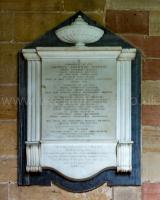
After 4th April 1843 Monument to Jacob John Hornby.
On 4th April 1850 John Merewether (age 53) died. He was buried in the Lady Chapel of Hereford Cathedral [Map]. The five lancet windows at the east end of the minster were fitted with stained glass to his memory with the inscription In Memoriam Johannis Merewether, S.T.P. ecclesiæ Heref. decani, quo strenuo fautore huius sacræ ædis restitutio feliciter est inchoata ie. In Memory of John Mereweather dean of Hereford whose energetic support the restoration of this sacred edifice was successfully begun.
Chronicle of a Bourgeois of Valenciennes
Récits d’un bourgeois de Valenciennes aka The Chronicle of a Bourgeois of Valenciennes is a vivid 14th-century vernacular chronicle written by an anonymous urban chronicler from Valenciennes in the County of Hainaut. It survives in a manuscript that describes local and regional history from about 1253 to 1366, blending chronology, narrative episodes, and eyewitness-style accounts of political, military, and social events in medieval France, Flanders, and the Low Countries. The work begins with a chronological framework of events affecting Valenciennes and its region under rulers such as King Philip VI of France and the shifting allegiances of local nobility. It includes accounts of conflicts, sieges, diplomatic manoeuvres, and the impact of broader struggles like the Hundred Years’ War on urban life in Hainaut. Written from the perspective of a burgher (bourgeois) rather than a monastery or royal court, the chronicle offers a rare lay viewpoint on high politics and warfare, reflecting how merchants, townspeople, and civic institutions experienced the turbulence of the 13th and 14th centuries. Its narrative style combines straightforward reporting of events with moral and civic observations, making it a valuable source for readers interested in medieval urban society, regional politics, and the lived experience of war and governance in pre-modern Europe.
Available at Amazon in eBook and Paperback format.
On 4th April 1872 Gilbert Bayes was born.

Henry Chaplin A Memoir: 2 Family and Social Life Part II. April 4.—I have been lucky to-day. Providence, I think, means to reward me for my virtue in giving up the Turf, or it would be more accurate to say my horses. My big horse won in a canter1, another in the stable of Cav's (age 43) [Lord Hartington] did the same, and I backed the winner of the big race as well from my own immaculate judgement. I think I must have had for me a very good day and won nearly £3000.
Note 1. Mr. Chaplin's winning horse was Strike, appropriately named, as he was by the Miner. He started second ravourite at 9 to 2. Lord Hartington's success was gained in the Wakefield Lawn Stakes by Ethelred.
On 4th April 1900 Henry Hugh Arthur Fitzroy Somerset 10th Duke Beaufort was born to Henry Adelbert Wellington Fitzroy 9th Duke Beaufort (age 52) and Louise Emily Harford 9th Duchess Beaufort (age 35). He married 14th June 1923 his half fourth cousin Mary Cambridge Duchess Beaufort, daughter of Adolphus Cambridge Duke Teck and Margaret Evelyn Grosvenor Duchess Teck.
4th April 1908. St Peter's Church, Edensor [Map]. Pictures from The Sphere of the funeral of Spencer Cavendish 8th Duke Devonshire (deceased).

"The Bishop of Derby officiated ... The little boy is the new Marquis of Hartington (age 12). His father (age 39) is seen supporting the Dowager Duchess (age 75).

On 4th April 1918 Eric Fox Pitt Lubbock (age 29) was killed in action. He was wounded on Line Patrol; shot down near Railway Wood near Ypres; crashed and wrecked; at 11.15 am when his A1082 Sopwith Strutter was attacked by two enemy Albatros D.IIIs. His Sopwith Camel bi-plane was shot down over Belgium by a German pilot, Lieutenant Paul Strahle. At the time of his death he was a Captain in the 45th Squadron of the RFC. Captain Lubbock is buried in Lijssenthoek Military Cemetery, Poperinge, Belgium.
From the diary of Collingwood Ingram, friend of Lubbock: "There have been few finer characters than Lubbock – a man of more than ordinary intelligence, he devoted all his mental and physical energy to his work and during my stay with 45 Squadron no pilot was so frequently in air. Absolutely unaffected, he was as courteous as he was kind, and from the very first moment I saw him he treated me with a natural politeness that set me entirely at my ease and made me feel as though I had known him for years. This sincerity was unquestionable. With Lubbock's death the Flying Corps has lost a valuable officer and England a gallant pure-minded gentleman that will be difficult to replace."

On 4th April 1918 Captain Harold Fox-Pitt Lubbock (age 29) was killed in action. He was killed instantly by a shell in the front line on the morning of 4 April 1918, south of Arras and was buried near Ficheux in Boisleux-Au-Mont Communal Cemetery, grave 3.A.
The regimental history says: "The 2nd Battalion went up into the line [on 3 April 1918] and found the trenches very wet. On the 4th, during a heavy shelling, which was entirely directed against no.1 Company on the right, Lieutenant the Hon H F P Lubbock was killed by a shell which pitched in the trench. This was a great loss to the battalion, for he was an officer of sound judgment, who did not know what fear was. Corporal Teague MM was killed at the same time, and 6 men were wounded."
A brother officer wrote: "Wherever he went he introduced the most valuable element. Whatever the conditions he was always alert, quick and keen, and strongly infected others with the same qualities. War was repulsive to him in every way, yet he never showed it, and so the vitality and charm which he radiated was not merely a natural 'joie de vie,' but sprang from a heart of real courage and fortitude." All who knew him testify to his splendid qualities both as a man and an officer. He seems to have been fearless to a fault, and as sound and capable as he was brave. The urbanity and charm which characterised his father, the first Baron Avebury, better known to his own generation as Sir John Lubbock, the eminent scientist and author, were reproduced in his son, who inherited the keen business instincts of his race. He was devoted to hunting and, before coming to Langham, hunted several seasons with the Vale of White Horse Hunt."
He is remembered on Langham's war memorial and also by a monument in woodland near the family home in Farnborough, Kent.
Captain Harold Fox-Pitt Lubbock: On 10th June 1888 he was born to John Lubbock 1st Baron Avebury and Alice Lane Fox-Pitt Baroness Avebury at 39 Berkeley Square, Mayfair. On 10th June 1914 Captain Harold Fox-Pitt Lubbock and Dorothy Charlotte Forster Baroness Wardington were married. In June 1917 Captain Harold Fox-Pitt Lubbock transferred to the Grenadier Guards and on 28 December went out to join the 2nd Battalion in France. He took part in the fine resistance to the great [German] offensive on 21 March in the second Battle of the Somme.
Become a Member via our Buy Me a Coffee page to read more.
4th April 1922. Pall Mall Gazette.
Earl of St Germans (deceased). Fatal chill during motor drive.
The Earl of St. Germans, whose death in South Africa was announced yesterday, died, according to Reuter, in a nursing home in Johannesburg on Friday night.
The Earl arrived at Cape Town from England on March 6, reaching Johannesburg on the 25th. It is believed that he caught a chill while motoring to Pretoria last Tuesday. On the following morning he was admitted to the nursing home, where he was treated for double pneumonia. The illness, however, developed rapidly, and he passed away on Friday night.
4th April 1922. Western Morning News. Page 4.
Tribute To His County Services.
Before commencing the business of the Cornwall Standing Joint Committee at Bodmin yesterday the Chairman (Mr. H.D. Foster) referred to the death of the Earl of St. Germans (deceased). Most of them, he said, were surprised and grieved to see the news in the paper that morning. The late Earl was a member of that committee. He had shown that he was willing to undertake the duties which should fall to such as he in the county. While his health was good no man paid more attention to the duties devolving upon him than did the late Earl. They must all feel that they had lost a very valuable life, and one who did good in the county. The meeting passed a standing vote with the bereaved relatives.
Henrici Quinti, Angliæ Regis, Gesta, is a first-hand account of the Agincourt Campaign, and subsequent events to his death in 1422. The author of the first part was a Chaplain in King Henry's retinue who was present from King Henry's departure at Southampton in 1415, at the siege of Harfleur, the battle of Agincourt, and the celebrations on King Henry's return to London. The second part, by another writer, relates the events that took place including the negotiations at Troye, Henry's marriage and his death in 1422.
Available at Amazon in eBook and Paperback format.
On 4th April 1340 Henry Beaumont 3rd Baron Beaumont was born to John Beaumont 2nd Baron Beaumont (age 22) and Eleanor Plantagenet Countess Arundel and Surrey (age 21). He a great x 2 grandson of King Henry III of England. He married before 1361 his fourth cousin once removed Margaret Vere Baroness Devereux and Beaumont, daughter of John de Vere 7th Earl of Oxford and Maud Badlesmere Countess of Oxford, and had issue.
On 4th April 1406 Ralph Neville 2nd Earl of Westmoreland was born to John Neville (age 19) and Elizabeth Holland at Cockermouth Castle [Map]. He a great x 3 grandson of King Edward I of England. He married (1) 1426 his second cousin once removed Elizabeth Percy Countess of Westmoreland, daughter of Henry "Hotspur" Percy and Elizabeth Mortimer Baroness Camoys, and had issue (2) February 1441 his fourth cousin once removed Margaret Cobham Countess Westmoreland, daughter of Reginald Cobham 4th Baron Cobham and Elizabeth Savage Baroness Cobham.
On 4th April 1590 Eleonore Oldenburg was born to John "Younger" Oldenburg Duke Schleswig Holstein Sonderburg (age 45) and Agnes Hedwig of Anhalt (age 17).
On 4th April 1617 George Wharton 1st Baronet was born.
On 4th April 1625 John Drake 1st Baronet was born to John Drake and Helen Boteler. He married (1) in or before 1647 Jane Yonge, daughter of John Yonge 1st Baronet, and had issue (2) before October 1654 Dionise Strode Lady Drake and had issue.
On 4th April 1641 James Oxenden 2nd Baronet was born to Henry Oxenden 1st Baronet (age 27) and Elizabeth Meredith. He married before 29th September 1708 Arabella Watson Lady Oxenden, daughter of Edward Watson 2nd Baron Rockingham and Anne Wentworth Baroness Rockingham.
On 4th April 1648 Grinling Gibbons was born.
On 4th April 1693 John West 1st Earl De La Warr was born to John West 6th Baron De La Warr (age 30). He married (1) 25th May 1721 his fifth cousin once removed Charlotte Maccarthy Baroness De La Warr, daughter of Donough MacCarty 4th Earl Clancarty and Elizabeth Spencer Countess Clancarty, and had issue (2) 1742 Anne Walker.
On 4th April 1701 Sophia Bentinck Duchess Kent was born to William Bentinck 1st Earl of Portland (age 51) and Jane Martha Temple Countess Portland (age 29). She married 24th March 1729 Henry Grey 1st Duke Kent, son of Anthony Grey 11th Earl Kent and Mary Lucas Countess Kent, and had issue.
On 4th April 1705 Roger Twisden 5th Baronet was born to Thomas Twisden 3rd Baronet (age 35).
Anne Boleyn. Her Life as told by Lancelot de Carle's 1536 Letter.
In 1536, two weeks after the execution of Anne Boleyn, her brother George and four others, Lancelot du Carle, wrote an extraordinary letter that described Anne's life, and her trial and execution, to which he was a witness. This book presents a new translation of that letter, with additional material from other contemporary sources such as Letters, Hall's and Wriothesley's Chronicles, the pamphlets of Wynkyn the Worde, the Memorial of George Constantyne, the Portuguese Letter and the Baga de Secrets, all of which are provided in Appendices.
Available at Amazon in eBook and Paperback format.
On 4th April 1741 John Wodehouse 1st Baron Wodehouse was born to Armine Wodehouse 5th Baronet (age 27) and Letitia Bacon Lady Woodhouse (age 26). He married 1769 Sophia Berkeley Baroness Wodehouse and had issue.
On 4th April 1758 John Hoppner was born in Whitechapel.
On 4th April 1762 John Fleming Leicester 1st Baron Tabley was born to Peter Leicester 4th Baronet (age 30) and Catherine Fleming at Tabley House, Cheshire. He married 9th November 1810 Georgiana Cottin Baroness Tabley and had issue.
On 4th April 1768 Margaretta Elizabeth Wilson Baroness Arden was born to Thomas Spencer Wilson 6th Baronet (age 41). She married 1st March 1787 Charles George Perceval 1st and 2nd Baron Arden, son of John Perceval 2nd Earl Egmont and Catherine Compton Countess Egmont, and had issue.
On 4th April 1779 John Chetwynd-Talbot was born to John Chetwynd-Talbot 1st Earl Talbot (age 30) and Charlotte Augusta Hill Countess Talbot.


On 4th April 1796 Charles Beville Dryden was born to John Turner aka Dryden 1st Baronet (age 43) and Elizabeth Dryden (age 42).
On 4th April 1802 Charlotte Beauclerk was born to William Beauclerk 8th Duke St Albans (age 35) and Maria Janetta Nelthorpe Duchess St Albans. She a great x 3 granddaughter of King Charles II of England Scotland and Ireland.
On 4th April 1808 George Child-Villiers 6th Earl Jersey was born to George Child-Villiers 5th Earl Jersey (age 34) and Sarah Sophia Fane Countess Jersey (age 23). He married 12th July 1841 Julia Peel Countess Jersey and had issue.
The History of William Marshal was commissioned by his son shortly after William’s death in 1219 to celebrate the Marshal’s remarkable life; it is an authentic, contemporary voice. The manuscript was discovered in 1861 by French historian Paul Meyer. Meyer published the manuscript in its original Anglo-French in 1891 in two books. This book is a line by line translation of the first of Meyer’s books; lines 1-10152. Book 1 of the History begins in 1139 and ends in 1194. It describes the events of the Anarchy, the role of William’s father John, John’s marriages, William’s childhood, his role as a hostage at the siege of Newbury, his injury and imprisonment in Poitou where he met Eleanor of Aquitaine and his life as a knight errant. It continues with the accusation against him of an improper relationship with Margaret, wife of Henry the Young King, his exile, and return, the death of Henry the Young King, the rebellion of Richard, the future King Richard I, war with France, the death of King Henry II, and the capture of King Richard, and the rebellion of John, the future King John. It ends with the release of King Richard and the death of John Marshal.
Available at Amazon in eBook and Paperback format.
On 4th April 1809 Katherine Isabella Manners was born to John Henry Manners 5th Duke Rutland (age 31) and Elizabeth Howard Duchess Rutland (age 28). She married 1st December 1830 her sixth cousin Frederick Hervey 2nd Marquess of Bristol, son of Frederick William Hervey 1st Marquess of Bristol and Elizabeth Albana Upton, and had issue.
On 4th April 1811 John Howard was born to Thomas Howard 16th Earl Suffolk 9th Earl Berkshire (age 34) and Elizabeth Jane Dutton Countess Suffolk and Berkshire (age 36).
On 4th April 1817 Cornwallis Maude 1st Earl Montalt was born to Cornwallis Maude 3rd Viscount Hawarden (age 37) and Jane Crawfurd Bruce. He married 24th March 1845 Clementina Elphinstone-Fleming Viscountess Hawarden and had issue.
On 4th April 1818 Hugh Fortescue 3rd Earl Fortescue was born to Hugh Fortescue 2nd Earl Fortescue (age 35) and Susan Ryder (age 21). He married his fourth cousin Georgina Augusta Dawson-Damer Countess Fortescue and had issue.
On 4th April 1822 William Verner 2nd Baronet was born to William Verner 1st Baronet (age 39) and Harriet Wingfield Lady Verner. He married 6th August 1850 Mary Frances Hester Pakenham.
On 4th April 1823 Richard Hely-Hutchinson 4th Earl of Donoughmore was born to John Hely-Hutchinson 3rd Earl of Donoughmore (age 36) and Margaret Gardiner (age 27).
On 4th April 1827 Gertrude Duncombe was born to William Duncombe 2nd Baron Feversham (age 29) and Louisa Stewart Baroness Feversham Duncombe Park (age 23). She married 27th November 1849 Francis Horatio Fitzroy.
On 4th April 1835 Marianne Sarah Sherard Lady Wrey was born to Henry or Philip Sherard 9th Baron Sherard (age 31). She married 6th September 1854 Henry Bourchier Toke Wrey 10th Baronet, son of Henry Bourchier Wrey 9th Baronet and Ellen Maria Toke, and had issue.
On 4th April 1846 James Joicey 1st Baron Joicey was born to George Joicey (age 32) and Dorothy Gowland (age 30). He married (1) 1879 Elizabeth Amy Robinson and had issue (2) 1884 Marguerite Smyles Drever Baroness Joicey and had issue.
The Deeds of the Dukes of Normandy
The Gesta Normannorum Ducum [The Deeds of the Dukes of Normandy] is a landmark medieval chronicle tracing the rise and fall of the Norman dynasty from its early roots through the pivotal events surrounding the Norman Conquest of England. Originally penned in Latin by the monk William of Jumièges shortly before 1060 and later expanded at the behest of William the Conqueror, the work chronicles the deeds, politics, battles, and leadership of the Norman dukes, especially William’s own claim to the English throne. The narrative combines earlier historical sources with firsthand information and oral testimony to present an authoritative account of Normandy’s transformation from a Viking settlement into one of medieval Europe’s most powerful realms. William’s history emphasizes the legitimacy, military prowess, and governance of the Norman line, framing their expansion, including the conquest of England, as both divinely sanctioned and noble in purpose. Later chroniclers such as Orderic Vitalis and Robert of Torigni continued the history, extending the coverage into the 12th century, providing broader context on ducal rule and its impact. Today this classic work remains a foundational source for understanding Norman identity, medieval statesmanship, and the historical forces that reshaped England and Western Europe between 800AD and 1100AD.
Available at Amazon in eBook and Paperback format.
On 4th April 1849 William Eden 7th and 5th Baronet was born to William Eden 6th and 4th Baronet (age 46). He married in or before 1887 Sybil Frances Grey Lady Eden and had issue.
On 4th April 1851 James Hozier 2nd Baron Newlands was born to William Hozier 1st Baron Newlands (age 26). He married 1880 Mary Louisa Cecil Baroness Newlands, daughter of William Alleyne Cecil 3rd Marquess Exeter.
On 4th April 1857 George Manners Astley 20th Baron Hastings was born to Delaval Loftus Astley 18th Baron Hastings (age 32) and Frances Diana Manners-Sutton Baroness Hastings at Melton Constable Hall, Norfolk. He married 17th April 1880 Elizabeth Evelyn Harbord Baroness Hastings, daughter of Charles Harbord 5th Baron Suffield and Cecilia Annetta Baring Baroness Suffield, and had issue.

On 4th April 1865 Edward George Villiers Stanley 17th Earl of Derby was born to Frederick Arthur Stanley 16th Earl of Derby (age 24) and Constance Villiers Countess Derby (age 25) at 23 St James' Square. He married 5th January 1889 Alice Maude Olivia Montagu Countess Derby, daughter of William Drogo Montagu 7th Duke Manchester and Louisa Vonalten Duchess Devonshire and Manchester, and had issue.
On 4th April 1872 Ferdinando Dudley William Lea Smith 12th Baron Dudley was born to Ferdinando Dudley Lea Smith (age 37). He married before 23rd April 1907 Sybil Augusta Coventry and had issue.
On 4th April 1872 Gilbert Bayes was born.
On 4th April 1881 Brigadier Eric FitzGerald Dillon 19th Viscount Dillon was born to Conrad Adderly Dillon (age 35) and Ellen Louisa Dashwood (age 35). He married 4th June 1907 Nora Juanita Muriel Beckett Viscountess Dillon and had issue.
On 4th April 1894 Beresford Annesley 8th Earl Annesley was born to Walter Annesley 7th Earl Annesley (age 33).
Chronicle of Geoffrey le Baker of Swinbroke
Baker was a secular clerk from Swinbroke, now Swinbrook, an Oxfordshire village two miles east of Burford. His Chronicle describes the events of the period 1303-1356: Gaveston, Bannockburn, Boroughbridge, the murder of King Edward II, the Scottish Wars, Sluys, Crécy, the Black Death, Winchelsea and Poitiers. To quote Herbert Bruce 'it possesses a vigorous and characteristic style, and its value for particular events between 1303 and 1356 has been recognised by its editor and by subsequent writers'. The book provides remarkable detail about the events it describes. Baker's text has been augmented with hundreds of notes, including extracts from other contemporary chronicles, such as the Annales Londonienses, Annales Paulini, Murimuth, Lanercost, Avesbury, Guisborough and Froissart to enrich the reader's understanding. The translation takes as its source the 'Chronicon Galfridi le Baker de Swynebroke' published in 1889, edited by Edward Maunde Thompson.
Available at Amazon in eBook and Paperback format.
On 4th April 1899 Audrey Latham was born to Thomas Latham 1st Baronet (age 44). She married (1) 12th July 1921 Henry Birkin 3rd Baronet (2) 5th July 1928 Edward Hay, son of William Hay 10th Marquess of Tweeddale (3) 28th February 1948 Niall Greville Chaplin, son of Eric Chaplin 2nd Viscount Chaplin and Gwladys Alice Wilson Viscountess Chaplin (4) 12th December 1952 Stewart Graham Menzies.
On 4th April 1900 Henry Hugh Arthur Fitzroy Somerset 10th Duke Beaufort was born to Henry Adelbert Wellington Fitzroy 9th Duke Beaufort (age 52) and Louise Emily Harford 9th Duchess Beaufort (age 35). He married 14th June 1923 his half fourth cousin Mary Cambridge Duchess Beaufort, daughter of Adolphus Cambridge Duke Teck and Margaret Evelyn Grosvenor Duchess Teck.
On 4th April 1915 Caryl Oliver Imbert Ramsden 8th Baronet was born to Lieutenant-Colonel Josslyn Vere Ramsden (age 38).
On 4th April 1721 Frederick IV King of Denmark and Norway (age 49) and Anne Sophie Reventlow Queen Consort Denmark and Norway (age 27) were married. She by marriage Queen Consort Denmark and Norway. The difference in their ages was 21 years. He the son of Christian V King of Denmark and Norway and Charlotte Amalie Hesse-Kassel Queen Consort Denmark and Norway.
On 4th April 1725 James Darcy 1st Baron Darcy of Navan (age 75) and Margaret Garth Baroness Darcy were married. She by marriage Baroness Darcy of Navan.
On 4th April 1791 George Gordon 9th Marquess Huntly (age 29) and Catherine Anne Cope (age 20) were married. She the daughter of Charles Cope 2nd Baronet and Catherine Bishopp Countess Liverpool (age 46). He the son of Charles Gordon 4th Earl Aboyne (age 65) and Margaret Stewart Countess Aboyne.
On 4th April 1793 William Kerr 6th Marquess Lothian (age 29) and Harriet Hobart Viscountess Belmore (age 30) were married. She the daughter of John Hobart 2nd Earl Buckinghamshire (age 69) and Mary Anne Drury Countess Buckinghamshire. He the son of William John Kerr 5th Marquess Lothian (age 56) and Elizabeth Fortescue 5th Marchioness Lothian.
On 4th April 1793 Prince Augustus Frederick Hanover 1st Duke Sussex (age 20) and Augusta Murray Duchess Sussex (age 25) were married at Rome, Italy [Map] in secret contrary to the Royal Marriages Act which required him to seek permission before marrying. She the daughter of John Murray 4th Earl Dunmore (age 63) and Charlotte Stewart Countess Dunmore (age 63). He the son of King George III of Great Britain and Ireland (age 54) and Charlotte Mecklenburg Strelitz Queen Consort England (age 48).
Jean de Waurin's Chronicle of England Volume 6 Books 3-6: The Wars of the Roses
Jean de Waurin was a French Chronicler, from the Artois region, who was born around 1400, and died around 1474. Waurin’s Chronicle of England, Volume 6, covering the period 1450 to 1471, from which we have selected and translated Chapters relating to the Wars of the Roses, provides a vivid, original, contemporary description of key events some of which he witnessed first-hand, some of which he was told by the key people involved with whom Waurin had a personal relationship.
Available at Amazon in eBook and Paperback format.
On 4th April 1807 Henry Edward Bunbury 7th Baronet (age 29) and Louisa Amelia Fox were married.
On 4th April 1825 Ulick Burgh 1st Marquess Clanricarde (age 22) and Harriet Canning Marchioness Clanricarde (age 20) were married at Gloucester Lodge. She by marriage Marchioness Clarincade. He the son of John Thomas Burgh 13th Earl Clanricarde.

On 4th April 1866 John "Jacky" Fisher 1st Baron Fisher (age 25) and Frances "Kitty" Katharine Broughton Baroness Fisher were married at Portsmouth, Hampshire [Map].
On 4th April 1872 George Barrington Baker Wilbraham 5th Baronet (age 27) and Katharine Frances Wilbraham Lady Wilbraham (age 22) were married.
On 4th April 1872 George Howland Beaumont 9th Baronet (age 43) and Octavia Willoughby Lady Beaumont (age 38) were married. She by marriage Lady Beaumont of Stoughton Grange in Leicestershire.
On 4th April 1908 Rowland Baring 2nd Earl Cromer (age 30) and Ruby Florence Mary Elliot-Murray-Kynynmound Countess Cromer (age 21) were married. She the daughter of Gilbert Elliot-Murray-Kynynmound 4th Earl Minto (age 62) and Mary Caroline Grey Countess Minto (age 50). He the son of Evelyn Baring 1st Earl Cromer (age 67) and Ethel Errington.
On 4th April 1281 Maurice Berkeley 5th Baron Berkeley (age 63) died at Thornbury, Gloucestershire. He was buried at St Augustine's Abbey, Bristol [Map]. His son Thomas (age 35) succeeded 6th Baron Berkeley Feudal. Joan Ferrers Baroness Berkeley by marriage Baroness Berkeley Feudal.
On 4th April 1373 John Luxemburg Archbishop of Mainz died.
On 4th April 1386 John Botetort 2nd Baron Botetort (age 68) died. His granddaughter Joyce (age 18) succeeded 3rd Baroness Botetort.
Jean de Waurin's Chronicle of England Volume 6 Books 3-6: The Wars of the Roses
Jean de Waurin was a French Chronicler, from the Artois region, who was born around 1400, and died around 1474. Waurin’s Chronicle of England, Volume 6, covering the period 1450 to 1471, from which we have selected and translated Chapters relating to the Wars of the Roses, provides a vivid, original, contemporary description of key events some of which he witnessed first-hand, some of which he was told by the key people involved with whom Waurin had a personal relationship.
Available at Amazon in eBook and Paperback format.
On 4th April 1406 King Robert III of Scotland (age 69) died at Rothesay Castle, Isle of Bute. His son James (age 11) succeeded I King Scotland. He, James, was a prisoner of King Henry IV having been captured by an English ship two weeks before when attempting to travel to France. He would remain in captivity for eighteen years until 1424.
On 4th April 1444 Cardinal Regnault de Chartres (age 64) died at Tours.
On 4th April 1474 Anna Brunswick Grubenhagen Duchess Bavaria (age 60) died.
On 4th April 1483 Henry Bourchier 2nd Count of Eu 1st Earl Essex (age 79) died. He was buried firstly in Beeleigh Abbey [Map] and, thereafter, St Mary's Church, Little Easton [Map]. His grandson Henry succeeded 2nd Earl Essex, 3rd Count Eu, 2nd Viscount Bourchier, 6th Baron Bourchier.
On 4th April 1497 Elizabeth Tilney Countess of Surrey (age 53) died.
On 4th April 1536 Frederick Hohenzollern I Margrave Brandenburg-Ansbach (age 75) died.
On 4th April 1576 Elizabeth Graham Countess Caithness (age 56) died.
On 4th April 1588 Frederick II King of Denmark (age 53) died. His son Christian (age 10) succeeded IV King of Denmark.
Abbot John Whethamstede’s Chronicle of the Abbey of St Albans
Abbot John Whethamstede's Register aka Chronicle of his second term at the Abbey of St Albans, 1451-1461, is a remarkable text that describes his first-hand experience of the beginning of the Wars of the Roses including the First and Second Battles of St Albans, 1455 and 1461, respectively, their cause, and their consequences, not least on the Abbey itself. His text also includes Loveday, Blore Heath, Northampton, the Act of Accord, Wakefield, and Towton, and ends with the Coronation of King Edward IV. In addition to the events of the Wars of the Roses, Abbot John, or his scribes who wrote the Chronicle, include details in the life of the Abbey such as charters, letters, land exchanges, visits by legates, and disputes, which provide a rich insight into the day-to-day life of the Abbey, and the challenges faced by its Abbot.
Available at Amazon in eBook and Paperback format.
On 4th April 1589 or 5th April 1589 Mildred Cooke Baroness Burghley (age 63) died. She was buried at the Chapel of St Nicholas, Westminster Abbey [Map].
On 4th April 1627 Mary Hyde Baroness Hunsdon (age 73) died.
On 4th April 1638 Lewis Mansel 2nd Baronet (age 44) died. His son Henry (age 8) succeeded 3rd Baronet Mansel of Margam.
On 4th April 1661 Alexander Leslie 1st Earl Leven (age 81) died. His grandson Alexander (age 23) succeeded 2nd Earl Leven. Margaret Howard Countess Leven (age 26) by marriage Countess Leven.
On 4th April 1739 Benjamin Haskins Styles died. His nephew Francis Haskins Eyles-Stiles 3rd Baronet inherited his estate on the proviso he adopted the name Styles.
On 4th April 1747 William Fitzmaurice 2nd Earl Kerry (age 53) died. His son Francis (age 6) succeeded 3rd Earl Kerry.
On 4th April 1748 Walter Aston 4th Baronet (age 88) died. His son James (age 24) succeeded 5th Baronet Aston of Tixall and 4th Baronet Aston of Forfar.
On 4th April 1751 Anne Dashwood Lady Peyton died.
The History of William Marshal was commissioned by his son shortly after William’s death in 1219 to celebrate the Marshal’s remarkable life; it is an authentic, contemporary voice. The manuscript was discovered in 1861 by French historian Paul Meyer. Meyer published the manuscript in its original Anglo-French in 1891 in two books. This book is a line by line translation of the first of Meyer’s books; lines 1-10152. Book 1 of the History begins in 1139 and ends in 1194. It describes the events of the Anarchy, the role of William’s father John, John’s marriages, William’s childhood, his role as a hostage at the siege of Newbury, his injury and imprisonment in Poitou where he met Eleanor of Aquitaine and his life as a knight errant. It continues with the accusation against him of an improper relationship with Margaret, wife of Henry the Young King, his exile, and return, the death of Henry the Young King, the rebellion of Richard, the future King Richard I, war with France, the death of King Henry II, and the capture of King Richard, and the rebellion of John, the future King John. It ends with the release of King Richard and the death of John Marshal.
Available at Amazon in eBook and Paperback format.

On 4th April 1761 Henry Ingram 7th Viscount Irvine (age 69) died. His brother George (age 67) succeeded 8th Viscount Irvine.
On 4th April 1763 Marcus Beresford 1st Earl Tyrone (age 68) died in Tyrone House, Dublin.
On 4th April 1766 John Molesworth 4th Baronet (age 61) died. His son John (age 37) succeeded 5th Baronet Molesworth of Pencarrow in Cornwall. Barbara St Aubyn Lady Molesworth (age 36) by marriage Lady Molesworth of Pencarrow in Cornwall.
On 4th April 1821 Randall Plunkett 13th Baron Dunsany (age 82) died. His son Edward (age 48) succeeded 14th Baron Dunsany.
On 4th April 1836 Bishop Bowyer Sparke (age 76) died at his home Ely House.
On 4th April 1850 John Merewether (age 53) died. He was buried in the Lady Chapel of Hereford Cathedral [Map]. The five lancet windows at the east end of the minster were fitted with stained glass to his memory with the inscription In Memoriam Johannis Merewether, S.T.P. ecclesiæ Heref. decani, quo strenuo fautore huius sacræ ædis restitutio feliciter est inchoata ie. In Memory of John Mereweather dean of Hereford whose energetic support the restoration of this sacred edifice was successfully begun.
On 4th April 1854 Maria O'Grady Viscountess Gort (age 63) died.
On 4th April 1861 James Caleb Anderson 1st Baronet (age 68) died. Baronet Anderson of Fermoy in Cork extinct.
Abbot John Whethamstede’s Chronicle of the Abbey of St Albans
Abbot John Whethamstede's Register aka Chronicle of his second term at the Abbey of St Albans, 1451-1461, is a remarkable text that describes his first-hand experience of the beginning of the Wars of the Roses including the First and Second Battles of St Albans, 1455 and 1461, respectively, their cause, and their consequences, not least on the Abbey itself. His text also includes Loveday, Blore Heath, Northampton, the Act of Accord, Wakefield, and Towton, and ends with the Coronation of King Edward IV. In addition to the events of the Wars of the Roses, Abbot John, or his scribes who wrote the Chronicle, include details in the life of the Abbey such as charters, letters, land exchanges, visits by legates, and disputes, which provide a rich insight into the day-to-day life of the Abbey, and the challenges faced by its Abbot.
Available at Amazon in eBook and Paperback format.
On 4th April 1875 Blanche Pocklington Senhouse Baroness Scarsdale (age 37) died.
On 4th April 1878 Francis Wheler 10th Baronet (age 76) died at The Roccles, Sydenham. He was buried at All Saints' Church, Leamington Hastings. His son Trevor (age 50) succeeded 11th Baronet Wheler of the City of Westminster. Cordelia Mary Jane Scott Lady Wheler by marriage Lady Wheler of the City of Westminster.
On 4th April 1897 Reverend John Frederick Halford 4th Baronet (age 66) died without male isse. Baronet Vaughan aka Halford of Wistow in Leicestershire extinct.
On 4th April 1909 Jane Hermione Seymour Lady Graham (age 77) died.
On 4th April 1926 Charles Francis Boothby 11th Baronet (age 67) died. His brother Herbert (age 62) succeeded 12th Baronet Boothby of Broadlow Ash in Derbyshire.
On 4th April 1929 Emma Sybil Wake Lady Morice (age 64) died.

On 4th April 1947 James Gascoyne-Cecil 4th Marquess Salisbury (age 85) died. His son Robert (age 53) succeeded 5th Marquess Salisbury in Wiltshire, 11th Earl Salisbury. Elizabeth Vere Cavendish Marchioness Salisbury (age 52) by marriage Marchioness Salisbury in Wiltshire.
On 4th April 1953 Gerald William Addington 5th Viscount Sidmouth (age 70) died without issue. His brother Raymond (age 66) succeeded 6th Viscount Sidmouth.
The History of William Marshal was commissioned by his son shortly after William’s death in 1219 to celebrate the Marshal’s remarkable life; it is an authentic, contemporary voice. The manuscript was discovered in 1861 by French historian Paul Meyer. Meyer published the manuscript in its original Anglo-French in 1891 in two books. This book is a line by line translation of the first of Meyer’s books; lines 1-10152. Book 1 of the History begins in 1139 and ends in 1194. It describes the events of the Anarchy, the role of William’s father John, John’s marriages, William’s childhood, his role as a hostage at the siege of Newbury, his injury and imprisonment in Poitou where he met Eleanor of Aquitaine and his life as a knight errant. It continues with the accusation against him of an improper relationship with Margaret, wife of Henry the Young King, his exile, and return, the death of Henry the Young King, the rebellion of Richard, the future King Richard I, war with France, the death of King Henry II, and the capture of King Richard, and the rebellion of John, the future King John. It ends with the release of King Richard and the death of John Marshal.
Available at Amazon in eBook and Paperback format.
On 4th April 1953 Francis Knowles 5th Baronet (age 67) died. His son Francis (age 38) succeeded 6th Baronet Knowles of Lovell Hill.
On 4th April 1977 Frederick Philip Wombwell 6th Baronet (age 66) died. His son George (age 27) succeeded 7th Baronet Wombwell of Wombwell in Yorkshire.