

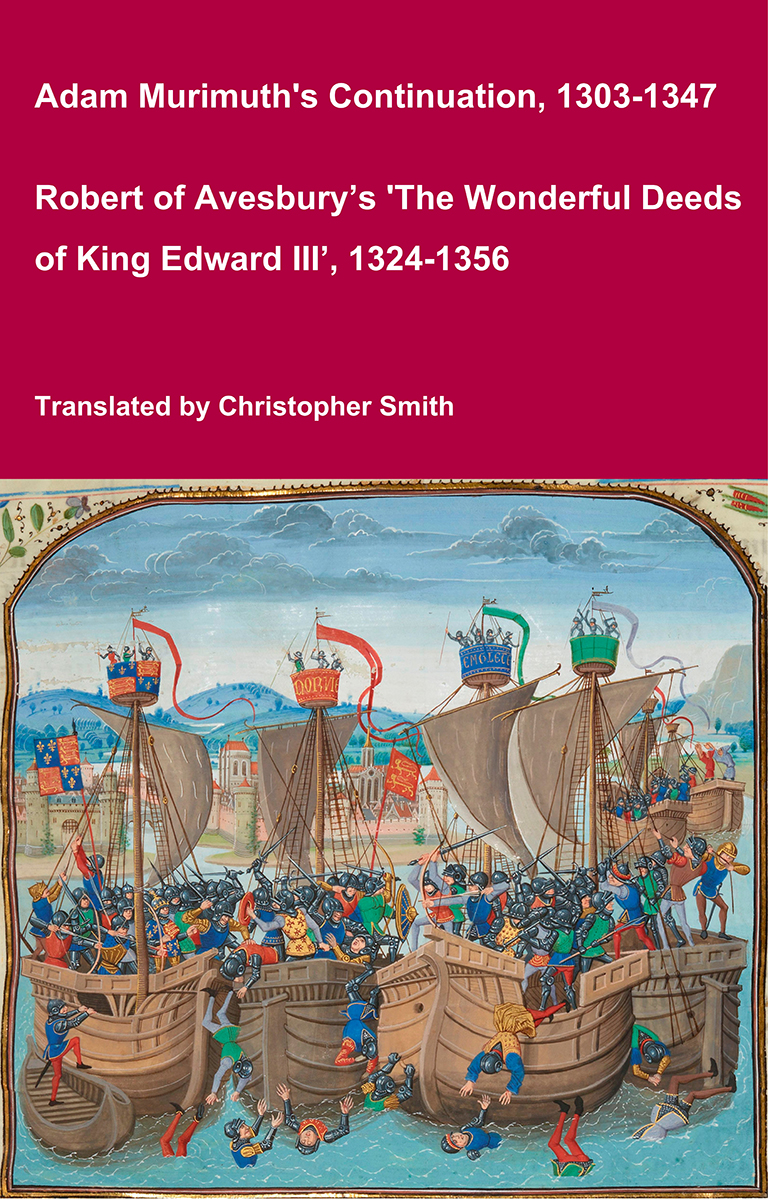
Adam Murimuth's Continuation and Robert of Avesbury’s 'The Wonderful Deeds of King Edward III'
This volume brings together two of the most important contemporary chronicles for the reign of Edward III and the opening phases of the Hundred Years’ War. Written in Latin by English clerical observers, these texts provide a vivid and authoritative window into the political, diplomatic, and military history of fourteenth-century England and its continental ambitions. Adam Murimuth Continuatio's Chronicarum continues an earlier chronicle into the mid-fourteenth century, offering concise but valuable notices on royal policy, foreign relations, and ecclesiastical affairs. Its annalistic structure makes it especially useful for establishing chronology and tracing the development of events year by year. Complementing it, Robert of Avesbury’s De gestis mirabilibus regis Edwardi tertii is a rich documentary chronicle preserving letters, treaties, and official records alongside narrative passages. It is an indispensable source for understanding Edward III’s claim to the French crown, the conduct of war, and the mechanisms of medieval diplomacy. Together, these works offer scholars, students, and enthusiasts a reliable and unembellished account of a transformative period in English and European history. Essential for anyone interested in medieval chronicles, the Hundred Years’ War, or the reign of Edward III.
Available at Amazon in eBook and Paperback format.
04 Jun is in June.
On 4th June 863 Charles Carolingian Archbishop of Mainz (age 38) died.
On 4th June 1094 Sancho Ramírez I King Aragon V King Pamplona (age 52) died. His son Peter (age 26) succeeded I King Aragon, I King Pamplona.
On 4th June 1246 Isabella of Angoulême Queen Consort England (age 58) died at Fontevraud Abbey [Map]. Her son Hugh (age 25) succeeded II Count Angoulême. Yolande Capet Countess Lusignan, La Marche and Angoulême (age 27) by marriage Countess Angoulême.
Archaeologia Volume 35 1853 XXXIII. On the 4th of June [1358], Isabella (age 63) set out on a pilgrimage to Canterbury, and a visit of nearly three weeks' duration to Leeds Castle [Map]. She rested at Tottenham on the 4th, at London on the 5th and 6th, where she received the Countess of Warren (age 62) to dinner, and many noblemen after dinner. At Dartford on the 7th; at Rochester on the 8th, the Countess of Warren again dining with her. At Ospringe on the 9th, and at Canterbury on the 10th and 11th; entertaining there the Abbot of St. Augustine's both days. Under the division of "Alms" are recorded the Queen's oblations at the tomb of St. Thomas; the crown of his head ( the part having the tonsure, cut off by his assassins ), and point of the sword (with which he had been slain); and her payment to minstrels playing "in volta;" as also her oblations in the Church of St. Augustine, and her donations to various hospitals and religious houses in the city.
On 3rd February 1388 the Merciless Parliament commenced. It ended on 4th June 1388. Its primary function was to prosecute members of the Court of King Richard II of England (age 21). The term "Merciless" is contemporary having been coined by the chronicler Henry Knighton.
Michael de la Pole 1st Earl Suffolk (age 58) was sentenced to be hanged, drawn and quartered in his absence. He had escaped to France.
Archbishop Alexander Neville (age 47) was found guilty of treason and it was determined to imprison him for life in Rochester Castle, Kent [Map]. He fled to Louvain [Map] where he became a parish priest for the remainder of his life.
On 19th February 1388 Robert Tresilian was hanged naked and his throat cut. See Chronicle of Adam of Usk.
On 25th March 1388 Nicholas Brembre was hanged. He was buried at Christ Church, Greyfriars [Map].
On 5th May 1388 Simon Burley (age 48) was executed despite the protestations of his friend Edmund of Langley 1st Duke of York (age 46). See Chronicle of Adam of Usk.
On 12th May 1388 John Beauchamp 1st Baron Beauchamp (age 69) was beheaded at Tower Hill [Map]. He was buried at Worcester Cathedral [Map]. Baron Beauchamp of Kidderminster forfeit.
Robert de Vere 1st Duke Ireland (age 26) was attainted.


On 4th June 1394 Philippa Lancaster Queen Consort Denmark was born to King Henry IV of England (age 27) and Mary Bohun (age 26) at Peterborough Castle [Map]. Her mother died in childbirth. She was buried at Church of the Annunciation of our Lady of the Newark [Map]. Coefficient of inbreeding 2.60%. She married 26th October 1406 King Eric of Norway, Denmark and Sweden.
Chronicle of Jean Molinet Chapter 158. [4th June 1487]1 King Edward, newly crowned in Ireland, arrived at Scanforth1 with a great force. Sir Edward de Hauteville, Lord of Scales, who supported King Henry, had come to a town named Lancaster, accompanied by six thousand men, to reinforce King Edward's army; but he was so relentlessly pursued from lodging to lodging, and driven back for three days straight, that he was forced to cross the forest of Nottingham in great haste. The Lord of Oxenford, the Lord of Salisbury and Talbot, the Lord of Astingham, Sir John Savage, and other great lords, accompanied by fifteen thousand men, after the arrival of the said Lord of Scales, and upon recognizing the strength of King Edward's army, recrossed the river with all speed, not daring to face his power, and fled like fugitives.
Le roy Édouard, nouvellement couronné en Irlande, arrive à Scanfort à grande puissance. Sire Édouard de Oudeville, seigneur d'Escalles, tenant parti pour le roy Henry, estoit venu à une ville nommée Lancastre, accompaignié de six mille hommes, pour secourir l'armée du roy Edouard; duquel il fut tellement poursuivi de logis en logis, et rebouté par trois jours continuels, qu'il fut contraint de passer la forest de Notinghen, à très grand hastė . Le seigneur de Occenfort, le seigneur de Saresbry et Tallebot, le seigneur d'Astinghen, messire Jehan Sauvaige, et aultres grands seigneurs, accompaignés de quinze mille hommes, lesquels, après la venue dudit seigneur d'Escales, congnoissant la disposition de l'armée du roy Edouard, repassèrent l'eaue à toute diligence, sans oser attendre sa puissance, et se rendirent comme fuitifs .
Note 1. Some sources say the 4th, some the 5th. The location "Scanfort" usually taken to mean "Piel Island [Map]", which given its size, is an unlikely landing point for the size of Simnel's army. "Carnforth" is a plausible alternative.
On 4th June 1489 Antoine Lorraine II Duke Lorraine was born to René Lorraine II Duke Lorraine Duke of Bar (age 38) and Philippa Egmont Duchess of Bar Duchess Lorraine (age 22) at Bar le Duc. He married 26th June 1515 his second cousin once removed Renée Bourbon Duchess Lorraine and had issue.
Wriothesley's Chronicle [1508-1562]. 4th June 1535. This yeare, the 4th day of June, were diverse Dutch men and weomen convicted for heresie to the number of 22,a of the which 14 were condemned, and two of them, that is to say a man and a woman, were brent in Smythfeild [Map] this day at three of the clocke in the aftemoone, and the other 12 were sent to diverse good townes in England, there to be brent; and the residue were converted and commaunded to departe out of this realme within 14 dayes into their countries, on payne of death at the Kings pleasure.
Note a. On the 25th May, in St. Paul's church at London, 19 men and 6 women, born in Holland, were examined, of whom 14 were convicted as Anabaptists.—Stow.

Letters and Papers. 4th June 1536. R. O. 1058. J. Husee to Lord Lisle (age 72).
Mr. Russell delivered your letter to the King in Mr. Secretary's presence, and declared your mind concerning the contents. Mr. Secretary was commanded to open and read the letter, and afterwards communed with the King a pretty space. I have since spoken with Mr. Secretary, urging him to keep you in remembrance, which he says he has done. He promises to show me more of his mind in three days, so by tomorrow or Tuesday I hope to know what he will say thereto. Undoubtedly he can do much good if he will be earnest as your friend. I wish his wine were had in remembrance. I wish your Lordship had Bewley, but I think it would be time lost to sue for it. If you would name one or two in Hampshire or Wiltshire, I have no fear but the King would soon know your mind. St. Mary's in Winchester, I am told, unless great friendship stay it, is like to be of the number. I am told Waberley is a pretty thing. I think your suit will not be frustrate if you let me know your mind and write to Hennage. Your counsel wish the proviso not to be spoken of. I will not forget Mr. Page for your nag. I have bought for my lady 14 yds. Lukes velvet; Skut will have no less. I hope she will have it before Corpus Christi Day [15 June]. I have also bought your Lordship ½ cwt. of ling and 1 cwt. haberdeyn. I have received £60 that Mr. Seymour (age 36) paid Mr. Wynsor, and have paid the parson of St. Martin's, your grocer and chandler, my lady's velvet, and the fish, in what manner I will write by him that brings my lady's gown. I send you by bearer a satin undercap, with two linings. By Fyssher I sent you two pair of hosen with your proxy, which I look for every day, with an answer to such letters as I sent by him. Mr. Treasurer (age 46) promises to move the King in Snowden's behalf. Mr. Whethill knelt before the King yesterday, I think for the same matter. I moved Mr. Treasurer for my check, showing that I was here on your affairs, and stood in continual danger of my wages by the Act; but he said your Lordship could protect me. Please write to Mr. Treasurer to write to the Controller and Treasurer there about it. I have been asked by one or two for money on your Lordship's behalf for the King's subsidy. Vycars, your late servant, begs you to write a letter to his father declaring the cause of his departure, else his father will never take him for his son. London, 4 June. Hol., pp. 2. Add.
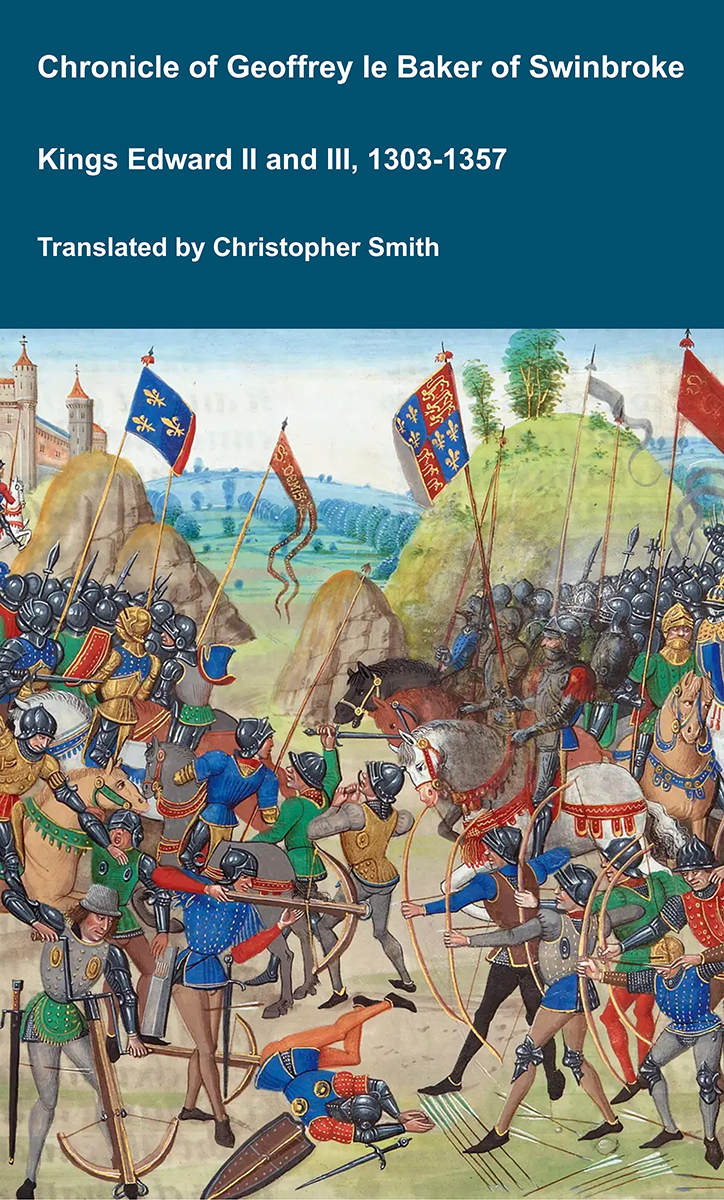
Chronicle of Geoffrey le Baker of Swinbroke
Baker was a secular clerk from Swinbroke, now Swinbrook, an Oxfordshire village two miles east of Burford. His Chronicle describes the events of the period 1303-1356: Gaveston, Bannockburn, Boroughbridge, the murder of King Edward II, the Scottish Wars, Sluys, Crécy, the Black Death, Winchelsea and Poitiers. To quote Herbert Bruce 'it possesses a vigorous and characteristic style, and its value for particular events between 1303 and 1356 has been recognised by its editor and by subsequent writers'. The book provides remarkable detail about the events it describes. Baker's text has been augmented with hundreds of notes, including extracts from other contemporary chronicles, such as the Annales Londonienses, Annales Paulini, Murimuth, Lanercost, Avesbury, Guisborough and Froissart to enrich the reader's understanding. The translation takes as its source the 'Chronicon Galfridi le Baker de Swynebroke' published in 1889, edited by Edward Maunde Thompson.
Available at Amazon in eBook and Paperback format.
Diary of Edward VI. 4th June 1550. Sir Robert Dudeley (age 17), third sonne to th'erle of Warwic (age 46), maried sir Jon Robsartes daughter (age 17)1, after wich mariage ther were certain gentlemen that did strive who shuld first take away a gose's heade, wich was hanged alive on tow crose postes.
Note 1. Whlst popular tradition, the ballad by Mickle, and Sir Walter Scott's romance of Kemlworth, had made the name of Amy Robsart exceedingly familiar, very little was formerly known of her actual history. That deficiency was in some measure supplied by a memoir of her, published in the Gentleman's Magazine for Dec. 1845, New Series, vol. xxiv. p. 595, to which was subsequently appended, in vol. xxxiv. p. 123, the account of her funeral at Oxford. Five letters relative to her mysterious death were also published in 1850, — nearly simultaneously in a new edition of Pepys's Diary, by Lord Braybrooke; and also in The Romance of the Peerage, by Mr. G. L. Craik (see the Gentleman's Magazine, New Series, vol. xxxiii. p. 255).


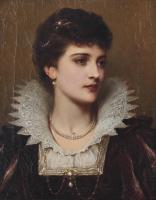
On 4th June 1550 Robert Dudley 1st Earl of Leicester (age 17) and Amy Robsart (age 17) were married at Sheen Palace [Map]. King Edward VI of England and Ireland (age 12) and William Cecil 1st Baron Burghley (age 29) attended. He the son of John Dudley 1st Duke Northumberland (age 46) and Jane Guildford Duchess Northumberland (age 41).

The Gentleman's Magazine Volume 179 Pages 595-600. [4th June 1550]. Lord Robert Dudley (age 17), at the period of his marriage, was eighteen years of age, and it is probable that the lady [Amy Robsart (age 17)] was not older. The wedding took place on the 4th of June, 1550, the day after the memorable alliance had been accomplished between the Lord Lisle (age 23), Lord Robert's elder brother, and the Lady Anne Seymour (age 12), which it was vainly hoped would have cemented the reconciliation of the rival statesmen their fathers,—Edward Seymour (age 50) Duke of Somerset, and John Dudley (age 46) Earl of Warwick, afterwards Duke of Northumberland. The second marriage, which was celebrated, like the former, at the royal palace of Sheen [Map], is thus noticed by King Edward VI. in his diary:
"June 4. Sir Robert Dudely, third sonne to th'erle of Warwic, maried sir John Robsartes daughter; after wich mariage ther were certain gentlemen that did strive who shuld first take away a gose's heade wich was hanged alive on tow crose postes."
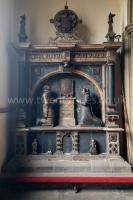
On 24th June 1584 Dorothy Vernon (age 53) died. On 4th June 1611 John Manners (age 57) died at Haddon Hall, Derbyshire [Map]. Both were buried at All Saint's Church, Bakewell, Derbyshire [Map]. Elizabethan Period facing each other. Complex armorial of his arms impaled with her arms.
Arms of John Manners impaled with those of Dorothy Vernon.
On the left, Top Row: 1  Manners Augmented Arms 2 His great-grandmother Eleanor Ros.
Second Row: 5  Beauchamp Arms 6
  Beaumont Arms 7
  Berkeley Arms 8
  Lisle Arms.
Third Row: 11  Tiptoft Arms.
On the right the arms of Dorothy Vernon. Top Row: 1  Vernon Arms. Her arms. Second Row: 5
  Welles Arms. Third Row: 9
  Tailboys Arms. Fourth Row: 10 Berkeley Arms.
Dorothy Vernon: In 1531 she was born to George Vernon "King of the Peak" and Margaret Tailboys. Before 22nd March 1572 John Manners and she were married. He the son of Thomas Manners 1st Earl of Rutland and Eleanor Paston Countess Rutland. They were fourth cousin once removed. He a great x 5 grandson of King Edward III of England.
John Manners: In 1527 he was born to Thomas Manners 1st Earl of Rutland and Eleanor Paston Countess Rutland.
Eleanor Ros: Around 1449 she was born to Thomas Ros 9th Baron Ros Helmsley and Philippa Tiptoft Baroness Ros of Helmsley. In or before 1460 Robert Manners and she were married. They were fifth cousins. He a great x 5 grandson of King Edward I of England. She a great x 5 granddaughter of King Edward I of England. In 1487 Eleanor Ros died. In 1492 George Manners 11th Baron Ros Helmsley became a ward of his uncle-in-law Thomas Lovell, husband of his mother's sister Isabel Ros as a consequence of his father Robert Manners being deemed unable to administer his own affairs.


Memorials of affairs of state in the reigns of Q Elizabeth and K James I Volume 3. Relation of the Formalities and Shews made at the Creation of Prince Henry Prince of Wales, on the 4th of June 1610.
Note 1. As there is no Name to this Letter, I cannot exactly determine by whom it was written; tho' the minute Exactness with which all Circumstances are related, and comparing this with other Papers of that Gentleman's, induces me to think it was wiote to Mr. Trumbull by Mr. John Finner, afterwards Master of the Ceremonies; many of whofe Letters I find in this curious Collection.

Diary of Anne Clifford. 4th June 1616. Upon the 4th Marsh and Rivers came from London and gave me to understand how my Lord (age 27) by the knowledge and consent of Sir William Howard and the advice of his learned Council had sent a letter down into Westmoreland to my Lady's servants and tenants to keep possession for him and me which was a thing I little expected but gave me much contentment for I thought my Lord of Cumberland had taken possession of her jointure quietly.
Calendar of State Papers Charles II 1665 04 Jun 1665. 4th June 1655. 37. Sir William Coventry (age 27) and Sir William Penn (age 34) to the Navy Comrs, A good quantity of masts, yards, and all other stores must be sent immediately to the Downs. Engaged yesterday with the Dutch; they began to stand away at 3 p.m.; chased them all the rest of the day and all night; 20 considerable ships are destroyed and taken; we have only lost the Great Charity. The Earl of Marlborough (age 37), Rear-Admiral Sansum, and Capt. Kirby'are slain, and Sir John Lawson (age 40) wounded. [Adm. Paper.]


John Evelyn's Diary. 4th June 1660. I received letters of Sir Richard Browne's (age 55) landing at Dover, Kent [Map], and also letters from the Queen (age 50), which I was to deliver at Whitehall, not as yet presenting myself to his Majesty (age 30), by reason of the infinite concourse of people. The eagerness of men, women, and children, to see his Majesty, and kiss his hands, was so great, that he had scarce leisure to eat for some days, coming as they did from all parts of the nation; and the King being as willing to give them that satisfaction, would have none kept out, but gave free access to all sorts of people.


John Evelyn's Diary. 4th June 1660. Addressing myself to the Duke (age 26), I was carried to his Majesty (age 30), when very few noblemen were with him, and kissed his hands, being very graciously received. I then returned home, to meet Sir Richard Browne (age 55), who came not till the 8th, after nineteen years exile, during all which time he kept up in his chapel the Liturgy and Offices of the Church of England, to his no small honor, and in a time when it was so low, and as many thought utterly lost, that in various controversies both with Papists and Sectaries, our divines used to argue for the visibility of the Church, from his chapel and congregation.
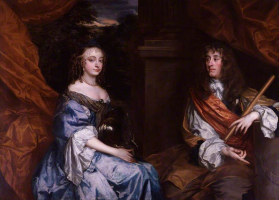


Samuel Pepys' Diary. 4th June 1661. From thence to my Lord Crew's to dinner with him, and had very good discourse about having of young noblemen and gentlemen to think of going to sea, as being as honourable service as the land war. And among other things he told us how, in Queen Elizabeth's time, one young nobleman would wait with a trencher at the back of another till he came to age himself. And witnessed in my young Lord of Kent, that then was, who waited upon my Lord Bedford at table, when a letter came to my Lord Bedford that the Earldom of Kent was fallen to his servant, the young Lord; and so he rose from table, and made him sit down in his place, and took a lower for himself, for so he was by place to sit. From thence to the Theatre [Map] and saw "Harry the 4th", a good play. That done I went over the water and walked over the fields to Southwark, and so home and to my lute. At night to bed.
John Evelyn's Diary. 4th June 1662. Went to visit the Earl of Bristol (age 49), at Wimbledon, Surrey.


Jean de Waurin's Chronicle of England Volume 6 Books 3-6: The Wars of the Roses
Jean de Waurin was a French Chronicler, from the Artois region, who was born around 1400, and died around 1474. Waurin’s Chronicle of England, Volume 6, covering the period 1450 to 1471, from which we have selected and translated Chapters relating to the Wars of the Roses, provides a vivid, original, contemporary description of key events some of which he witnessed first-hand, some of which he was told by the key people involved with whom Waurin had a personal relationship.
Available at Amazon in eBook and Paperback format.
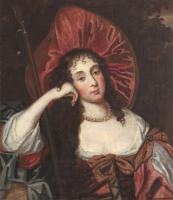
Samuel Pepys' Diary. 4th June 1663. By and by comes Will Howe to see us, and walked with me an hour in the garden, talking of my Lord's falling to business again, which I am glad of, and his coming to lie at his lodgings at White Hall again. The match between Sir J. Cutts and my Lady Jemimah, he says, is likely to go on; for which I am glad. In the Hall to-day James Pearce Surgeon tells me that the Queen (age 24) begins to be brisk, and play like other ladies, and is quite another woman from what she was, of which I am glad. It may be, it may make the King (age 33) like her the better, and forsake his two mistresses, my Baroness Castlemaine's (age 22) and Stewart. He gone we sat at the office till night, and then home, where my wife is come, and has been with her father all the afternoon, and so home, and she and I to walk in the garden, giving ear to her discourse of her father's affairs, and I found all well, so after putting things in order at my office, home to supper and to bed.




Samuel Pepys' Diary. 4th June 1663. Home by water, where by and by comes Dean Honiwood, and I showed him my double horizontal diall, and promise to give him one, and that shall be it. So, without eating or drinking, he went away to Mr. Turner's, where Sir J. Minnes (age 64) do treat my Chancellor (age 54) and a great deal of guests to-day with a great dinner, which I thank God I do not pay for; and besides, I doubt it is too late for any man to expect any great service from my Chancellor, for which I am sorry, and pray God a worse do not come in his room. So I to dinner alone, and so to my chamber, and then to the office alone, my head aching and my mind in trouble for my wife, being jealous of her spending the day, though God knows I have no great reason. Yet my mind is troubled.


On 4th June 1663 Archbishop William Juxon (age 81) died.
Samuel Pepys' Diary. 4th June 1664. So to the Committee for Tangier all afternoon, where still the same confused doings, and my Lord Fitz-Harding (age 34) now added to the Committee; which will signify much. It grieves me to see how brokenly things are ordered.
Samuel Pepys' Diary. 4th June 1664. So by coach home, and at my office late, and so to supper and to bed, my body by plenty of breaking of wind being just now pretty well again, having had a constant akeing in my back these 5 or 6 days. Mr. Coventry (age 36) discoursing this noon about Sir W. Batten (age 63) (what a sad fellow he is!) told me how the King (age 34) told him the other day how Sir W. Batten, being in the ship with him and Prince Rupert (age 44) when they expected to fight with Warwick, did walk up and down sweating with a napkin under his throat to dry up his sweat; and that Prince Rupert being a most jealous man, and particularly of Batten, do walk up and down swearing bloodily to the King, that Batten had a mind to betray them to-day, and that the napkin was a signal; "but, by God", says he, "if things go ill, the first thing I will do is to shoot him".


Samuel Pepys' Diary. 4th June 1664. The like he says is said of my Lord Tiviott, who was the boldest adventurer of his person in the world, and from a mean man in few years was come to this greatness of command and repute only by the death of all his officers, he many times having the luck of being the only survivor of them all, by venturing upon services for the King of France (age 25) that nobody else would; and yet no man upon a defence, he being all fury and no judgment in a fight.
Samuel Pepys' Diary. 4th June 1665. Thence to my chamber again to settle my Tangier accounts against tomorrow and some other things, and with great joy ended them, and so to supper, where a good fowl and tansy, and so to bed. Newes being come that our fleete is pursuing the Dutch, who, either by cunning, or by being worsted, do give ground, but nothing more for certain. Late to bed upon my papers being quite finished.
Before 4th June 1666 William Clarke (age 43) died after having had his leg amputated following the Four Days' Battle.

Samuel Pepys' Diary. 4th June 1666. THE FIGHT.
How we found the Dutch fleete at anchor on Friday half seas over, between Dunkirke and Ostend, and made them let slip their anchors. They about ninety, and we less than sixty. We fought them, and put them to the run, till they met with about sixteen sail of fresh ships, and so bore up again. The fight continued till night, and then again the next morning from five till seven at night. And so, too, yesterday morning they begun again, and continued till about four o'clock, they chasing us for the most part of Saturday and yesterday, we flying from them. The Duke (age 32) himself, then those people were put into the catch, and by and by spied the Prince's (age 46) fleete coming, upon which De Ruyter (age 59) called a little council (being in chase at this time of us), and thereupon their fleete divided into two squadrons; forty in one, and about thirty in the other (the fleete being at first about ninety, but by one accident or other, supposed to be lessened to about seventy); the bigger to follow the Duke, the less to meet the Prince. But the Prince come up with the Generall's fleete, and the Dutch come together again and bore towards their own coast, and we with them; and now what the consequence of this day will be, at that time fighting, we know not. The Duke was forced to come to anchor on Friday, having lost his sails and rigging. No particular person spoken of to be hurt but Sir W. Clerke (age 43), who hath lost his leg, and bore it bravely. The Duke himself had a little hurt in his thigh, but signified little. The King (age 36) did pull out of his pocket about twenty pieces in gold, and did give it Daniel for himself and his companion; and so parted, mightily pleased with the account he did give him of the fight, and the successe it ended with, of the Prince's coming, though it seems the Duke did give way again and again. The King did give order for care to be had of Mr. Daniel and his companion; and so we parted from him, and then met the Duke [of York], and gave him the same account: and so broke up, and I left them going to the surgeon's and I myself by water to the 'Change [Map], and to several people did give account of the business.
Samuel Pepys' Diary. 4th June 1666. Thence with my Lord Bruncker (age 46) and Creed by coach to White Hall, where fresh letters are come from Harwich, Essex [Map], where the Gloucester, Captain Clerke, is come in, and says that on Sunday night upon coming in of the Prince (age 46), the Duke did fly; but all this day they have been fighting; therefore they did face again, to be sure. Captain Bacon of The Bristoll is killed. They cry up Jenings of The Ruby, and Saunders of The Sweepstakes. They condemn mightily Sir Thomas Teddiman for a coward, but with what reason time must shew. Having heard all this Creed and I walked into the Parke till 9 or 10 at night, it being fine moonshine, discoursing of the unhappinesse of our fleete, what it would have been if the Prince had not come in, how much the Duke hath failed of what he was so presumptuous of, how little we deserve of God Almighty to give us better fortune, how much this excuses all that was imputed to my Lord Sandwich (age 40), and how much more he is a man fit to be trusted with all those matters than those that now command, who act by nor with any advice, but rashly and without any order. How bad we are at intelligence that should give the Prince no sooner notice of any thing but let him come to Dover without notice of any fight, or where the fleete were, or any thing else, nor give the Duke any notice that he might depend upon the Prince's reserve; and lastly, of how good use all may be to checke our pride and presumption in adventuring upon hazards upon unequal force against a people that can fight, it seems now, as well as we, and that will not be discouraged by any losses, but that they will rise again.

Samuel Pepys' Diary. 4th June 1666. Up, and with Sir J. Minnes (age 67) and Sir W. Pen (age 45) to White Hall in the latter's coach, where, when we come, we find the Duke (age 32) at St. James's, whither he is lately gone to lodge. So walking through the Parke we saw hundreds of people listening at the Gravel-pits, [Kensington] and to and again in the Parke to hear the guns, and I saw a letter, dated last night, from Strowd (age 38), Governor of Dover Castle, which says that the Prince (age 46) come thither the night before with his fleete, but that for the guns which we writ that we heard, it is only a mistake for thunder1 and so far as to yesterday it is a miraculous thing that we all Friday, and Saturday and yesterday, did hear every where most plainly the guns go off, and yet at Deale [Map] and Dover, Kent [Map] to last night they did not hear one word of a fight, nor think they heard one gun. This, added to what I have set down before the other day about the Katharine, makes room for a great dispute in philosophy, how we should hear it and they not, the same wind that brought it to us being the same that should bring it to them: but so it is. Major Halsey, however (he was sent down on purpose to hear newes), did bring newes this morning that he did see the Prince and his fleete at nine of the clock yesterday morning, four or five leagues to sea behind the Goodwin [Map], so that by the hearing of the guns this morning we conclude he is come to the fleete.
Note 1. Evelyn (age 45) was in his garden when he heard the guns, and be at once set off to Rochester, Kent [Map] and the coast, but he found that nothing had been heard at Deal (see his "Diary", June 1st, 1666).


John Evelyn's Diary. 4th June 1679. I dined with Mr. Pepys (age 46) in the Tower of London [Map], he having been committed by the House of Commons for misdemeanors in the Admiralty when he was secretary; I believe he was unjustly charged. Here I saluted my Lords Stafford (age 64) and Petre (age 53), who were committed for the Popish plot.


John Evelyn's Diary. 4th June 1685. Came to visite and take leave of me Sr Gab. Sylvius, now going Envoy extraordinary into Denmark, with his Secretary and Chaplaine, a Frenchman, who related the miserable persecution of the Protestants in France; not above 10 Churches left them, and those also threaten'd to be demolish'd; they were commanded to christen their children within 24 houres after birth, or else a Popish Priest was to be call'd, and then ye infant brought up in Popery. In some places they were 30 leagues from any minister or opportunity of worship. "This persecution had displeas'd the most industrious part of ye nation, and dispers'd those into Swisse, Burgundy, Holland, Germany, Denmark, England, and the Plantations". There were with Sr Gabriel, his lady, Sr Wm Godolphin (age 45) and sisters, and my Lord Godolphin's (age 39) little son, my charge. I brought them to the water side where Sir Gabriel embark'd, and the rest return'd to London.
John Evelyn's Diary. 4th June 1685. Then the King (age 51) rose, the Lords accompanying him to his bed-chamber, where, whilst he repos'd himselfe, tired indeede as he was with griefe and watching, they return'd againe Into the Council-chamber to take order for the proclaiming his Ma*, which (after some debate) they consented should be in the very forme his grandfather K. James I. was, after ye death of Queene Elizabeth; as likewise that the Lords, &c. should proceede in their coaches thro' the Citty for the more solemnity of it. Upon this was I, and severall other Gentlemen waiting in the Privy-gallerie, admitted into ye Council-chamber to be witnesse of what was resolv'd on. Thence with the Lords, the Lord Marshall and Heraulds, and other Crowne Officers being ready, we first went to White-hall gate, where the Lords stood on foote bare-headed, whilst the Herauld proclaim'd his Majesty's title to the Imperial Crowne and Succession according to ye forme, the trumpets and kettle-drums having first sounded 3 times, which ended with the people's acclamations. Then a Herauld call'd the Lords' coaches according to rank, myselfe accompanying the solemnity in my Lord Cornwallis's (age 29) coach, first to Temple Barr, where the Lord Maior and his brethren met us on horseback, in all theire formalities, and proclaim'd the King; hence to the Exchange in Cornhill, and so we return'd in the order we set forth. Being come to Whitehall, we all went and kiss'd the King and Queenes (age 26) hands. He had ben on ye bed, but was now risen and in his undresse. The Queene (age 23) was in bed in her appartment, but put forth her hand, seeming to be much afflicted, as I believe she was, having deported herselfe so decently upon all occasions since she came into England, which made her universally belov'd. Thus concluded this sad and not joyfull day.


The History of William Marshal was commissioned by his son shortly after William’s death in 1219 to celebrate the Marshal’s remarkable life; it is an authentic, contemporary voice. The manuscript was discovered in 1861 by French historian Paul Meyer. Meyer published the manuscript in its original Anglo-French in 1891 in two books. This book is a line by line translation of the first of Meyer’s books; lines 1-10152. Book 1 of the History begins in 1139 and ends in 1194. It describes the events of the Anarchy, the role of William’s father John, John’s marriages, William’s childhood, his role as a hostage at the siege of Newbury, his injury and imprisonment in Poitou where he met Eleanor of Aquitaine and his life as a knight errant. It continues with the accusation against him of an improper relationship with Margaret, wife of Henry the Young King, his exile, and return, the death of Henry the Young King, the rebellion of Richard, the future King Richard I, war with France, the death of King Henry II, and the capture of King Richard, and the rebellion of John, the future King John. It ends with the release of King Richard and the death of John Marshal.
Available at Amazon in eBook and Paperback format.
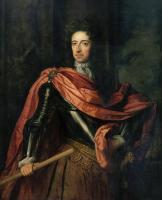
John Evelyn's Diary. 4th June 1690. King William (age 39) set forth on his Irish expedition, leaving the Queen (age 28) Regent.


John Evelyn's Diary. 4th June 1696. A committee met at Whitehall [Map] about Greenwich Hospital [Map], at Sir Christopher Wren's (age 72), his Majesty's Surveyor-General. We made the first agreement with divers workmen and for materials; and gave the first order for proceeding on the foundation, and for weekly payments to the workmen, and a general account to be monthly.
On 4th June 1699 Popham Seymour-Conway (age 24) drunkenly duelled with Captain George Kirk of the Royal Horse Guards; he was wounded in the neck.
On 18th June 1699 he died from wounds received duelling. His estates were inherited by his younger brother Francis Seymour-Conway 1st Baron Conway (age 20).

Minutes of the Society of Antiquaries. 4th June 1718. Mr Mirkleton [?] showed the Society a picture he has of William Earl of Pembroke, an other of an Earl of Essex.
Mr Warkhouse exhibited an old parchment deed with many seals to it being a Letter of Authority to grant livery and seizin to Sir Thomas Erpingham [Possibly Thomas Erpingham] of an Hospital lately called Berneys Inn in Norwich 10 H.III and likewise two Latin Letters from Abraham Wheeler to his patron Alderman Adams.
On 4th June 1723 Léopold Clement Charles Lorraine (age 16) died of smallpox.


On 4th June 1729 William Cavendish 2nd Duke Devonshire (age 57) died. His son William (age 30) succeeded 3rd Duke Devonshire, 6th Earl Devonshire, 6th Baron Cavendish Hardwick. Catherine Hoskins Duchess Devonshire (age 30) by marriage Duchess Devonshire.


On 4th June 1732 Cornwall Fitzfrederick Vane was born illegitimately to Frederick Louis Hanover Prince of Wales (age 25) and Anne Vane in St James' Street. He a grandson of King George II of Great Britain and Ireland. He died aged three in 1736.


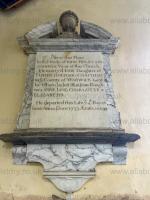
St Nicholas' Church, Stanford-on-Avon [Map]. Memorial to Reverend John Pinley, Vicar, died 4th June 1733, aged 39.
On 4th June 1738 King George III of Great Britain and Ireland was born to Frederick Louis Hanover Prince of Wales (age 31) and Augusta Saxe Coburg Altenburg (age 18) at Norfolk House, St James' Square. He a grandson of King George II of Great Britain and Ireland. He married 8th September 1761 his third cousin Charlotte Mecklenburg Strelitz Queen Consort England and had issue.


On 4th June 1803 Henry Somerset 5th Duke Beaufort (age 58) abeyance terminated 5th Baron Botetort.
Henrici Quinti, Angliæ Regis, Gesta, is a first-hand account of the Agincourt Campaign, and subsequent events to his death in 1422. The author of the first part was a Chaplain in King Henry's retinue who was present from King Henry's departure at Southampton in 1415, at the siege of Harfleur, the battle of Agincourt, and the celebrations on King Henry's return to London. The second part, by another writer, relates the events that took place including the negotiations at Troye, Henry's marriage and his death in 1422.
Available at Amazon in eBook and Paperback format.

Thomas Bateman 1845. On the 4th of June, 1845, another large flat barrow was opened, which is situated upon the level summit of a hill upon Alsop Moor, known by the name of Net Lowe Hill [Map]. This barrow is about twenty-five yards in diameter, and not more than two feet in height; it was opened by cutting through it in different directions, so as to divide it into quarters. In each of these trenches, on approaching the centre, were found horses' teeth and an abundance of rats' bones; and in one of them a small piece of a coarse urn. In the centre of the tumulus was found a skeleton extended on its back at full length, and lying on a rather higher level than the surface of the natural soil; close to the right arm lay a large dagger of brass (broken in two by the weight of the superincumbent stones), with the decorations of its handle consisting of thirty rivets, and two pins of brass. In vol. i, plate 23, of Sir Richard Hoare's "Ancient Wiltshire" a dagger is engraved of a precisely similar character the number of rivets or studs and pins being exactly the same; close to this dagger were two highly-polished ornaments made from a kind of bituminous shale known in the south of England as Kimmeridge coal and equally well known to the archaeologist as the material of the coal money and of many other ancient British ornaments. Those in question are circular and moulded round the edges having a round elevation on the fronts to allow of two perforations which meet in an oblique direction on the back for the purpose of attaching the ornaments to some part of the dress or more probably to the dagger-belt of the chief with whose remains they were interred. In vol. 1, plate 34, of Sir Richard Hoare's book a similar ornament of jet is engraved, which is smaller, and does seem to have a moulding round the edge. It is a singular fact that, although the skeleton had evidently been never previously disturbed, the lower jaw lay at the feet of the body. Along with the above-mentioned articles were numerous fragments of calcined flint, and amongst the soil of the barrow were two rude instruments of the same.
Ten Years' Digging. The largest barrow at Three Lows [Either Three Lows Barrow 1 [Map] or Three Lows Barrow 2 [Map]?], near Wetton, opened, as far as the central part is concerned, on the 7th of June, 1845, was now fully investigated on the evenings of the 4th, 10th, 12th, and 13th of June, by a trench cut round the former excavation, so as to expose a considerable space between it and the outside of the mound. We began at the west side, and found, first, an imperfect armlet of thick bronze wire; next, a noble pair of red deer's horns, with part of the skull attached to one of them, and having with them a neat arrow-head of flint. Proceeding onward, we found many pieces of a large urn, with the burnt bones it had contained; and on the 13th we discovered the place where it had been first placed, part of the bottom still remaining in situ. Amongst earth blackened by the admixture of ashes, here were found a very neat barbed arrow-head, and a remarkably fine spear-head or dagger of flint, upwards of five inches long, without the point, which is missing. The latter has been so much calcined as to present a dark-coloured vitrified surface, exhibiting numberless cracks precisely similar to Cracklin porcelain; where broken, it shows a white interior. We had before found two calcined flint spear-heads of smaller size, and a round instrument which may also have been originally deposited with the burnt bones. Fragments of many urns, some tastefully ornamented, burnt and unburnt haman bones, large pieces of stags' horns, and flakes of flint, were found in all parts of the mound, but most plentifully on the south and west sides. The unusual number of stags' horns of the largest size found in this barrow on both occasions is very remarkable. They indicate the hunter-life of its occupants, naturally resulting from the fiudlity with which a regular supply of large game could be obtained before the country was to any great extent brought under cultivation.
The Diary of George Price Boyce 1851. 4th June 1851. Called on Wells (age 22). Miss Guyson, the model, was with him, a good looking girl. She gave him a ticket for the Portland Gallery, National Institution, which I made use of. A fine picture [See Painting] there by Collinson (age 26), P.R.B., from the life of St. Elizabeth of Hungary (price £240).
Ten Years' Digging. On the 4th and 6th of June we re-opened a barrow [Beechen Hill Barrow 1 [Map] or Beechen Hill Barrow 2 [Map]] at Bitchin Hill Harbour [Map], which had been partially excavated on the 8th of July, 1845. The present operations were directed to the south-east side, where, at the depth of about a foot from the surface, we found the contracted skeleton of a young person, lying on its right side^ and having a small vase, 6½ inches high simply ornamented, standing upright at the feet — a very imusual position in this part of the country, as the vessels are almost always placed near the upper part of the person. The vase was guarded by a flat stone, a foot square, set up by its side. A similar stone was set on edge by the skeleton, which was embedded in rats' bones, and was much decayed. About a handful of burnt bones was found at no great distance from it. More to the east we found the skeleton of an adult^ wanting the head, although the bones had not been disturbed; it lay in the usual contracted posture, with the shoulders towards the head of the other skeleton, and was accompanied by a boar's tusk of small size only. Amongst other animal remains observed in the barrow were bones of the polecat (Mustela Putorius, Linn.). It will be remarked that headless skeletons are not very unusual in tumuli in this part of England.
On 4th June 1868 Henry John Chetwynd-Talbot 3rd Earl Talbot 18th Earl of Shrewsbury (age 64) died. His son Charles (age 38) succeeded 19th Earl of Shrewsbury, 19th Earl Waterford, 4th Earl Talbot, 4th Viscount Ingestre, 6th Baron Talbot of Hensol in Glamorganshire. Anna Theresa Cockerell Countess Shrewsbury and Waterford (age 32) by marriage Countess of Shrewsbury, Countess Waterford, Countess Talbot.
Monument at St Mary the Virgin Church, Ingestre [Map] sculpted by John Steell (age 63).
Charles Chetwynd-Talbot 19th Earl of Shrewsbury 4th Earl Talbot: On 13th April 1830 he was born to Henry John Chetwynd-Talbot 3rd Earl Talbot 18th Earl of Shrewsbury and Sarah Elizabeth Beresford Countess Talbot Shrewsbury Waterford. On 15th February 1855 Charles Chetwynd-Talbot 19th Earl of Shrewsbury 4th Earl Talbot and Anna Theresa Cockerell Countess Shrewsbury and Waterford were married. He the son of Henry John Chetwynd-Talbot 3rd Earl Talbot 18th Earl of Shrewsbury and Sarah Elizabeth Beresford Countess Talbot Shrewsbury Waterford. In 1874 he was appointed Privy Council. On 11th May 1877 Charles Chetwynd-Talbot 19th Earl of Shrewsbury 4th Earl Talbot died. His son Charles succeeded 20th Earl of Shrewsbury, 20th Earl Waterford, 5th Earl Talbot, 5th Viscount Ingestre, 7th Baron Talbot of Hensol in Glamorganshire.
Anna Theresa Cockerell Countess Shrewsbury and Waterford: On 20th February 1836 she was born to Richard Howe Cockerell and Theresa Howe Newcomen. On 29th July 1912 Anna Theresa Cockerell Countess Shrewsbury and Waterford died.


On 4th June 1887 Albert-Ernest Carrier-Belleuse (age 62) died.
On 4th June 1892 Charles Alfred Euston Fitzroy 10th Duke Grafton was born to Charles Edward Fitzroy (age 35) and Ismay Fitzroy (age 29) at Euston Hall, Suffolk. He married (1) 24th January 1918 Doreen Buxton Duchess Grafton, daughter of Sydney Charles Buxton 1st Earl Buxton, and had issue (2) 6th October 1924 Lucy Eleanor Barnes Duchess Fitzroy and had issue (3) 18th July 1944 Rita Emily Carr-Ellison Duchess Grafton.
On 4th June 1913 Emily Wilding Davison (age 40) was hit by the King's (age 48) horse Anmer after she had stepped into its path at Tattenham Corner during the Derby at Epsom Racecourse. The jockey Herbert Jones was injured. The King and Queen (age 46) were present. The King recorded in his diary "a most regrettable and scandalous proceeding". She was operated on two days later, but she never regained consciousness.

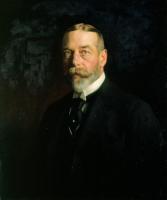


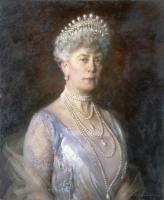


On 4th June 1941 Wilhelm Hohenzollern (age 82) died.
On 4th June 1394 Philippa Lancaster Queen Consort Denmark was born to King Henry IV of England (age 27) and Mary Bohun (age 26) at Peterborough Castle [Map]. Her mother died in childbirth. She was buried at Church of the Annunciation of our Lady of the Newark [Map]. Coefficient of inbreeding 2.60%. She married 26th October 1406 King Eric of Norway, Denmark and Sweden.
On 4th June 1418 Henry Scrope 4th Baron Scrope of Bolton was born to Richard Scrope 3rd Baron Scrope of Bolton (age 25) and Margaret Neville Baroness Scrope Bolton. He married 1435 his half fourth cousin Elizabeth Scrope Baroness Scrope Bolton, daughter of John Scrope 4th Baron Scrope of Masham and Elizabeth Chaworth Baroness Scrope Masham, and had issue.
Abbot John Whethamstede’s Chronicle of the Abbey of St Albans
Abbot John Whethamstede's Register aka Chronicle of his second term at the Abbey of St Albans, 1451-1461, is a remarkable text that describes his first-hand experience of the beginning of the Wars of the Roses including the First and Second Battles of St Albans, 1455 and 1461, respectively, their cause, and their consequences, not least on the Abbey itself. His text also includes Loveday, Blore Heath, Northampton, the Act of Accord, Wakefield, and Towton, and ends with the Coronation of King Edward IV. In addition to the events of the Wars of the Roses, Abbot John, or his scribes who wrote the Chronicle, include details in the life of the Abbey such as charters, letters, land exchanges, visits by legates, and disputes, which provide a rich insight into the day-to-day life of the Abbey, and the challenges faced by its Abbot.
Available at Amazon in eBook and Paperback format.
On 4th June 1489 Antoine Lorraine II Duke Lorraine was born to René Lorraine II Duke Lorraine Duke of Bar (age 38) and Philippa Egmont Duchess of Bar Duchess Lorraine (age 22) at Bar le Duc. He married 26th June 1515 his second cousin once removed Renée Bourbon Duchess Lorraine and had issue.

On 4th June 1731 Catherine Compton Countess Egmont was born to Charles Compton (age 39) and Mary Lucy (age 21) at Quinta. She married after 16th August 1752 John Perceval 2nd Earl Egmont, son of John Perceval 1st Earl Egmont and Catherine Parker Countess Egmont, and had issue.
On 4th June 1732 Cornwall Fitzfrederick Vane was born illegitimately to Frederick Louis Hanover Prince of Wales (age 25) and Anne Vane in St James' Street. He a grandson of King George II of Great Britain and Ireland. He died aged three in 1736.
On 4th June 1737 Charles Davers 6th Baronet was born to Jermyn Davers 4th Baronet (age 51) and Margaretta Green.
On 4th June 1738 King George III of Great Britain and Ireland was born to Frederick Louis Hanover Prince of Wales (age 31) and Augusta Saxe Coburg Altenburg (age 18) at Norfolk House, St James' Square. He a grandson of King George II of Great Britain and Ireland. He married 8th September 1761 his third cousin Charlotte Mecklenburg Strelitz Queen Consort England and had issue.
On 4th June 1739 John Aubrey 6th Baronet was born to Thomas Aubrey 5th Baronet (age 31) and Martha Carter Lady Aubrey. He married (1) 9th March 1771 Mary Colebrooke, daughter of James Colebrooke 1st Baronet, and had issue (2) 26th May 1783 his first cousin Martha Catherine Carter.
On 4th June 1741 Edward Stracey 1st Baronet was born.
On 4th June 1742 Jacob Bouverie was born to Jacob Bouverie 1st Viscount Folkestone (age 47) and Elizabeth Marsham Viscountess Fokestone (age 30). He died aged two in 1745.

On 4th June 1751 John Scott 1st Earl Eldon was born.
On 4th June 1752 Charles Finch was born to Heneage Finch 3rd Earl Aylesford (age 36) and Charlotte Seymour Countess Aylesford (age 21).
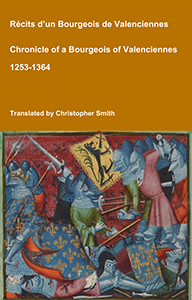
Chronicle of a Bourgeois of Valenciennes
Récits d’un bourgeois de Valenciennes aka The Chronicle of a Bourgeois of Valenciennes is a vivid 14th-century vernacular chronicle written by an anonymous urban chronicler from Valenciennes in the County of Hainaut. It survives in a manuscript that describes local and regional history from about 1253 to 1366, blending chronology, narrative episodes, and eyewitness-style accounts of political, military, and social events in medieval France, Flanders, and the Low Countries. The work begins with a chronological framework of events affecting Valenciennes and its region under rulers such as King Philip VI of France and the shifting allegiances of local nobility. It includes accounts of conflicts, sieges, diplomatic manoeuvres, and the impact of broader struggles like the Hundred Years’ War on urban life in Hainaut. Written from the perspective of a burgher (bourgeois) rather than a monastery or royal court, the chronicle offers a rare lay viewpoint on high politics and warfare, reflecting how merchants, townspeople, and civic institutions experienced the turbulence of the 13th and 14th centuries. Its narrative style combines straightforward reporting of events with moral and civic observations, making it a valuable source for readers interested in medieval urban society, regional politics, and the lived experience of war and governance in pre-modern Europe.
Available at Amazon in eBook and Paperback format.

On 4th June 1775 William Henry Byng was born to George Byng 4th Viscount Torrington (age 34) and Lucy Boyle Viscountess Torrington.
On 4th June 1777 Henry Every 9th Baronet was born to Edward Every 8th Baronet (age 23) and Mary Morley (age 24). He married 22nd December 1798 Penelope Mosley Lady Every, daughter of John Parker Mosley 1st Baronet, and had issue.
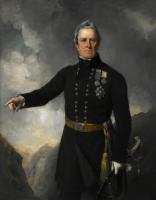
On 4th June 1786 Field Marshal George Pollock 1st Baronet was born to David Pollock of Charing Cross and Sarah Parsons. He married (1) 1810 Frances Webbe Barclay and had issue (2) 1852 Henrietta Wollaston.
On 4th June 1786 Caroline Chetwynd was born to George Chetwynd 1st Baronet (age 47). She married 17th November 1808 Colonel Lancelot Rolleston and had issue.
On 4th June 1794 Archibald Kennedy was born to Archibald Kennedy 1st Marquess of Ailsa (age 24) and Margaret Erskine Marchioness Ailsa (age 22).


On 4th June 1810 Walter Rockliffe Farquhar 3rd Baronet was born to Thomas Harvie Farquhar 2nd Baronet (age 34). He married 28th November 1837 Mary Octavia Somerset Lady Farquhar, daughter of Henry Charles Somerset 6th Duke Beaufort and Charlotte Sophia Leveson-Gower Duchess Beaufort, and had issue.
On 4th June 1810 John Savile 4th Earl Mexborough was born to John Savile 3rd Earl Mexborough (age 26) and Anne Yorke Countess Mexborough (age 27). He married (1) 1842 Rachel Katherine Walpole, daughter of Horatio Walpole 3rd Earl Orford and Mary Fawkener Countess Orford, and had issue (2) July 1861 Agnes Louisa Elizabeth Raphael and had issue.
On 4th June 1819 Thomas Bateson 1st Baron Deramore was born to Robert Bateson 1st Baronet (age 37). He married 24th February 1849 Caroline Elizabeth Anne Rice Trevor Baroness Deramore, daughter of George Rice Trevor 4th Baron Dynevor and Frances Fitzroy Baroness Dynevor, and had issue.
On 4th June 1828 George Cubitt 1st Baron Ashcombe was born to Thomas Cubitt (age 40) and Mary Anne Warner (age 26).

On 4th June 1833 Garnet Wolseley 1st Viscount Wolseley was born to Major Garnet Wolseley (age 45) and Frances Anne Smith (age 32). He married 4th June 1867 Louisa Erskine Holmes Viscountess Wolseley and had issue.
On 4th June 1843 Mary Bruce was born to James Bruce 12th Earl Kincardine 8th Earl Elgin (age 31) and Elizabeth Mary Cumming Bruce Countess Kincardine and Elgin at Jamaica. On 7th June 1843 she and her mother died.
On 4th June 1846 Mary Hood Marchioness Hertford was born to Alexander Nelson Hood 1st Viscount Bridport (age 31) and Mary Penelope Hill (age 28). She married 16th April 1868 Hugh de Grey Seymour-Conway 6th Marquess Hertford, son of Francis George Hugh Seymour-Conway 5th Marquess Hertford and Frances Elizabeth Anson Marchioness Hertford, and had issue.
On 4th June 1846 Fredrick George Lindley Meynell was born to Charles Wood 1st Viscount Halifax (age 45) and Mary Grey Viscountess Halifax (age 39). He married before 1910 Mary Susan Félicie Lindsay.
On 4th June 1851 George Howland William Beaumont 10th Baronet was born to George Howland Beaumont 9th Baronet (age 22) and Pauline Menzies Belli Lady Beaumont (age 22).
Chronicle of Walter of Guisborough
A canon regular of the Augustinian Guisborough Priory, Yorkshire, formerly known as The Chronicle of Walter of Hemingburgh, describes the period from 1066 to 1346. Before 1274 the Chronicle is based on other works. Thereafter, the Chronicle is original, and a remarkable source for the events of the time. This book provides a translation of the Chronicle from that date. The Latin source for our translation is the 1849 work edited by Hans Claude Hamilton. Hamilton, in his preface, says: 'In the present work we behold perhaps one of the finest samples of our early chronicles, both as regards the value of the events recorded, and the correctness with which they are detailed; Nor will the pleasing style of composition be lightly passed over by those capable of seeing reflected from it the tokens of a vigorous and cultivated mind, and a favourable specimen of the learning and taste of the age in which it was framed.'
Available at Amazon in eBook and Paperback format.
On 4th June 1860 Annie Cass Viscountess Cowdray was born. She married 1881 Weetman Dickinson Pearson 1st Viscount Cowdray and had issue.
On 4th June 1889 Cicely Mordaunt was born to Charles Mordaunt 10th Baronet (age 53) and Mary Louisa Cholmondeley Lady Massingham Parva (age 37).
On 4th June 1892 David Cecil Lycett Green was born to Edward Lycett Green 2nd Baronet (age 32) and Ethel Mary Wilson Lady Green (age 27).
On 4th June 1892 Charles Alfred Euston Fitzroy 10th Duke Grafton was born to Charles Edward Fitzroy (age 35) and Ismay Fitzroy (age 29) at Euston Hall, Suffolk. He married (1) 24th January 1918 Doreen Buxton Duchess Grafton, daughter of Sydney Charles Buxton 1st Earl Buxton, and had issue (2) 6th October 1924 Lucy Eleanor Barnes Duchess Fitzroy and had issue (3) 18th July 1944 Rita Emily Carr-Ellison Duchess Grafton.
On 4th June 1918 Ronald Horace Brooke-Pechell 9th Baronet was born to Major Hugh Charles Pechell (age 27).
On 4th June 1960 John Gerald Strutt 6th Baron Rayleigh was born to Charles Richard Strutt (age 50).
On 4th June 1337 Charles of Blois Duke Brittany (age 18) and Joan "Lame" Capet Countess Penthièvre (age 18) were married at Paris [Map]. She the daughter of Guy Capet Count Penthièvre and Jeanne Avaugour Countess Penthièvre. He the son of Guy Chatillon I Count Blois and Margaret Valois (age 42). They were fourth cousins. He a great x 5 grandson of King Stephen I England. She a great x 2 granddaughter of King Henry III of England.
On 4th June 1550 Robert Dudley 1st Earl of Leicester (age 17) and Amy Robsart (age 17) were married at Sheen Palace [Map]. King Edward VI of England and Ireland (age 12) and William Cecil 1st Baron Burghley (age 29) attended. He the son of John Dudley 1st Duke Northumberland (age 46) and Jane Guildford Duchess Northumberland (age 41).
On 4th June 1724 Charles Radclyffe Earl Newburgh (age 30) and Charlotte Livingstone 3rd Countess Newburgh (age 30) were married. He by marriage Earl of Newburgh. She the daughter of Charles Livingston 2nd Earl of Newburgh and Frances Brudenell Countess Newburgh. He the son of Edward Radclyffe 2nd Earl Derwentwater and Mary Tudor Countess Derwentwater (age 50). They were third cousin once removed. He a grandson of King Charles II of England Scotland and Ireland.
On 4th June 1765 John Perceval 3rd Earl Egmont (age 27) and Isabella Powlett Countess Egmont were married. He the son of John Perceval 2nd Earl Egmont (age 54) and Catherine Cecil Countess Egmont. They were first cousin once removed. She a great x 2 granddaughter of King Charles II of England Scotland and Ireland.
The History of William Marshal was commissioned by his son shortly after William’s death in 1219 to celebrate the Marshal’s remarkable life; it is an authentic, contemporary voice. The manuscript was discovered in 1861 by French historian Paul Meyer. Meyer published the manuscript in its original Anglo-French in 1891 in two books. This book is a line by line translation of the first of Meyer’s books; lines 1-10152. Book 1 of the History begins in 1139 and ends in 1194. It describes the events of the Anarchy, the role of William’s father John, John’s marriages, William’s childhood, his role as a hostage at the siege of Newbury, his injury and imprisonment in Poitou where he met Eleanor of Aquitaine and his life as a knight errant. It continues with the accusation against him of an improper relationship with Margaret, wife of Henry the Young King, his exile, and return, the death of Henry the Young King, the rebellion of Richard, the future King Richard I, war with France, the death of King Henry II, and the capture of King Richard, and the rebellion of John, the future King John. It ends with the release of King Richard and the death of John Marshal.
Available at Amazon in eBook and Paperback format.
On 4th June 1768 George Bowyer 5th and 1st Baronet (age 28) and Henrietta Brett Lady Bowyer (age 15) were married.
On 4th June 1807 John Shelley 6th Baronet (age 35) and Frances Wickley Lady Shelley (age 10) were married. She by marriage Lady Shelley of Mitchelgrove in Sussex. The difference in their ages was 24 years.
On 4th June 1827 Frederick Twisleton-Wykeham-Fiennes 10th or 16th Baron Saye and Sele (age 27) and Emily Wingfield (age 29) were married.
On 4th June 1867 Garnet Wolseley 1st Viscount Wolseley (age 34) and Louisa Erskine Holmes Viscountess Wolseley (age 24) were married.


On 4th June 1868 George Compton Reade 9th Baronet (age 22) and Melissa Ray Lady Reade were married.
On 4th June 1872 John "Yvo" Vesey 4th Viscount Vesci (age 28) and Evelyn Charteris Viscountess Vesci (age 23) were married. She the daughter of Francis Richard Charteris 10th Earl of Wemyss (age 53) and Anne Frederica Anson Countess Wemyss (age 49). They were fifth cousin once removed.
On 4th June 1883 Richard George Penn Curzon 4th Earl Howe (age 22) and Georgiana Elizabeth Spencer-Churchill Countess Howe (age 23) were married at St George's Church, Hanover Square. She the daughter of John Winston Spencer-Churchill 7th Duke of Marlborough (age 61) and Frances Anne Emily Vane Duchess of Marlborough (age 61). He the son of Richard William Penn Curzon Howe 3rd Earl Howe (age 61) and Isabella Maria Katherine Anson Countess Howe (age 51). They were sixth cousins.
On 4th June 1889 John Douglas-Scott-Montagu 2nd Baron Montagu of Beaulieu (age 22) and Cecil Victoria Kerr Baroness Montagu of Beaulieu (age 23) were married. She the daughter of Schomberg Henry Kerr Kerr 9th Marquess Lothian (age 55) and Victoria Alexandrina Montagu-Douglas-Scott Marchioness Lothian (age 44). They were first cousins.
On 4th June 1907 Brigadier Eric FitzGerald Dillon 19th Viscount Dillon (age 26) and Nora Juanita Muriel Beckett Viscountess Dillon were married.
On 4th June 863 Charles Carolingian Archbishop of Mainz (age 38) died.
On 4th June 1094 Sancho Ramírez I King Aragon V King Pamplona (age 52) died. His son Peter (age 26) succeeded I King Aragon, I King Pamplona.
On 4th June 1155 Baldwin de Redvers 1st Earl Devon died. His grandson Richard succeeded 2nd Earl Devon.
Chronicle of Walter of Guisborough
A canon regular of the Augustinian Guisborough Priory, Yorkshire, formerly known as The Chronicle of Walter of Hemingburgh, describes the period from 1066 to 1346. Before 1274 the Chronicle is based on other works. Thereafter, the Chronicle is original, and a remarkable source for the events of the time. This book provides a translation of the Chronicle from that date. The Latin source for our translation is the 1849 work edited by Hans Claude Hamilton. Hamilton, in his preface, says: 'In the present work we behold perhaps one of the finest samples of our early chronicles, both as regards the value of the events recorded, and the correctness with which they are detailed; Nor will the pleasing style of composition be lightly passed over by those capable of seeing reflected from it the tokens of a vigorous and cultivated mind, and a favourable specimen of the learning and taste of the age in which it was framed.'
Available at Amazon in eBook and Paperback format.
On 4th June 1246 Isabella of Angoulême Queen Consort England (age 58) died at Fontevraud Abbey [Map]. Her son Hugh (age 25) succeeded II Count Angoulême. Yolande Capet Countess Lusignan, La Marche and Angoulême (age 27) by marriage Countess Angoulême.
On 4th June 1375 John Grey 2nd Baron Grey (age 59) died. His son Bartholomew (age 28) succeeded 3rd Baron Grey of Rotherfield.
On 3rd February 1388 the Merciless Parliament commenced. It ended on 4th June 1388. Its primary function was to prosecute members of the Court of King Richard II of England (age 21). The term "Merciless" is contemporary having been coined by the chronicler Henry Knighton.
Michael de la Pole 1st Earl Suffolk (age 58) was sentenced to be hanged, drawn and quartered in his absence. He had escaped to France.
Archbishop Alexander Neville (age 47) was found guilty of treason and it was determined to imprison him for life in Rochester Castle, Kent [Map]. He fled to Louvain [Map] where he became a parish priest for the remainder of his life.
On 19th February 1388 Robert Tresilian was hanged naked and his throat cut. See Chronicle of Adam of Usk.
On 25th March 1388 Nicholas Brembre was hanged. He was buried at Christ Church, Greyfriars [Map].
On 5th May 1388 Simon Burley (age 48) was executed despite the protestations of his friend Edmund of Langley 1st Duke of York (age 46). See Chronicle of Adam of Usk.
On 12th May 1388 John Beauchamp 1st Baron Beauchamp (age 69) was beheaded at Tower Hill [Map]. He was buried at Worcester Cathedral [Map]. Baron Beauchamp of Kidderminster forfeit.
Robert de Vere 1st Duke Ireland (age 26) was attainted.
On 4th June 1514 John Clinton 7th Baron Clinton (age 44) died. His son Thomas (age 24) succeeded 8th Baron Clinton. Jane Poynings Baroness Clinton by marriage Baroness Clinton.

On 4th June 1645 Frances Coke Viscountess Purbeck (age 42) died at Oxford, Oxfordshire [Map]. She was buried at the Church of St Mary the Virgin.
On 4th June 1663 Archbishop William Juxon (age 81) died.
On 4th June 1670 Christopher Hatton 1st Baron Hatton (age 64) died. His son Christopher (age 38) succeeded 2nd Baron Hatton.
On 4th June 1699 Popham Seymour-Conway (age 24) drunkenly duelled with Captain George Kirk of the Royal Horse Guards; he was wounded in the neck.
On 18th June 1699 he died from wounds received duelling. His estates were inherited by his younger brother Francis Seymour-Conway 1st Baron Conway (age 20).
On 4th June 1710 James Stuart 1st Earl Bute (age 44) died. His son James (age 14) succeeded 2nd Earl Bute. Anne Campbell Countess Bute (age 24) by marriage Countess Bute.
On 4th June 1724 Richard Bulkeley 4th Viscount Bulkeley died. His son Richard succeeded 5th Viscount Bulkeley of Cashel in Tipperary.
On 4th June 1729 William Cavendish 2nd Duke Devonshire (age 57) died. His son William (age 30) succeeded 3rd Duke Devonshire, 6th Earl Devonshire, 6th Baron Cavendish Hardwick. Catherine Hoskins Duchess Devonshire (age 30) by marriage Duchess Devonshire.
Adam Murimuth's Continuation and Robert of Avesbury’s 'The Wonderful Deeds of King Edward III'
This volume brings together two of the most important contemporary chronicles for the reign of Edward III and the opening phases of the Hundred Years’ War. Written in Latin by English clerical observers, these texts provide a vivid and authoritative window into the political, diplomatic, and military history of fourteenth-century England and its continental ambitions. Adam Murimuth Continuatio's Chronicarum continues an earlier chronicle into the mid-fourteenth century, offering concise but valuable notices on royal policy, foreign relations, and ecclesiastical affairs. Its annalistic structure makes it especially useful for establishing chronology and tracing the development of events year by year. Complementing it, Robert of Avesbury’s De gestis mirabilibus regis Edwardi tertii is a rich documentary chronicle preserving letters, treaties, and official records alongside narrative passages. It is an indispensable source for understanding Edward III’s claim to the French crown, the conduct of war, and the mechanisms of medieval diplomacy. Together, these works offer scholars, students, and enthusiasts a reliable and unembellished account of a transformative period in English and European history. Essential for anyone interested in medieval chronicles, the Hundred Years’ War, or the reign of Edward III.
Available at Amazon in eBook and Paperback format.
On 4th June 1729 John Delaval 3rd Baronet (age 74) died. Baronet Delaval of Seaton in Northumberland extinct. Possibly succeeded by son Thomas?
On 4th June 1736 Thomas Fane 6th Earl of Westmoreland (age 54) died. His brother John (age 51) succeeded 7th Earl of Westmoreland, 10th Baron Despencer, 14th Baron Abergavenny, 12th Baron Abergavenny, 7th Baron Burghesh in Suffolk. Mary Cavendish Countess of Westmoreland (age 36) by marriage Countess of Westmoreland.
On 4th June 1756 Charles Tracy 5th Viscount Tracy (age 65) died. He was buried at Toddington, Gloucestershire.
On 4th June 1786 Edward Leigh 5th Baron Leigh (age 44) died. He was buried at Church of the Virgin Mary, Stoneleigh [Map]. Baron Leigh of Stoneleigh in Warwickshire, Baronet Leigh of Stoneleigh in Warwickshire extinct. The estates of Stoneleigh, Warwickshire [Map] were inherited by his sister Mary Leigh.
On 4th June 1802 Bishop Lewis Bagot (age 62) died.
On 4th June 1806 Charles Davers 6th Baronet (age 69) died without legitimate issue. Baronet Davers of Rougham in Suffolk extinct. He was buried in St Nicholas' Church, Rushbrooke.
On 4th June 1825 Henrietta Morris Lady Peacocke died.

On 4th June 1827 Henrietta Bentinck Countess Stamford and Warrington (age 90) died.

On 4th June 1833 Peter King 7th Baron King (age 56) died. His son William (age 28) succeeded 8th Baron King of Ockham in Surrey.

On 4th June 1849 Marguerite Power Countess of Blessington (age 59) died.
On 4th June 1868 Henry John Chetwynd-Talbot 3rd Earl Talbot 18th Earl of Shrewsbury (age 64) died. His son Charles (age 38) succeeded 19th Earl of Shrewsbury, 19th Earl Waterford, 4th Earl Talbot, 4th Viscount Ingestre, 6th Baron Talbot of Hensol in Glamorganshire. Anna Theresa Cockerell Countess Shrewsbury and Waterford (age 32) by marriage Countess of Shrewsbury, Countess Waterford, Countess Talbot.
Monument at St Mary the Virgin Church, Ingestre [Map] sculpted by John Steell (age 63).
Charles Chetwynd-Talbot 19th Earl of Shrewsbury 4th Earl Talbot: On 13th April 1830 he was born to Henry John Chetwynd-Talbot 3rd Earl Talbot 18th Earl of Shrewsbury and Sarah Elizabeth Beresford Countess Talbot Shrewsbury Waterford. On 15th February 1855 Charles Chetwynd-Talbot 19th Earl of Shrewsbury 4th Earl Talbot and Anna Theresa Cockerell Countess Shrewsbury and Waterford were married. He the son of Henry John Chetwynd-Talbot 3rd Earl Talbot 18th Earl of Shrewsbury and Sarah Elizabeth Beresford Countess Talbot Shrewsbury Waterford. In 1874 he was appointed Privy Council. On 11th May 1877 Charles Chetwynd-Talbot 19th Earl of Shrewsbury 4th Earl Talbot died. His son Charles succeeded 20th Earl of Shrewsbury, 20th Earl Waterford, 5th Earl Talbot, 5th Viscount Ingestre, 7th Baron Talbot of Hensol in Glamorganshire.
Anna Theresa Cockerell Countess Shrewsbury and Waterford: On 20th February 1836 she was born to Richard Howe Cockerell and Theresa Howe Newcomen. On 29th July 1912 Anna Theresa Cockerell Countess Shrewsbury and Waterford died.
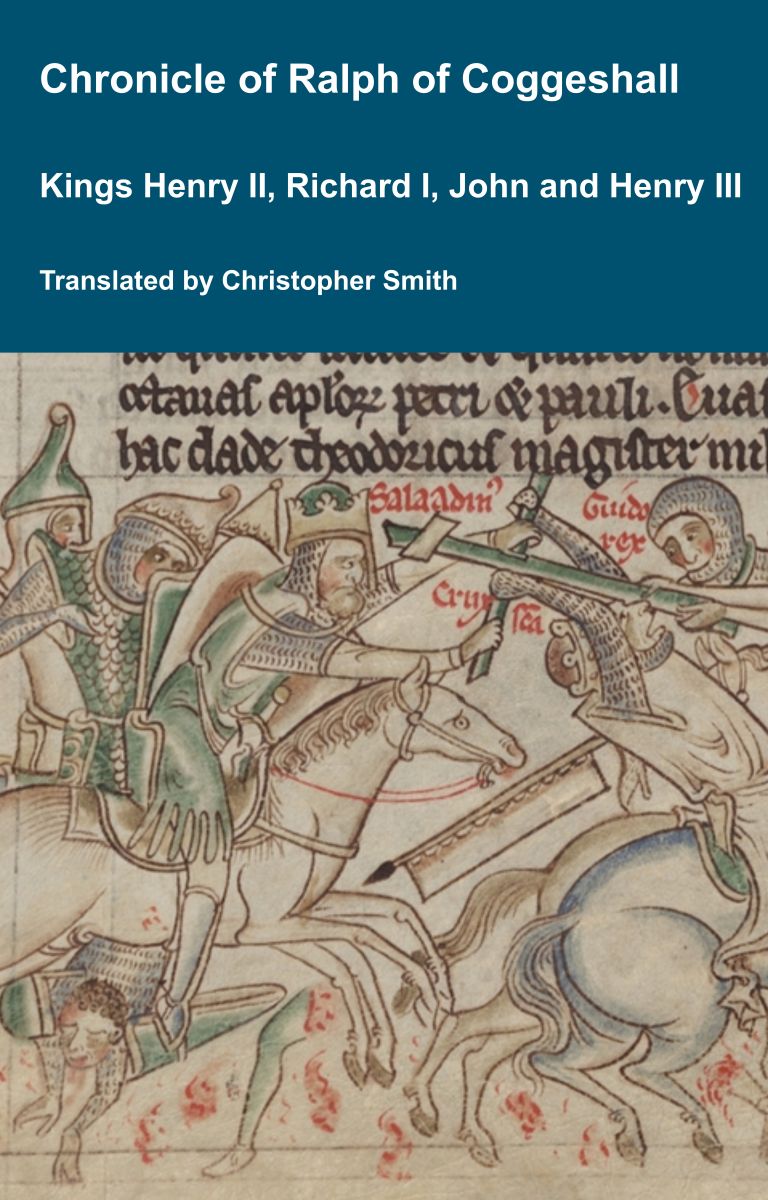
Chronicle of Abbot Ralph of Coggeshall
The Chronicle of Abbot Ralph of Coggeshall (Chronicon Anglicanum) is an indispensable medieval history that brings to life centuries of English and European affairs through the eyes of a learned Cistercian monk. Ralph of Coggeshall, abbot of the Abbey of Coggeshall in Essex in the early 13th century, continued and expanded his community’s chronicle, documenting events from the Norman Conquest of 1066 into the tumultuous reign of King Henry III. Blending eyewitness testimony, careful compilation, and the monastic commitment to record-keeping, this chronicle offers a rare narrative of political intrigue, royal power struggles, and social upheaval in England and beyond. Ralph’s work captures the reigns of pivotal figures such as Richard I and King John, providing invaluable insights into their characters, decisions, and the forces that shaped medieval rule. More than a simple annal, Chronicon Anglicanum conveys the texture of medieval life and governance, making it a rich source for scholars and readers fascinated by English history, monastic authorship, and the shaping of the medieval world.
Available at Amazon in eBook and Paperback format.
On 4th June 1877 Henry Pelly 3rd Baronet (age 33) died. His brother Harold (age 14) succeeded 4th Baronet Pelly of Upton in Essex.
On 4th June 1887 Albert-Ernest Carrier-Belleuse (age 62) died.

On 4th June 1906 Charles Tennant 1st Baronet (age 82) died. His son Edward (age 47) succeeded 2nd Baronet Tennant of The Glen and St Rollox.
On 4th June 1914 William Reynell Anson 3rd Baronet (age 70) died unmarried. His nephew Denis (age 25) succeeded 4th Baronet Anson of Birch Hall in Lancashire; he drowned in the River Thames one month later.
On 4th June 1917 Alexander Fuller-Acland-Hood 1st Baron St Audries (age 63) died. His son Alexander (age 23) succeeded 2nd Baron St Audries of St Audries in Somerset, 5th Baronet Hood of Tidlake in Surrey, 7th Baronet Bateman of Hartington Hall in Derbyshire.
On 4th June 1941 Wilhelm Hohenzollern (age 82) died.
On 4th June 2009 Helen Alice Douglas Baroness de Mauley (age 87) died.