

Henrici Quinti, Angliæ Regis, Gesta, is a first-hand account of the Agincourt Campaign, and subsequent events to his death in 1422. The author of the first part was a Chaplain in King Henry's retinue who was present from King Henry's departure at Southampton in 1415, at the siege of Harfleur, the battle of Agincourt, and the celebrations on King Henry's return to London. The second part, by another writer, relates the events that took place including the negotiations at Troye, Henry's marriage and his death in 1422.
Available at Amazon in eBook and Paperback format.
29 Dec is in December.
1170 Murder of Thomas a Becket
1680 Trial and Execution of William Howard 1st Viscount Stafford
On 29th December 1079 Robert the Lotharingian was consecrated Bishop of Hereford by Archbishop Lanfranc (age 74) at Canterbury Cathedral [Map].
Chronicon ex Chronicis by Florence and John of Worcester. 29th December 1122. John, bishop of Bath, on the fourth of the calends of January [29th December]: during his lifetime he had bought the whole city of Bath from king Henry for five hundred pounds.
On 29th December 1158 Eleanor of Aquitaine Queen Consort Franks and England (age 36) travelled from Normandy [Map] on board the Esnecca (Snake) with her children Henry the Young King (age 3) and Matilda Plantagenet Duchess Saxony (age 2) to Southampton, Hampshire [Map]. She then went to Winchester, Hampshire [Map] where she collected funds from the Royal Treasury and returned to Normandy.
On 29th December 1170 Archbishop Thomas Becket (age 51) was murdered at Canterbury Cathedral [Map] by four knights on behalf of King Henry "Curtmantle" II of England (age 37). Whether Henry ordered the murder, or whether the four knights were acting without orders, is a matter of conjecture. The first use of the well-known phrase "Will no-one rid me of this turbulent priest" appears some five hundred and more years later in Robert Dodsley's 1740 Chronicle of the Kings of England.
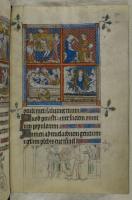
29th December 1170. A bas-de-page image illustrating the murder of Archbishop Thomas Becket (age 51), from the Queen Mary Psalter: England (London/Westminster or East Anglia?) between 1310 and 1320, Royal MS 2 B VII, f. 298r.
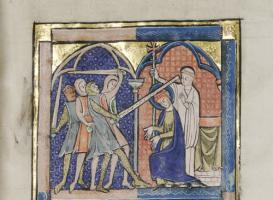
29th December 1170. Archbishop Thomas Becket (age 51) is murdered by a group of knights; BL Add MS 38116; 'The Huth Psalter'; 1280 CE-1300 CE; England,N.; f.13r.
29th December 1170. Earliest known depiction of the murder of Archbishop Thomas Becket (age 51). BL Cotton MS Claudius B II; Alan of Tewkesbury, Collectio Epistolarum Sancti Thome Cantuariensis; 12th c; England; f.341r.
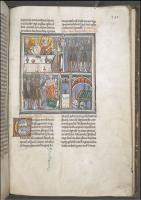
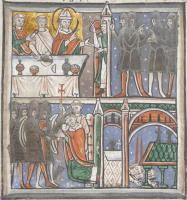
The Life of Thomas Becket by Edward Grim. Inspired by fury the knights called out, "Where is Thomas Becket, traitor to the king and realm?" As he answered not they cried out the more furiously, "Where is the archbishop?" At this, intrepid and fearless, as it is written, "The just, like a bold lion, shall be without fear," he descended from the stair where he had been dragged by the monks in fear of the knights, and in a clear voice answered "I am here, no traitor to the king, but a priest. Why do ye seek me?" And whereas he had already said that he feared them not, he added, "So I am ready to suffer in His name, Who redeemed me by His Blood: be it far from me to flee from your swords, or to depart from justice." Having thus said, he turned to the right, under a pillar, having on one side the altar of the blessed Mother of God and ever Virgin Mary, on the other that of S. Benedict the Confessor: by whose example and prayers, having crucified the world with its lusts, he bore all that the murderer could do with such constancy of soul as if he had been no longer in the flesh. The murderers followed him; "Absolve," they cried, "and restore to communion those whom you have excommunicated, and restore their powers to those whom you have suspended." He answered: "There has been no satisfaction, and I will not absolve them." "Then you shall die," they cried, "and receive what you deserve." "I am ready," he replied, "to die for my Lord, that in my blood the Church may obtain liberty and peace. But in the name of Almighty God, I forbid you to hurt my people whether clerk or lay." Thus piously and thoughtfully, did the noble martyr provide that no one near him should be hurt or the innocent be brought to death, whereby his glory should be dimmed as he hastened to Christ. Thus did it become the martyr-knight to follow in the footsteps of his Captain and Saviour Who when the wicked sought Him said: "If ye seek Me, let these go their way." Then they laid sacrilegious hands on him, pulling and dragging him that they might kill him outside the Church, or carry him away a prisoner, as they afterwards confessed. But when he could not be forced away from the pillar, one of them pressed on him and clung to him more closely. Him he pushed off calling him "pander," and saying, "Touch me not, Reginald; you owe me fealty and subjection; you and your accomplices act like madmen". The knight, fired with terrible rage at this severe repulse, waved his sword over the sacred head. "No faith," he cried, "nor subjection do I owe you against my fealty to my lord the king." Then the unconquered martyr seeing the hour at hand which should put an end to this miserable life and give him straightway the crown of immortality promised by the Lord, inclined his neck as one who prays and joining his hands he lifted them up, and commended his cause and that of the Church to God, to S. Mary, and to the blessed martyr Denys. Scarce had he said the words than the wicked knight fearing lest he should be rescued by the people and escape alive, leapt upon him suddenly and wounded this lamb who was sacrificed to God on the head, cutting off the top of the crown which the sacred unction of the chrism had dedicated to God; and by the same blow he wounded the arm of him who tells this. For he, when the others, both monks and clerks, fled, stuck close to the sainted archbishop and held him in his arms till the one he interposed was almost severed. Behold the simplicity of the dove, the wisdom of the serpent, in the martyr who opposed his body to those who struck that he might preserve his head, that is his soul and the Church, unharmed, nor would he use any forethought against those who destroyed the body whereby he might escape. O worthy shepherd, who gave himself so boldly to the wolves that his flock might not be torn. Because he had rejected the world, the world in wishing to crush him unknowingly exalted him. Then he received a second blow on the head but still stood firm. At the third blow he fell on his knees and elbows, offering himself a living victim, and saying in a low voice, "For the Name of Jesus and the protection of the Church I am ready to embrace death." Then the third knight inflicted a terrible wound as he lay, by which the sword was broken against the pavement, and the crown which was large was separated from the head; so that the blood white with the brain and the brain red with blood, dyed the surface of the virgin mother Church with the life and death of the confessor and martyr in the colours of the lily and the rose. The fourth knight prevented any from interfering so that the others might freely perpetrate the murder. As to the fifth, no knight but that clerk who had entered with the knights, that a fifth blow might not be wanting to the martyr who was in other things like to Christ, he put his foot on the neck of the holy priest and precious martyr, and, horrible to say, scattered his brains and blood over the pavement, calling out to the others, "Let us away, knights; he will rise no more."
The Conquest of Ireland Chapter 20. The Martyrdom of St. Thomas
Raymond pursuing his journey and having arrived at court with the earl's letter, the king received him with great coldness, and being as usual much occupied with business, deferred his reply.
About that time, Thomas, archbishop of Canterbury, in England, perished by the hands of impious men, to the dismay of the great men of the realm, both lay and clerical; after having undergone the sufferings of banishment for nearly seven years in much grief, wearing sackcloth on every part of his body, and giving himself up to reading and prayer, besides, the most severe of all afflictions, a grievous proscription which spared no one, of whatever age or sex, his martyrdom at last filled up the measure of his sufferings and glory. He himself threw open the doors of the sanctuary to his furious enemies, and meeting boldly their drawn swords, bowed his consecrated head to their violence. This took place in the mother and metropolitan church, and before the altar. There he received four wounds on the crown of his head, the shaven crown which used to be regarded as a token of the protection due to the clergy, inflicted by four brutal retainers of the court, with more than brutal rage.1 The illustrious soldier and martyr of Christ was thus distinguished by intrepidly suffering in that part of the body which betokened Christ's sufferings during his passion, and exchanged a corruptible for an incorruptible crown. He also hallowed the holy week of Christmas by then shedding his blood; and as the fifth day before Christmas is consecrated to the memory of the first Thomas, so the second Thomas shed glory on the fifth day after Christmas.2 The one was the light of the East, the other of the West; one illuminated the infant church, the other the church of the latter days; and as the one cemented the foundations of the rising church with his blood, so the other, by shedding his blood, renewed the primitive virtues, and restored the edifice which in the lapse of so many ages had fallen to decay by the injuries of time, and the violence of the storms to which it had been exposed. The first Thomas was actuated by an ardent faith, the second was more than fervent when faith was now growing old. The one submitted to cruel torments while erecting the frame of the church, the other did not shrink from meeting death in order to preserve that frame uninjured. His triumphant claims to such glory are well summed up in the two following verses:
Pro Christi sponsa, Christi sub tempore, Christi
In templo Christi verus amator obit.
In Christ church, and at Christmas tide,
For Christ's spouse, Christ's true servant died.
Among his numerous miracles, there was one which was very memorable, and is well worthy of being mentioned namely, the marvellous way in which he restored organs which had been actually lost; for by this novel kind of miracle it plainly appeared that he was a new martyr. Hence some one has said,
Miratur rediisse virum neutratus, ocelli [He is surprised that the husband has returned, neutral, blind]
Succedunt oculis, albus hic, ille niger [The eyes succeed, this white, that black]
In order that no caviller might object that they were the same eyes which the sufferer had before, and to shew that they were not merely injured but actually plucked out, the new organs of sight were smaller and of a different colour, and had the power of seeing not only in the light of day, but in the dark.
Note 1. A quatuor aulicis canibus, rabie plusquam canina furentibns. [From the four court dogs, more rabid than canines]
Note 2. The feast of St. Thomas, the apostle, is held on the 21st December, and that of St. Thomas a Becket on the 29th December.
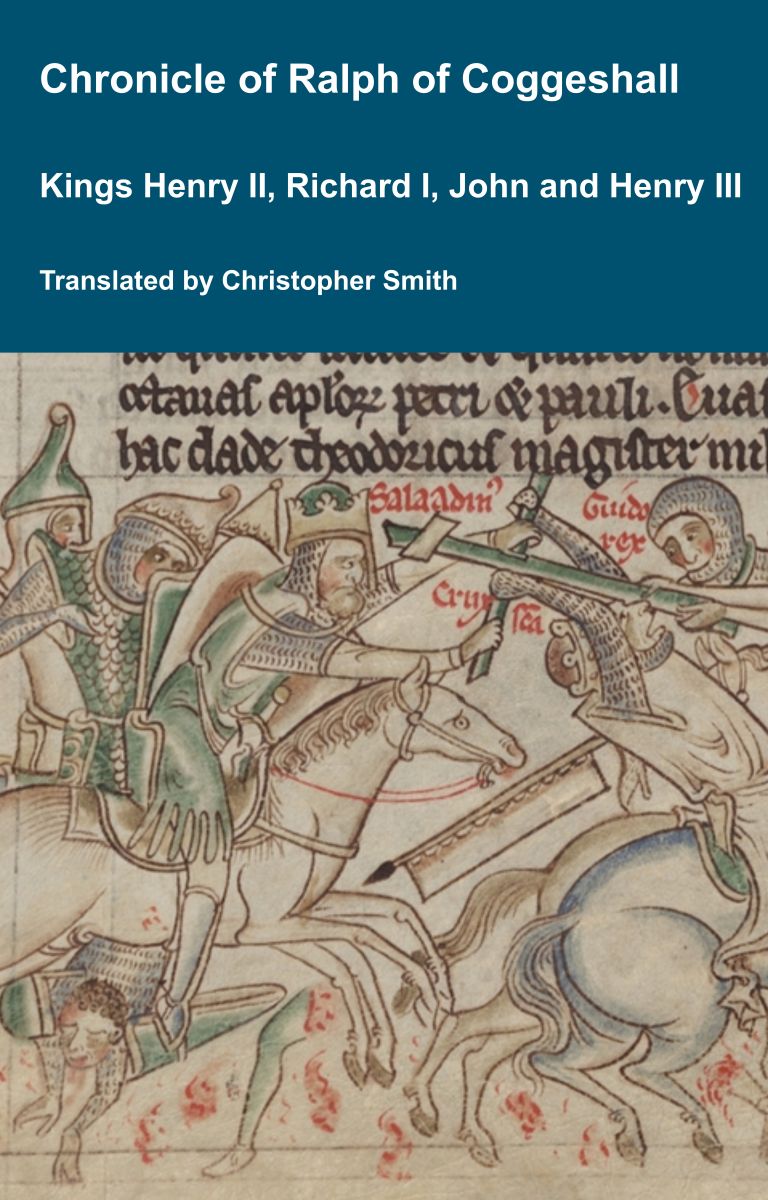
Chronicle of Abbot Ralph of Coggeshall
The Chronicle of Abbot Ralph of Coggeshall (Chronicon Anglicanum) is an indispensable medieval history that brings to life centuries of English and European affairs through the eyes of a learned Cistercian monk. Ralph of Coggeshall, abbot of the Abbey of Coggeshall in Essex in the early 13th century, continued and expanded his community’s chronicle, documenting events from the Norman Conquest of 1066 into the tumultuous reign of King Henry III. Blending eyewitness testimony, careful compilation, and the monastic commitment to record-keeping, this chronicle offers a rare narrative of political intrigue, royal power struggles, and social upheaval in England and beyond. Ralph’s work captures the reigns of pivotal figures such as Richard I and King John, providing invaluable insights into their characters, decisions, and the forces that shaped medieval rule. More than a simple annal, Chronicon Anglicanum conveys the texture of medieval life and governance, making it a rich source for scholars and readers fascinated by English history, monastic authorship, and the shaping of the medieval world.
Available at Amazon in eBook and Paperback format.
The Chronicle of the Kings of England by Robert Dodsley. 29th December 1170. Then certain of the priests and the nobles came unto the king, and complained of Becket, saying, O king! the man whom thou forgavest is now more wicked than he was before, his crimes are increased seven-fold.
Then the king waxed exceeding wrath, and his countenance changed, and be cried out, O wretched man that I am, who shall deliver me from this turbulent priest1?
Now this saying was heard by certain of the king's servants, and they went forth privily, and finding the high priest at the altar, they fell on him and slew him, and dashed out his brains at the foot of the altar, and his blood stained the holy place2.
And the priests were inflamed with fury, and they sent unto the pope, accusing the king for the murder of Becket,
Note 1. Henry said, "Shall this fellow, who came to court on a lame horse, with all his estate on a wallet behind him, trample on ih» King, the royal family, and the whole kingdom. Will none of all these lazy insignificant persons, whom I maintain, deliver me from this turbulent priest?"
Note 2. Historians differ as to the rank of the persons who undertook to despatch Becket; some say they were barons, others knights, belonging to the King's household. Their names were Reginald Fitzurse, William Tracy, Richard Britton, and Hugh Morvill. They went first to his house, expostulated with him about the excommunicated bishops, his pride, and Ingratitude: to which Becket returned a firm and resolute answer. They then left him; but in the evening, the archbishop going into the cathedral to vespers, they followed him, and clave his skull with their clubs at the foot of the altar. The murderers, not daring to return to the King, staid a year at Knaresborough castle, in Yorkshire, belonging lo Morvill; after which they went to Rome for absolution, and were enjoined to do penance on the Black Mountain for life. Some chroniclers say, they all died miserably three or four years after. But this must be false; for we are told by the annotator on Camden, that one of the assassins, William Tracy, retired twenty-three years after, to Mort, in Devonshire.
Chronicum Anglicanum by Ralph Coggeshall. 1171. Blessed Thomas, archbishop of Canterbury, formerly chancellor of King Henry II, for defending the liberty of ecclesiastical dignity, after he had endured exile for seven years, was crowned with martyrdom1 in the basilica of his see, before the altar of blessed Benedict, on the fifth day of Christmas [29th December 1170], while the evening service was being celebrated. [Henry, bishop of Winchester, died.]
MCLXXI. Beatus Thomas Cantuariensis archiepiscopus, quondam regis Henrici Secundi cancellarius, pro ecclesiasticae dignitatis libertate tuenda, postquam septem annis exilium perpessus fuerat, in basilica sedis suæ coram altare beati Benedicti, quinta die Natalis Domini, dum vespertina synaxis ageretur, martyrio coronatus est. [Obiit Henricus episcopus Wintoniensis.]
Note 1. Edward Grim: "Inspired by fury the knights called out, 'Where is Thomas Becket, traitor to the king and realm?' As he answered not they cried out the more furiously, 'Where is the archbishop?' At this, intrepid and fearless, as it is written, 'The just, like a bold lion, shall be without fear,' he descended from the stair where he had been dragged by the monks in fear of the knights, and in a clear voice answered 'I am here, no traitor to the king, but a priest. Why do ye seek me?' And whereas he had already said that he feared them not, he added, 'So I am ready to suffer in His name, Who redeemed me by His Blood: be it far from me to flee from your swords, or to depart from justice.' Having thus said, he turned to the right, under a pillar, having on one side the altar of the blessed Mother of God and ever Virgin Mary, on the other that of S. Benedict the Confessor: by whose example and prayers, having crucified the world with its lusts, he bore all that the murderer could do with such constancy of soul as if he had been no longer in the flesh. The murderers followed him; 'Absolve,' they cried, 'and restore to communion those whom you have excommunicated, and restore their powers to those whom you have suspended.' He answered: 'There has been no satisfaction, and I will not absolve them.' 'Then you shall die,' they cried, 'and receive what you deserve.' 'I am ready,' he replied, 'to die for my Lord, that in my blood the Church may obtain liberty and peace. But in the name of Almighty God, I forbid you to hurt my people whether clerk or lay.' Thus piously and thoughtfully, did the noble martyr provide that no one near him should be hurt or the innocent be brought to death, whereby his glory should be dimmed as he hastened to Christ. Thus did it become the martyr-knight to follow in the footsteps of his Captain and Saviour Who when the wicked sought Him said: 'If ye seek Me, let these go their way.' Then they laid sacrilegious hands on him, pulling and dragging him that they might kill him outside the Church, or carry him away a prisoner, as they afterwards confessed. But when he could not be forced away from the pillar, one of them pressed on him and clung to him more closely. Him he pushed off calling him 'pander,' and saying, 'Touch me not, Reginald; you owe me fealty and subjection; you and your accomplices act like madmen'. The knight, fired with terrible rage at this severe repulse, waved his sword over the sacred head. 'No faith,' he cried, 'nor subjection do I owe you against my fealty to my lord the king.' Then the unconquered martyr seeing the hour at hand which should put an end to this miserable life and give him straightway the crown of immortality promised by the Lord, inclined his neck as one who prays and joining his hands he lifted them up, and commended his cause and that of the Church to God, to S. Mary, and to the blessed martyr Denys. Scarce had he said the words than the wicked knight fearing lest he should be rescued by the people and escape alive, leapt upon him suddenly and wounded this lamb who was sacrificed to God on the head, cutting off the top of the crown which the sacred unction of the chrism had dedicated to God; and by the same blow he wounded the arm of him who tells this. For he, when the others, both monks and clerks, fled, stuck close to the sainted archbishop and held him in his arms till the one he interposed was almost severed. Behold the simplicity of the dove, the wisdom of the serpent, in the martyr who opposed his body to those who struck that he might preserve his head, that is his soul and the Church, unharmed, nor would he use any forethought against those who destroyed the body whereby he might escape. O worthy shepherd, who gave himself so boldly to the wolves that his flock might not be torn. Because he had rejected the world, the world in wishing to crush him unknowingly exalted him. Then he received a second blow on the head but still stood firm. At the third blow he fell on his knees and elbows, offering himself a living victim, and saying in a low voice, 'For the Name of Jesus and the protection of the Church I am ready to embrace death.' Then the third knight inflicted a terrible wound as he lay, by which the sword was broken against the pavement, and the crown which was large was separated from the head; so that the blood white with the brain and the brain red with blood, dyed the surface of the virgin mother Church with the life and death of the confessor and martyr in the colours of the lily and the rose. The fourth knight prevented any from interfering so that the others might freely perpetrate the murder. As to the fifth, no knight but that clerk who had entered with the knights, that a fifth blow might not be wanting to the martyr who was in other things like to Christ, he put his foot on the neck of the holy priest and precious martyr, and, horrible to say, scattered his brains and blood over the pavement, calling out to the others, 'Let us away, knights; he will rise no more.'"
| Eissi avint de Deu, quant il ala orer | Thus it happened by God, when he went to pray |
| Desur munt d’Olivet, la noit à l’avesprer; | Upon Mount Olivet, in the evening at nightfall; |
| E cil li commencièrent qui l’ quistrent,, à crier: | And those who sought him then began to cry out: |
| «U est li Nazareus?» — «Ci me poez trover, | “Where is the Nazarene?” — “Here you may find me,” |
| Fit lur Deus, mès les miens en leissiez tuz aler.» | Said God to them, “but let all of mine go free.” |
| Dunc l’unt saisi as puinz li fil à l'aversier, | Then they seized him with fists, the sons of the adversary, |
| Si l’ commencent forment à trère et à sachier, | And began strongly to drag and to haul him; |
| E sur le col Willams le voldrent enchargier; | And upon William’s neck they wished to load him, |
| Kar là hors le voleient ou occire ou lier. | For they wanted either to kill him outside or bind him there. |
| Mès del piler ne l’ porent oster, ne csluingnier. | But from the pillar they could neither remove nor dislodge him, |
| Cum seint Thomas s’esteit apuiez al piler, | Just as Saint Thomas had leaned himself against the pillar— |
| Ki suffri mort en croiz pur s’iglise estorer, | He who suffered death on the cross to exalt his Church— |
| Ne l’en poeit nuls huem esluignier ne oster. | So that no man could move or tear him away. |
| Mès ore en coveneit un sul à mort livrer | But now it was fitting that one alone be given to death |
| AI piler del mustier, pur le pueple sauver. | At the pillar of the minster, to save the people. |
| Car cil qui mielz déussent sainte Église tenser | For those who ought best to have defended Holy Church |
| La voldrent et ses menbres del tut agraventer, | Wished to crush it utterly, it and its members, |
| Le piler et le chief ki l’ suslint aterrer. | And to cast down the pillar and the head that upheld it. |
| Icel sanc de péchié covint par sance laver, | That sinful blood had to be washed away by blood, |
| Pur relever le chief, le chief del chief doner. | To raise up the head—the head that gives to the Head. |
| Ne Deus ne voleit pas k’il fust traitiez vilment: | And God did not wish that he be shamefully dragged; |
| Si l’ fist pur espruver cele malveise gent, | So He allowed it to test that wicked people, |
| S'osassent el mustier errer si cruelment. | Whether they would dare to rage so cruelly in the minster. |
| Car il n’a si felun, entrès k’en Orient, | For there is no felon, even as far as the East, |
| Qui en oï parler, qui ne s’en espoent. | Who, on hearing of it, would not be struck with dread. |
| E mestre Edward Grim l’aveit forment saisi, | And Master Edward Grim had seized him tightly, |
| Enbrascié par de sus, quant l’orent envaï; | Embracing him from above when they attacked him; |
| Cuntr’els tuz le retint, de rien ne s’esbahi, | Against them all he held him fast, not at all afraid, |
| Ne pur les chevaliers ne l'aveit pas guerpi; | Nor because of the knights did he abandon him; |
| Si clerc et si sergant s’en èrent tuz fui, | Though clerks and servants had all fled away. |
| Mestre Edward le tint kan k’il l’unt desachié: | Master Edward held him until they struck him loose: |
| «Que volez, fet-il, fère? Estes-vus enragié? | “What do you wish to do?” he said. “Are you mad? |
| «Esguardez ù vus estes et qui sunt li feirié! | Look where you are and whom you strike! |
| «Main sur vostre arcevesque metez à grant pecchié!» | To lay hands upon your archbishop is a great sin!” |
| Mès pur feirié ne l’unt, ne pur mustier lessié. | But neither for the sacred place nor for the minster did they desist. |
| Or veit bien saint Thomas sun martire en présent. | Now Saint Thomas clearly sees his martyrdom at hand. |
| Les mains mist à sun vis, à Dampnedeu se rent, | He placed his hands upon his face, and to God he surrendered himself, |
| Al martir saint Denis, cui dulce France apent, | To Saint Denis the martyr, to whom dear France belongs, |
| E as sainz de l’Yglise se commande erraument, | And to the saints of the Church he commended himself at once, |
| La cause seinte Yglise et la sue ensement. | The holy cause of the Church and his own likewise. |
| Willames vint avant, ne volt Deu aorer. | William stepped forward and did not wish to honor God; |
| Pur estre plus legiers, n’i volt hauberc porter. | To be more agile, he would not wear his hauberk. |
| Le traïtur le Rei commence à demander. | “The king’s traitor,” he begins to cry out. |
| Quant ne porent le saint hors del muster geter, | When they could not throw the saint out of the minster, |
| Enz el chief de l’espée grant cop li va-doner; | With the edge of his sword he dealt him a great blow to the head, |
| Si ke de la corone le cupel en porta, | So that he carried away a piece of the crown, |
| Et la hure abati et granment entama. | And struck down the skull and deeply gashed it. |
| Sur l’espaulle senestre l’espée li cola, | The sword slid onto the left shoulder, |
| Le mantel et les dras très k’al quir encisa, | Cut through mantle and garments down to the flesh, |
| E le braz Edward près tut en dous colpa. | And nearly severed Edward’s arm in two. |
| Dunc l’aveit à cel colp mestre Edward guerpi. | At that blow Master Edward released him. |
| «Ferez,» fet dunc Willames. Mès idune le féri | “Strike,” then said William. But Danz Renald struck him, |
| Danz Renalz, le fils Hurs, mès pa ne l’abati. | The son of Urs, yet he did not fell him. |
| Idunc le referi Willames de Traci | Then William of Tracy struck him again, |
| Qui tut l’escervela, et saint Thomas chaï. | Who shattered his skull entirely, and Saint Thomas fell.” |
Annals of Dunstable. Then the King (of England) set out from there and came to the sea, and, procuring ships, he landed at Dover on the feast of Saint John the Evangelist, where he was met and joyfully received by many of the nobles of England. And on the next day, the feast of Saint Thomas the Martyr [29th December 1254], at Canterbury he held a great feast for his nobles. And on the Sunday next following he came to London, where he was received with honour by the clergy and the people.
Rex inde profectus venit ad mare, et petens naves, cum suis, die Sancti Johannis Evangelistæ applicuit apud Doveram, occurrentibus et eum cum gaudio recipientibus multis magnatibus Angliæ. Et in crastino, die Sancti Thomæ martyris, apud Cantuariam fecit Hetur magnatibus suis grande convivium. Die vero Domito London, nica proximo sequente, venit Londoniis, ubi a clero et a populo cum honore susceptus est.
On 29th December 1299 William Morley 1st Baron Morley was created 1st Baron Morley by writ of summons to King Edward I's (age 60) 47th Parliament. Isabel Mohaut Baroness Morley by marriage Baroness Morley.
On 29th December 1397 Archbishop Robert Waldby died. He was buried at the Chapel of St Edmund, Westminster Abbey [Map].

Letters and Papers Foreign and Domestic Henry VIII 1529. 29th December 1529. R. O. 6115. Cardinal Wolsey (age 56).
Grant by Wolsey to George Boleyn (age 26), knt., Viscount Rochford, son and heir apparent of Thomas Earl of Wiltshire and Ormond (age 52), of an annuity of £200 out of the lands of the Bishopric of Winchester, with power to distrain for nonpayment.
ii. Similar grant of an annuity of 200 marks out of the abbey lands of St. Albans.
Letters and Papers Foreign and Domestic Henry VIII 1535. 29th December 1535. Vienna Archives. 1035. Charles V. to [Chapuys].
Received, on the 24th inst., his letters of 21 Nov. The ill will of the king of England to the Queen and Princess (age 50) is cruel and horrible. It is impossible to believe that he would be so unnatural as to put them to death, considering his ties to them, their descent, their virtues and long sufferings. He probably intends by threats to make them swear to and approve his statutes. There are two reasons against their taking the oath:—One, that it would alienate and discourage the good people of England, and be a means for the King and his concubine gaining the good will of all. The other is, that the King would perhaps take it as a further reason for revenging himself on them for having so long refused, and would assume that their taking the oath was an acknowledgment of the fault of disobedience, and therefore deserving the same punishment. He would suppose that the oath was taken by the Emperor's advice. Chapuys must do what he can to avoid their taking the oath without letting them run an irremediable risk. Hopes to do something for them at the approaching interview with the Pope, from his Holiness's desire to chastise the King for his daily insults to him and the Holy See. Will wait also to see whether the enterprise for which his man was sent can be carried out. He must, however, advise them to take the oath rather than lose their lives, protesting that they do it from fear. It cannot then prejudice their rights. Protestation to this effect shall be made by their proctor at Rome. Chapuys must assure them that the Emperor will take care of their interests when at Rome. Naples, 29 Dec. 1535.
Fr., from a modern copy, pp. 2.


On 29th December 1558 Gómez Suárez de Figueroa y Córdoba 1st Duke of Feria (age 38) and Jane Dormer Duchess Feria (age 20) were married. She by marriage Duchess Feria. He had been one of the gentleman who had accompanied Philip "The Prudent" II King Spain (age 31) to England for his marriage to Queen Mary I of England and Ireland (deceased).
On 29th December 1595 Frances Berkeley (age 31) died. She was buried at Church of St Mary and St Hardulph, Breedon on the Hill [Map]. Monument to Frances Berkeley and George Shirley 1st Baronet (age 36). The armorial shows  Shirley Arms and
  Berkeley Arms impaled. Cadaver Underneath. Attributed to Jasper Hollemans.
Frances Berkeley: Around 1564 she was born to Henry Berkeley 7th Baron Berkeley and Katherine Howard Baroness Berkeley. After 21st February 1587 George Shirley 1st Baronet and she were married.


John Evelyn's Diary. 29th December 1649. I christened Sir Hugh Rilie's child with Sir George Radcliffe in our chapel, the parents being so poor that they had provided no gossips, so as several of us drawing lots it fell on me, the Dean of Peterborough (Dr. Cousin (age 55)) officiating: we named it Andrew, being on the eve of that Apostle's day.
On 29th December 1655 Charles Killigrew was born to Thomas Killigrew (age 43) and Charlotte Hesse (age 26) in Maastricht.


Samuel Pepys' Diary. 29th December 1662. After all was done, the company broke up; and I spent a little while walking up and down the gallery seeing the ladies, the Queens, and the Duke of Monmouth (age 13) with his little mistress, which is very little, and like my brother-in-law's wife.


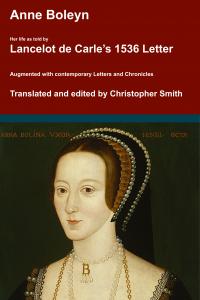
Anne Boleyn. Her Life as told by Lancelot de Carle's 1536 Letter.
In 1536, two weeks after the execution of Anne Boleyn, her brother George and four others, Lancelot du Carle, wrote an extraordinary letter that described Anne's life, and her trial and execution, to which he was a witness. This book presents a new translation of that letter, with additional material from other contemporary sources such as Letters, Hall's and Wriothesley's Chronicles, the pamphlets of Wynkyn the Worde, the Memorial of George Constantyne, the Portuguese Letter and the Baga de Secrets, all of which are provided in Appendices.
Available at Amazon in eBook and Paperback format.
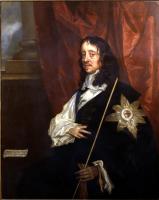
Samuel Pepys' Diary. 29th December 1662. Hither came Jack Spicer to me, and I took him to the Swan [Map], where Mr. Herbert did give me my breakfast of cold chine of pork; and here Spicer and I talked of Exchequer matters, and how the Lord Treasurer (age 55) hath now ordered all monies to be brought into the Exchequer, and hath settled the King's revenue, and given to every general expence proper assignments; to the Navy £200,000 and odd. He also told me of the great vast trade of the goldsmiths in supplying the King (age 32) with money at dear rates.
Samuel Pepys' Diary. 29th December 1664. Up and to the office, where we sat all the morning. Then whereas I should have gone and dined with Sir W. Pen (age 43) (and the rest of the officers at his house), I pretended to dine with my Lady Sandwich (age 39) and so home, where I dined well, and began to wipe and clean my books in my chamber in order to the settling of my papers and things there thoroughly, and then to the office, where all the afternoon sitting, and in the evening home to supper, and then to my work again.


On 29th December 1680 William Howard 1st Viscount Stafford (age 66) was beheaded at Tower Hill [Map]. He was attainted; Viscount Stafford forfeit. His wife Mary Stafford Countess Stafford (age 60), with whom he was jointly created Baron Stafford continued as Baroness.
John Evelyn's Diary. 29th December 1680. The Viscount Stafford (age 66) was beheaded on Towerhill [Map].
John Evelyn's Diary. 29th December 1686. I went to hear the music of the Italians in the new chapel, now first opened publicly at Whitehall [Map] for the Popish Service. Nothing can be finer than the magnificent marble work and architecture at the end, where are four statues, representing St. John, St. Peter, St. Paul, and the Church, in white marble, the work of Mr. Gibbons (age 38), with all the carving and Pillars of exquisite art and great cost. The altar piece is the Salutation; the volto in fresco, the Assumption of the blessed Virgin, according to their tradition, with our blessed Savior, and a world of figures painted by Verrio. The throne where the King (age 53) and Queen (age 28) sit is very glorious, in a closet above, just opposite to the altar. Here we saw the Bishop in his mitre and rich copes, with six or seven Jesuits and others in rich copes, sumptuously habited, often taking off and Putting on the Bishop's mitre, who sat in a chair with arms pontifically, was adored and censed by three Jesuits in their copes; then he went to the altar and made divers cringes, then censing the images and glorious tabernacle placed on the altar, and now and then changing place: the crosier, which was of silver, was put into his hand with a world of mysterious ceremony, the music playing, with singing. I could not have believed I should ever have seen such things in the King of England's palace, after it had pleased God to enlighten this nation; but our great sin has, for the present, eclipsed the blessing, which I hope he will in mercy and his good time restore to its purity.
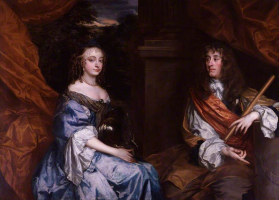


John Ashton Edmund Elliot Richard Graham 1691. On Fryday, the 2d day of this Sessions, my Lord Preston (age 41), John Ashton and Edmund Elliot, were all Arrained for High Treason, my Lord Preston was Tryed on Saturday by the name of Sir Richard Graham, Mr. Ashton on Monday. The Indictments against them consisted of Two Parts, the First of which set forth, That they had a Treasonable Design carrying on to Depose the King and Queen, and to Subvert and Alter the Government of the Kingdom of England, and to raise War and Rebellion in the same; which said Traiterous and Wicked Designs and Purposes to bring to pass, they did, on the 29th of December last, Meet and Conspire together, with several other Traitors not yet discovered, and did Compose several Treasonable Letters, Notes and Memorandums in writing, which set forth the most effectual way and means how they might Dethrone and Depose our Most Gracious Sovereign Lord and Lady the King (age 40) and Queen (age 28), and further describing therein how the Affairs of this Kingdom stood, and of what Strength and Force our Shipping was; as also the Fortifications of several Sea-Port-Towns within this Kingdom. The Second Part was their adhering to the Kings's Enemies: And to that end, that they might Acquaint Lewis the French King of the same, they did hire a Boat and Embarque themselves in order to Transport themselves and Pacquet of Treasonable Letters into France, agreeing to pay for their said Passages the Sum of One hundred Pound; and, in order to their Treasonable Voyage, they had made their Passage as far as below Gravesend [Map], but were then Taken by Captain Billop, who Cruised abroad to search for them.
After this the Evidence for the King being called, gave an Account particularly from Step to Step, how cunningly and subtilly they managed this horrid Conspiracy, by hiring the Smack called the Thomas and Elizabeth, to convey them secretly into France; in order to which they took Water in a Skuller at Surrey-Stairs, and went on Board the aforesaid Vessel, which lay in the River of Thames over against the Tower [Map]: From thence they set Sail down the River, till coming within the View of the George Frigate, lying in Long-reach, they desired the Master of the Smack to hide them under the Quarter-Hatches; which was done, they having some Fear of being discovered: There they remained till past that Danger, and then came up; but when they were within Sight of Gravesend [Map] they hid again, and a little below it Captain Billop came aboard them, under Pretence of Pressing the Masters two Men, who were assistants to him; but indeed his Design and real Intention was to find out those Traytors, which, upon Search, he found lying along under the Hatches; and after their being haled up he search'd them, and found a Pacquet of Treasonable Papers in Mr. Ashton's Bosom: which he with the Prisoners carried before my Lord Nottingham; who examined the Papers, and after being examined by the Cabinet Council they were committed to the Tower. The Evidence was very full and plain against them both, much to the same effect and purport: The Letters being also Read against them in Court, were adjudged to be of no less Import than High-Treason. Upon the whole they had nothing material to offer in their Defence; so after a very long hearing, they were both found Guilty of High Treason. Edmond Elliot was ordered to remain till further order.

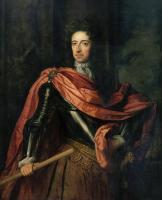


John Evelyn's Diary. 29th December 1694. The smallpox increased exceedingly, and was very mortal. The Queen (deceased) died of it on the 28th.
On 29th December 1704 Basil Murray was born to John Murray 1st Duke Atholl (age 44) and Catherine Hamilton Duchess Atholl (age 42). He died aged seven in 1712.
On 29th December 1735 Thomas Banks was born.
On 29th December 1740 Edward Seymour 5th Baronet (age 79) died. His son Edward (age 45) succeeded 6th Baronet Seymour of Berry Pomeroy. Mary Webb Duchess Somerset (age 43) by marriage Lady Seymour of Berry Pomeroy.
In December 1800 King George III of Great Britain and Ireland (age 62) created a number of peers who supported the Act of Union...
On 21st December 1800 Charles Stanley Monck 1st Viscount Monck (age 46) was created 1st Viscount Monck.
On 29th December 1800....
Murrough O'Brien 1st Marquess Thomond (age 74) was created 1st Marquess Thomond. Mary Palmer Marchioness Thomond (age 50) by marriage Marchioness Thomond.
Charles Tottenham aka Loftus 1st Marquess Ely (age 62) was created 1st Marquess Ely in County Wexford. Jane Myhill Marchioness Ely by marriage Marchioness Ely in County Wexford.
James Alexander 1st Earl Caledon (age 70) was created 1st Earl Caledon in County Tyrone.
On 29th December 1806 Charles Lennox 3rd Duke Richmond (age 71) died at Goodwood West Sussex. He was buried at Chichester Cathedral [Map]. His nephew Charles (age 42) succeeded 4th Duke Richmond, 4th Earl March, 4th Baron Settrington. Charlotte Gordon Duchess Richmond (age 38) by marriage Duchess Richmond.


On 29th December 1808 Henry William Paget 1st Marquess Anglesey (age 40) commanded the cavalry at the Battle of Benavente whe defeated the elite Chasseurs à cheval of the French Imperial Guard.


On 29th December 1810 Adeliza Elizabeth Gertrude Manners was born to John Henry Manners 5th Duke Rutland (age 32) and Elizabeth Howard Duchess Rutland (age 30). She married 22nd February 1848 her first cousin Reverend Frederick John Norman and had issue.
Jean de Waurin's Chronicle of England Volume 6 Books 3-6: The Wars of the Roses
Jean de Waurin was a French Chronicler, from the Artois region, who was born around 1400, and died around 1474. Waurin’s Chronicle of England, Volume 6, covering the period 1450 to 1471, from which we have selected and translated Chapters relating to the Wars of the Roses, provides a vivid, original, contemporary description of key events some of which he witnessed first-hand, some of which he was told by the key people involved with whom Waurin had a personal relationship.
Available at Amazon in eBook and Paperback format.
On 29th December 1825 Jacques-Louis David (age 77) died.
After 29th December 1828. Monument in St Mary's Church, Swinstead [Map] to Priscilla Barbara Elizabeth Bertie 21st Baroness Willoughby of Eresby (deceased) sculpted by James Forsyth in 1883. An elaborate Gothic Aedicule of limestone. Above the Recessed inscription an achievement of arms of the Bertie's.


Ten Years' Digging. 29th of December, a barrow [Ribden Low Barrow [Map]] was opened between the villages of Cotton and Cauldon, called Ribden Low, about 30 yards diameter. In cutting through the centre, we found a large flat stone covering a rudely walled cist, built upon the natural surface, about three feet from the top of the barrow, containing a much decayed skeleton, which reposed in the usual flexed position, on its left side, accompanied by a remarkably beautiful spear-head of flint, and some other pieces of the same material, all of which had been slightly burnt; at the feet was a human skull much decayed. The ground continuing to sink by the side of the cist, we were led to another interment, which consisted of a deposit of calcined bones, placed in a hole dug two feet lower in the natural soil, and paved with flat stones. Amongst the bones were found three large instruments, and three barbed arrow-heads of flint, remains of about five bone implements, some of which appear to have been modelling or netting tools; others pointed at each end are perforated through the middle. They are all in bad preservation, owing to their having been calcined along with the corpse of the owner. The barrow was thickly strewn with burnt bones, fragments of pottery, and rats' bones.; and two very small pieces of bronze, slightly ornamented, were found near the capstone of the cist.
Ten Years' Digging. On the 29th of December we proceeded to excavate the Cock Low barrow [Map], close to the town of Leek, a large mound forty yards diameter and eighteen feet high, composed of sand, and raised above a natural surface of red sand, unmixed with any other tint. After cutting a square six yards each way down the centre to the depth of five feet, we came to a layer of ashes and charcoal, resting on a stratum of white sand. Among the former were some small pieces of an urn, a few pieces of calcined human bone, and a round-edged instrument of flint. Besides these we observed nothing; and it does not appear that any interment had ever been deposited on the natural level, in which respect the barrow resembles many other large mounds of earth in which an interment by cremation has been made at a high level or near the summit.
The following notice appeared in the Derby Mercury of January 7th, 1852 — "On Tuesday, some degree of excitement was caused in Leek by the circumstance that Mr. Bateman had sent an exploring party to open the Cock Low, a barrow standing on part of the property of Mrs. Watt. The party worked vigorously on Monday and Tuesday, and were so far successful in their search as to find the usual deposit of charcoal, &c. They found one instrument and a small piece or two of bone, which, however, pulverised on coming into contact with the air. The party began their cutting a few yards to the south of the centre, and continued to sink the opening until they arrived at the original surface, which is about six yards below the present surface of the tumulus, and was indicated by being of the same red sand as the surrounding surface of the field, and by its being unmixed with charcoal or any other extraneous substance. It appeared evident, from the appearances presented by the cutting, that when the tumulus, at its formation, had attained to within five feet of its present altitude, a large fire had been kindled upon it, as was manifested by the abundance of ashes and charcoal found at that elevation, amongst and nearly in the centre of which they found a few fragments of an earthen vase or urn, and one of those small rounded flints, for which conjecture has as yet assigned no certain use. Below and in contact with this layer of charcoal and ashes was a layer of white sand, and it was surmised that this lightness of colour might have been the effect of the fire; and in this idea Mr. Carrington coincided, or at least conceded to have been well founded. On and about these particular spots Mr. Carrington bestowed the most minute attention, as he believed that there the body had been calcined; and he was the more inclined to believe this opinion from the fact that there were no indications below of any kind to lead him to infer that any interment had ever taken place at a greater depth. With the exception of a very few tumuli, Mr. Bateman and Mr. Carrington have always found that, in all barrows compoiftd entirely of soil, as in the present instance, nothing has been discovered except a deposit of calcined bones, charcoal^ and a few flint ins^raments, arrow-heads, &c., accidentally dropped there during the ceremony, or brought casually in the earth of which the mound has been formed. The opening of the tumulus has led to this satisfactory result — that there no longer remains any doubt that this barrow has been a place of interment; and although it has added nothing to the museum of the gentleman who has been at th^ cost of the imdertaking, he has had the satisfaction of imparting much gratification to many anxious observers; and we trust not without having added something to the fund of information he has amassed upon this subject".
On 29th December 1855 Matthew Noble (age 38) and Frances Mary Claxton (age 28) were married.
On 29th December 1867 Baron Pietro Carlo Marochetti (age 62) died.

The London Gazette 25183. Whitehall, December 29, 1882. The Queen has been pleased to direct Letters Patent to be passed under the Great Seal granting the dignities of a Viscount and an Earl of the United Kingdom of Great Britain and Ireland unto the Right Honourable Roundell, Lord Selborne (age 70), Lord High Chancellor of that part of the said United Kingdom called Great Britain, and the heirs male of his body lawfully begotten, by the names, styles, and titles of Viscount Wolmer, of Blackmoor, in the county of Southampton, and Earl of Selborne, in the said county. [Laura Waldegrave Countess Selborne (age 61) by marriage Countess Selborne.]

On 29th December 1886 Margaret York aka Pole Countess of Salisbury was beatified as a martyr by Pope Leo XIII.
Ancient Remains near Buxton: Barrows: Grin Low. On December 29th, 1894, Mr. Salt and his sons resumed their diggings at this barrow, confining their work to the south-east margin. On this occasion they found, at a depth of ten inches (F), many fragments of hard, coarse, dark-red, wheel-formed pottery, which belonged to a vessel having a general resemblance to the ordinary Roman cinerary urn, but less graceful and more jar-like. It had slightly bulging sides, and was about seven and a half inches in diameter at the base, and five and a half inches at the mouth, and of uncertain height. The lip was only slightly recurved. There is no reason to doubt its Roman origin, but it may be doubted whether it contained an interment, for no traces of calcined bone were found amongst the fragments. While digging on this occasion a rude-trimmed flint flake of uncertain use, and another of still ruder character, were found in soil which had been thrown up from interment D.
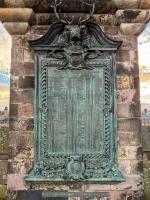
29th December 1903Gordon Highlanders South African War Memorial [Map]. Unveiled by Earl of Kintore, the Colonel commanding the 3rd Battalion Gordon Highlanders.
On 29th December 1922 Kenelm Charles (age 21) died of pneumonia unmarried. His brother Mark (age 19) succeeded 6th Earl of Cottenham, 6th Viscount Crowhurst of Crowhurst in Surrey, 6th Baron Cottenham of Cottenham in Cambridgshire, 8th Baronet Pepys of Wimpole Street, 9th Baronet Pepys of Brook Street.
Henrici Quinti, Angliæ Regis, Gesta, is a first-hand account of the Agincourt Campaign, and subsequent events to his death in 1422. The author of the first part was a Chaplain in King Henry's retinue who was present from King Henry's departure at Southampton in 1415, at the siege of Harfleur, the battle of Agincourt, and the celebrations on King Henry's return to London. The second part, by another writer, relates the events that took place including the negotiations at Troye, Henry's marriage and his death in 1422.
Available at Amazon in eBook and Paperback format.
On 29th December 1971 Hilda Madeline Brassey Duchess Richmond (age 99) died.
On 29th December 1974 William Charles Fuller (age 90) died. He was buried at Oystermouth Cemetery, The Mumbles. At the time of his burial his grave was not marked with a stone.
On 29th December 1552 Henri Bourbon Condé Prince Condé was born to Louis Bourbon Prince Condé (age 22) and Eléanor de Roucy de Roye Princess Condé (age 17). He married (1) Charlotte Catherine Tremoille Princess Condé and had issue (2) Marie Cleves Princess Condé and had issue.
On 29th December 1625 Alice Spencer Countess Drogheda was born to William Spencer 2nd Baron Spencer (age 34) and Penelope Wriothesley Baroness Spencer Wormleighton (age 27). She married before 11th January 1676 Henry Moore 1st Earl Drogheda, son of Charles Moore 2nd Viscount Moore of Drogheda and Alice Loftus Viscountess Moore, and had issue.
On 29th December 1640 William Feilding 2nd Earl Desmond 3rd Earl Denbigh was born to George Feilding 1st Earl Desmond (age 26) and Bridget Stanhope Countess Desmond (age 25). He married before 1668 Mary Carey Countess Desmond and Denbigh, daughter of Henry Carey 2nd Earl Monmouth and Martha Cranfield Countess Monmouth, and had issue.
On 29th December 1655 Charles Killigrew was born to Thomas Killigrew (age 43) and Charlotte Hesse (age 26) in Maastricht.
On 29th December 1655 Lewis Watson 1st Earl Rockingham was born to Edward Watson 2nd Baron Rockingham (age 25) and Anne Wentworth Baroness Rockingham (age 26). He married 1667 Catherine Sondes Countess Rockingham, daughter of George Sondes 1st Earl Feversham, and had issue.
On 29th December 1704 Basil Murray was born to John Murray 1st Duke Atholl (age 44) and Catherine Hamilton Duchess Atholl (age 42). He died aged seven in 1712.
On 29th December 1735 Thomas Banks was born.
On 29th December 1736 Frances Mordaunt was born to Charles Mordaunt 4th Earl Peterborough 2nd Earl Monmouth (age 28) and Mary Cox Countess Peterborough and Monmouth. She married 10th October 1765 Reverend Samuel Bulkeley.
On 29th December 1752 Cecil Bishopp 12th Baron Zouche was born to Cecil Bishopp 7th Baronet and Susan Hedges Lady Bishopp. He married in or before 1783 Harriet Anne Southwell.
On 29th December 1757 William Lowther 1st Earl Lonsdale was born to William Lowther 1st Baronet (age 50). He married 12th July 1781 Augusta Fane Countess Lonsdale, daughter of John Fane 9th Earl of Westmoreland and Augusta Bertie, and had issue.
Jean de Waurin's Chronicle of England Volume 6 Books 3-6: The Wars of the Roses
Jean de Waurin was a French Chronicler, from the Artois region, who was born around 1400, and died around 1474. Waurin’s Chronicle of England, Volume 6, covering the period 1450 to 1471, from which we have selected and translated Chapters relating to the Wars of the Roses, provides a vivid, original, contemporary description of key events some of which he witnessed first-hand, some of which he was told by the key people involved with whom Waurin had a personal relationship.
Available at Amazon in eBook and Paperback format.
On 29th December 1785 William Sefton George Stanhope was born to Charles Stanhope 3rd Earl of Harrington (age 32) and Jane Fleming Countess Harrington (age 30). He a great x 3 grandson of King Charles II of England Scotland and Ireland. He died aged less than one years old.


On 29th December 1809 William Ewart Gladstone was born to John Gladstone 1st Baronet (age 45) and Anne MacKenzie Robertson (age 37) at 62 Rodney Street, Liverpool [Map]. He married 25th July 1839 Catherine Glynne, daughter of Stephen Richard Glynne 8th Baronet and Mary Griffin, and had issue.
On 29th December 1810 Thomas Grey was born to Charles Grey 2nd Earl Grey (age 46) and Mary Elizabeth Ponsonby Countess Grey (age 34).


On 29th December 1810 Adeliza Elizabeth Gertrude Manners was born to John Henry Manners 5th Duke Rutland (age 32) and Elizabeth Howard Duchess Rutland (age 30). She married 22nd February 1848 her first cousin Reverend Frederick John Norman and had issue.
On 29th December 1810 Charlotte Susannah Gardner was born to Alan Hyde Gardner 2nd Baron Gardner (age 40) and Charlotte Elizabeth Smith Baroness Gardner. She married 1835 Edward Harbord 4th Baron Suffield, son of Edward Harbord 3rd Baron Suffield and Georgiana Venables-Vernon Baroness Suffield.

On 29th December 1810 Elizabeth Laura Wodehouse was born to John Wodehouse 2nd Baron Wodehouse (age 39) and Charlotte Norris Baroness Woodhouse.
On 29th December 1812 William Wentworth Brabazon Ponsonby was born to John Ponsonby 4th Earl Bessborough (age 31) and Maria Fane (age 25).
On 29th December 1820 Dudley Marjoribanks 1st Baron Tweedmouth was born to Edward Marjoribanks (age 44).
On 29th December 1831 John Francis Arundell 12th Baron Arundel was born to Henry Benedict Arundell 11th Baron Arundel (age 27) and Frances Catherine Tichborne Baroness Arundel. He married 13th October 1862 Anne Lucy Errington Baroness Arundel Wardour.
On 29th December 1857 Courtenay Robert Percy Vernon 3rd Baron Lyveden was born to Courtenay John Vernon (age 29).
Abbot John Whethamstede’s Chronicle of the Abbey of St Albans
Abbot John Whethamstede's Register aka Chronicle of his second term at the Abbey of St Albans, 1451-1461, is a remarkable text that describes his first-hand experience of the beginning of the Wars of the Roses including the First and Second Battles of St Albans, 1455 and 1461, respectively, their cause, and their consequences, not least on the Abbey itself. His text also includes Loveday, Blore Heath, Northampton, the Act of Accord, Wakefield, and Towton, and ends with the Coronation of King Edward IV. In addition to the events of the Wars of the Roses, Abbot John, or his scribes who wrote the Chronicle, include details in the life of the Abbey such as charters, letters, land exchanges, visits by legates, and disputes, which provide a rich insight into the day-to-day life of the Abbey, and the challenges faced by its Abbot.
Available at Amazon in eBook and Paperback format.
On 29th December 1860 Tatton Lane-Fox Willoughby was born to Henry Willoughby 8th Baron Middleton (age 43) and Julia Louisa Bosville Baroness Middleton (age 36). He married 18th June 1898 Esther Ann Strickland, daughter of Charles Strickland 8th Baronet and Anne Elizabeth Nevile.
On 29th December 1868 William Trench 5th Earl of Clancarty was born to Richard Trench 4th Earl of Clancarty (age 34) and Adeliza Georgiana Hervey Countess Clancarty (age 25). He married 1889 Isabelle "Belle Bilton" Penrice Countess Clancarty.
On 29th December 1871 Francis John Lascelles was born to Henry Thynne Lascelles 4th Earl Harewood (age 47) and Diana Smyth Countess Harewood (age 33).
On 29th December 1871 Sybil Cholmondeley was born to Hugh Cholmondeley 2nd Baron Delamere (age 60) and Augusta Emily Seymour-Conway Baroness Delamere (age 36). She married (1) 13th April 1896 Algernon Edwyn Burnaby and had issue.
On 29th December 1873 Charles Cospatrick Douglas-Home 13th Earl of Home was born to Charles Douglas-Home 12th Earl of Home (age 39) and Maria Gray Countess of Home (age 24). He married 14th July 1902 his third cousin once removed Lilian Lambton Countess of Home, daughter of Frederick Lambton 4th Earl Durham and Beatrix Bulteel Countess Durham, and had issue.
On 29th December 1873 Oswald Mosley 5th Baronet was born to Oswald Mosley 4th Baronet (age 25) at Beaumaris, Anglesey. He married 12th December 1895 Katharine Maud Edwards-Heathcote and had issue.
On 29th December 1874 George Charles Montagu 9th Earl Sandwich was born to Rear-Admiral Victor Alexander Montagu (age 33) and Agneta Harriet Yorke (age 36). He married 1905 Alberta Sturges Countess Sandwich and had issue.
On 29th December 1879 Sydney Edward Marsham was born to Charles Marsham 4th Earl Romney (age 38) and Frances Augusta Constance Muir Rawdon-Hastings Countess Romney (age 35).
On 29th December 1882 Henry Edward Fitzherbert was born to Richard Fitzherbert 5th Baronet (age 36) and Mary Anne Arkwright Lady Fitzherbert (age 32). He married 4th April 1907 Margaret Elinor à Court-Holmes, daughter of William à Court-Holmes 3rd Baron Heytesbury, and had issue.
On 29th December 1899 William Graham Esplen 2nd Baronet was born to John Esplen 1st Baronet (age 36).
Chronicle of Walter of Guisborough
A canon regular of the Augustinian Guisborough Priory, Yorkshire, formerly known as The Chronicle of Walter of Hemingburgh, describes the period from 1066 to 1346. Before 1274 the Chronicle is based on other works. Thereafter, the Chronicle is original, and a remarkable source for the events of the time. This book provides a translation of the Chronicle from that date. The Latin source for our translation is the 1849 work edited by Hans Claude Hamilton. Hamilton, in his preface, says: 'In the present work we behold perhaps one of the finest samples of our early chronicles, both as regards the value of the events recorded, and the correctness with which they are detailed; Nor will the pleasing style of composition be lightly passed over by those capable of seeing reflected from it the tokens of a vigorous and cultivated mind, and a favourable specimen of the learning and taste of the age in which it was framed.'
Available at Amazon in eBook and Paperback format.
On 29th December 1900 Andrew Shirley was born to Walter Shirley 11th Earl Ferrers (age 36) and Mary Jane Moon Countess Ferrers.
On 29th December 1902 Edward Pakenham 6th Earl of Longford was born to Thomas Pakenham 5th Earl of Longford (age 38) and Mary Julia Child-Villiers Countess Longford (age 25).
On 29th December 1924 Charles John Jessel 3rd Baronet was born to George Jessel 2nd Baronet (age 33) and Muriel Gladys Chapline Lady Jessel (age 40).
On 29th December 1952 Robert William Saswalo Shirley 14th Earl Ferrers was born to Robert Shirley 13th Earl Ferrers (age 23).
On 29th December 1958 Richard Cæsar Hawkins 9th Baronet was born to Humphrey Villiers Cæsar Hawkins 7th Baronet (age 35).
On 29th December 1558 Gómez Suárez de Figueroa y Córdoba 1st Duke of Feria (age 38) and Jane Dormer Duchess Feria (age 20) were married. She by marriage Duchess Feria. He had been one of the gentleman who had accompanied Philip "The Prudent" II King Spain (age 31) to England for his marriage to Queen Mary I of England and Ireland (deceased).
On 29th December 1574 George Carey 2nd Baron Hunsdon (age 27) and Elizabeth Spencer Baroness Hunsdon and Eure (age 22) were married.

On 29th December 1629 William Savile 3rd Baronet (age 17) and Anne Coventry Baroness Savile (age 17) were married.
On 29th December 1685 Daniel Finch 2nd Earl Nottingham 7th Earl Winchilsea (age 38) and Anne Hatton Countess Nottingham and Winchelsea were married. She being a fourth-cousin once-removed of his first wife Essex Rich Countess Nottingham. She by marriage Countess Nottingham. He the son of Heneage Finch 1st Earl Nottingham and Elizabeth Harvey Baroness Finch.
On 29th December 1798 Charles Hanbury-Tracy 1st Baron Sudeley (age 20) and Henrietta Susanna Tracy were married.
On 29th December 1855 Matthew Noble (age 38) and Frances Mary Claxton (age 28) were married.
On 29th December 1170 Archbishop Thomas Becket (age 51) was murdered at Canterbury Cathedral [Map] by four knights on behalf of King Henry "Curtmantle" II of England (age 37). Whether Henry ordered the murder, or whether the four knights were acting without orders, is a matter of conjecture. The first use of the well-known phrase "Will no-one rid me of this turbulent priest" appears some five hundred and more years later in Robert Dodsley's 1740 Chronicle of the Kings of England.
On 29th December 1397 Archbishop Robert Waldby died. He was buried at the Chapel of St Edmund, Westminster Abbey [Map].
On 29th December 1540 Hugh Hastings 14th Baron Hastings (age 35) died. His son John (age 9) de jure 15th Baron Hastings.
Abbot John Whethamstede’s Chronicle of the Abbey of St Albans
Abbot John Whethamstede's Register aka Chronicle of his second term at the Abbey of St Albans, 1451-1461, is a remarkable text that describes his first-hand experience of the beginning of the Wars of the Roses including the First and Second Battles of St Albans, 1455 and 1461, respectively, their cause, and their consequences, not least on the Abbey itself. His text also includes Loveday, Blore Heath, Northampton, the Act of Accord, Wakefield, and Towton, and ends with the Coronation of King Edward IV. In addition to the events of the Wars of the Roses, Abbot John, or his scribes who wrote the Chronicle, include details in the life of the Abbey such as charters, letters, land exchanges, visits by legates, and disputes, which provide a rich insight into the day-to-day life of the Abbey, and the challenges faced by its Abbot.
Available at Amazon in eBook and Paperback format.
On 29th December 1559 Elizabeth Grey Baroness Chandos (age 67) died. She was buried at St Faith's under St Paul's [Map].
On 29th December 1595 Frances Berkeley (age 31) died. She was buried at Church of St Mary and St Hardulph, Breedon on the Hill [Map]. Monument to Frances Berkeley and George Shirley 1st Baronet (age 36). The armorial shows Shirley Arms and Berkeley Arms impaled. Cadaver Underneath. Attributed to Jasper Hollemans.
Frances Berkeley: Around 1564 she was born to Henry Berkeley 7th Baron Berkeley and Katherine Howard Baroness Berkeley. After 21st February 1587 George Shirley 1st Baronet and she were married.
On 29th December 1624 Dermod McMurrough O'Brien 5th Baron Inchiquin (age 30) died.

On 29th December 1625 Henry Hobart 1st Baronet (age 65) died. He was buried at St Andrew's Church, Blickling [Map]. His son John (age 32) succeeded 2nd Baronet Hobart of Intwood in Norfolk. Frances Egerton Lady Hobart by marriage Lady Hobart of Intwood in Norfolk.

On 29th December 1630 Oliver St John 1st Viscount Grandison (age 71) died. His great nephew William (age 16) succeeded 2nd Viscount Grandison. Mary Bayning Countess Anglesey (age 7) by marriage Viscountess Grandison.
On 29th December 1677 Robert Digby 3rd Baron Digby (age 23) died. His brother Simon (age 20) succeeded 4th Baron Digby of Geashill in County Offaly. Frances Noel Baroness Digby (age 16) by marriage Baroness Digby of Geashill in County Offaly.
On 29th December 1680 William Howard 1st Viscount Stafford (age 66) was beheaded at Tower Hill [Map]. He was attainted; Viscount Stafford forfeit. His wife Mary Stafford Countess Stafford (age 60), with whom he was jointly created Baron Stafford continued as Baroness.
On 29th December 1683 John Monson 2nd Baronet (age 84) died. His grandson Henry (age 30) succeeded 3rd Baronet Monson of Carleton in Lincolnshire.
On 29th December 1693 Vere Fane 4th Earl of Westmoreland (age 48) died. His son Vere (age 15) succeeded 5th Earl of Westmoreland, 8th Baron Despencer, 12th Baron Abergavenny, 10th Baron Abergavenny, 5th Baron Burghesh in Suffolk.
On 29th December 1721 Thomas Rouse 4th Baronet died. Baronet Rouse of Rouse Lench in Worcestershire extinct.
On 29th December 1732 Geoffrey Palmer 3rd Baronet (age 77) died without issue. His nephew Thomas (age 30) succeeded 4th Baronet Palmer of Carlton in Northampton.
Henrici Quinti, Angliæ Regis, Gesta, is a first-hand account of the Agincourt Campaign, and subsequent events to his death in 1422. The author of the first part was a Chaplain in King Henry's retinue who was present from King Henry's departure at Southampton in 1415, at the siege of Harfleur, the battle of Agincourt, and the celebrations on King Henry's return to London. The second part, by another writer, relates the events that took place including the negotiations at Troye, Henry's marriage and his death in 1422.
Available at Amazon in eBook and Paperback format.
On 29th December 1740 Edward Seymour 5th Baronet (age 79) died. His son Edward (age 45) succeeded 6th Baronet Seymour of Berry Pomeroy. Mary Webb Duchess Somerset (age 43) by marriage Lady Seymour of Berry Pomeroy.
On 29th December 1772 John Astley 2nd Baronet (age 85) died. Baronet Astley of Patshull extinct.
On 29th December 1795 Mary Murray Countess Findlater (age 75) died.
On 29th December 1803 Hester Amelia Vincent Countess Clanricarde died.
On 29th December 1806 Charles Lennox 3rd Duke Richmond (age 71) died at Goodwood West Sussex. He was buried at Chichester Cathedral [Map]. His nephew Charles (age 42) succeeded 4th Duke Richmond, 4th Earl March, 4th Baron Settrington. Charlotte Gordon Duchess Richmond (age 38) by marriage Duchess Richmond.
On 29th December 1813 Alexander Bannerman 6th Baronet (age 72) died. His son Alexander (age 44) succeeded 7th Baronet Bannerman of Elsick in Kincardineshire.
On 29th December 1825 Jacques-Louis David (age 77) died.
On 29th December 1828 Priscilla Barbara Elizabeth Bertie 21st Baroness Willoughby of Eresby (age 67) died. Her son Peter (age 46) succeeded 22nd Baron Willoughby de Eresby. Clementina Sarah Drummond Baroness Gwydyr and Willoughby (age 42) by marriage Baroness Willoughby de Eresby.

On 29th December 1841 Edward Boscawen 1st Earl Falmouth (age 54) died. His son George (age 30) succeeded 2nd Earl Falmouth, 5th Viscount Falmouth.

On 29th December 1858 Horatio Walpole 3rd Earl Orford (age 75) died. His son Horatio (age 45) succeeded 4th Earl Orford, 5th Baron Walpole of Wollerton.
Jean de Waurin's Chronicle of England Volume 6 Books 3-6: The Wars of the Roses
Jean de Waurin was a French Chronicler, from the Artois region, who was born around 1400, and died around 1474. Waurin’s Chronicle of England, Volume 6, covering the period 1450 to 1471, from which we have selected and translated Chapters relating to the Wars of the Roses, provides a vivid, original, contemporary description of key events some of which he witnessed first-hand, some of which he was told by the key people involved with whom Waurin had a personal relationship.
Available at Amazon in eBook and Paperback format.
On 29th December 1867 Baron Pietro Carlo Marochetti (age 62) died.
On 29th December 1872 George Musgrave 10th Baronet (age 73) died. His son Richard (age 34) succeeded 11th Baronet Musgrave of Hartley Castle in Westmoreland. Adora Frances Olga Wells Lady Musgrave and Baroness Brougham (age 23) by marriage Lady Musgrave of Hartley Castle in Westmoreland.
On 29th December 1878 Arthur Hay 9th Marquess Tweedale (age 54) died without issue. His brother William (age 52) succeeded 10th Marquess Tweeddale.
On 29th December 1879 Emma Stapleton died.
On 29th December 1893 William King Noel 1st Earl Lovelace (age 88) died. His son Ralph (age 54) succeeded 2nd Earl Lovelace, 2nd Viscount Ockham of Ockham in Surrey, 9th Baron King of Ockham in Surrey.
On 29th December 1906 Dorothea Hester Bluett Wallop Lady Rycroft died.
On 29th December 1909 George Bridges Rodney 7th Baron Rodney (age 52) died. His son George (age 18) succeeded 8th Baron Rodney of Rodney Stoke in Somerset.
On 29th December 1909 Edward Knatchbull-Hugessen 2nd Baron Brabourne (age 52) died. His son Wyndham (age 24) succeeded 3rd Baron Bradbourne.
On 29th December 1922 Kenelm Charles (age 21) died of pneumonia unmarried. His brother Mark (age 19) succeeded 6th Earl of Cottenham, 6th Viscount Crowhurst of Crowhurst in Surrey, 6th Baron Cottenham of Cottenham in Cambridgshire, 8th Baronet Pepys of Wimpole Street, 9th Baronet Pepys of Brook Street.
On 29th December 1934 Mildred Mary Josephine de Trafford Baroness Bellow (age 78) died.
On 29th December 1953 Kathleen Douglas-Pennant Viscount Falmouth (age 92) died.
On 29th December 1971 Hilda Madeline Brassey Duchess Richmond (age 99) died.
On 29th December 1972 Rosa Bingham Countess Warwich and Brooke (age 59) died.
On 29th December 1974 William Charles Fuller (age 90) died. He was buried at Oystermouth Cemetery, The Mumbles. At the time of his burial his grave was not marked with a stone.
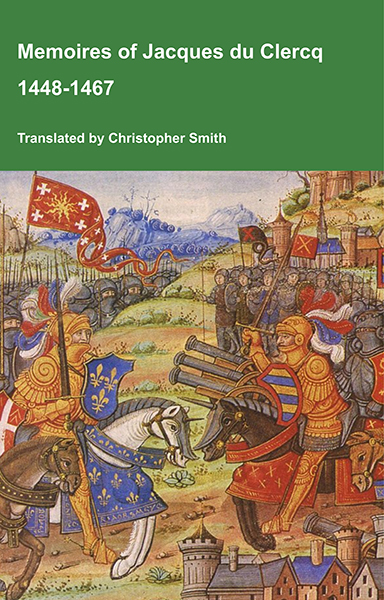
This is a translation of the 'Memoires of Jacques du Clercq', published in 1823 in two volumes, edited by Frederic, Baron de Reissenberg. In his introduction Reissenberg writes: 'Jacques du Clercq tells us that he was born in 1424, and that he was a licentiate in law and a counsellor to Philip the Good, Duke of Burgundy, in the castellany of Douai, Lille, and Orchies. It appears that he established his residence at Arras. In 1446, he married the daughter of Baldwin de la Lacherie, a gentleman who lived in Lille. We read in the fifth book of his Memoirs that his father, also named Jacques du Clercq, had married a lady of the Le Camelin family, from Compiègne. His ancestors, always attached to the counts of Flanders, had constantly served them, whether in their councils or in their armies.' The Memoires cover a period of nineteen years beginning in in 1448, ending in in 1467. It appears that the author had intended to extend the Memoirs beyond that date; no doubt illness or death prevented him from carrying out this plan. As Reissenberg writes the 'merit of this work lies in the simplicity of its narrative, in its tone of good faith, and in a certain air of frankness which naturally wins the reader’s confidence.' Du Clercq ranges from events of national and international importance, including events of the Wars of the Roses in England, to simple, everyday local events such as marriages, robberies, murders, trials and deaths, including that of his own father in Book 5; one of his last entries.
Available at Amazon in eBook and Paperback format.
On 29th December 1986 Harold Macmillan 1st Earl Stockton (age 92) died. His grandson Alexander (age 43) succeeded 2nd Earl of Stockton, 2nd Viscount Macmillan of Ovenden, of Chelwood Gate in East Sussex and of Stockton-on-Tees in Cleveland.
On 29th December 2008 John Wyndham Hanmer 8th Baronet (age 80) died. His son Wyndham (age 53) succeeded 9th Baronet Hamner of Hamner in Flintshire.
On 29th December 2009 Anthony Gerard Edward Noel 5th Earl of Gainsborough (age 86) died. His son Anthony (age 59) succeeded 6th Earl Gainsborough, 8th Baron Barham. Sarah Rose Winnington Countess Gainsborough (age 58) by marriage Countess Gainsborough.