

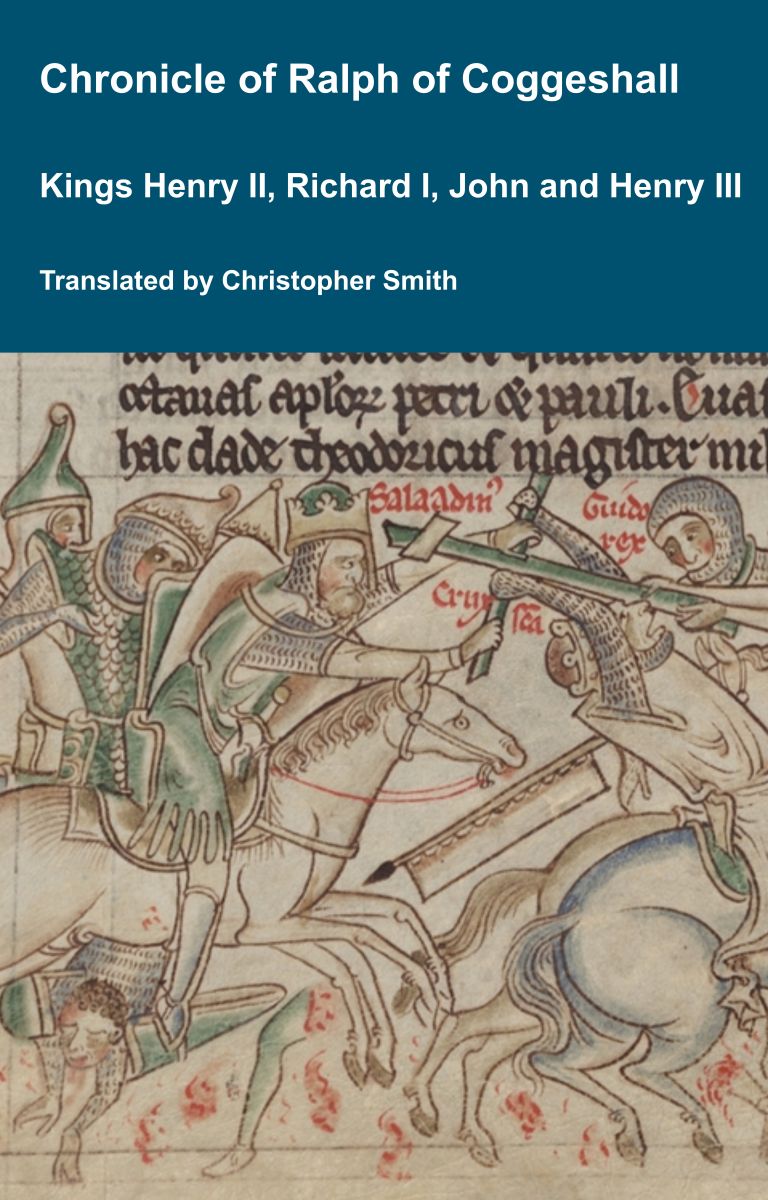
Chronicle of Abbot Ralph of Coggeshall
The Chronicle of Abbot Ralph of Coggeshall (Chronicon Anglicanum) is an indispensable medieval history that brings to life centuries of English and European affairs through the eyes of a learned Cistercian monk. Ralph of Coggeshall, abbot of the Abbey of Coggeshall in Essex in the early 13th century, continued and expanded his community’s chronicle, documenting events from the Norman Conquest of 1066 into the tumultuous reign of King Henry III. Blending eyewitness testimony, careful compilation, and the monastic commitment to record-keeping, this chronicle offers a rare narrative of political intrigue, royal power struggles, and social upheaval in England and beyond. Ralph’s work captures the reigns of pivotal figures such as Richard I and King John, providing invaluable insights into their characters, decisions, and the forces that shaped medieval rule. More than a simple annal, Chronicon Anglicanum conveys the texture of medieval life and governance, making it a rich source for scholars and readers fascinated by English history, monastic authorship, and the shaping of the medieval world.
Available at Amazon in eBook and Paperback format.
1175-1189 Abergavenny Massacre is in 12th Century Events.
Around 25th December 1175, Christmas, William de Braose 4th Baron Bramber [aged 31] invited the local Welsh nobles to his Christmas court at Abergavenny Castle [Map] as an act of reconciliation. Seisyll ap Dyfnwal Gwent and his elder son Geoffrey Gwent were murdered. William de Braose 4th Baron Bramber and his men then rode to Seisyll's home. There his younger son Cadwalladr Gwent [aged 7] was murdered and his wife captured.
Chronicle of the Princes of Wales. Immediately after that, Seisyll, son of Dyvnwal, was slain, through the treachery of the lord of Brecheiniog [William de Braose 4th Baron Bramber [aged 31]], in the castle of Abergavenny [Map] and with him Gruffudd his son, and many of the chieftains of Gwent. And then the French repaired to the court of Seisyll, son of Dyvnwal; and after seizing Gwladus his wife, they killed his son Cadwalader [aged 7]. And on that day there was the most miserable slaughter of the good people of Gwent. And after that most open and ílagitious treachery, none of the Welsh dared trust to the French
Holinshed's Chronicle [1525-1582]. The same yeare [1175] William de Breause having got a great number of Welshmen into the castell of Abergauennie [Map], vnder a colourable pretext of communication, proponed this ordinance to be receiued of them with a corporall oth; That no traueller by the waie amongst them should beare The Welshmē not well dealt withall.any bow, or other vnlawfull weapon. Which oth when they refused to take, bicause they would not stand to that ordinance he condemned them all to death. This deceit he vsed towards them in reuenge of the death of his vncle Henrie of Hereford, whom vpon easter euen before, they had through treason murthered, and were now acquited with the like againe.
Annals of Six Kings of England by Nicholas Trivet [1258-1328]. In this year, when a conflict began between the Christians and Saladin, the war grew heavier against the Christians. Many fell in battle, and the Master of the Knights Templar was captured. When Saladin wished to exchange him for his own nephew, whom the Christians had taken prisoner, the Master of the Temple refused, saying that it was not the custom of the knights of his order for any ransom to be given for them except a belt and a knife. Thus he remained in captivity and died there. Afterward Saladin laid siege to the castle of Jacob's Ford, captured it by force, and killed all who were found within it.
Hoc anno inito conflictu Christianorum contra Saladinum, aggravatum est bellum super Christianos; multisque cadentibus, magister militiæ Templi captus est; quem cum Saladinus commutare vellet pro nepote suo, quem ceperant Christiani, renuit magister Templi dicens, non esse consuetudinis militum suæ religionis, ut aliqua pro eis daretur redemptio, præter cingulum et cultellum; sicque in captivitate detentus mortuus est. Postea obsedit Saladinus castrum de Vado Jacob, et illud violenter cepit, omnesque in eo inventos occidit.
On 11th June 1183 Henry the Young King [aged 28] died at Castle of Martel clasping a ring his father had sent as a token of forgiveness. He was buried at Rouen Cathedral [Map].
Chronicum Anglicanum by Ralph Coggeshall. Year 1183. King Henry the Younger, who had rebelled against his father, died at Martel without children, and was buried at Rouen in the church of Blessed Mary; his wife Margaret afterwards married Béla, king of the Hungarians.
Anno MCLXXXIII. Henricus rex junior, qui contra patrem rebellaverat, apud Marteus moritur absque liberis, sepultusque est Rothomagi in ecclesia Beatæ Mariæ; cujus uxor Margareta regi Belo Hungariorum postmodum nupsit.
Annals of Six Kings of England by Nicholas Trivet [1258-1328]. Henry, the young king of England, died [on 11th June 1183]. He had bequeathed his body to the church of Rouen. His death was mourned by the princes and knights who were accustomed to accompany him with such grief that nothing like it had been heard since ancient times. The citizens of Le Mans, through whose city the funeral procession was being carried, forced the body to be buried there the next day, after it had rested during the night in their principal church. But the church of Rouen, to which he had devoted himself, did not neglect its right. Through the efforts of the noble man Robert, dean of Rouen, the people of Le Mans were compelled after ten weeks to return the body. From Le Mans to Rouen, a journey of four days, it was carried only upon the shoulders of princes and noblemen. There it was honourably buried in the metropolitan church, to the right of the high altar, accompanied, as some writers report, by the glory of miracles. His father the king is said to have lamented his death with inconsolable grief.
Henricus rex Angliæ junior moritur, qui corpus suum legavit ecclesiæ Rothomagensi. Mortem ejus planxerunt principes et milites, qui eam comitari solebant, tanto dolore, ut nullus ab antiquis temporibus ei similis audiretur. Cives Cenomannenses, per quorum urbem erat funus deportandum, cum nocte in ecclesia eorum majori quievisset, coegerunt illud ibidem in crastino sepeliri. Sed ecclesia Rothomagensis, cui se devoverat, jus suum non negligens, agente viro nobili Roberto Rothomagensi decano, Cenomanenses post decem septimanas compulit reddere sibi funus. Quod a Cenomannis usque Rothomagum, quatuor videlicet dietis, non nisi principum et nobilium virorum cervicibus est delatum; ubi in metropolitana basilica juxta majus altare a dextris, non sine miraculorum gloria, ut nonnulli scribunt, honorifice est sepultum. Mortem vero ejus rex pater inconsolabiliter dicitur deplorasse.
On 4th July 1187 the Battle of Hattin took place on 4 July 1187, between the Crusader states of the Levant and the forces of the Ayyubid sultan Saladin. The Muslim armies captured or killed the majority of the Crusader forces resulting in the Muslims once again becoming the pre-eminent military power in the Holy Land, re-capturing Jerusalem and most of the other Crusader-held cities and castles.
Raynald of Châtillon [aged 63] was captured during the battle and personally beheaded by Saladin after he refused to convert to Islam.
Chronicum Anglicanum by Ralph Coggeshall. In this year [4th July 1187] Saladin attacked the army of the Christians, which, worn out by a laborious march and weighed down by the excessive heat, with water entirely lacking, he defeated in a place called Marescaucie, which is three miles distant from the city of Tiberias. Then six of King Guy's knights fled to Saladin and informed him of everything and of the plans of the Christians. Whereupon Saladin, who had previously doubted the outcome of the battle, regained confidence, and with an innumerable multitude of warriors he attacked the Christians with every form of combat and defeated them. At last Taqi al-Din, nephew of Saladin, captured King Guy of Jerusalem as he attempted to flee, together with the Cross of the Lord's wood, after Rufinus, bishop of Acre, who against custom had carried it while clad in armour, was killed. And this by the just judgment of God, because he had placed his confidence more in earthly arms than in heavenly. Prince Reynald [of Châtillon] was killed there; Roger de Mowbray and Hugh de Beauchamp were captured, with many nobles besides; and almost the whole Christian army was shattered, captured, and slaughtered by the Saracens. But the count of Tripoli with a few others escaped unharmed by flight.
Hoc anno Saláádini exercitus Christianorum exercitum, laborioso itinere confectum et nimio caloris æstu prægravatum, aqua omnino deficiente, expugnavit in loco qui dicitur Marescaucie, qui locus distat a civitate Tyberiadis tribus millibus. Tunc sex ex militibus regis Guidonis ad Saláádinum confugerunt, et de omni re et proposito Christianorum eum instruxerunt. Unde Saláádinus, qui antea de discrimine belli dubitabat, resumpsit vires, et cum infinita multitudine bellatorum Christianos omni genere pugnandi invasit et expugnavit. Tandem Tekedinus, nepos Saláádini, Guidonem regem Hierusalem fugam arripientem cepit cum Cruce Dominici ligni, interfecto Rufino episcopo de Achon, qui eam, contra consuetudinem, loricatus portavit, et hoc digno Dei judicio, quia magis in armis terrenis quam in cœlestibus confidentiam habuit. Princeps Reginaldus ibidem interfectus est; Rogerus de Mumbrai, Hugo de Bellocampo capti sunt, et plures nobilium cum eis; et fere universus exercitus Christianorum a Sarracenis confractus, captus et trucidatus est; sed comes Tripolitanus cum quibusdam aliis per fugam illæsus evasit.
Chronicle of Walter of Guisborough
A canon regular of the Augustinian Guisborough Priory, Yorkshire, formerly known as The Chronicle of Walter of Hemingburgh, describes the period from 1066 to 1346. Before 1274 the Chronicle is based on other works. Thereafter, the Chronicle is original, and a remarkable source for the events of the time. This book provides a translation of the Chronicle from that date. The Latin source for our translation is the 1849 work edited by Hans Claude Hamilton. Hamilton, in his preface, says: 'In the present work we behold perhaps one of the finest samples of our early chronicles, both as regards the value of the events recorded, and the correctness with which they are detailed; Nor will the pleasing style of composition be lightly passed over by those capable of seeing reflected from it the tokens of a vigorous and cultivated mind, and a favourable specimen of the learning and taste of the age in which it was framed.'
Available at Amazon in eBook and Paperback format.
Annals of Six Kings of England by Nicholas Trivet [1258-1328]. Saladin, prince of Damascus, having engaged the Christians in battle and gained the victory, captured Guy, king of Jerusalem, and Reynald, prince of Antioch, and killed very many others in the battle. The city of Jerusalem was taken, and the wood of the Holy Cross, and almost all Judaea, together with all the maritime cities except Tyre. The archbishop of that city was sent as the messenger of this dreadful disaster to the Christian world, and especially to Henry, king of England, whose fame had spread far and wide through the earth for wealth, power, and courage. Immediately, before all others, Richard, the son of the king of England, inflamed with zeal for God, took the cross to avenge the injury done to the Cross, and by his action went before all the rest, whom he encouraged by his example. Bohemond, count of Tripoli, fifteen days after the capture of Jerusalem, being accused of treachery, fell into madness and died.
Saladinus, princeps Damasci, commisso cum Christianis prælio, victor effectus, cepit Guidonem regem Jerusalem, Reynaldumque principem Antiochiæ, et alios quamplurimos in prælio interemit. Capta est civitas Jerusalem, lignumque sanctæ Crucis, et Judæa fere tota, cum civitatibus omnibus maritimis, præter Tyrum; cujus archiepiscopus diræ cladis nuntius ad orbem Christianum missus est, et specialiter ad regem Anglorum Henricum, cujus fama longe lateque diffusa erat super terram divitiis, potentia, ac virtute. Statimque præ aliis Ricardus filius regis Anglorum, zelo Dei accensus, ob ulciscendam Crucis injuriam crucem accipiens, ceteros omnes præcedit facto, quos invitat exemplo. Boamundus, comes Tripolitanus, quindecim diebus elapsis post captam Jerusalem, proditionis reus, versus in amentiam exspiravit.
Chronicum Anglicanum by Ralph Coggeshall. After this, on the twentieth day of the month of September [1187], the holy city of Jerusalem was besieged by the unbelievers with great blaring of trumpets, the clash of arms, and the howling of those shouting. The people of Jerusalem for one week fought manfully against them. But at length the Christians, worn down and exhausted by the cruel and unrelenting struggle of the Turks, were so reduced that scarcely twenty or thirty appeared for the defence of the city's walls. Already there was no man so bold in the whole city who, even for the price of a hundred bezants, would dare to keep watch for one night in its defence. Meanwhile, the inhabitants of Jerusalem, compelled by necessity, three times sent envoys to the king of Syria, begging that he accept a hundred bezants for their ransom and allow them to depart freely with their goods from the holy city. But when he refused this, at last, after taking counsel, he imposed this tribute upon the Jerusalemites: that each male of ten years and above should pay ten bezants for his release, each woman five, and each child of seven years and under, one; and so, being freed from slavery, they might safely depart wherever they wished. This agreement pleased the lord patriarch and the others who had money; but those who had no gold wept continually with lamentable cries. Thus, in the year 1187, Jerusalem was handed over (alas!) into the hands of the wicked by the Christians, who had possessed it for eighty-seven years since it was first wrested from the power of the pagans.
Post hæc, vicesima die mensis Septembris sancta civitas Hierusalem obsessa est ab incredulis cum magno clangore tubarum, et strepitu armorum, et ululatu vociferantium. Hierosolymitæ vero per unam hebdomadam viriliter contra eos certabant. Sed tandem Christiani crudeli et indefesso Turcorum certamine sic defatigati et defecti erant, ut vix viginti vel triginta ad defensiones murorum civitatis apparerent. Non inveniebatur jam homo tam audax in omni civitate qui pro pretio centum Bisantiorum auderet una nocte ad defensionem vigilare. Inter hæc habitatores Hierusalem, necessitate compulsi, legatos ad regem Syriæ per ter mittunt, supplicantes quatenus centum Bisantiorum pro sua redemptione ab eis accipiat, et eos libere de sancta civitate cum suis egredi permittat. At illo renuente, tandem, accepto consilio, tale tributum Hierosolymitis instituit, quatenus unusquisque masculus decem annorum et supra, pro sui liberatione decem Bisantios persolveret, femina quinque, puer septem annorum et infra, unum; et sic a servitute liberati, quo vellent securi abirent. Placuit ergo conventio ista domino patriarchæ et cæteris qui pecunias habebant; qui vero aureos non habebant, lamentabili voce indesinenter plangebant. Igitur anno MCLXXXVII. tradita est Hierusalem (proh dolor!) in manibus nefandorum a Christianis, qui eam possederant per quater viginti et septem annos ex quo erepta fuerat a potestate paganorum.
On 15th September 1189 King Richard "Lionheart" I of England [aged 32] held a Council meeting at Pipewell [Map] at which he appointed a number of Bishops:
Bishop William Longchamp was elected Bishop of Ely.
Bishop Godfrey Lucy was elected Bishop of Winchester.
Bishop Richard Fitzneal [aged 59] was elected Bishop of London.
Archbishop Hubert Walter [aged 29] was elected Bishop of Salisbury.
On 22nd October 1189 two of Richard's new Bishops were consecrated...
Bishop Godfrey Lucy was consecrated Bishop of Winchester.
Archbishop Hubert Walter [aged 29] was consecrated Bishop of Salisbury.
On 31st December 1189 two of Richard I's new bishops were consecrated...
Bishop William Longchamp was consecrated Bishop of Ely.
Bishop Richard Fitzneal [aged 59] was consecrated Bishop of London.