

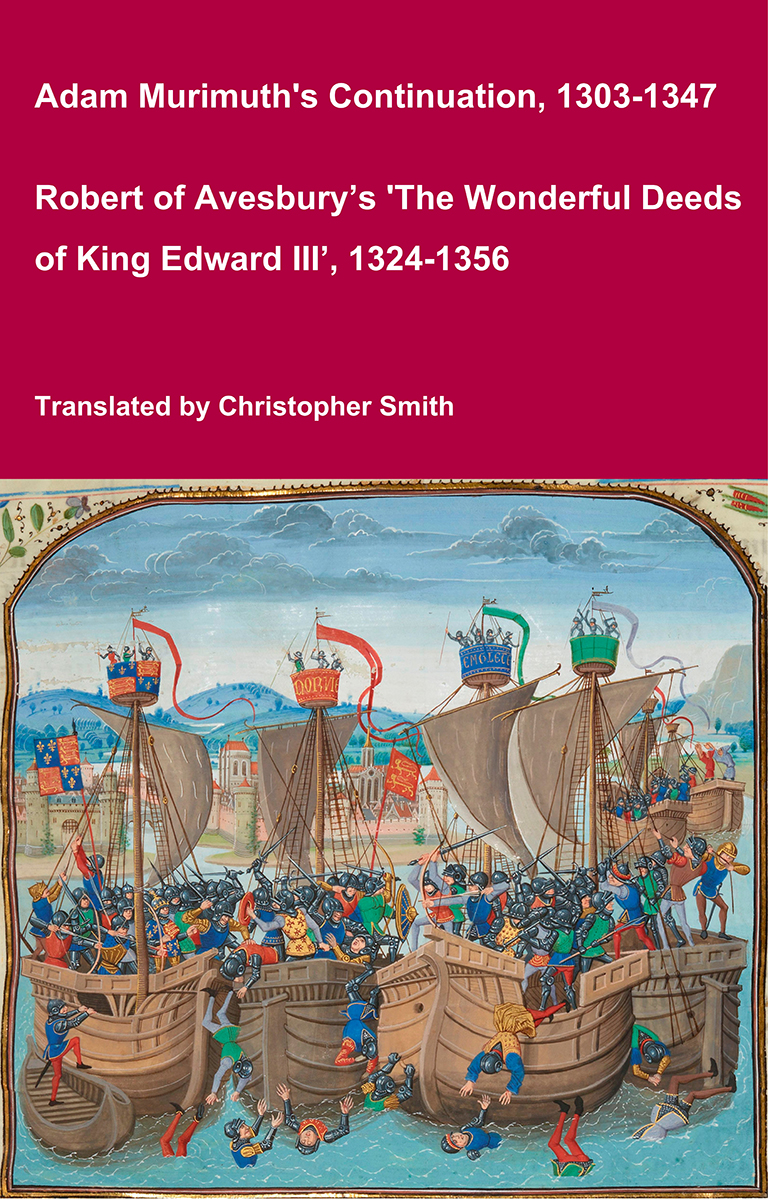
Adam Murimuth's Continuation and Robert of Avesbury’s 'The Wonderful Deeds of King Edward III'
This volume brings together two of the most important contemporary chronicles for the reign of Edward III and the opening phases of the Hundred Years’ War. Written in Latin by English clerical observers, these texts provide a vivid and authoritative window into the political, diplomatic, and military history of fourteenth-century England and its continental ambitions. Adam Murimuth Continuatio's Chronicarum continues an earlier chronicle into the mid-fourteenth century, offering concise but valuable notices on royal policy, foreign relations, and ecclesiastical affairs. Its annalistic structure makes it especially useful for establishing chronology and tracing the development of events year by year. Complementing it, Robert of Avesbury’s De gestis mirabilibus regis Edwardi tertii is a rich documentary chronicle preserving letters, treaties, and official records alongside narrative passages. It is an indispensable source for understanding Edward III’s claim to the French crown, the conduct of war, and the mechanisms of medieval diplomacy. Together, these works offer scholars, students, and enthusiasts a reliable and unembellished account of a transformative period in English and European history. Essential for anyone interested in medieval chronicles, the Hundred Years’ War, or the reign of Edward III.
Available at Amazon in eBook and Paperback format.
1230-1259 Henry III is in 13th Century Events.
On 23rd December 1230 Berengaria of Navarre Queen Consort England [aged 65] died. She the widow of King Richard "Lionheart" I of England who she had married in 1191 in Cyprus whilst he was on Crusade. She had been brought to Cyprus by his mother Eleanor of Aquitaine Queen Consort Franks and England who was near seventy at the time. Their marriage started with his taking Jerusalem then being captured and held hostage for three years. There were no children of the marriage. She is believed to have never set foot in England. She didn't marry again.
Flowers of History by Roger of Wendover 1233. Of the fierce battle between the marshal and the Poictevins.
In the same year the marshal [aged 42], on one of his foraging incursions into the territories of his enemies, came to the town of Monmouth [Map], which was hostile to him, where he ordered his army to proceed on their expedition, whilst he with a hundred of his fellow knights turned aside towards the castle of that place to examine its condition, as he purposed to besiege it in a few days; but as he was riding round the walls of the town, he was seen by Baldwin de Guisnes [aged 33], to whom the king had entrusted the charge of that castle [Map] together with several Poictevins, and understanding that the marshal was there with only a few followers for the purpose of examining the castle, he sallied out with a thousand brave and well-equipped soldiers, and pursued him at full speed, designing to make him and his followers prisoners and bring them into the town. The earl Marshal's companions however, when they saw the impetuous advance of the enemy, advised him to consult their safety by flight, saying that it would be rash for such a few of them to engage with such a number of the enemy; to which the marshal replied that he had never as yet turned his back on his enemies in battle, and declared that he would not do so now, and exhorted them to defend themselves bravely and not to die unavenged. The troops from the castle then rushed fiercely on them and attacked them with their lances and swords [Battle of Monmouth]: a severe though very unequal conflict then ensued, yet although there were only a hundred of the marshal's party to oppose a thousand of their adversaries, they fought for a great part of the day. But Baldwin de Guisnes with twelve of his stoutest and best armed soldiers made au attack on the marshal in person, and endeavoured to take him prisoner and carry him off to the castle; he however kept them at a distance, brandishing his sword right and left, and struck down whoever came within reach, either killing them or stunning them hy the force of his blows, and although engaged single-handed against twelve enemies, defended himself for a length of time. His enemies at length, not daring to approach him, killed the horse he rode with their lances; but the marshal, who was well practised in the French way of fighting, seized one of the knights who was attacking him by the feet, and dragged him to the ground, and then quickly mounting his adversary's horse, he renewed the battle. The knight Baldwin was ashamed that the marshal defended himself single-handed against so many of his enemies for such a time, and made a desperate attack on him, and seizing his helmet, tore it from his head with such violence, that blood gushed forth from his mouth and nostrils; he then seized the marshal's horse by the bridle, and endeavoured to drag it with its rider towards the castle, whilst others assisted him by impelling the marshal on from behind. The latter however, sweeping his sword behind him, struck two of his enemies to the earth stunned, but could not then release himself from their grasp. At this juncture however a cross-bowman amongst the marshal's company, seeing his lord in danger, discharged an arrow from his bow, which, striking Baldwin, who was dragging the marshal away, in the breast, entered his body, notwithstanding his armour, and he fell to the earth believing himself mortally wounded; his companions on seeing this, left the marshal, and went to raise Baldwin from the ground, for they thought that he was dead.
 Become a Member via our Buy Me a Coffee page to read more.
Flowers of History by Roger of Wendover 1233. After this battle the marshal with Gilbert Basset, Richard Siward, and his other proscribed confederates, laid ambuscades for the Poictevins who held charge of the king's castles, so that whenever any of them went out foraging, they were attacked, and no quarter was given them: the consequence of which was, that the whole atmosphere in that part of the country was tainted by the numbers of dead foreigners who lay about in the roads and other places.
On 1st April 1234 Richard Marshal 3rd Earl Pembroke [aged 43], an opponent of King Henry III, was fatally injured at the Battle of the Curragh. He died on the 16th.
Flowers of History by Roger of Wendover 1234. 1st April 1234. When the troops were drawn up, the earl marshal [aged 43] saw that there were a great many to engage with only a few, he however exhorted his men to battle, asserting that he had undertaken this war for the sake of justice and the laws of England on account of the oppression of the Poietevins, thinking that they all were faithful to him, when in fact they were traitors. he then dashed boldly into the midst of the enemy, and forcing his way through them he opened a road for his knights with his sword, but only fifteen knights, his own retainers, followed him and endeavoured to disperse their enemies. His sworn dependants and knights on whom he trusted, as had been pre-agreed amongst these traitors, gave themselves up as prisoners to the enemies without force, without being wounded either by lance or sword, as if they were friends glad to see one another; some of them tied, without striking a blow, to the churches and convents, leaving the marshal with only fifteen knights. These however defended themselves bravely, unequal as the struggle was, against a hundred and forty; the whole weight of the battle however fell on the marshal, who then first discovered the treacherous design against his life, but, although attacked on all sides by his enemies, he still defended himself and slew six of them. A knight of gigantic size, to whom Richard de Burgh had given his armour, indignant at seeing this, made a rush at the marshal in order to kill him at once, and endeavoured forcibly to snatch his helmet from his head; the marshal, when he saw this man, thought that it was Richard de Burgh, and exclaimed, "Fly, vilest of traitors, lest I kill you;" to which he replied, "I will not fly, but will come nearer you;" he then lifted up his hands to seize the marshal's helmet, but the latter, by one blow of his sword, cut off both of his hands although covered with armour. Another of them, seeing his companion wounded, rushed with all the speed of his horse at the marshal, and exerting all his force struck him on his head, but owing to his helmet the blow took no effect; the earl however returned the blow and cut his enemy in two as far as the middle, after which not one of them would come near him for a long while. The leaders of his enemies, in a state of consternation, than urged on a host of people who had come there with lances, pitchforks, axes, and halberds, to surround the marshal, kill his horse, and bring him to the ground; and they at once surrounded and overwhelmed him, piercing his horse with many wounds; they could not even then however dismount him, they therefore cut off the horse's feet with their axes; the marshal then fell with his horse, overcome with fatigue, having been engaged fighting from the first hour of the day till the eleventh, and his enemies, rushing on him, lifted up his armour and mortally wounded him in the back. The nobles themselves on learning that he was mortally wounded, and lying as it were lifeless on the ground, conveyed him with scarcely any signs of life, to his own castle, which Maurice the justiciary had taken possession of but shortly before, where he was placed in close confinement and attended by only one young man of his party. He there remained in the hands of his enemies. This battle was fought on Saturday the first day of April.
Become a Member via our Buy Me a Coffee page to read more.
Chronica Majora by Matthew Paris.
April 1236. About the same time, several nobles and powerful men from the various provinces of the West, namely from Galloway, the Isle of Man, and parts of Ireland, assembled at the instance of Hugh de Lacy [aged 60], whose daughter had been married to Alan of Galloway, lately deceased, and they all united together for the purpose of restoring Galloway to the illegitimate son of the aforesaid Alan, and of annulling by force the just disposition made by the king of Scots [aged 37], who had distributed the inheritance amongst the three daughters of Alan, to whom it belonged by hereditary right. In order, therefore, to revoke and annul his distribution, and to restore the territory to the aforesaid Thomas, or to the son of Thomas, Alan's brother, or at least to one of that family, these presumptuous chiefs flew to arms, and, bursting forth into insolence, endeavoured to free themselves from the authority of the king. And in order to bring their attempts to the desired result, they entered into a strange kind of treaty, by means of a certain mode of divination, yet according to an abominable custom of their ancestors. For all these barbarians and their chiefs and magistrates drew blood from a vein near the heart, and poured it into a large cup, they then stirred and mixed it up, and afterwards, drinking to one another, quaffed it off, as a token that they were from that time forth allied by an indissoluble and, as it were, kindred treaty, and indivisible both in prosperity and adversity, even at the risk of their heads. They therefore provoked the king and the kingdom to war, burning their own houses and those of their neighbours, that the king, when he arrived, might not find either shelter or food for his army, and indulged in rapine and incendiarism, heaping injury on injury. On hearing of this, the king of Scotland collected his forces from all quarters, and, marching to meet them, drew up his forces in order and engaged them in open battle; and the fortune of war turning against the Galwegians, they were put to flight, and the royal troops, pursuing them at the sword's point, slew many thousands of them, and those who were taken alive by the king and his soldiers were put to an ignominious death without any chance of ransoming themselves. Some threw themselves on the king's mercy, and were consigned to close imprisonment by him till he could consult as to what should be done with them, and all of them, together with their descendants, he, not without good reason, disinherited. Having gained this victory the king glorified God, the lord of armies, and listening to good counsel, he sent word to Roger de Quincy [aged 41], earl of Winchester, John Baliol [aged 28], and William, the son of the earl of Albemarle, that, as they had married the three sisters, the daughters of Alan of Galloway, they might now, as the disturbances were quelled, hold peaceable possession of the rights pertaining to them. This battle took place in the month of April, the fortune of war favouring the king of Scots.
Become a Member via our Buy Me a Coffee page to read more.
On 22nd June 1239 King Edward I of England was christened at Westminster Abbey [Map]. Humphrey Bohun 2nd Earl Hereford 1st Earl Essex [aged 35] was godfather. He was named after King Edward "The Confessor" of England.
In 1240 Bishop Walter de Cantelupe [aged 49] convened the Synod of Worcester.
On 21st July 1242 the forces of King Henry III of England [aged 34] and Hugh XI of Lusignan VI Count of La Marche II Count Angoulême [aged 21] fought against the forces of at King Louis IX of France [aged 28] and his brother Alphonse Count Poitiers II Count Toulouse [aged 21] at Taillebourg [Map] during the Battle of Taillebourg. The battle was a decisive victory for the French. Henry thereafter signed a five-year truce with the French.
The History of William Marshal was commissioned by his son shortly after William’s death in 1219 to celebrate the Marshal’s remarkable life; it is an authentic, contemporary voice. The manuscript was discovered in 1861 by French historian Paul Meyer. Meyer published the manuscript in its original Anglo-French in 1891 in two books. This book is a line by line translation of the first of Meyer’s books; lines 1-10152. Book 1 of the History begins in 1139 and ends in 1194. It describes the events of the Anarchy, the role of William’s father John, John’s marriages, William’s childhood, his role as a hostage at the siege of Newbury, his injury and imprisonment in Poitou where he met Eleanor of Aquitaine and his life as a knight errant. It continues with the accusation against him of an improper relationship with Margaret, wife of Henry the Young King, his exile, and return, the death of Henry the Young King, the rebellion of Richard, the future King Richard I, war with France, the death of King Henry II, and the capture of King Richard, and the rebellion of John, the future King John. It ends with the release of King Richard and the death of John Marshal.
Available at Amazon in eBook and Paperback format.
Annals of Six Kings of England by Nicholas Trivet [1258-1328]. 1244. David, Prince of Wales, nephew of the King of England by his sister, suggested to Pope Innocent that the principality of Wales belonged to the fief of the Roman Church, and that he was unjustly compelled to hold it from the King of England. On this account the supreme pontiff wrote to the abbot of Abercon concerning this matter, which, being more fully understood, he passed over with dissimulation. The Sultan of Babylon, greatly angered at the breaking of the truce, having hired the Khwarezmians, who are thought the most warlike of the Saracens, attacked the Christians and slew a great multitude of them in a most bloody battleENDNOTE 1; in which battle both the prior of the Hospital and the master of the Knights Templar were taken captive by the enemy, and the Saracens destroyed the city of Jerusalem and the Lord’s sepulchre. Roger, precentor of Salisbury, was consecrated Bishop of Bath at Reading by the Bishop of Winchester. William, Bishop of Exeter, died. Baldwin de Redvers, Earl of Devon, also died. A second son was born to the king, called Edmund.
Note 1. The Battle of Forbie, Gaza, was fought on 17th and
On 15th January 1245 Archbishop Boniface Savoy [aged 38] was consecrated Archbishop of Canterbury at Lyon, France [Map] by Pope Innocent IV during the First Council of Lyon.
Annals of Six Kings of England by Nicholas Trivet [1258-1328]. 1245. Pope Innocent, after holding long discussions with the emperor concerning peace, and perceiving his obstinacy against the Church, with the help of the Genoese came into Gaul, and, holding a council at Lyons, condemned him as an enemy of the Church, depriving him of the empire. Envoys were sent to this council by the King of England, on the advice of the prelates, earls, and barons, namely Hugh Bigod, John fitz Geoffrey, William de Cantilupe, and Philip Basset, with Master William of Powick given to them as advocate, to oppose the concession of King John concerning the annual tribute for England and Ireland, and to declare that it had not proceeded with the assent of the kingdom, but had been protested against by the Archbishop of Canterbury on behalf of the whole realm. But the pope, replying that this required prolonged deliberation, suspended the matter. The prelates of England in this year complained to the king of the oppression of the English Church, the revenues and incomes of which were for the most part occupied by foreigners; on which account Master Martin, a kinsman of the lord pope, who was then considered the chief among them and the protector and defender of the others in such matters, was commanded by royal edict to leave the kingdom without delay. Boniface of Savoy, kinsman of the Queen of England, was raised to the archbishopric of Canterbury by the gift of the supreme pontiff, at the king’s procurement. Odo, Bishop of Tusculum, preached the cross in France for the passage of the King of France to the Holy Land. In the regions of Hainaut also many took the cross in support of the Landgrave of Thuringia, newly elected King of the Romans through the agency of the lord pope, against Henry, son of the deposed Frederick, who was defending his father against the Church. Charles, brother of the King of France, took as wife the fourth daughter of the Count of Provence, through whom he afterwards obtained the whole county. The third daughter of the same count, named Sanchia, had been married by Richard, brother of the King of England, his former wife Isabella, once the wife of Gilbert de Clare, having died, by whom he had begotten a son named Henry. Master Richard Blund was made Bishop of Exeter.
On 6th April 1250 the Battle of Fariskur was the last major battle of the Seventh Crusade. The Crusader army was defeated. King Louis IX of France [aged 35] and his two brothers Alphonse Count Poitiers II Count Toulouse [aged 29] and King Charles Capet of Sicily [aged 23] were captured.
On 8th May 1250 King Louis IX of France [aged 36] and his two brothers Alphonse Count Poitiers II Count Toulouse [aged 29] and King Charles Capet of Sicily [aged 23] with 12,000 fellow prisoners were allowed to leave for Acre [Map] after paying a ransom of 400,000 dinars.
Annals of Six Kings of England by Nicholas Trivet [1258-1328]. 1250. The King of France, his army suffering from plague and famine in the siege of Mansurah, while returning to Damietta, was captured on the road by the Saracen army that came upon him, together with his two brothers, Alfonso, Count of Poitou, and Charles, Count of Anjou, and many other great men. Robert, Count of Artois, the king’s third brother, was drowned while fleeing. Many also were slain in the battle [on 6th April 1250], among whom was William Longespée, Earl of Salisbury, who fell fighting bravely, overwhelmed by the heavy assault of the enemy. His mother, the abbess of Lacock as has been said above, on the night before the day on which her son was killed, saw the heavens opened, and her son armed, raised up by angels, entering with joy. The only daughter and heiress of this William was married by Henry de Lacy, Earl of Lincoln, who received with her the earldom of Salisbury. In Denmark Henry, the renowned king of the Danes, was suffocated at sea by his younger brother Abel, that he might reign in his place. William of Raleigh died, and Aymer, brother of King Henry by his mother, was made Bishop of Winchester.
Bourgeois de Valenciennes. In the year 1253, Lord Guy of Flanders [aged 27], son of Countess Margaret, went against the Count of Holland with great effort, and he led there a very fine company of knights and men-at-arms. But he was captured and held in a battle1, and there his heel was cut off2, and all his host was defeated. And the Count of Bar [aged 32]3 and the Count of Guines4 and the greater part of the Flemings were taken or drowned, and the remainder fled in pitch-stained breeches.
En l'an mil IIc LIII alla monseigneur Guy de Flandres fils de la contesse Marguerite sur le conte de Holande à grant effort et y mena moult belle compaignie de cheva liers et de gens d’armes; mais il fut prins et retenus en une bataille, et y eult le talon coppe, et tout son ost des confit. Et le conte de Bar et le conte de Guines et la plus grande partye des Flamens furent prins ou noyés, et le remanant s’en fuy à braies de poix.
Note 1. The Battle of Walcheren was fought on 4th July 1253.
Note 2. The expression 'his heel was cut off' suggests that Guy was severely injured in the battle i.e. he could no longer stand and fight. Similarly, the expression 'pitch-stained breeches' suggests probably mean soiled breeches.
Note 3. Theobald, around 1221-1291, II Count of Bar. Married 1 in 1243 Jeanne of Dampierre, no issue, 2 in 1266 to Jeanne de Toucy, with whom he had a number of children.
Note 4. Guy of Dampierre, around 1226-1305. Brother-in-law of Theobald of Bar. Married 1 in 1246 Mathilde of Béthune, 2 Isabelle of Luxembourg. Issue from both marriages.
Annals of Dunstable. And leaving Edward with his wife and their attendants in Gascony, the King of England, with the queen and their household, having first requested and obtained leave from the King of France, came to Paris. And the King of France received him with the kiss of peace and great joy, and held for him a splendid feast; to which the King of England on the following day returned equal honour. And there were present together four sisters: namely, the Queen of England, the Queen of France, the wife [Sanchia Provence Queen Consort Germany] of Count Richard, and the wife [Beatrice Provence Queen Consort Sicily] of the brother of the King of France.
Et Edwardo cum uxore et suis in Wasconia dimissis, rex Angliæ cum regina et suis, petita licentia a rege Franciæ et obtenta, venit Parysius; et suscepit eum rex Franciæ in osculum pacis cum gaudio magno, et solemne fecit ei convivium; cui rex Angliæ in crastino reddidit talionem. Et ibi fuerunt simul quatuor sorores; scilicet, regina Angliæ, regina Franciæ, uxor comitis Ricardi, et uxor comitis fratris regis Franciæ.
In June 1255 Llywelyn "Last" Aberffraw [aged 22] defeated his brothers Owain "The Red" Aberffraw [aged 23] and Dafydd ap Gruffudd Aberffraw Prince of Wales [aged 16] during the Battle of Bryn Derwin. Owain "The Red" Aberffraw and Dafydd ap Gruffudd Aberffraw Prince of Wales were both imprisoned.
Annals of Six Kings of England by Nicholas Trivet [1258-1328]. Llywelyn, Prince of Wales, having gathered a strong force, entered the county of Chester, which the king had lately granted to his son Edward, and laid waste all with slaughter and fire as far as the gates of the city of Chester. To restrain his attack, a valiant and renowned knight called Stephen, surnamed Bauzan, being sent with an army by the king, when he had entered the land of a certain Welsh noble named Rhys, surnamed Fychan, that is Little, was surrounded by a multitude of enemies in marshy places and slain on the Saturday [22nd June 1255] in the week of Pentecost. The rest of his army either fell fighting with their leader or were taken alive and cast into chains, except a few who were able to escape by flight. In this year a certain Christian boy, named Hugh, was seized by the Jews at Lincoln and, in reproach of the Christian name, was cruelly crucified.
Henrici Quinti, Angliæ Regis, Gesta, is a first-hand account of the Agincourt Campaign, and subsequent events to his death in 1422. The author of the first part was a Chaplain in King Henry's retinue who was present from King Henry's departure at Southampton in 1415, at the siege of Harfleur, the battle of Agincourt, and the celebrations on King Henry's return to London. The second part, by another writer, relates the events that took place including the negotiations at Troye, Henry's marriage and his death in 1422.
Available at Amazon in eBook and Paperback format.
Annals of Six Kings of England by Nicholas Trivet [1258-1328]. 1257. The King of England summoned a parliament at Oxford, at which, the prelates, earls, and barons having assembled, statutes were made which are to this day called the 'Provisions of Oxford'; and the king was compelled to swear a corporal oath to observe them inviolably, almost all likewise taking the same oath. Aymer, Bishop-elect of Winchester, William de Valence, Guy and Geoffrey de Lusignan, the king’s uterine brothers, refusing to swear with the others, withdrew, and the barons pursuing them with some horsemen and arms, they at once crossed the sea towards France. Walter, Archdeacon of Surrey, was made Bishop of Exeter.
On 4th December 1259 King Henry III of England [aged 52] and King Louis IX of France [aged 45] signed the Treaty of Paris aka Abbeville. The Treaty Under the treaty, Henry acknowledged the loss of the Duchy of Normandy. Henry agreed to renounce control of Maine, Anjou, Touraine and Poitou, which had also been lost under the reign of King John, but Henry remained Duke of Aquitaine as a vassal to Louis. In exchange, Louis withdrew his support for English rebels.