

William of Worcester's Chronicle of England
William of Worcester, born around 1415, and died around 1482 was secretary to John Fastolf, the renowned soldier of the Hundred Years War, during which time he collected documents, letters, and wrote a record of events. Following their return to England in 1440 William was witness to major events. Twice in his chronicle he uses the first person: 1. when writing about the murder of Thomas, 7th Baron Scales, in 1460, he writes '… and I saw him lying naked in the cemetery near the porch of the church of St. Mary Overie in Southwark …' and 2. describing King Edward IV's entry into London in 1461 he writes '… proclaimed that all the people themselves were to recognize and acknowledge Edward as king. I was present and heard this, and immediately went down with them into the city'. William’s Chronicle is rich in detail. It is the source of much information about the Wars of the Roses, including the term 'Diabolical Marriage' to describe the marriage of Queen Elizabeth Woodville’s brother John’s marriage to Katherine, Dowager Duchess of Norfolk, he aged twenty, she sixty-five or more, and the story about a paper crown being placed in mockery on the severed head of Richard, 3rd Duke of York.
Available at Amazon in eBook and Paperback format.
1600-1603 Essex Rebellion Elizabeth's Death is in 17th Century Events.
On 16th June 1600 Henry Somerset 1st Marquess Worcester [aged 23] and Anne Russell Countess Worcester [aged 22] were married. He the son of Edward Somerset 4th Earl of Worcester [aged 50] and Elizabeth Hastings Countess of Worcester [aged 54]. They were fifth cousins.
Mary Fitton [aged 21] led a Masque in celebration at the Blackfriars residence of Henry Brooke 11th Baron Cobham [aged 35] with Queen Elizabeth I of England and Ireland [aged 66] and William Herbert 3rd Earl Pembroke [aged 20] attending. She, Mary soon afterwards became the mistress of William Herbert 3rd Earl Pembroke and soon became pregnant.
On 2nd July 1600 the Battle of Nieuwpoort took place at Nieuwpoort in Flanders.
Charles Drury was killed.
On 28th November 1660, considered to be the official foundation date of the Royal Society, a meeting at Gresham College of 12 natural philosophers decided to commence a "Colledge for the Promoting of Physico-Mathematicall Experimentall Learning". Amongst those founders were Christopher Wren, Robert Boyle, John Wilkins, William Brouncker and Robert Moray.
On 5th August 1600. The Gowrie Conspiracy was an attempt by John Ruthven 3rd Earl Gowrie [aged 23] and his brother Alexander Ruthven [aged 20] to kill King James I [aged 34]. He, King James, had had their father William Ruthven 1st Earl Gowrie executed for his part in the Raid of Ruthven eighteen years earlier.
The attempt was botched. John Ruthven 3rd Earl Gowrie and Alexander Ruthven were killed, the former by John Ramsay 1st Earl Holderness [aged 20].
William Ruthven fled to France.
Patrick Ruthven was imprisoned for nineteen years at the Tower of London [Map].


On 23rd December 1600 the future King Charles I was baptised at Holyrood Palace [Map]. He was created Duke Albany.


On 25th December 1600 Alexander Livingston 1st Earl Linlithgow was created 1st Earl Linlithgow on the occasion of the Baptism of Prince Charles.
On 31st December 1600 Queen Elizabeth I of England and Ireland [aged 67] granted a Royal Charter to the Company of Merchants of London trading into the East Indies aka the East India Company led by George Clifford 3rd Earl of Cumberland [aged 42] by which they received a monopoloy on trade with the East Indies. Thomas Smythe [aged 42] was appointed first Governor of the East India Company.


General History of Voyages Volume 8 Chapter 10 Section 1 Preparation. Every thing being in readiness, the fleet departed from Woolwich, in the river Thames, on the 13th of February, 1600, after the English mode of reckoning, or more properly 1601. They were so long delayed in the Thames and the Downs, for want of wind, that it was Easter before they arrived at Dartmouth, where they spent, five or six days, taking in bread.and,other provisions, appointed to be procured there.
On 24th March 1603 Elizabeth I [aged 69] died at Richmond Palace [Map] around three in the morning. Her first cousin twice removed James [aged 36] succeeded I King England Scotland and Ireland.
Immediately following her death Robert Carey 1st Earl Monmouth [aged 43] started on horseback for Edinburgh to inform King James I of England and Ireland and VI of Scotland arriving at Holyrood Palace [Map] late on the 26 Mar 1603. His conduct met with general disapproval and merited censure as contrary to all decency, good manners and respect. George Carew and Thomas Lake [aged 35] were sent by the Council to formally inform James of her death.
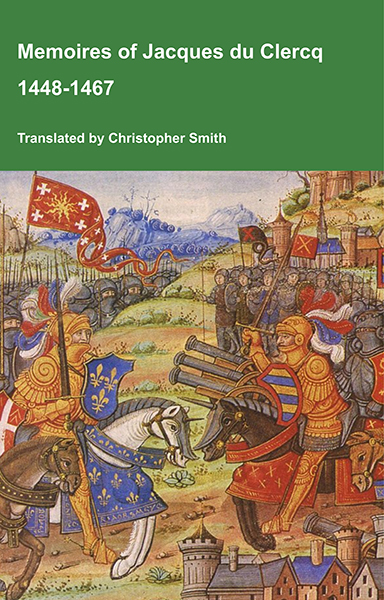
This is a translation of the 'Memoires of Jacques du Clercq', published in 1823 in two volumes, edited by Frederic, Baron de Reissenberg. In his introduction Reissenberg writes: 'Jacques du Clercq tells us that he was born in 1424, and that he was a licentiate in law and a counsellor to Philip the Good, Duke of Burgundy, in the castellany of Douai, Lille, and Orchies. It appears that he established his residence at Arras. In 1446, he married the daughter of Baldwin de la Lacherie, a gentleman who lived in Lille. We read in the fifth book of his Memoirs that his father, also named Jacques du Clercq, had married a lady of the Le Camelin family, from Compiègne. His ancestors, always attached to the counts of Flanders, had constantly served them, whether in their councils or in their armies.' The Memoires cover a period of nineteen years beginning in in 1448, ending in in 1467. It appears that the author had intended to extend the Memoirs beyond that date; no doubt illness or death prevented him from carrying out this plan. As Reissenberg writes the 'merit of this work lies in the simplicity of its narrative, in its tone of good faith, and in a certain air of frankness which naturally wins the reader’s confidence.' Du Clercq ranges from events of national and international importance, including events of the Wars of the Roses in England, to simple, everyday local events such as marriages, robberies, murders, trials and deaths, including that of his own father in Book 5; one of his last entries.
Available at Amazon in eBook and Paperback format.
Diary of Anne Clifford. 24th March 1603. The 20th [Note. A mistake for the 24th?] Mr Flocknall, my Aunt Warwick's [aged 55] man, brought us word from his Lady, that the Queen died about 2/3 o'clock in the morning.
This message was delivered to my Mother [aged 42] and me in the same chamber where afterwards I was married.
Note 1. I was at Queen Elizabeth's death thirteen years and two months old, and Mr Richard Sackville was fourteen years old, he being then at Dorset House with his grandfather and that great family.
At the death of this worthy Queen my mother and I lay at Austin Friars in the same chamber where afterwards I was married.
Diary of Anne Clifford. 24th March 1603. About 10 o'clock King James was proclaimed in Cheapside by all the Council with great joy and triumph.1 I went to see and hear. This peaceable coming-in of the King was unexpected of all sorts of people. Within two or three days we returned to Clerkenwell again. A little after this Queen Elizabeth's corpse came by night in a barge from Richmond to Whitehall, my Mother [aged 42] and a great company of ladies attending it, where it continued a great while standing in the Drawing Chamber, where it was watched all night by several lords and ladies, my Mother sitting up with it two or three nights, but my Lady would not give me leave to watch, by reason I was held too young. At this time we used to go very much to Whitehall, and walked much in the garden which was frequented by lords and ladies, my Mother being all full of hopes, every man expecting mountains and finding molehills, excepting Sir R. Cecil [aged 39] and the house of the Howards, who hated my Mother and did not much love my Aunt Warwick [aged 55]. About this time my Lord Southampton [aged 29] was enlarged of his imprisonment out of the Tower. When the corpse of Queen Elizabeth had continued at Whitehall as the Council had thought fit, it was carried with great solemnity to Westminster,2 the lords and ladies going on foot to attend it, my Mother and my Aunt of Warwick being mourners, but I was not allowed to be one, because I was not high enough, which did much trouble me then, but yet I stood in the church at Westminster to see the solemnities performed. A little after this my Lady and a great deal of other company as Mrs Eliz. Bridges [aged 25], Lady Newtin, and her daughter Lady Finch [aged 43] [?], went down with my Aunt Warwick to North Hall, and from thence we all went to Tibbalds to see the King who used my Mother and aunt very graciously, but we all saw a great change between the fashion of the Court as it is now and of that in the Queen's time, for we were all lousy by sitting in the chamber of Sir Thomas Erskine [aged 37]. As the King came out of Scotland, when he lay at York, there was a strife between my Father [aged 44] and Lord Burleigh3 (who was the President,) who should carry the sword, but it was adjudged on my Father's side because it was an office by inheritance and so it lineally descended to me. From Tibbalds the King went to Charterhouse, where Lord T. Howard [aged 41] was created Earl of Suffolk, and Lord Mountjoy [aged 40] Earl of Devonshire, and restored Lords Southampton and Essex [aged 12], who stood attainted, likewise he created many barons, among which my uncle Russell [aged 43] was made Lord Russell of Thorney, [sic] and for knights they were innumerable. All this spring I had my health very well. My Father used to come to us sometimes at Clerkenwell but not often, for he had at this time as it were wholly left my Mother, yet the house was kept still at his charge.
Note 1. The first time that King sent to the Lords in England, he gave command that the Earls of Northumberland [aged 38], Cumberland, Lord Thomas Howard, and Lord Mountjoy should be added to the Council.
Note 2. Queen Elizabeth's funeral was on Thursday, April the 8th.
Note 3. A dispute between George Earl of Cumberland, and the Lord Burleigh.


 Become a Member via our Buy Me a Coffee page to read more.

On 28th April 1603 Queen Elizabeth I of England and Ireland [deceased] was buried at Westminster Abbey [Map].
Helena Snakenbourg Marchioness Northampton [aged 54] was Chief Mourner in the procession since Arabella Stewart [aged 28] refused to take part. She was supported by Thomas Cecil 1st Earl Exeter [aged 60] and Charles Howard 1st Earl Nottingham [aged 67].
George Bourchier [aged 68] carried the Standard of the Dragon.
Philip Herbert 4th Earl Pembroke 1st Earl Montgomery [aged 18] carried the Standard of the Greyhound.
Thomas Somerset carried the Standard of the Lyon.
William Segar [aged 49] carried the Sword of State as Norrey King of Arms.
Admiral Richard Leveson [aged 33] was one of the six knights who carried the canopy.
George Bourchier: George Bourchier and Martha Howard were married. The difference in their ages was 20 years. He the son of John Bourchier 2nd Earl Bath and Eleanor Manners Countess Bath. They were fifth cousin once removed. He a great x 5 grandson of King Edward III of England. In 1535 he was born to John Bourchier 2nd Earl Bath and Eleanor Manners Countess Bath. In 1605 George Bourchier died.
Thomas Somerset: he was born to Henry Somerset 1st Marquess Worcester and Anne Russell Countess Worcester. On 30th December 1648 Thomas Somerset died at Dunkirk.