

Henrici Quinti, Angliæ Regis, Gesta, is a first-hand account of the Agincourt Campaign, and subsequent events to his death in 1422. The author of the first part was a Chaplain in King Henry's retinue who was present from King Henry's departure at Southampton in 1415, at the siege of Harfleur, the battle of Agincourt, and the celebrations on King Henry's return to London. The second part, by another writer, relates the events that took place including the negotiations at Troye, Henry's marriage and his death in 1422.
Available at Amazon in eBook and Paperback format.
1900-1910 Edward VII is in 20th Century Events.
On 29th October 1900 Christian Victor Oldenburg [aged 33] died of enteric fever during the Boer War.
From 5th February 1900 to 7th February 1900. The Battle of Vaal Krantz was fought at Vaal Krantz, Natal between General Redvers Buller's British army and Louis Botha's army of Boer irregulars and lift the Siege of Ladysmith. Buller tried, unsuccessfully, to force a bridgehead across the Tugela River.
John Spencer Cavendish [aged 24] was present.
Lieutenant Charles Duncombe Shafto [aged 22] was killed in action whilst serving with the Durham Light Infantry.
Between 14th February 1900 and 27th February 1900 the Battle of Tugela Heights aks Pieters Hill was a series of military actions in which General Buller's [aged 60] British army forced Louis Botha's Boer army to lift the Siege of Ladysmith.
John Spencer Cavendish [aged 24] was present.
On 22nd January 1901 Queen Victoria of the United Kingdom [aged 81] died at Osborne House, Isle of Wight. Her son Edward [aged 59] succeeded VII King of the United Kingdom.
On 9th August 1902 King Edward VII of the United Kingdom [aged 60] was crowned VII King of the United Kingdom at Westminster Abbey [Map]. Alexandra of Denmark Queen Consort England [aged 57] was crowned Queen Consort by Archbishop William Dalrymple Maclagan [aged 76].
Winifred, Duchess of Portland [aged 38], wearing the Portland Diamond Tiara, commissioned esppecially for the event, served as a canopy bearer to Queen Alexandra.



On 17th December 1903 the Wright brothers, Edgar and Orville, completed the first powered flight, piloted by Orville, at Kitty Hawk Dare County North Carolina.
On 10th February 1904 Alexander Teck 1st Earl Athlone [aged 30] and Princess Alice Countess Athlone [aged 20] were married at St George's Chapel, Windsor Castle [Map]. She the daughter of Leopold Saxe Coburg Gotha 1st Duke Albany and Helena Waldeck Duchess Albany. They were second cousin once removed. He a great grandson of King George III of Great Britain and Ireland. She a granddaughter of Queen Victoria of the United Kingdom.
On 29th January 1906 King Christian IX of Denmark [aged 87] died. His son Frederick [aged 62] succeeded VIII King of Denmark. Louise of Sweden Queen Consort Denmark [aged 54] by marriage Queen Consort Denmark.
On 1st July 1906, at 2:40 in the morning, the Salisbury Railway Disaster resulted in the death of twenty-eight people including a number from America and Canada.
A boat train from Plymouth to London failed to negotiate a sharp bend at more than twice the speed limit and crashed into a milk train. The curve had a maximum permitted speed of 30 miles per hour, but the express had been travelling at a much higher speed.
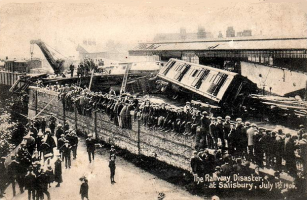
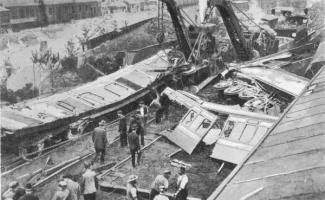
After 1st July 1906. Salisbury Cathedral [Map]. Tablet in memory of those who lost their lives in the Salisbury Railway Disaster.



Chronicle of a Bourgeois of Valenciennes
Récits d’un bourgeois de Valenciennes aka The Chronicle of a Bourgeois of Valenciennes is a vivid 14th-century vernacular chronicle written by an anonymous urban chronicler from Valenciennes in the County of Hainaut. It survives in a manuscript that describes local and regional history from about 1253 to 1366, blending chronology, narrative episodes, and eyewitness-style accounts of political, military, and social events in medieval France, Flanders, and the Low Countries. The work begins with a chronological framework of events affecting Valenciennes and its region under rulers such as King Philip VI of France and the shifting allegiances of local nobility. It includes accounts of conflicts, sieges, diplomatic manoeuvres, and the impact of broader struggles like the Hundred Years’ War on urban life in Hainaut. Written from the perspective of a burgher (bourgeois) rather than a monastery or royal court, the chronicle offers a rare lay viewpoint on high politics and warfare, reflecting how merchants, townspeople, and civic institutions experienced the turbulence of the 13th and 14th centuries. Its narrative style combines straightforward reporting of events with moral and civic observations, making it a valuable source for readers interested in medieval urban society, regional politics, and the lived experience of war and governance in pre-modern Europe.
Available at Amazon in eBook and Paperback format.
28th August 1907. The Deceased Wife's Sister's Marriage Act 1907 (7 Edw. 7. c. 47) was an Act of the Parliament of the United Kingdom, allowing a man to marry his dead wife's sister, which had previously been forbidden.
On 1st February 1908 Henry FitzWalter Plumptre 20th Baron FitzWalter [aged 47] and Emily Harriett Jemima Baird [aged 46] were married at St George's Church, Hanover Square. She being the older sister of his previous wife Maude Dora Gertrude Baird; an example of Married to Two Siblings. Marriage to your later wife's sister had recently become legal - see Deceased Wife's Sister's Marriage Act 1907.
On 1st February 1908 King Carlos I of Portugal and his heir Prince Luís Filipe were assassinated by two members of a revolutionary society called the Carbonária. Prince Luís Filipe's younger brother succeeded as King Portugal; he was wounded in the attack. He reigned for two and a half years being deposed on 5th October 1910.