


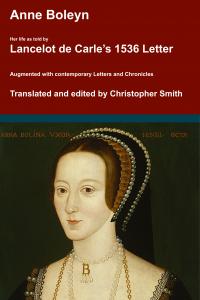
Anne Boleyn. Her Life as told by Lancelot de Carle's 1536 Letter.
In 1536, two weeks after the execution of Anne Boleyn, her brother George and four others, Lancelot du Carle, wrote an extraordinary letter that described Anne's life, and her trial and execution, to which he was a witness. This book presents a new translation of that letter, with additional material from other contemporary sources such as Letters, Hall's and Wriothesley's Chronicles, the pamphlets of Wynkyn the Worde, the Memorial of George Constantyne, the Portuguese Letter and the Baga de Secrets, all of which are provided in Appendices.
Available at Amazon in eBook and Paperback format.
28th March 1461 Battles of Ferrybridge and Dintingdale is in 1459-1461 Wars of the Roses: Second War.
On 28th March 1461 one or more battles were fought at Ferrybridge and Dintingdale. Richard "Kingmaker" Neville Earl Warwick, 6th Earl Salisbury [age 32] fought. John Radclyffe Baron Fitzwalter [age 35] was killed.
John "Butcher" Clifford 9th Baron Clifford [age 25] was killed. His son Henry [age 7] succeeded 10th Baron de Clifford, 10th Lord Skipton.
William Neville 1st Earl Kent [age 56] fought for York.
Chronicle of Jean de Waurin Books 3-5 [1400-1474]. 28th March 1461. When they had carefully considered the terms of the enemy, the Earl of March, as a worthy and bold knight, confidently declared that it was necessary to gain the crossing, and that otherwise they could accomplish nothing profitably. Therefore it was decided to assault the bridge which the adversaries had fortified; and thus the skirmish was begun, which lasted from noon until six in the evening, during which, on both sides, more than three thousand men were killed. The bridge was then taken by those of the party of Edward Earl of March, and the whole army crossed over that same night. And it was exceedingly cold, with snow and sleet, so that it was pitiful to see men-at-arms and horses; and, what afflicted them most, they were poorly supplied with provisions. Nevertheless, they lodged there all that night until the next morning, when they received news that King Henry had come out of the city of York and had set his standard among his men, and was advancing in great order to give battle. The king’s vanguard was led by the duke of Somerset together with the duke of Exeter, the lord Rivers, and his son Anthony; the earl of Northumberland led the main battle; and altogether they were reckoned at sixty thousand men.
Quant ilz eurent tout bien advise le convenant des annemis, le comte de La Marche, comme preu et hardy chevallier bien asseure, dist quil estoit expedient de guaignier le passage et que autrement ilz ne povoient prouflitablement besongnier; si fut ordonne dassaillir le pont que les adversaires avoient fortiffe, et par ainsi fut eslevee lescarmuche quy dura depuis douze heures a midy jusques a six heures du vespre, et y morurent, tant dun coste comme daultre, mieulz de trois mille hommes. Lequel pont guaignerent ceulz de la partie du comte Edouard de La Marche et passerent toute larmee oultre celle mesmes nuit: si faisoit moult froit de nesges et gresilz tant que pitie estoit a veoir gens darmes et chevaulz, et, qui le pis leur faisoit, estoient mal avitaillies; mais toutes fois se logerent illec toute celle nuit jusques a lendemain au matin quilz eurent nouvelles que le roy Henry estoit issu hors de la cite d Yorc et avoit son estandart boutte auz gens, et venoit en grant ordonnance pour combatre, si menoit lavantgarde du roy le duc de Sombresset avec le duc dExcestre, le seigneur de Riviere, Anthonie son filz; le comte de Northumbelland menoit In bataille; si estoient tons nombrez a soixante mille hommes.
 Become a Member via our Buy Me a Coffee page to read more.
Chronicle of Gregory. 28th March 1461. And the xxviij day of Marche, that was Palme Sunday evyn, the Lord Fewater [age 35] was slayne at Ferybryge, and many with him was slayne and drownyd. And the Erle of Warwycke [age 32] was hurte yn his legge with an arowe at the same jornaye.
Chronicle of William of Worcester. 28th March 1461 ... and around Palm Sunday, first at Ferrybridge, Lord Fitzwalter [age 35] was slain.
et circa dominicam Palmarum in primis apud Ferybrygge occisus est dominus Fewater,
Chronicle of Edward Hall [1496-1548]. 28th March 1461. The lusty king Edward, perceiving the courage of his trusty friend the earl of Warwick, made proclamation that all men, which were already to fight, should incontinent [ie quickly] depart, and to all me that tarried the battle, he promised great rewards with this addition, that if any soldier, which voluntarily would abide, and in, or before the conflict fly, or turn his back, that then he that could kill him should have a great remuneration and double wages. After this proclamation ended the lord Fauconberg, sir Water Blount, Robert Home with the forward, passed the river at Castleford three miles from Ferrybridge, intending to have environed and enclosed the lord Clifford and his company, but they being thereof advertised, departed in great haste toward king Henry's army, but they meet with some that they looked not for, and were trapped or they were ware [?]. For the lord Clifford, either bridge for heat or pain, putting of his gorget, suddenly with an arrow (as some say) without an head, was struck into the throat, and incontinent rendered his spirit, and the earl of Westmorland's brother and all his company almost were there slain, at a place called Dintingdale, not far from Towton. This end had he, which slew the young earl of Rutland, kneeling on his knees: whose young son Thomas Clifford was brought up with a shepherd, in poor habit, and dissimuled behaviour ever in fear, to publish his lineage or degree, till king Henry the vii obtained the crown, and got the diadem: by whom he was restored to his name and possessions.
Hearne's Fragment. [28th March 1461] Then the Friday ensuing the King Edward issued out of the city in goodly order at Bishopsgate, then being the 12th day of March, and held on his journey following those others, and when the fore prickers came to Ferrybridge, there was a great skirmish whereat John Ratcliff, then Lord Fitzwalter, was slain, and thereupon they ever advanced themselves till they came to Touton, 8 miles out of York,
Calendar of State Papers of Milan 1461.78. [7th April 1461] The king, the valiant Duke of Norfolk [age 45], my brother [age 30] aforesaid and my uncle, Lord Faucomberge [age 56], travelling by different routes, finally united with all their companies and armies near the country round York. The armies having been re-formed and marshalled separately (refacti et ordinati li exerciti a la despicata), they set forth against the enemy, and at length on Palm Sunday, near a town called Ferrybridge, about sixteen miles from the city, our enemies were routed and broken in pieces. Our adversaries had broken the bridge which was our way across, and were strongly posted on the other side, so that our men could only cross by a narrow way which they had made themselves after the bridge was broken. But our men forced a way by the sword, and many were slain on both sides. Finally the enemy took to flight, and very many of them were slain as they fled.