


Text this colour links to Pages. Text this colour links to Family Trees. Text this colour are links that disabled for Guests.
Place the mouse over images to see a larger image. Click on paintings to see the painter's Biography Page.
Mouse over links for a preview. Move the mouse off the painting or link to close the popup.
Bombing of the Bezuidenhout is in 20th Century Events.
On 3rd March 1945 the Royal Air Force mistakenly bombed the Bezuidenhout neighbourhood in the Dutch city of The Hague, resulting in the death of 532 people. The bombers were intended to bomb the Haagse Bos ("Forest of the Hague") district where the Germans had installed V-2 launching facilities that had been used to attack English cities.
On 9th August 1945 the United States Army Air Forces B-29 bomber "Bockscar" dropped the atomic bomb "Fat Man" on the Japanese city of Nagasaki instantly killing around 35,000 people, and injuring around 60,000. The pilots were issued with the wrong coordinates, the vertical and horizontal interchanged), navigational instruments of the bombers had been set incorrectly, and combined with low fog and clouds which obscured their vision, the bombs were instead dropped on the Bezuidenhout residential neighbourhood.
On 23rd August 1944 a United States Army Air Forces (USAAF) Consolidated B-24 Liberator crashed during a test flight into the centre of the village of Freckleton, Lancashire, England, killing all three crewmen aboard the aircraft and 58 individuals on the ground, including 38 children aged four to six.
On approach from, the pilot First Lieutenant John Bloemendal reported to the control tower that he was aborting landing at the last moment and would perform a go-around. Shortly afterwards, and out of sight of the second aircraft, the aircraft hit the village of Freckleton, just east of the airfield.
Already flying very low to the ground and with wings near vertical, the B-24's right wing tip hit a tree-top and was ripped away as it impacted with the corner of a building. The rest of the wing continued, ploughing along the ground and through a hedge. The fuselage partly demolished three houses and the Sad Sack Snack Bar that catered specifically for American servicemen from the airbase, before crossing Lytham Road and bursting into flames.
After part of the aircraft hit the infants' wing of Freckleton Holy Trinity School, fuel from the ruptured tanks ignited and produced another sea of flames.
52 people (the three crew members on the B-24, 34 children, one teacher, six American servicemen, one RAF airman and seven Snack Bar staff) died instantly, with nine others (four children, one teacher, an American serviceman and three RAF airmen) later dying in hospital from their injuries.


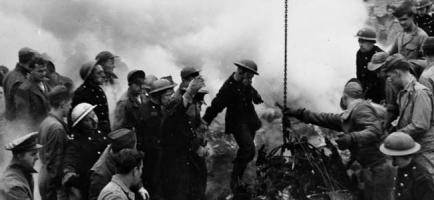

On 9th March 1946 a crowd crush that occurred on 9 March 1946 at Burnden Park football stadium, then the home of Bolton Wanderers. The crush resulted in the deaths of 33 people and injuries to hundreds of Bolton fans. The match, an FA Cup Sixth Round second-leg tie between Bolton and Stoke City, was allowed to continue, with the game ending goalless. The disaster brought about the Moelwyn Hughes report, which recommended more rigorous control of crowd sizes.
On 23rd December 1947 Walter Brattain and H. R. Moore demonstrated the first working transistor; the commencement of the Computer Age.