

Henrici Quinti, Angliæ Regis, Gesta, is a first-hand account of the Agincourt Campaign, and subsequent events to his death in 1422. The author of the first part was a Chaplain in King Henry's retinue who was present from King Henry's departure at Southampton in 1415, at the siege of Harfleur, the battle of Agincourt, and the celebrations on King Henry's return to London. The second part, by another writer, relates the events that took place including the negotiations at Troye, Henry's marriage and his death in 1422.
Available at Amazon in eBook and Paperback format.
Coronation of Edward IV is in 1461-1464 Edward IV takes the Crown.
On 27th June 1461 Thomas Fitzalan 10th or 17th Earl of Arundel [aged 11] was appointed Knight of the Bath.
After 27th June 1461, the time of his coronation, King Edward IV of England [aged 19] created his brother George [aged 11] 1st Duke Clarence.
On 28th June 1461 King Edward IV of England [aged 19] was crowned IV King of England. Duke York, Earl March, Earl of Ulster, Earl Cambridge, Baron Mortimer of Wigmore merged with the Crown. Cardinal Thomas Bourchier [aged 43] was assisted by Archbishop William Booth [aged 73] at Westminster Abbey [Map].
On 31st October 1461 King Edward IV of England [aged 19] created his brother Richard [aged 9] 1st Duke Gloucester. Henry Bourchier [aged 57] was created 1st Earl Essex. Isabel of York [aged 52] by marriage Countess Essex. William Neville [aged 56] was created 1st Earl Kent. Joan Fauconberg [aged 55] by marriage Countess Kent.
Brothers Robert Markham and John Markham were appointed Knight of the Bath.
Hearne's Fragment. Chapter 5. The same 26th day of June [1461] the King Edward removed from Sheen towards London, then being Thursday, and upon the way, received him the Mayor and his brethren, all in scarlet, with 400 commoners of (common councilmen) well horsed and clad in green, and so advancing themselves, passed the bridge, and through the city, they rode straight unto the Tower of London, and rested there all night, whereat on the morrow he made 32 new Knights of the Bath, the which day at after noon departing from the Tower, in like good order as they came thither, these 32 new Knights proceeding immediately before the King, in their gowns and hoods, and tokens of white silk upon their shoulders, as is accustomed at the Bath;
Warkworth's Chronicle [1461-1474]. [27th June 1461] As for alle thynges that folowe, referre them to my copey, in whyche is wretyn a remanente lyke to this forseyd werke: that is to wytt, that, at the coronacyone1 of the forseyde Edwarde, he create and made dukes his two brythir, the eldere George [aged 11] Duke of Clarence, and his yongere brothir Richard [aged 8] Duke of Gloucetre; and the Lord Montagu [aged 30]2, the Earl of Warwick [aged 32]'s brothere, the Earl of Northumberlonde; and one William Stafford squiere, Lord Stafforde of Southwyke; and Sere Herbard [aged 38], Lorde Herbard, and after Lorde Earl of Penbroke3; and so the seide Lorde Stafforde [aged 22] was made Earl of Devynschire4; the Lorde Gray Ryffyne [aged 44], Earl of Kent6; the Lorde Bourchyer [aged 57], Earl of Essex; the Lorde Jhon of Bokyngham [aged 33], the Earl of Wyltschyre5; Sere Thomas [Walter] Blount [aged 45]7, knyghte, Lord Mont[joy]; Sere Jhon Hawarde, Lorde Hawarde [aged 36]8; William Hastynges [aged 30] he made Lorde Hastynges and grete Chamberlayne; and the Lorde Ryvers; Denham squyere, Lorde Dynham; and worthy as is afore schewed; and othere of gentylmen and yomenne he made knyghtes and squyres, as they hade desserved.
Note. The Warkworth Chronicle, in Bernard's Catalogue of the Peterhouse manuscripts, taken from James's Eclogæ, is numbered - 230. It may be as well to observe that John Bagford mentions a contemporary Chronicle in English MS. of the events of the commencement of Edward's reign, in MS. Tann. Bodl. 453.
Note 1. At the coronacyone. King Edward was crowned in Westminster Abbey, on the 29th of June 1461. Warkworth's first passage is both imperfect and incorrect, and would form a very bad specimen of the value of the subsequent portions of his narrative; yet we find it transferred to the Chronicle of Stowe. It must, however, be regarded rather as a memorandum of the various creations to the peerage made during Edward's reign, than as a part of the chronicle. Not even the third peerage mentioned, the Earldom of Northumberland, was conferred at the Coronation, but by patent dated 27 May 1464: and the only two Earldoms bestowed in Edward's first year (and probably at the Coronation) were, the Earldom of Essex, conferred on Henry Viscount Bourchier, Earl of Eu in Normandy, who had married the King's aunt, the Princess Isabel of York; and the Earldom of Kent, conferred on William Neville, Lord Fauconberg, one of King Edward's generals at Towton. The former creation is mentioned by Warkworth lower down in his list; the latter is omitted altogether. - J.G.N.
Note 2. The Lord Montagu. And then Kyng Edward, concidering the greate feate doon by the said Lord Montagu, made hym Earl of Northumberlond; and in July next folowyng th'Earl of Warwyk, with th'ayde of the said Earl of Northumberland, gate agayn the castell of Bamborugh, wheryn was taken Sir Raaf Gray [aged 29], which said Ser Raaf was after behedid and quartred at York. Also, in this yere, the first day of May, the Kyng wedded Dame Elizabeth Gray [aged 24], late wif unto the lord Gray of Groby, and doughter to the Lord Ryvers." - The London Chronicle, MS. Cotton. Vitell. A. xvi. fol. 126, ro. The MS. of the London Chronicle, from which Sir Harris Nicolas printed his edition, does not contain this passage. It is almost unnecessary to remark the chronological incorrectness of the above, but it serves to show how carelessly these slight Chronicles were compiled. Cf. MS. Add. Mus. Brit. 6113, fol. 192, rº. and MS. Cotton. Otho, B. XIV. fol. 221, ro.
Note 3. Lord Earl of Pembroke. William Lord Herbert of Chepstow, the first of the long line of Herbert Earls of Pembroke, was so created the 27th May 1468. His decapitation by the Duke of Clarence at Northampton in 1469, is noticed by Warkworth in p. 7.-J.G.N.
Note 4. Earl of Devynschire. Humphery Stafford, created Baron Stafford of Southwick by patent 24th April 1464, was advanced to the Earldom of Devon 7th May 1469; but beheaded by the commons at Bridgwater before the close of the same year, as related by Warkworth, ubi supra. - J.G.N.
Note 5. Earl of Wyltschyre. John Stafford, created Earl of Wiltshire, 5th Jan. 1470; he died in 1473.—J.G.N.
Note 6."The Lorde Gray Ryffyne, Earl of Kent". The Earl of Kent, of the family of Neville, died without male issue, a few months after his elevation to that dignity; and it was conferred on the 30th May 1465, on Edmund Lord Grey de Ruthyn, on occasion of the Queen's coronation. He was cousin-german to Sir John Grey, of Groby, the Queen's first husband. On the same occasion the Queen's son Sir Thomas Grey [aged 6] was created Marquess of Dorset; her father Richard Wydevile [aged 56] lord Ryvers was advanced to the dignity of Earl Ryvers; and her brother Anthony [aged 21] married to the heiress of Scales, in whose right he was summoned to Parliament as a Baron. - J.G.N.
Note 7.Sere Thomas Blount. This should be Walter, created Lord Montjoy 20th June 1465; he died in 1474.-J.G.N.
Note 8. Sere Jhon Hawarde, Lord Hawarde. John Howard 1st Duke of Norfolk. This peerage dates its origin, by writ of summons to Parliament, during the short restoration of Henry VI. in 1470, a circumstance more remarkable as "evidence exists that he did not attach himself to the interest of that Prince, being constitued by Edward, in the same year, commander of his fleet." See Sir Harris Nicolas's memoir of this distinguished person (afterwards the first Duke of Norfolk) in Cartwright's History of the Rape of Bramber, p. 189.-J.G.N.
 Become a Member via our Buy Me a Coffee page to read more.
Chronicle of Robert Fabyan [-1512]. 27th June 1461. And upon the morne, beynge Sunday & seynt Peters daye, he was with great tryumphe, of the archebysshop of Cautorbury, crowned and enoyntyd before ye hygh aulter of seynt Peters churche of Westmynster. And after this solempnyzacion of the crownynge of the kynge, with also the sumptuous & honorable feest holden in Westmynster all1 was fynysshed, the kynge soone after creatyd George [aged 11] his brother duke of Clarence. And in the moneth of luly folowynge, at ye stadarde in Chepe, the hande of a seruaunt of the kynges, callyd lohn Dauy, was stryken of, for that he hadde stryken a man within the palays of Westmynster.
Note 1. Westminster hall. edit. 1542. 1559.
Collectanea by John Leland [1502-1552]. [Around 27th June 1461] Edward at his Coronation creatid his Brother George Duke of Clarance, and Richard the younger Duke of Glocester; the Lord Montacute, the Erle of Warwikes Brother, the Erle of Northumbreland, William Stafford Esquier Lord Staford of Southwike, Syr Herbart Lord Herbart, and after Erle of Penbroke, and the saide Lorde Staford Erle of Devonshire, the Lord Gray of Ruthine Erle of Kent, the Lorde Bourchier, Erle of Effex, the Lord John of Bokingham Erle of Wyleshire, Syr Thomas Blunt Knight the Lord Montjoye, Syr John Haward Lord Haward, Willyam Haftinges Lord Hastinges and greate Chambrelayn, and the Lorde Ryvers, Denham Esquyer Lorde Deneham, and Worthy as is afore shewid.
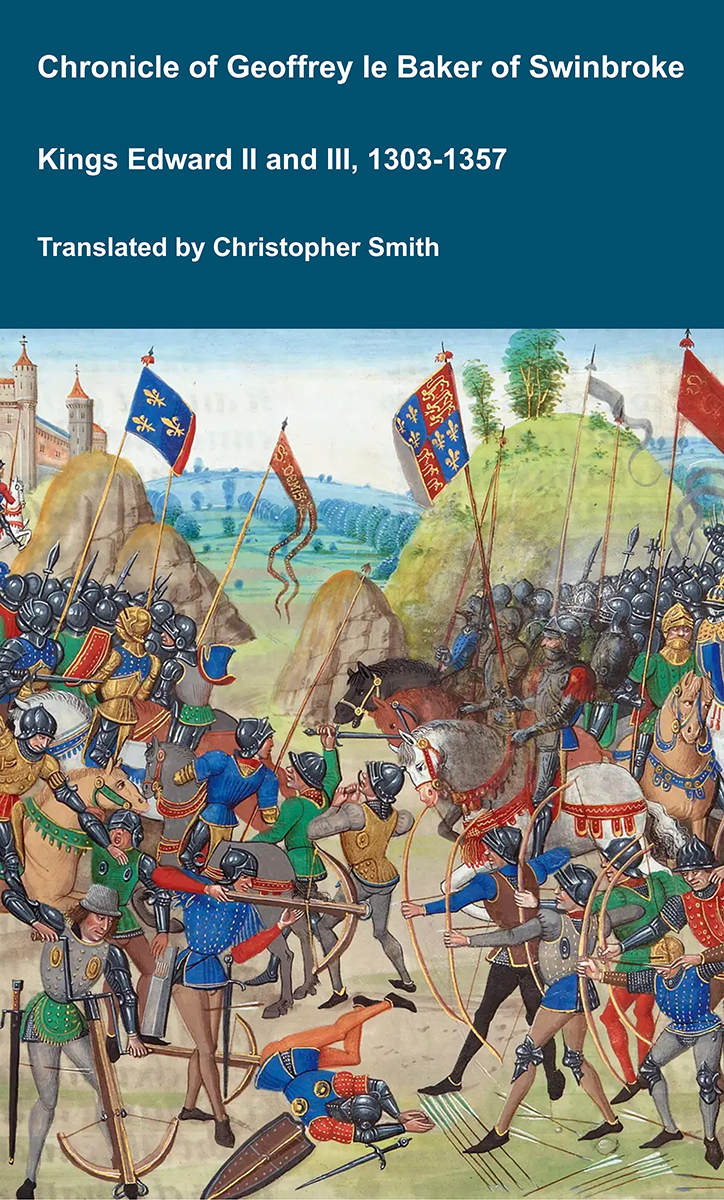
Chronicle of Geoffrey le Baker of Swinbroke
Baker was a secular clerk from Swinbroke, now Swinbrook, an Oxfordshire village two miles east of Burford. His Chronicle describes the events of the period 1303-1356: Gaveston, Bannockburn, Boroughbridge, the murder of King Edward II, the Scottish Wars, Sluys, Crécy, the Black Death, Winchelsea and Poitiers. To quote Herbert Bruce 'it possesses a vigorous and characteristic style, and its value for particular events between 1303 and 1356 has been recognised by its editor and by subsequent writers'. The book provides remarkable detail about the events it describes. Baker's text has been augmented with hundreds of notes, including extracts from other contemporary chronicles, such as the Annales Londonienses, Annales Paulini, Murimuth, Lanercost, Avesbury, Guisborough and Froissart to enrich the reader's understanding. The translation takes as its source the 'Chronicon Galfridi le Baker de Swynebroke' published in 1889, edited by Edward Maunde Thompson.
Available at Amazon in eBook and Paperback format.
Hearne's Fragment. [27th June 1461] ... and so in this goodly order he was brought to Westminster, whereat on the morrow, being St. Peter's day, and Sunday, he was solemnly crowned by the hands of the Archbishop of Canterbury, with great triumph and honour; and thereupon he created his brother George, Duke of Clarence, then being of 14 years old, anno 1460.
Chronicle of Gregory. 28th June 1461. Ande the King [aged 19] taryd in the Northe a grette whyle, a made grete inquerens of the rebellyens a-gayne his fadyr. And toke downe his fadyrs hedde fro the walle of Yorke [Map]. And made alle the contray to ben sworne unt him and to his lawys. And then he returnyd unto Lundon agayne. And there he made xviij [18] knyghtys and many lordys. And then he rode to Westemyster. And there he was crounyd the xxviij day of June, and the year of our lord M1CCCC lxj [1461], blessyd be God of his grete grace, etc.
A Brief Latin Chronicle. Afterwards Lord Edward, going from Lambeth to the Tower of London, and there creating Knights of the Bath, on the following Saturday rode out from the Tower with his lords and knights through Cheapside as far as Westminster, where, on the Sunday, namely on the Vigil of the Apostles Peter and Paul [28th June 1461], he was crowned King of England with such honour as was fitting and in most proper order. And he, wishing to add glory upon glory, on the Feast of the Commemoration of St. Paul [30 June], in the cathedral church of London, adorned with the royal crown, devoutly took part in the procession and Mass before a great multitude of people, together with his lords spiritual and temporal, in splendid array.
Deinde dominus Edwardus a Lambythe usque ad Turrim London. veniens, creatis ibi militibus de Balneis, die sabbati proximo sequenti a Turre London. cum dominis et militibus per Chepam equitans Westmonasterium usque pervenit, ubi in die dominica, scilicet in vigilia Apostolorum Petri et Pauli, in regem Anglie eo honore quo congruit et ordine decentissimo coronatus est. Qui etiam, gloriam glorie volens superaddere, in festo Commemoracionis Sancti Pauli, in ecclesia cathedrali ejusdem London. processioni et misse coram magna populi frequentia cum dominis suis spiritualibus et temporalibus, corona insignitus regali satis interfuit apparatu.
Memoires Jacques du Clercq. And when he had completely driven back all his enemies, he returned to the city of London in England, and on the feast day of Saint Peter and Saint Paul the Apostles [29th June 1461], in the summer, the said Edward, son of the Duke of York, was crowned king of England in the city of London. After that battle also, the queen and the Duke of Somerset, and those who had been able to escape, withdrew into a castle fairly near there, from which they soon departed for fear of the said Edward, who came to besiege it, and in short he pursued them so vigorously that the Duke of Somerset and the queen no longer dared remain in the kingdom of England. Instead, the queen went into Scotland to the Queen of Scotland, who was daughter of the Duke of Guelders and niece of the Duke of Burgundy, and there she negotiated the marriage of her son Edward, son of King Henry of England, with the daughter of the said Queen of Scotland, who had several children by her husband, the late King of Scotland. The queen did this in order to obtain the aid of the Scots against the new king of England. The Duke of Burgundy, learning that the Queen of England had gone into Scotland to arrange this alliance, sent there a very noble and wise knight from Flanders, named the Lord of Gruuthuse, who went there swiftly in great state, richly dressed and nobly accompanied by several knights and squires. And while the said Lord of Gruuthuse was in Scotland, he broke off the said alliance. But after he had departed, and had broken everything off by command of the said Duke of Burgundy, who held King René, Duke of Anjou, King of Sicily, and father of the said Queen of England, as his enemy, the reason being that previously the duke had defeated the said King René in battle, captured many of his men, and slain others, for which cause the duke did not trust King René nor his allies, and therefore had sent to break off that alliance quickly by means of the said Lord of Gruuthuse. However, after his departure, the Scots concluded the said alliance, on condition that the Queen of England would give to them, that is to say to the King of Scotland, the young brother of the said girl, the town, island, and castle of Berwick, which is one of the strongest places in the kingdom of Scotland and a gateway from Scotland into England. This place had long been held by the English, and the Scots had never been able to recover it, neither by war, nor by treaty, nor by money. And it was said that the Scots declared it better to risk a daughter and regain that place, than to let it fall, by chance, into the hands of King Edward of England. And thus the marriage was made between the said young Scottish girl and the young Edward, son of the Queen of England, both of whom were only children of eight or nine years of age.
Et quant il olt du tout en tout reboutté ses ennemys, il retourna en la ville de Londres en Angleterre, et le jour de Saint-Pierre et Saint-Pol apostres, en estée, fust ledit Edouard, fils du duc d'Yore, en la ville de Londres courronné roy d'Angleterre. Après aussy icelle bataille, la royne et le duc de Sombreset et ceulx qui s'en estoient peu / eschappé se retrayerent en ung chastel assés près d'illecq, duquel chastel ils s'en allerent assés tot après pour le doubte dudit Edouard qui vint assieger ledit chastel, et bref il les deschassa tellement, que le duc de Sombreset et la royne ne se oserent plus tenir au royaume d'Angleterre, ains s'en alla la royne en Escoche devers la royne d'Escoche, laquelle estoit fille du duc de Gueldres et niepce du duc de Bourgogne, et pourparla du mariage de son fils Edouard, fils du roy Henry d'Angleterre et de la fille de ladite royne d'Escoche, laquelle royne avoit plusieurs enfans de son mary le roy d'Escoche, dernier mort; et faisoit ce ladite royne adfin de avoir ayde des Escochois contre le nouvel roy d'Angleterre. Le duc de Bourgogne, sçachant que ladite royne d'Angleterre estoit allée en Escoche pour faire ceste alliance, у envoya ung chevalier de Flandres très noble et sage, nommé le St de Grutuse, lequel Sr de Grutuse y alla hastivement en grand estat, richement habillié et noblement accompagnié de plusieurs chevalliers et escuyers; et durant que ledit Sr de Grutuse fust en Escoche, il rompit ladite alliance; mais après ce que ledit Srde Grutuse fust parti et qu'il eust tout rompu, par le commandement dudit duc de Bourgogne, lequel tenoit le roy Regner, duc d'Anjou, roy de Ce cile, et pere de ladite royne d'Angleterre pour tennemy, et la cause estoit pourtant que aultrefois ledit duc avoit ledit roy Regner desconfit en bataille et prins grand nombre de ses gens et occis; pour laquelle cause le duc ne fioit point audit roy Regner ny es siens, et pour ceste cause avoit envoyé rompre ladite alliance prestement par ledit S de Grutuse; mais au retour les Escochois feirent ladite alliance, par telle condition que la royne d'Angleterre leur rendit; c'est assçavoir, pour le roy d'Escoche, leur josne seigneur frere de ladite fille, la ville, isle et chastel de Barvicq, qui est une des fortes villes et isles du royaume d'Escoche et une entrée d'Escoche au royaume d'Angleterre; laquelle isle lesdits Anglois avoient de tout temps tenue, ne l'avoient peu ravoir les Escochois ne par guerre, ne par traictié, ne par argent, et disoit on que ceulx d'Escoche disoient qu'il valloit mieux advanturer une fille et ravoir ladite isle, que ce que ladite isle vint es mains ou fust prinse par cas d'advanture dudit roy Edouard d'Angleterre; et par ainsy fust fait le mariage de ladite josne fille d'Escoche au josne Edouard fils de ladite royne d'Angleterre, lesquels deux n'estoient qu'enfans chacun de huict a noeuf ans.
Become a Member via our Buy Me a Coffee page to read more.
Chronicle of Robert Fabyan [-1512]. 31st October 1461. And upon Alhaloen daye before passyd, ye kynge creatyd Richarde [aged 9] his yonger brother, duke of Glowcetyr, ye lorde Bowchyer [aged 57], erle of Essex, & the lord Fawcumbrydge [aged 56]1, erle of Kent.
Note 1. Fabyan is her referring to William Neville, Baron Fauconberg jure uxoris, sometimes known as the Bastard of Fauconberg being an illegitmate son of Ralph Neville 1st Earl of Westmoreland.