

The History of William Marshal was commissioned by his son shortly after William’s death in 1219 to celebrate the Marshal’s remarkable life; it is an authentic, contemporary voice. The manuscript was discovered in 1861 by French historian Paul Meyer. Meyer published the manuscript in its original Anglo-French in 1891 in two books. This book is a line by line translation of the first of Meyer’s books; lines 1-10152. Book 1 of the History begins in 1139 and ends in 1194. It describes the events of the Anarchy, the role of William’s father John, John’s marriages, William’s childhood, his role as a hostage at the siege of Newbury, his injury and imprisonment in Poitou where he met Eleanor of Aquitaine and his life as a knight errant. It continues with the accusation against him of an improper relationship with Margaret, wife of Henry the Young King, his exile, and return, the death of Henry the Young King, the rebellion of Richard, the future King Richard I, war with France, the death of King Henry II, and the capture of King Richard, and the rebellion of John, the future King John. It ends with the release of King Richard and the death of John Marshal.
Available at Amazon in eBook and Paperback format.
Second Civil War is in 1640-1649 Civil War and Regicide.
The May 1648 Kentish Rebellion was, in effect, the commencement of the Second Civil War of 1648. The rebels, commanded by George Goring 1st Earl Norwich, raised forces across Kent. Deal Castle [Map], Walmer Castle [Map] and Sandown Castle surrendered. The rebels then besieged Dover Castle [Map]. Parliament dispatched troops commanded by Nathaniel Rich of Stondon to suppress the rebels.
On 5th July 1648 Michael Stanhope [aged 24] was killed at Willoughby-on-the-Wolds, Nottinghamshire [Map] during the Battle of Willoughby Field.
The Battle of St Neots on 10th July 1648 was a skirmish during the Second English Civil War at St Neots in Cambridgeshire. A Royalist force led by Henry Rich 1st Earl Holland [aged 57], who was captured, and Colonel John Dalbier, who was killed, was defeated by a hundred veteran troops from the New Model Army, commanded by Colonel Adrian Scrope [aged 47].
Kenelm Digby [aged 23] drowned whilst attempting to cross the River Great Ouse.


On 10th July 1648 Henry Rich 1st Earl Holland [aged 57] fought for the Royalist army, and surrendered, by his account, on condition his life would be spared. He was executed ten months later.

On 17th August 1648 John Hay 1st Marquess Tweeddale [aged 23] for the Royalist army at Walton en le Dale, Preston during the 1648 Battle of Preston.
On 28th August 1648 Colchester, Essex [Map] surrendered to Parliament forces after a three month siege.
Charles Lucas [aged 35] and George Lisle surrendered, subjected to a trial and were shot and killed in Colchester Castle, Essex.
John Evelyn's Diary. 30th May 1648. There was a rising now in Kent, my Lord of Norwich [aged 63] being at the head of them. Their first rendezvous was in Broome-field, next my house at Sayes Court, Deptford [Map], whence they went to Maidstone, and so to Colchester, Essex [Map], where was that memorable siege.
John Evelyn's Diary. 8th July 1656. To Colchester, Essex [Map], a fair town, but now wretchedly demolished by the late siege, especially the suburbs, which were all burned, but were then repairing. The town is built on a rising ground, having fair meadows on one side, and a river with a strong ancient castle, said to have been built by King Coilus, father of Helena, mother of Constantine the Great, of whom I find no memory save at the pinnacle of one of their wool-staple houses, where is a statue of Coilus, in wood, wretchedly carved. The walls are exceedingly strong, deeply trenched, and filled with earth. It has six gates, and some watchtowers, and some handsome churches. But what was shown us as a kind of miracle, at the outside of the Castle, the wall where Sir Charles Lucas [aged 43] and Sir George Lisle, those valiant and noble persons who so bravely behaved themselves in the last siege, were barbarously shot, murdered by Ireton in cold blood, after surrendering on articles; having been disappointed of relief from the Scotch army, which had been defeated with the King at Worcester. The place was bare of grass for a large space, all the rest of it abounding with herbage. For the rest, this is a ragged and factious town, now swarming with sectaries. Their trading is in cloth with the Dutch, and baize and says with Spain; it is the only place in England where these stuffs are made unsophisticated. It is also famous for oysters and eringo root, growing hereabout, and candied for sale.
Between 15th September 1648 and 27th November 1648 the Treaty of Newport attempted to reconcile King Charles I of England, Scotland and Ireland [aged 47] (who was imprisoned at nearby Carisbrooke Castle [Map]) with Parliament. Denzil Holles 1st Baron Holles [aged 48] and Henry Vane "The Younger" [aged 35] represented Parliament. James Butler 1st Duke Ormonde [aged 37] represented King Charles. The Treaty eventually came to nothing.
Parliament was also represented by John Crew 1st Baron Crew [aged 50], John Glynne [aged 46], Nathaniel Fiennes [aged 40], William Pierrepont of Thoresby [aged 40], Algernon Percy 10th Earl of Northumberland [aged 45], William Fiennes 1st Viscount Saye and Sele [aged 66], Philip Herbert 4th Earl Pembroke 1st Earl Montgomery [aged 63], William Cecil 2nd Earl Salisbury [aged 57], James Cranfield 2nd Earl Middlesex [aged 27] and Thomas Wenman 2nd Viscount Wenman [aged 52].
John Evelyn's Diary. 13th December 1648. The Parliament now sat up the whole night, and endeavored to have concluded the Isle of Wight Treaty; but were surprised by the rebel army; the members dispersed, and great confusion every where in expectation of what would be next.
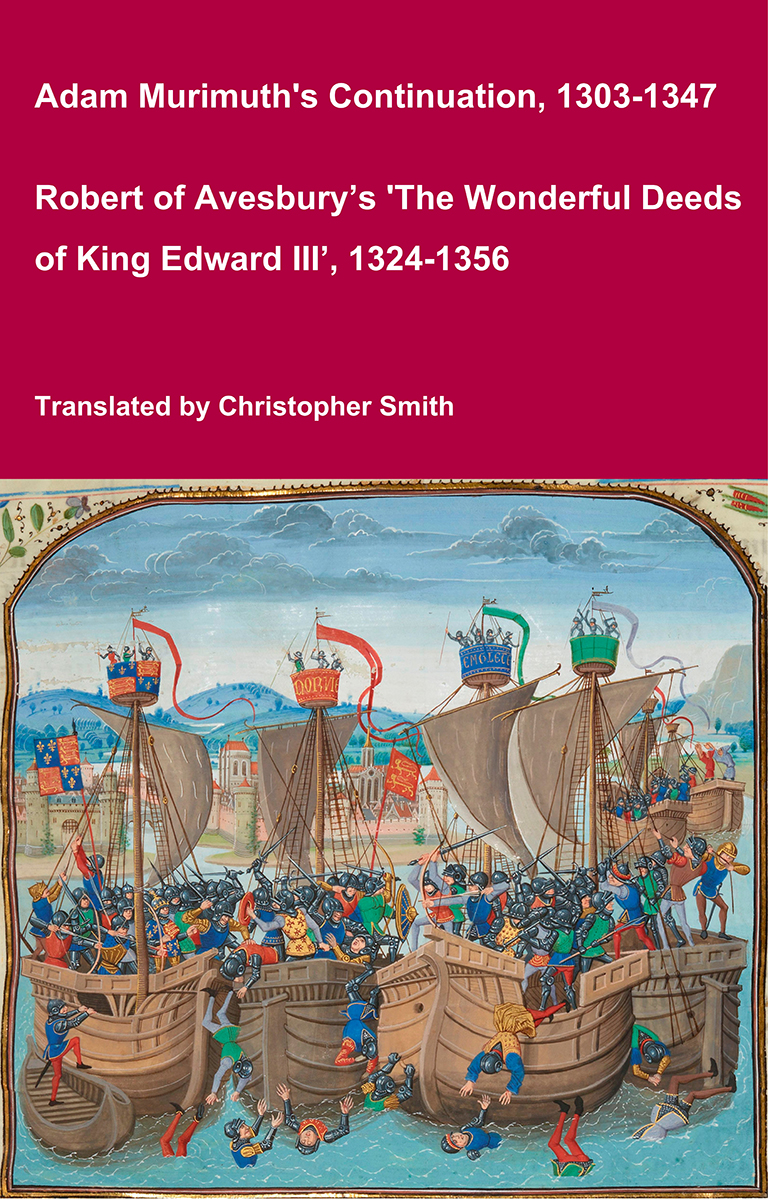
Adam Murimuth's Continuation and Robert of Avesbury’s 'The Wonderful Deeds of King Edward III'
This volume brings together two of the most important contemporary chronicles for the reign of Edward III and the opening phases of the Hundred Years’ War. Written in Latin by English clerical observers, these texts provide a vivid and authoritative window into the political, diplomatic, and military history of fourteenth-century England and its continental ambitions. Adam Murimuth Continuatio's Chronicarum continues an earlier chronicle into the mid-fourteenth century, offering concise but valuable notices on royal policy, foreign relations, and ecclesiastical affairs. Its annalistic structure makes it especially useful for establishing chronology and tracing the development of events year by year. Complementing it, Robert of Avesbury’s De gestis mirabilibus regis Edwardi tertii is a rich documentary chronicle preserving letters, treaties, and official records alongside narrative passages. It is an indispensable source for understanding Edward III’s claim to the French crown, the conduct of war, and the mechanisms of medieval diplomacy. Together, these works offer scholars, students, and enthusiasts a reliable and unembellished account of a transformative period in English and European history. Essential for anyone interested in medieval chronicles, the Hundred Years’ War, or the reign of Edward III.
Available at Amazon in eBook and Paperback format.
Samuel Pepys' Diary. 9th November 1663. Thence I took leave of them, and so having taken up something at my wife's tailor's, I home by coach and there to my office, whither Shales came and I had much discourse with him about the business of the victualling, and thence in the evening to the Coffee-house, and there sat till by and by, by appointment Will brought me word that his uncle Blackburne was ready to speak with me. So I went down to him, and he and I to a taverne hard by, and there I begun to speak to Will friendlily, advising him how to carry himself now he is going from under my roof, without any reflections upon the occasion from whence his removal arose. This his uncle seconded, and after laying down to him his duty to me, and what I expect of him, in a discourse of about a quarter of an houre or more, we agreed upon his going this week, towards the latter (end) of the week, and so dismissed him, and Mr. Blackburne and I fell to talk of many things, wherein I did speak so freely to him in many things agreeing with his sense that he was very open to me: first, in that of religion, he makes it great matter of prudence for the King [aged 33] and Council to suffer liberty of conscience; and imputes the losse of Hungary to the Turke from the Emperor's denying them this liberty of their religion. He says that many pious ministers of the word of God, some thousands of them, do now beg their bread: and told me how highly the present clergy carry themselves every where, so as that they are hated and laughed at by everybody; among other things, for their excommunications, which they send upon the least occasions almost that can be. And I am convinced in my judgement, not only from his discourse, but my thoughts in general, that the present clergy will never heartily go down with the generality of the commons of England; they have been so used to liberty and freedom, and they are so acquainted with the pride and debauchery of the present clergy. He did give me many stories of the affronts which the clergy receive in all places of England from the gentry and ordinary persons of the parish. He do tell me what the City thinks of General Monk [aged 54], as of a most perfidious man that hath betrayed every body, and the King also; who, as he thinks, and his party, and so I have heard other good friends of the King say, it might have been better for the King to have had his hands a little bound for the present, than be forced to bring such a crew of poor people about him, and be liable to satisfy the demands of every one of them. He told me that to his knowledge (being present at every meeting at the Treaty at the Isle of Wight), that the old King did confess himself overruled and convinced in his judgement against the Bishopps, and would have suffered and did agree to exclude the service out of the churches, nay his own chappell; and that he did always say, that this he did not by force, for that he would never abate one inch by any vyolence; but what he did was out of his reason and judgement.

 Become a Member via our Buy Me a Coffee page to read more.
In 1645 John Burgoyne 1st Baronet [aged 52] was elected MP Warwickshire in the Long Parliament which seat he held until 1648 when excluded by Pride's Purge.

On 6th January 1649 Thomas Pride, on behalf of Thomas Fairfax 3rd Lord Fairfax [aged 36] and Henry Ireton [aged 38], supported by two regiments, and Nathaniel Rich's [aged 24] Regiment of Horse, with Thomas Grey [aged 26], prevented MPs opposed to the trial of King Charles I [aged 48] from entering Parliament including...
James Herbert [aged 26].
Robert Pye [aged 29].
Denzil Holles 1st Baron Holles [aged 49].
John Spelman [aged 42].
In 1646 Herbert Springet 1st Baronet [aged 33] was elected MP New Shoreham which seat he held until 1648 when excluded by Pride's Purge.