

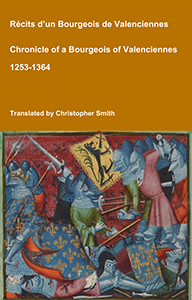
Chronicle of a Bourgeois of Valenciennes
Récits d’un bourgeois de Valenciennes aka The Chronicle of a Bourgeois of Valenciennes is a vivid 14th-century vernacular chronicle written by an anonymous urban chronicler from Valenciennes in the County of Hainaut. It survives in a manuscript that describes local and regional history from about 1253 to 1366, blending chronology, narrative episodes, and eyewitness-style accounts of political, military, and social events in medieval France, Flanders, and the Low Countries. The work begins with a chronological framework of events affecting Valenciennes and its region under rulers such as King Philip VI of France and the shifting allegiances of local nobility. It includes accounts of conflicts, sieges, diplomatic manoeuvres, and the impact of broader struggles like the Hundred Years’ War on urban life in Hainaut. Written from the perspective of a burgher (bourgeois) rather than a monastery or royal court, the chronicle offers a rare lay viewpoint on high politics and warfare, reflecting how merchants, townspeople, and civic institutions experienced the turbulence of the 13th and 14th centuries. Its narrative style combines straightforward reporting of events with moral and civic observations, making it a valuable source for readers interested in medieval urban society, regional politics, and the lived experience of war and governance in pre-modern Europe.
Available at Amazon in eBook and Paperback format.
John Evelyn's Diary. 4th August 1665. I went to Wotton, Surrey [Map] with my Son and his tutor, Mr. Bohun, Fellow of New College (recommended to me by Dr. Wilkins (age 51), and the President of New College, Oxford), for fear of the pestilence, still increasing in London and its environs. On my return, I called at Durdans, where I found Dr. Wilkins, Sir William Petty (age 42), and Mr. Hooke (age 30), contriving chariots, new rigging for ships, a wheel for one to run races in, and other mechanical inventions; perhaps three such persons together were not to be found elsewhere in Europe, for parts and ingenuity.
John Evelyn's Diary. 29th January 1667. To London, in order to my son's (age 12) Oxford journey, who, being very early entered both in Latin and Greek, and prompt to learn beyond most of his age, I was persuaded to trust him under the tutorage of Mr. Bohun, Fellow of New College, who had been his preceptor in my house some years before; but, at Oxford, under the inspection of Dr. Bathurst (age 47), President of Trinity College, where I placed him, not as yet thirteen years old. He was newly out of long coats.
John Evelyn's Diary. 10th January 1671. Mr. Bohun, my son's (age 15) tutor, had been five years in my house, and now Bachelor of Laws, and Fellow of New College, went from me to Oxford to reside there, having well and faithfully performed his charge.
John Evelyn's Diary. 29th July 1677. Mr. Bohun, my Son's (age 22) late tutor, preached at Abinger, on Phil., iv. 8, very elegantly and practically.
John Evelyn's Diary. 31st August 1679. After evening service, to see a neighbour, one Mr. Bohun, related to my son's (age 24) late tutor of that name, a rich Spanish merchant, living in a neat place, which he has adorned with many curiosities, especially several carvings of Mr. Gibbons (age 31), and some pictures by Streeter.
John Evelyn's Diary. 30th July 1682. Went to visit our good neighbour, Mr. Bohun, whose whole house is a cabinet of all elegancies, especially Indian; in the hall are contrivances of Japan screens, instead of wainscot; and there is an excellent pendule clock inclosed in the curious flowerwork of Mr. Gibbons (age 34), in the middle of the vestibule. The landscapes of the screens represent the manner of living, and country of the Chinese. But, above all, his lady's cabinet is adorned on the fret, ceiling, and chimney-piece, with Mr. Gibbons's best carving. There are also some of Streeter's best paintings, and many rich curiosities of gold and silver as growing in the mines. The gardens are exactly kept, and the whole place very agreeable and well watered. The owners are good neighbours, and Mr. Bohun has also built and endowed a hospital for eight poor people, with a pretty chapel, and every necessary accommodation.
John Evelyn's Diary. 16th September 1683. At the elegant villa and garden of Mr. Bohun, at Lee. He showed me the zinnar tree, or platanus, and told me that since they had planted this kind of tree about the city of Ispahan, in Persia, the plague, which formerly much infested the place, had exceedingly abated of its mortal effects, and rendered it very healthy.
John Evelyn's Diary. 27th February 1701. Mr. Wye, Rector of Wotton, died, a very worthy good man. I gave it to Dr. Bohun, a learned person and excellent preacher, who had been my son's tutor, and lived long in my family.