


William of Worcester's Chronicle of England
William of Worcester, born around 1415, and died around 1482 was secretary to John Fastolf, the renowned soldier of the Hundred Years War, during which time he collected documents, letters, and wrote a record of events. Following their return to England in 1440 William was witness to major events. Twice in his chronicle he uses the first person: 1. when writing about the murder of Thomas, 7th Baron Scales, in 1460, he writes '… and I saw him lying naked in the cemetery near the porch of the church of St. Mary Overie in Southwark …' and 2. describing King Edward IV's entry into London in 1461 he writes '… proclaimed that all the people themselves were to recognize and acknowledge Edward as king. I was present and heard this, and immediately went down with them into the city'. William’s Chronicle is rich in detail. It is the source of much information about the Wars of the Roses, including the term 'Diabolical Marriage' to describe the marriage of Queen Elizabeth Woodville’s brother John’s marriage to Katherine, Dowager Duchess of Norfolk, he aged twenty, she sixty-five or more, and the story about a paper crown being placed in mockery on the severed head of Richard, 3rd Duke of York.
Available at Amazon in eBook and Paperback format.
In 1621 Robert Streater was born.
After 1660 Robert Streater (age 39) was appointed Serjeant to King Charles II of England Scotland and Ireland (age 29).
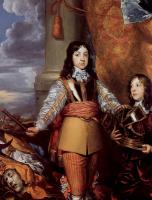


John Evelyn's Diary. 1st July 1664. Went to see Mr. Povey's (age 50) elegant house in Lincoln's Inn Fields, where the perspective in his court, painted by Streeter (age 43), is indeed excellent, with the vases in imitation of porphyry, and fountains; the inlaying of his closet; above all, his pretty cellar and ranging of his wine bottles.
John Evelyn's Diary. 9th February 1671. I saw the great ball danced by the Queen (age 32) and distinguished ladies at Whitehall Theater. Next day; was acted there the famous play, called, "The Siege of Granada", two days acted successively; there were indeed very glorious scenes and perspectives, the work of Mr. Streeter (age 50), who well understands it.
John Evelyn's Diary. 26th September 1672. I carried with me to dinner my Lord H. Howard (age 44) (now to be made Earl of Norwich and Earl Marshal of England) to Sir Robert Clayton's (age 43), now Sheriff of London, at his new house, where we had a great feast; it is built indeed for a great magistrate, at excessive cost. The cedar dining room is painted with the history of the Giants' War, incomparably done by Mr. Streeter (age 51), but the figures are too near the eye.


John Evelyn's Diary. 20th January 1675. Went to see Mr. Streeter (age 54), that excellent painter of perspective and landscape, to comfort and encourage him to be cut for the stone, with which that honest man was exceedingly afflicted.
In 1679 Robert Streater (age 58) died.
John Evelyn's Diary. 31st August 1679. After evening service, to see a neighbour, one Mr. Bohun, related to my son's (age 24) late tutor of that name, a rich Spanish merchant, living in a neat place, which he has adorned with many curiosities, especially several carvings of Mr. Gibbons (age 31), and some pictures by Streeter.
John Evelyn's Diary. 30th July 1682. Went to visit our good neighbour, Mr. Bohun, whose whole house is a cabinet of all elegancies, especially Indian; in the hall are contrivances of Japan screens, instead of wainscot; and there is an excellent pendule clock inclosed in the curious flowerwork of Mr. Gibbons (age 34), in the middle of the vestibule. The landscapes of the screens represent the manner of living, and country of the Chinese. But, above all, his lady's cabinet is adorned on the fret, ceiling, and chimney-piece, with Mr. Gibbons's best carving. There are also some of Streeter's best paintings, and many rich curiosities of gold and silver as growing in the mines. The gardens are exactly kept, and the whole place very agreeable and well watered. The owners are good neighbours, and Mr. Bohun has also built and endowed a hospital for eight poor people, with a pretty chapel, and every necessary accommodation.