

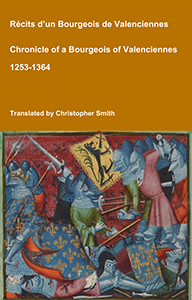
Chronicle of a Bourgeois of Valenciennes
Récits d’un bourgeois de Valenciennes aka The Chronicle of a Bourgeois of Valenciennes is a vivid 14th-century vernacular chronicle written by an anonymous urban chronicler from Valenciennes in the County of Hainaut. It survives in a manuscript that describes local and regional history from about 1253 to 1366, blending chronology, narrative episodes, and eyewitness-style accounts of political, military, and social events in medieval France, Flanders, and the Low Countries. The work begins with a chronological framework of events affecting Valenciennes and its region under rulers such as King Philip VI of France and the shifting allegiances of local nobility. It includes accounts of conflicts, sieges, diplomatic manoeuvres, and the impact of broader struggles like the Hundred Years’ War on urban life in Hainaut. Written from the perspective of a burgher (bourgeois) rather than a monastery or royal court, the chronicle offers a rare lay viewpoint on high politics and warfare, reflecting how merchants, townspeople, and civic institutions experienced the turbulence of the 13th and 14th centuries. Its narrative style combines straightforward reporting of events with moral and civic observations, making it a valuable source for readers interested in medieval urban society, regional politics, and the lived experience of war and governance in pre-modern Europe.
Available at Amazon in eBook and Paperback format.
Middle East is in Asia.
Flowers of History. 1080. This year also, king William [aged 52] led a powerful army into Wales, and subjugated it; and received homage and hostages for their fidelity from the petty kings of the viscounty. The same year, Antioch was taken by the pagans, together with the adjacent province, which had been a Christian land ever since the time of Saint Peter, without any disturbances. The same year, Malcolm, king of Scotland [aged 48], became furious a second time after the Assumption of the blessed Virgin Mary, and ravaged the whole of Northumberland, as far as the river Tyne. But when he heard of this, the king of England sent his son Robert [aged 29] with an army into Scotland, who returned without having succeeded in his objects, and built a new castle in the river Tyne, and then returned to his father. The same year also, the king sent his brother Odo, bishop of Bayeux, with a large army, to lay waste Northumberland, the people of which district had risen in insurrection against the king, and had murdered Walcher, bishop of Durham, a man of exemplary character, at Gateshead.
In 1097 Adalbéron Luxemburg Ardennes died at Antioch.
On 1st August 1190 Floris Gerulfing III Count Holland [aged 49] died at Antioch.
On 10th February 1163 Baldwin III King Jerusalem [aged 33] died at Beirut. His brother Almaric [aged 27] succeeded I King Jerusalem.
On 2nd July 1865 Frederick Emil Oldenburg [aged 64] died at Beirut.
On 12th July 1240 or 4th December 1240 Blanche Capet was born to King Louis IX of France [aged 26] and Margaret Provence Queen Consort France [aged 19] at Jaffa. She a great x 2 granddaughter of King Henry "Curtmantle" II of England. She died aged three in 1244.
In 1192 Osmond Stuteville [aged 76] died in Joppa.
On 12th December 1098 the garrison of Ma'arrat Nu'man [Map] negotiated with Prince Bohemond I of Antioch [aged 44], who promised them safe conduct if they surrendered. The Muslims surrendered, but the crusaders immediately began to massacre the population.
In 1148 Enguerrand Coucy [aged 38] died at Nazareth.
In 1097 Henry Namur I Count Durbuy died at Palestine. His son Godefroi succeeded I Count Durbuy.
In 1177 Hugh Bigod 1st Earl Norfolk [aged 82] died at Palestine. His son Roger [aged 33] succeeded 2nd Earl Norfolk. Ida Tosny Countess Norfolk [aged 21] by marriage Countess Norfolk.
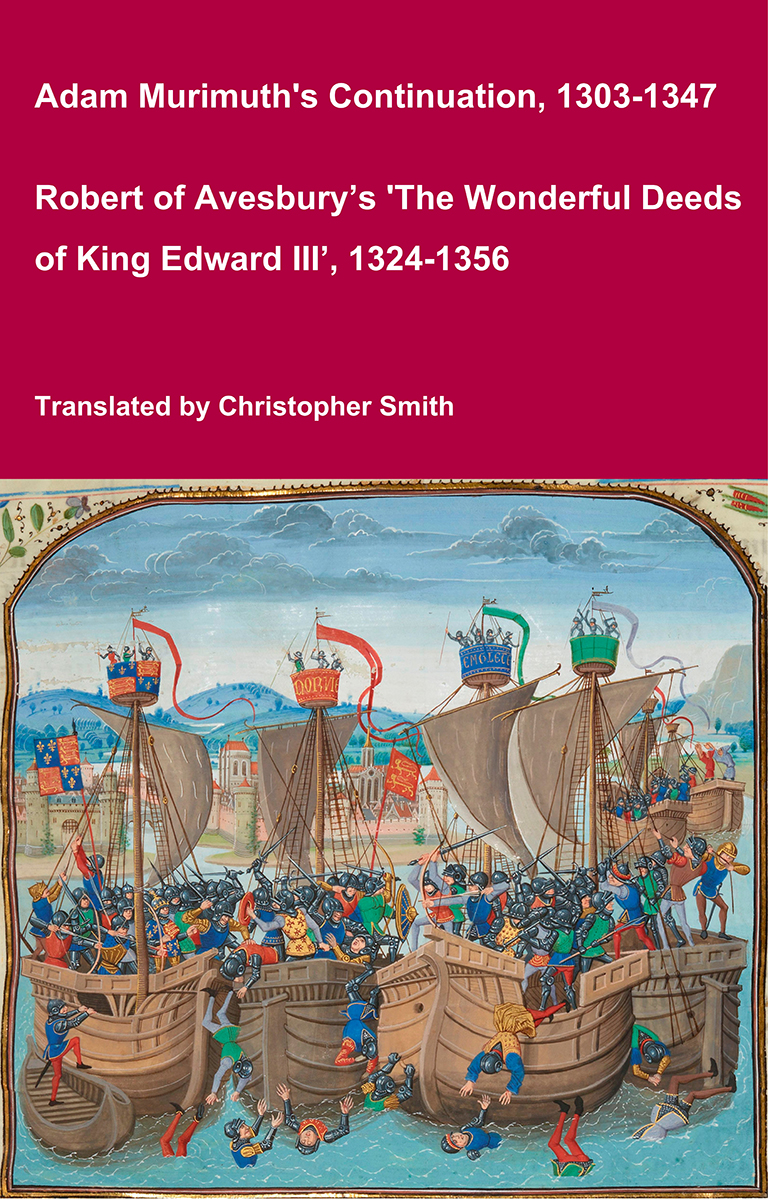
Adam Murimuth's Continuation and Robert of Avesbury’s 'The Wonderful Deeds of King Edward III'
This volume brings together two of the most important contemporary chronicles for the reign of Edward III and the opening phases of the Hundred Years’ War. Written in Latin by English clerical observers, these texts provide a vivid and authoritative window into the political, diplomatic, and military history of fourteenth-century England and its continental ambitions. Adam Murimuth Continuatio's Chronicarum continues an earlier chronicle into the mid-fourteenth century, offering concise but valuable notices on royal policy, foreign relations, and ecclesiastical affairs. Its annalistic structure makes it especially useful for establishing chronology and tracing the development of events year by year. Complementing it, Robert of Avesbury’s De gestis mirabilibus regis Edwardi tertii is a rich documentary chronicle preserving letters, treaties, and official records alongside narrative passages. It is an indispensable source for understanding Edward III’s claim to the French crown, the conduct of war, and the mechanisms of medieval diplomacy. Together, these works offer scholars, students, and enthusiasts a reliable and unembellished account of a transformative period in English and European history. Essential for anyone interested in medieval chronicles, the Hundred Years’ War, or the reign of Edward III.
Available at Amazon in eBook and Paperback format.
In 1188 Roger de Albini [aged 68] died in Palestine. His son Nigel [aged 42] succeeded 5th Baron Thirsk.
In 1189 Engeurrand "Crusader" Fiennes [aged 61] died at Palestine.
In 1190 Alice Fitzroger [aged 32] died at Palestine.
In 1218 Peter Courtenay [aged 63] died in Palestine.
On 11th October 1190 John Fitzrichard 6th Baron Halton [aged 46] died at Tyre. His son Roger [aged 19] succeeded 7th Baron Halton. Maud Clere Baroness Lacy Baroness Warkworth by marriage Baroness Halton.