


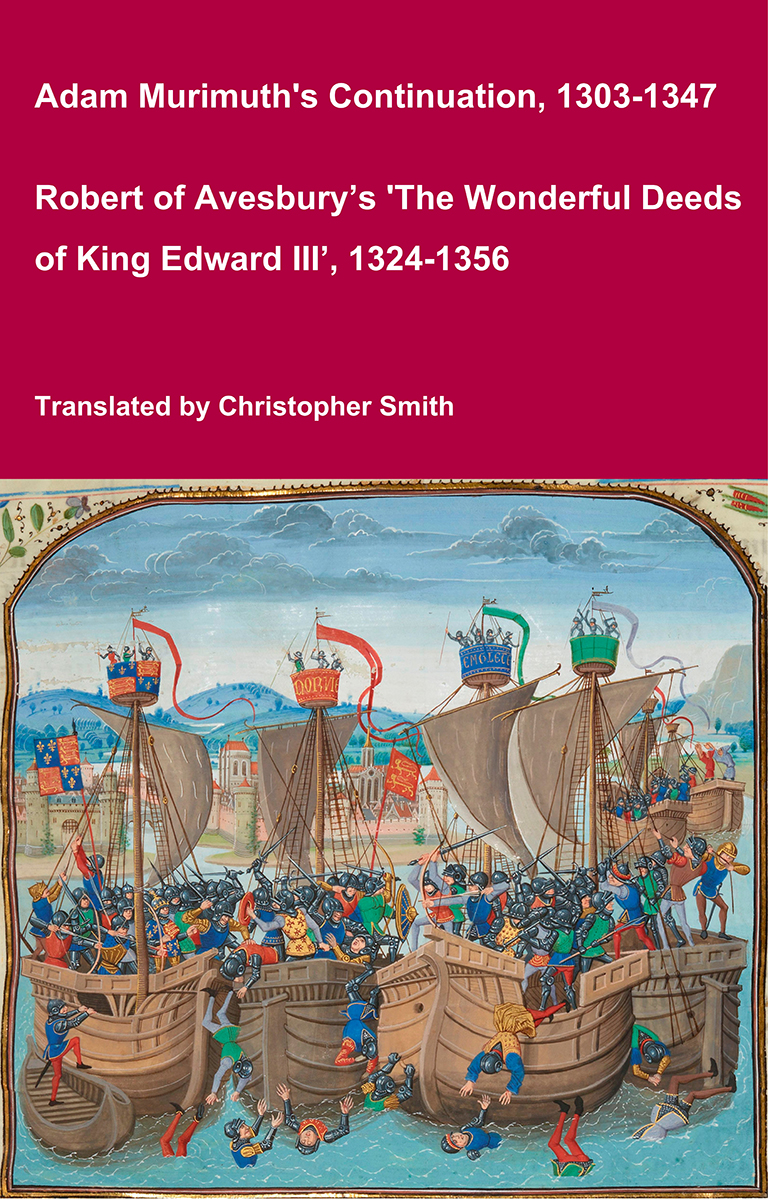
Adam Murimuth's Continuation and Robert of Avesbury’s 'The Wonderful Deeds of King Edward III'
This volume brings together two of the most important contemporary chronicles for the reign of Edward III and the opening phases of the Hundred Years’ War. Written in Latin by English clerical observers, these texts provide a vivid and authoritative window into the political, diplomatic, and military history of fourteenth-century England and its continental ambitions. Adam Murimuth Continuatio's Chronicarum continues an earlier chronicle into the mid-fourteenth century, offering concise but valuable notices on royal policy, foreign relations, and ecclesiastical affairs. Its annalistic structure makes it especially useful for establishing chronology and tracing the development of events year by year. Complementing it, Robert of Avesbury’s De gestis mirabilibus regis Edwardi tertii is a rich documentary chronicle preserving letters, treaties, and official records alongside narrative passages. It is an indispensable source for understanding Edward III’s claim to the French crown, the conduct of war, and the mechanisms of medieval diplomacy. Together, these works offer scholars, students, and enthusiasts a reliable and unembellished account of a transformative period in English and European history. Essential for anyone interested in medieval chronicles, the Hundred Years’ War, or the reign of Edward III.
Available at Amazon in eBook and Paperback format.
Algebraic Numbers is in Real Numbers.
Real Numbers can be either Algebraic Numbers or Transcendental Number.
Irrational Number. An Irrational Number is a number that cannot be expressed as a Fraction.
Constructable Numbers are numbers that can be derived using a straight edge and a compass.
The Golden Ratio, also known as the Golden Mean and Golden Section, is 1.618033... It is the solution to the equation x^2 - x - 1 = 0, or ( a + b ) / a = a / b.
The Golden Ratio is usually represented by the Greek Letter phi φ.
The Fibaonacci Series converges on the Golden Ratio.
The formula ( 1 + SQRT(5) ) / 2 is the Golden Ratio.
Square Root of 2, or 2^(1/2) being the length of the diagonal of a square with sides of length 1. It is 1.4142135623...
99/70 = 1.4142857 approximates to the Square Root of 2.
Non-Constructable Numbers are the solution to algebraic equations with a cube root of higher eg 2^(1/3).
Fractions are an Integer divided by an Integer eg 1/2, 5/13, 241/98.
Rational Number. A Rational Number is a number that can be expressed as a Fraction of two Integers. Integers are Fractions with a divisor of 1.
Adam Murimuth's Continuation and Robert of Avesbury’s 'The Wonderful Deeds of King Edward III'
This volume brings together two of the most important contemporary chronicles for the reign of Edward III and the opening phases of the Hundred Years’ War. Written in Latin by English clerical observers, these texts provide a vivid and authoritative window into the political, diplomatic, and military history of fourteenth-century England and its continental ambitions. Adam Murimuth Continuatio's Chronicarum continues an earlier chronicle into the mid-fourteenth century, offering concise but valuable notices on royal policy, foreign relations, and ecclesiastical affairs. Its annalistic structure makes it especially useful for establishing chronology and tracing the development of events year by year. Complementing it, Robert of Avesbury’s De gestis mirabilibus regis Edwardi tertii is a rich documentary chronicle preserving letters, treaties, and official records alongside narrative passages. It is an indispensable source for understanding Edward III’s claim to the French crown, the conduct of war, and the mechanisms of medieval diplomacy. Together, these works offer scholars, students, and enthusiasts a reliable and unembellished account of a transformative period in English and European history. Essential for anyone interested in medieval chronicles, the Hundred Years’ War, or the reign of Edward III.
Available at Amazon in eBook and Paperback format.
Irrational Number. An Irrational Number is a number that cannot be expressed as a Fraction.
Integers aka whole numbers. Fractions with a divisor of 1.
Rational Number. A Rational Number is a number that can be expressed as a Fraction of two Integers. Integers are Fractions with a divisor of 1.
Prime Number. A Prime Number is an Integer that is only divisible by 1 and itself with the Remainder ie. 1, 2, 3, 5, 7, 11, 13, 17, 19, ...
Fermat Prime. A Prime Number that is a solution to 2^2^N + 1 eg 3, 5, 17, 65537, 4294967297, 18446744073709551617
2 ^ 2 ^ 0 + 1 = 3
2 ^ 2 ^ 1 + 1 = 5
2 ^ 2 ^ 2 + 1 = 17
With the exeception of the first and second terms Germat Primes always end in 7.
Mersenne Prime. A Mersenne Prime is a prime number that is one less than a power of two. Mersenne Primes do not include all numbers that are one less than a power of two eg 16 - 1 = 15 which is divisible by 1, 3 and 5.