

Chronicle of Walter of Guisborough
A canon regular of the Augustinian Guisborough Priory, Yorkshire, formerly known as The Chronicle of Walter of Hemingburgh, describes the period from 1066 to 1346. Before 1274 the Chronicle is based on other works. Thereafter, the Chronicle is original, and a remarkable source for the events of the time. This book provides a translation of the Chronicle from that date. The Latin source for our translation is the 1849 work edited by Hans Claude Hamilton. Hamilton, in his preface, says: 'In the present work we behold perhaps one of the finest samples of our early chronicles, both as regards the value of the events recorded, and the correctness with which they are detailed; Nor will the pleasing style of composition be lightly passed over by those capable of seeing reflected from it the tokens of a vigorous and cultivated mind, and a favourable specimen of the learning and taste of the age in which it was framed.'
Available at Amazon in eBook and Paperback format.
Anglo-Saxon Chronicle. 795. This year was the moon eclipsed, between cock-crowing and dawn31, on the fifth day before the calends of April; and Erdulf succeeded to the Northumbrian kingdom on the second before the ides of May. He was afterwards consecrated and raised to his throne, at York, on the seventh day before the calends of June, by Archbishop Eanbald, and Bishops Ethelbert, Hibbald, and Baldulf.
Note 31. This is the Grecian method of computation; between the hours of three and six in the morning. It must be recollected, that before the distribution of time into hours, minutes, and seconds, the day and night were divided into eight equal portions, containing three hours each; and this method was continued long afterwards by historians.
Anglo-Saxon Chronicle. 800. This year was the moon eclipsed, at eight in the evening, on the seventeenth day before the calends of February; and soon after died King Bertric and Alderman Worr. Egbert [aged 27] succeeded to the West-Saxon kingdom; and the same day Ethelmund, alderman of the Wiccians, rode over the Thames at Kempsford; where he was met by Alderman Woxtan, with the men of Wiltshire, and a terrible conflict ensued, in which both the commanders were slain, but the men of Wiltshire obtained the victory.
Anglo-Saxon Chronicle. 802Her aðeostrade se mona on dagunge on xiii kt Iañr. ⁊ Beornmod wæs gehalgod to b to Rofeceastre þy ilcan geare.
Note 802. This year was the moon eclipsed, at dawn, on the thirteenth day before the calends of January; and Bernmod was consecrated Bishop of Rochester.
Anglo-Saxon Chronicle. 806. This year was the moon eclipsed, on the first of September; Erdwulf, king of the Northumbrians, was banished from his dominions; and Eanbert, Bishop of Hexham, departed this life. This year also, on the next day before the nones of June, a cross was seen in the moon, on a Wednesday, at the dawn; and afterwards, during the same year, on the third day before the calends of September, a wonderful circle was displayed about the sun.
Anglo-Saxon Chronicle. 827. This year was the moon eclipsed, on mid-winter's mass-night; and King Egbert [aged 54], in the course of the same year, conquered the Mercian kingdom, and all that is south of the Humber, being the eighth king who was sovereign of all the British dominions. Ella, king of the South-Saxons, was the first who possessed so large a territory; the second was Ceawlin, king of the West-Saxons: the third was Ethelbert, King of Kent; the fourth was Redwald, king of the East-Angles; the fifth was Edwin, king of the Northumbrians; the sixth was Oswald, who succeeded him; the seventh was Oswy, the brother of Oswald; the eighth was Egbert, king of the West-Saxons. This same Egbert led an army against the Northumbrians as far as Dore, where they met him, and offered terms of obedience and subjection, on the acceptance of which they returned home.
Anglo-Saxon Chronicle. 904. This year came Ethelwald hither over sea with all the fleet that he could get, and he was submitted to in Essex. This year the moon was eclipsed.
Anglo-Saxon Chronicle. 1077. This year the moon was eclipsed three nights before Candlemas; and in the same year died Aylwy, the prudent Abbot of Evesham, on the fourteenth day before the calends of March, on the mass-day of St. Juliana; and Walter was appointed abbot in his stead; and Bishop Herman also died, on the tenth day before the calends of March, who was Bishop in Berkshire, and in Wiltshire, and in Dorsetshire. This year also King Malcolm [aged 45] won the mother of Malslaythe…. and all his best men, and all his treasures, and his cattle; and he himself not easily escaped…. This year also was the dry summer; and wild fire came upon many shires, and burned many towns; and also many cities were ruined thereby.
Anglo-Saxon Chronicle. 5th May 1110. On the fifth night in the month of May appeared the moon shining bright in the evening, and afterwards by little and little its light diminished, so that, as soon as night came139, it was so completely extinguished withal, that neither light, nor orb, nor anything at all of it was seen. And so it continued nearly until day, and then appeared shining full and bright. It was this same day a fortnight old. All the night was the firmament very clear, and the stars over all the heavens shining very bright. And the fruits of the trees were this night sorely nipt by frost.
Note 139. Or, "in the early part of the night," etc.
Anglo-Saxon Chronicle. 1121. And the moon was eclipsed in the night of the nones of April, being a fortnight old.
Flowers of History by Roger of Wendover 1135. Whilst king Henry [aged 67] was in Normandy, he one day returned from hunting, and stopped at St. Denys, in the wood of Lions [Map], to eat some lampreys, a fish which he was very fond of, though they always disagreed with him, and the physicians had often cautioned him against eating them, but he would not listen to their advice. This food mortally chilled the old man's blood, and caused a sudden and violent illness, against which nature struggled, and brought on an acute fever, in the effort to resist the worst effects of the disease. Unable to overcome the malady, this great king died on the first day of December [1135], after he had reigned thirty-five years and three months. His death was foreshown by a violent wind, which, on the eve of the apostles Simon and Jude [28th October], cast down towers, and houses, and trees on every side: the moon also was eclipsed the same year, on the 29th of July. This king founded the abbeys of Reading, Cirencester, de Pre near Rouen, and Mortimer, and built twenty-five noble towns, besides towers and castles.
Anno Domini mcxxxv. Rex Henricus moratus in Normannia cum die quodam a venatu rediisset apud sanctum Dionysium in silva Leonum carnes comedit murænarum quæ ei semper nocebant et eas semper supra modum amabat; et, cum medici eas comedere prohiberent, non adquievit rex consilio salutari. Haec igitur comestio, pessimi humoris illatrix et consimilium vehemens excitatrix, senile corpus lethaliter refrigidans subitam et summam perturbationem effecit; contra quam natura renitens febrem excitavit acutam, ad impetum materiei gravissimse dissolvendum; cum autem resistere vi nulla potuisset, decessit rex magnus, cum regnasset triginta quinque annis ac tribus mensibus, prima die Decembris. lllius autem obitum ventus vehemens præsignavit, qui in vigilia apostolorum Simonis et Judas turres et sedificia dejecit et arbores usquequaque subvertit; luna etiam eclipsim passa est eodem anno quarto kalendas Augusti. Cœnobia fecit rex, de Radingis, de Cirencestre, de Prato ante Rothomagum, et de Mortuo-mari; municipia vero, præter turres et castella, viginti quinque opere sumptuoso construxit.
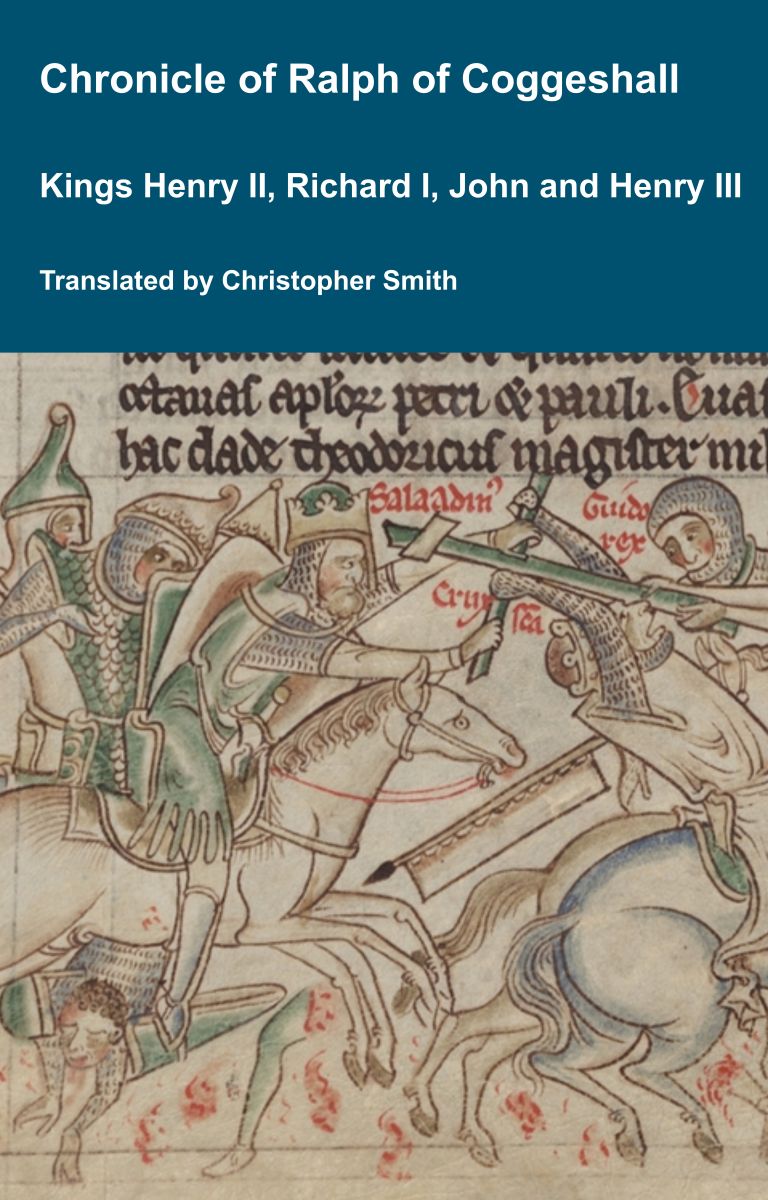 Chronicum Anglicanum by Ralph Coggeshall. 1136. An lunar eclipse took place on the Kalends of January [1st January].
MCXXXVI. Eclipsis lunae facta est calendis Januarii.
The History of William Marshal was commissioned by his son shortly after William’s death in 1219 to celebrate the Marshal’s remarkable life; it is an authentic, contemporary voice. The manuscript was discovered in 1861 by French historian Paul Meyer. Meyer published the manuscript in its original Anglo-French in 1891 in two books. This book is a line by line translation of the first of Meyer’s books; lines 1-10152. Book 1 of the History begins in 1139 and ends in 1194. It describes the events of the Anarchy, the role of William’s father John, John’s marriages, William’s childhood, his role as a hostage at the siege of Newbury, his injury and imprisonment in Poitou where he met Eleanor of Aquitaine and his life as a knight errant. It continues with the accusation against him of an improper relationship with Margaret, wife of Henry the Young King, his exile, and return, the death of Henry the Young King, the rebellion of Richard, the future King Richard I, war with France, the death of King Henry II, and the capture of King Richard, and the rebellion of John, the future King John. It ends with the release of King Richard and the death of John Marshal.
Available at Amazon in eBook and Paperback format.
Memoires Jacques du Clercq. In the said year 1460, on a Saturday, the 26th day of December, there was an eclipse of the moon at midnight, between Saturday and Sunday, and the said eclipse lasted for the space of two or three hours. Item, in the same year, on the night of Christmas, although it had been very hard frost and extremely cold in the region of Artois, at Hesdin, Saint-Pol, Arras, and elsewhere, it thundered so violently and there was such lightning that many people saw a great burning bolt of fire in the sky, in the form of a fiery dragon, as some said; others said that it was like a running flame.
Audit an mil iiije lx, par ung samedy xxvije du mois de decembre, fust eclipse de lune a minuit, entre le samedy et dimanche, et dura ladite eclipse l'espace de deulx ou trois heures. Item audit an, la nuit de Noel, jasoit ce qu'il ouist très fort gelé et feit moult froid au pays d'Artois, a Hesdin, Saint-Pol, Arras et ailleurs, il tonna si fort et eclistra, que plusieurs gens veirent une grosse fouldre de feu ardente au chiel, en maniere d'ung dragon ardent, comme aulcuns disoient; les aultres disoient que ce avoit esté comme une flambe courante.
Cassius Dio Roman History Book 60. 26. Since there was to be an eclipse of the sun on his birthday, he feared that there might be some disturbance in consequence, inasmuch as some other portents had already occurred; he therefore issued a proclamation in which he stated not only the fact that there was to be an eclipse, and when, and for how long, but also the reasons for which this was bound to happen. These reasons I will now give. The moon, which revolves in its orbit (or so it is believed), either directly below it or perhaps with Mercury and Venus intervening, has a longitudinal motion, just as the sun has, and a vertical motion, as the other perhaps likewise has, but it has also a latitudinal motion such as the sun never shows under any conditions. When, therefore, the moon gets in a direct line with the sun over our heads and passes under its blazing orb, it obscures the rays from that body that extend toward the earth. To some of the earth's inhabitants this obscuration lasts for a longer and to others for a shorter time, whereas to still others it does not occur for even the briefest moment. For since the sun always has a light of its own, it is never deprived of it, and consequently to all those between whom and the sun the moon does not pass, so as to throw a shadow over it, it always appears entire. This, then, is what happens to the sun, and it was made public by Claudius at that time. But now that I have once touched upon this subject, it will not be out of place to give the explanation of a lunar eclipse also. Whenever, then, the moon gets directly opposite the sun (for it is eclipsed only at full moon, just as the sun is eclipsed at the time of new moon) and runs into the cone-shaped shadow of the earth, a thing that happens whenever it passes through the mean point in its latitudinal motion, it is then deprived of the sun's light and appears by itself as it really is. Such is the explanation of these phenomena.