


Text this colour is a link for Members only. Support us by becoming a Member for only £3 a month by joining our 'Buy Me A Coffee page'; Membership gives you access to all content and removes ads.
Text this colour links to Pages. Text this colour links to Family Trees. Place the mouse over images to see a larger image. Click on paintings to see the painter's Biography Page. Mouse over links for a preview. Move the mouse off the painting or link to close the popup.

All About History Books
The Deeds of King Henry V, or in Latin Henrici Quinti, Angliæ Regis, Gesta, is a first-hand account of the Agincourt Campaign, and subsequent events to his death in 1422. The author of the first part was a Chaplain in King Henry's retinue who was present from King Henry's departure at Southampton in 1415, at the siege of Harfleur, the battle of Agincourt, and the celebrations on King Henry's return to London. The second part, by another writer, relates the events that took place including the negotiations at Troye, Henry's marriage and his death in 1422.
Available at Amazon as eBook or Paperback.
Fleur de lys is in Charges.
Fleur de lys. The Lily. Typically representing the House of France.

Around 1400. Window in the Chicheley Chapel at St Andrew's Church, Wimpole [Map] from the late 14th early 15th Century depicting alliances of the Ufford family (who are thought to have owned the manor of Wimpole before the Chicheleys) and the Plantagenets through the marriage of Ralph Ufford and Maud Plantagenet Countess Ulster, daughter of Henry Plantagenet 3rd Earl of Leicester 3rd Earl Lancaster .
From top to bottom, left to right:
 Tiptoft Arms. The Tiptoft family owned the nearby manor of Harleston.
 Avenell Arms. The Avenell family once held a manor in Wimpole.
Telemache Arms.
 Ufford Arms. Believed to be the arms of William Ufford 2nd Earl Suffolk. Note the difference of an annulet argent (white) in the top left corner.
 Bohun Arms. Possibly William Bohun 1st Earl of Northampton.
 Henry Plantagenet 3rd Earl of Leicester 3rd Earl Lancaster 1281 1345 Arms. Possibly Henry Plantagenet 3rd Earl of Leicester 3rd Earl Lancaster although the label doesn't appear to have the fleur de lys of France.
Bassingbourne Arms.
Engaine Arms. John de Engaine lived in Huntingdonshire.
 Lisle Arms. Possibly Robert Lisle 1st Baron Lisle. Robert settled at nearby Rampton.
Robert Ufford 1st Earl Suffolk who married Margaret Norwich Countess Suffolk whose father Walter Norwich owned the manor of Cobbs in Wimpole.
Ufford Arms with a label three points. Believed to be Robert Ufford who predeceased his father Robert Ufford 1st Earl Suffolk.
Bassingbourne Arms.
The figure in the middle is believed to represent William Ufford 2nd Earl Suffolk.
From an original description by James C Powell 1903.
 Become a Member via our 'Buy Me a Coffee' page to read complete text.
 Capet Arms. Azure, three Fleur de lys or. Source.
 Belasyse Arms. Argent a chevron gules between three fleur de lys azure. Source.
 Godolphin Arms. Gules, an eagle with two heads, displayed between three fleur de lys, two and one, argent.
 Digby Arms. Azure, a fleur de lys argent. Source.
 Lewis Arms. Sable a chevron or three fleur de lys or. Source.
 Cranfield Arms. Argent, in pale three fleur de lys argent. Source.
 Fanshawe Arms. Or a chevron between three fleur de lys sable. Source.
All About History Books
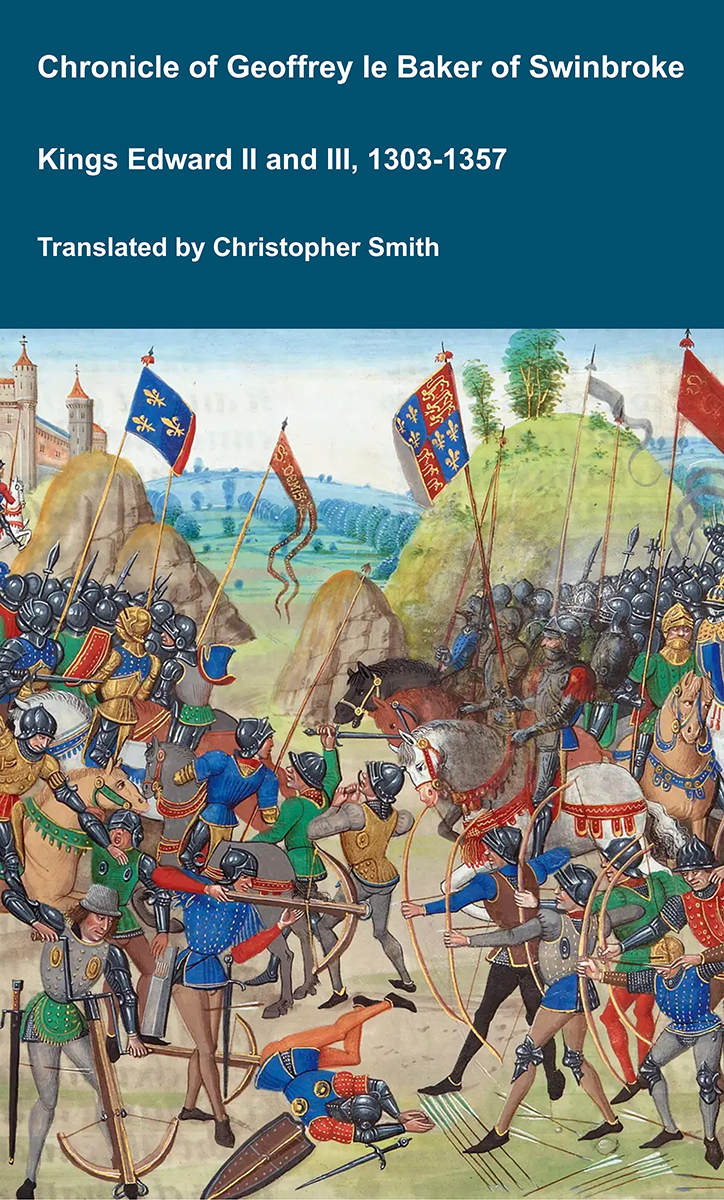
The Chronicle of Geoffrey le Baker of Swinbroke. Baker was a secular clerk from Swinbroke, now Swinbrook, an Oxfordshire village two miles east of Burford. His Chronicle describes the events of the period 1303-1356: Gaveston, Bannockburn, Boroughbridge, the murder of King Edward II, the Scottish Wars, Sluys, Crécy, the Black Death, Winchelsea and Poitiers. To quote Herbert Bruce 'it possesses a vigorous and characteristic style, and its value for particular events between 1303 and 1356 has been recognised by its editor and by subsequent writers'. The book provides remarkable detail about the events it describes. Baker's text has been augmented with hundreds of notes, including extracts from other contemporary chronicles, such as the Annales Londonienses, Annales Paulini, Murimuth, Lanercost, Avesbury, Guisborough and Froissart to enrich the reader's understanding. The translation takes as its source the 'Chronicon Galfridi le Baker de Swynebroke' published in 1889, edited by Edward Maunde Thompson. Available at Amazon in eBook and Paperback.
 Fox Arms. Ermine, on a chevron azure three fox's heads and necks erased or on a canton of the second a fleur de lys of the third. The canton is an augmentation of honour to his paternal arms, granted out of the Royal Arms as a mark of esteem to him and his heirs forever, by King Charles II following the Restoration of the Monarchy. Source.



NO IMAGE. Or, on a pile gules between six fleur de lys azure three lions of England. Augmentation of honour granted to Edward Seymour 1st Duke of Somerset when his sister Queen Jane Seymour married King Henry VIII of England and Ireland. Source.


 Beresford Arms. Argent, crusilly fitchée sable, three fleurs-de-lis within a bordure engrailed of the second. Source.


.svg)


_Arms.png)
.svg)


.svg)