

The History of William Marshal was commissioned by his son shortly after William’s death in 1219 to celebrate the Marshal’s remarkable life; it is an authentic, contemporary voice. The manuscript was discovered in 1861 by French historian Paul Meyer. Meyer published the manuscript in its original Anglo-French in 1891 in two books. This book is a line by line translation of the first of Meyer’s books; lines 1-10152. Book 1 of the History begins in 1139 and ends in 1194. It describes the events of the Anarchy, the role of William’s father John, John’s marriages, William’s childhood, his role as a hostage at the siege of Newbury, his injury and imprisonment in Poitou where he met Eleanor of Aquitaine and his life as a knight errant. It continues with the accusation against him of an improper relationship with Margaret, wife of Henry the Young King, his exile, and return, the death of Henry the Young King, the rebellion of Richard, the future King Richard I, war with France, the death of King Henry II, and the capture of King Richard, and the rebellion of John, the future King John. It ends with the release of King Richard and the death of John Marshal.
Available at Amazon in eBook and Paperback format.
Gules is in Field.
 Hanover Arms. Gules, a horse courant argent.
 Bacon Arms. Gules, on a chief argent two mullets pierced sable. Source.
 Beauchamp Arms. Gules a fess or between six cross crosslets or.
 Beke Arms. Gules, a cross recerclée argent. Sometimes a cross moline. Source.
 Berkeley Arms. Gules a chevron between ten crosses pattee six in chief and four in base argent.
 Blennerhassett Arms. Gules, a chevron ermine, between three dolphins naiant embowed argent. Source.
 Brabazon Arms. Gules on a bend or three martlets sable. Source.
 Brooke Arms. Gules, on a chevron argent a lion rampant sable crowned or. Source.
Abbot John Whethamstede’s Chronicle of the Abbey of St Albans
Abbot John Whethamstede's Register aka Chronicle of his second term at the Abbey of St Albans, 1451-1461, is a remarkable text that describes his first-hand experience of the beginning of the Wars of the Roses including the First and Second Battles of St Albans, 1455 and 1461, respectively, their cause, and their consequences, not least on the Abbey itself. His text also includes Loveday, Blore Heath, Northampton, the Act of Accord, Wakefield, and Towton, and ends with the Coronation of King Edward IV. In addition to the events of the Wars of the Roses, Abbot John, or his scribes who wrote the Chronicle, include details in the life of the Abbey such as charters, letters, land exchanges, visits by legates, and disputes, which provide a rich insight into the day-to-day life of the Abbey, and the challenges faced by its Abbot.
Available at Amazon in eBook and Paperback format.
 Burghesh Arms. Gules, a lion rampant or, double queued or.
 Cadogan Arms. Gules, a lion rampant reguardant or. Source.
 Caerleon Arms. Gules three castles argent. Source.
 Carr Arms. Gules, on a chevron argent, three mullets, of the field.
 Carteret Arms. Gules four fusils in fess argent.
 Cholmondeley Arms. Gules, in chief two esquire's helmets argent in base a garb or. Source.
 Cobham Arms. Gules a chevron or three lions rampant sable. Source.
 Dacre Arms. Gules three escallops argent. Source.
 Dampierre Arms. Gules, two lions passant or, armed and langued azure. Source.
 Danvers Arms. Gules a chevron or three estoiles. Source.
The History of William Marshal was commissioned by his son shortly after William’s death in 1219 to celebrate the Marshal’s remarkable life; it is an authentic, contemporary voice. The manuscript was discovered in 1861 by French historian Paul Meyer. Meyer published the manuscript in its original Anglo-French in 1891 in two books. This book is a line by line translation of the first of Meyer’s books; lines 1-10152. Book 1 of the History begins in 1139 and ends in 1194. It describes the events of the Anarchy, the role of William’s father John, John’s marriages, William’s childhood, his role as a hostage at the siege of Newbury, his injury and imprisonment in Poitou where he met Eleanor of Aquitaine and his life as a knight errant. It continues with the accusation against him of an improper relationship with Margaret, wife of Henry the Young King, his exile, and return, the death of Henry the Young King, the rebellion of Richard, the future King Richard I, war with France, the death of King Henry II, and the capture of King Richard, and the rebellion of John, the future King John. It ends with the release of King Richard and the death of John Marshal.
Available at Amazon in eBook and Paperback format.
 Daubigny Arms. Gules, four fusils conjoined in fess argent. Source.
 De Quincy Arms. Gules, seven mascles or 3,3,1. Source.
 Denny Arms. Gules, a saltire argent between twelve crosses pattee or. Source.
 Despencer Arms. Quarterly 1&4: Argent, 2&3: Gules, a fret or, over all a bend sable. Source.
 Dunbar Arms. Gules a lion rampant argent on a bordure of the same eight roses of the field. Source.
 Plantagenet Arms. Gules, three lions passant guardant in pale or armed and langued azure. Source.
 Verney Arms. Gules, three crosses recerclée voided throughout or a chief vair ermine and ermines. Source.
 Umfraville Arms. Gules crusilly of crosses crosslet a cinquefoil or. Source.
 Ughtred Arms. Gules, a cross moline or. Source.
 Giffard Arms. Gules Three lions passant guardant or in pale or.
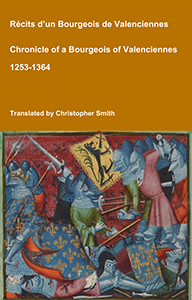
Chronicle of a Bourgeois of Valenciennes
Récits d’un bourgeois de Valenciennes aka The Chronicle of a Bourgeois of Valenciennes is a vivid 14th-century vernacular chronicle written by an anonymous urban chronicler from Valenciennes in the County of Hainaut. It survives in a manuscript that describes local and regional history from about 1253 to 1366, blending chronology, narrative episodes, and eyewitness-style accounts of political, military, and social events in medieval France, Flanders, and the Low Countries. The work begins with a chronological framework of events affecting Valenciennes and its region under rulers such as King Philip VI of France and the shifting allegiances of local nobility. It includes accounts of conflicts, sieges, diplomatic manoeuvres, and the impact of broader struggles like the Hundred Years’ War on urban life in Hainaut. Written from the perspective of a burgher (bourgeois) rather than a monastery or royal court, the chronicle offers a rare lay viewpoint on high politics and warfare, reflecting how merchants, townspeople, and civic institutions experienced the turbulence of the 13th and 14th centuries. Its narrative style combines straightforward reporting of events with moral and civic observations, making it a valuable source for readers interested in medieval urban society, regional politics, and the lived experience of war and governance in pre-modern Europe.
Available at Amazon in eBook and Paperback format.
 Godolphin Arms. Gules, an eagle with two heads, displayed between three fleur de lys, two and one, argent.
 Granville Arms. Gules three clarions or. Source.
 Throckmorton Arms. Gules, on a chevron argent three bars gemelles sable. Source.
 Walmesley Arms. Gules a chief ermine two hurts.
 Hamlyn Arms. Gules, a lion rampant ermine crowned or. Source.
 Harcourt Arms. Gules two bars or. Source.
 Hayward Arms. Gules, a lion rampant argent crowned or. Source.
 Hervey Arms. Gules, on a bend argent three trefoils slipped vert, Source.
 Howard Arms. Gules bend argent six crosslets fitchy. Source.
 Howard Augmented Arms. Gules bend argent six crosslets fitchy augmented after the Battle of Flodden with an inescutcheon bearing the lion of Scotland pierced through the mouth with an arrow. Source.
 Isle of Man Arms. Gules, a Triskelion argent. Sources.
 Joigny Arms. Gules, an eagle argent. Source.
 Keppel Arms. Gules, three escallops argent. Source.
Jean de Waurin's Chronicle of England Volume 6 Books 3-6: The Wars of the Roses
Jean de Waurin was a French Chronicler, from the Artois region, who was born around 1400, and died around 1474. Waurin’s Chronicle of England, Volume 6, covering the period 1450 to 1471, from which we have selected and translated Chapters relating to the Wars of the Roses, provides a vivid, original, contemporary description of key events some of which he witnessed first-hand, some of which he was told by the key people involved with whom Waurin had a personal relationship.
Available at Amazon in eBook and Paperback format.
 Knollys Arms. Gules, on a chevron argent, three roses gules, barbed and seeded proper. Source.
 Liddell Arms. Gules, on a bend argent, three mullets sable. Source.
 Louvain Arms. Gules billety or a fess of the last. Source.
 Monck Arms. Gules, a chevron between three lion's heads erased argent. Source.
 Mowbray Arms. Gules, a lion rampant argent. Source.
 Narborough Arms. Gules, a chief ermine. Source.
 Neville Arms. Gules, a saltire argent.
 Normandy Arms. Gules, two lions passant guardant in pale or armed and langued azure. Source.
 Ponsonby Arms. Gules, a chevron between three combs argent. Source.
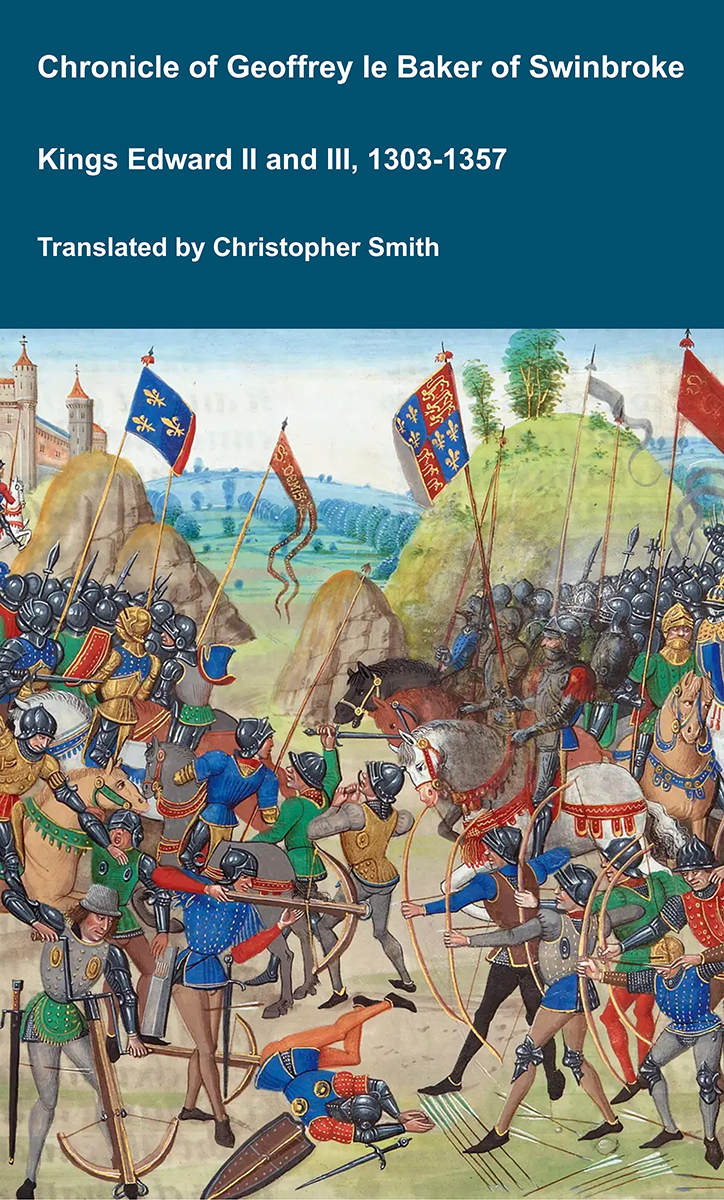
Chronicle of Geoffrey le Baker of Swinbroke
Baker was a secular clerk from Swinbroke, now Swinbrook, an Oxfordshire village two miles east of Burford. His Chronicle describes the events of the period 1303-1356: Gaveston, Bannockburn, Boroughbridge, the murder of King Edward II, the Scottish Wars, Sluys, Crécy, the Black Death, Winchelsea and Poitiers. To quote Herbert Bruce 'it possesses a vigorous and characteristic style, and its value for particular events between 1303 and 1356 has been recognised by its editor and by subsequent writers'. The book provides remarkable detail about the events it describes. Baker's text has been augmented with hundreds of notes, including extracts from other contemporary chronicles, such as the Annales Londonienses, Annales Paulini, Murimuth, Lanercost, Avesbury, Guisborough and Froissart to enrich the reader's understanding. The translation takes as its source the 'Chronicon Galfridi le Baker de Swynebroke' published in 1889, edited by Edward Maunde Thompson.
Available at Amazon in eBook and Paperback format.
 Rich Arms. Gules, a chevron between three crosses botonée or. Source.
 Ros Arms. Gules, three water bougets argent.
 Salusbury Arms. Gules a lion rampant argent three crescents argent.
 Seymour Arms. Gules two wings conjoined in lure.
 Castile Arms. Gules a castle or.
 Spencer Arms. Quarterly 1&4: Argent, 2&3: Gules, a fret or, over all a bend sable.
 Talbot Arms. Gules, a lion rampant within a bordure engrailed or. Source.
 Fitzpayn Arms. Gules, three lions passant guardant argent, overall a bend azure. Source.
 Fitzherbert Arms. Gules, three lions rampant or. Source.
Jean de Waurin's Chronicle of England Volume 6 Books 3-6: The Wars of the Roses
Jean de Waurin was a French Chronicler, from the Artois region, who was born around 1400, and died around 1474. Waurin’s Chronicle of England, Volume 6, covering the period 1450 to 1471, from which we have selected and translated Chapters relating to the Wars of the Roses, provides a vivid, original, contemporary description of key events some of which he witnessed first-hand, some of which he was told by the key people involved with whom Waurin had a personal relationship.
Available at Amazon in eBook and Paperback format.
 Fitzalan Arms. Gules, a lion rampant or. Source.
 Audley Arms. Gules, fretty. Source.


#/media/File:BaconArms.svg)


.svg)


.svg)


.svg)
.svg)
#/media/File:Blason_Thomas_Le_Despencer.svg)


.svg)
.svg)


_Arms.svg)

.svg)

.svg)

.svg)

.svg)


.svg)


