

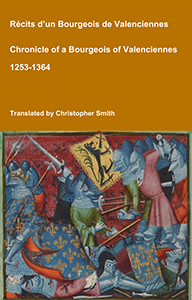
Chronicle of a Bourgeois of Valenciennes
Récits d’un bourgeois de Valenciennes aka The Chronicle of a Bourgeois of Valenciennes is a vivid 14th-century vernacular chronicle written by an anonymous urban chronicler from Valenciennes in the County of Hainaut. It survives in a manuscript that describes local and regional history from about 1253 to 1366, blending chronology, narrative episodes, and eyewitness-style accounts of political, military, and social events in medieval France, Flanders, and the Low Countries. The work begins with a chronological framework of events affecting Valenciennes and its region under rulers such as King Philip VI of France and the shifting allegiances of local nobility. It includes accounts of conflicts, sieges, diplomatic manoeuvres, and the impact of broader struggles like the Hundred Years’ War on urban life in Hainaut. Written from the perspective of a burgher (bourgeois) rather than a monastery or royal court, the chronicle offers a rare lay viewpoint on high politics and warfare, reflecting how merchants, townspeople, and civic institutions experienced the turbulence of the 13th and 14th centuries. Its narrative style combines straightforward reporting of events with moral and civic observations, making it a valuable source for readers interested in medieval urban society, regional politics, and the lived experience of war and governance in pre-modern Europe.
Available at Amazon in eBook and Paperback format.
Hip Belt is in Belts.

After 10th August 1358. Monument to Piers Grandison 2nd Baron Grandison [deceased]. Lady Chapel of Hereford Cathedral [Map]. Mid 14th-century, altar-tomb with effigy and canopy, altar-tomb with range of cinquefoil-headed panels in front and panelled buttresses at ends carried up to the cornice of the canopy, effigy in mixed mail and plate-armour with camail and ridged bascinet, hauberk with scalloped lower edge, cyclas, enriched Hip Belt with dagger hanging in front and sword at side, head on cushions and feet on hound; recess with panelled back, moulded jambs and square head enriched with Paterae and trefoiled and sub-cusped pendant tracery below the head; vaulted soffit to canopy; canopy with range of six bays of open arcading with trefoiled and sub-cusped heads, crockets and finials, in arcading two headless figures of the Coronation of the Virgin, headless figure with book, archbishop with cross-staff, St. John the Baptist holding a roundel with the Agnus Dei, and a bishop, last four figures brought from elsewhere; canopy finished with enriched cornice and pierced parapet with quatrefoils and cusped cresting.
On 26th July 1375 Richard Pembridge [aged 55] died. Hereford Cathedral [Map]. Alabaster altar-tomb and effigy, altar-tomb with moulded base and capping, sides and ends panelled with alternate quatrefoils enclosing shields of his arms and trefoil-headed panels; effigy in bascinet, Camail and Jupon Period. His jupon with same arms as his shield. Hip Belt, Leg Garter, right leg modern, head on helm crested with a Feathered Crest, feet on hound.


On 25th February 1387 John Grey aka Marmion [aged 44] died in Spain. In 1400 Elizabeth St Quentin [aged 40] died.
Monument in St Nicholas Church, West Tanfield, North Yorkshire [Map]. Camail and Jupon Period. Lancastrian Esses Collar. Hip Belt. Feathered Crest on Great Helm. Angels Supporting Pillow. His bascinet has decorated edges with the camail appearing to attach inside the bascinet. Decorated flat band. She wearing a unusual headress which appears to be a cross between Gabled Headress and Bongrace. Her dress long with a Low Rounded Neckline and appears to be decoated with an armorial: vair at the top, chevrons at the bottom, which may be  Marmion Arms or a variation of.
John Grey aka Marmion: In 1343 he was born to John Grey 1st Baron Grey and Avice Marmion Baroness Grey Rotherfield. He a great x 4 grandson of King Henry "Curtmantle" II of England. Before 25th February 1387 John Grey aka Marmion and Elizabeth St Quentin were married.
Elizabeth St Quentin: Before 1347 she was born to Herbert St Quentin and Mary Lisle.




In 1389 Robert de Fouleshurst [aged 59] died. He was buried at St Bertoline's Church, Barthomley [Map]. Camail and Jupon Period. Chest with Angels with Rounded Wings holding Shields. Hip Belt. Lancastrian Esses Collar. IHC NASARE Lettering.
Ray State, in his book 'The Alabaster Carvers', describing the 1389 Fouleshurst monument in Note d3: 'Tomb chest with angels, which may not belong. The angels are standing holding shields and extended wings with serrated edges a feature not thought to be used for another 20 years.'
Robert de Fouleshurst: Around 1330 he was born. Before 1366 Robert de Fouleshurst and Elizabeth de Praers were married.


On 23rd April 1394 Hugh Calverley [aged 70] died. He was probably buried in St Boniface's Church, Bunbury [Map]. Monument Early Plate Bascinet Period. Finely carved Calf's Head on the breastplate representing Hugh Calverley's canting arms. Calf's Head Crest. Hip Belt. Basinet with decorated Orle.


In 1410 John Mainwaring [aged 66] died. On 6th April 1418 Margaret Stafford [aged 65] died. Both buried at St Lawrence's Church, Over Peover [Map].
Monument at St Lawrence's Church, Over Peover [Map]. Camail and Jupon Period. IHC NASARE Lettering. Hip Belt. Lancastrian Esses Collar. Woman Esses Collar.
John Mainwaring: Around 1344 he was born to William "The Elder" IV Mainwaring in Over Peover, Cheshire. Before 1410 John Mainwaring and Margaret Stafford were married.
Margaret Stafford: Around 1345 she was born to John Stafford and Margaret Stafford.




After 1st September 1414 William Ros 6th Baron Ros Helmsley [deceased] was buried at Belvoir Priory [Map]. At the dissolution of the monasteries his monument was moved to the Chancel of St Mary the Virgin Church, Bottesford, Leicestershire [Map] on the right side of the High Altar. Alabaster Monument of the Camail and Jupon Period. Possibly Sutton and Prentys.

Scabbard with IHS. Wire Wrapped Grip. Hip Belt.


Detail of the Ros Family Peacock Crest surmounting his Great Helm.

Detail of decorated Orle and Vervelle Cover.

Detail of Lancastrian Esses Collar and face. Note the twisted moustache that is frequently seen on Sutton and Prentys monuments. The fixing of the Esses Collar to the Camail using a small trefoil.
After 1418. Monument to John Harrington 4th Baron Harington [aged 34] and Elizabeth Courtenay Baroness Bonville and Harington. Finely carved alabaster. Monument of the Early Plate Bascinet and Gorget Period. Decorated orle and the plate gorget (throat protection), Hip Belt and the Horses Head Crest. She wearing a Crespine Headress. Chunky Lions Mane. Angels Supporting Pillow.
John Harrington 4th Baron Harington: In 1384 he was born to Robert Harrington 3rd Baron Harington and Isabel Loring Baroness Harington. On 21st May 1406 Robert Harrington 3rd Baron Harington died at Aldingham Furness, Lancashire. His son John succeeded 4th Baron Harington. On 11th April 1418 John Harrington 4th Baron Harington died. He was buried in the Lady Chapel of St Dubricius Church, Porlock [Map]. His brother William succeeded 5th Baron Harington. After 17th February 1461 John Harrington 4th Baron Harington and Elizabeth Courtenay Baroness Bonville and Harington were married. She by marriage Baroness Harington. She the daughter of Edward Courtenay 3rd or 12th Earl Devon and Maud Camoys Countess Devon.


After 17th January 1425. Monument in Church of St Oswald, Methley [Map] to Robert Waterton [deceased] and Cecily Fleming.
York School of Carving. Crocketed arch. He in Early Plate Bascinet Period armour. Large Orle highly decorated with head resting on great helm with feathered crest. Beard with spiral twists. Collar Esses and Crowns Alternating. Misericorde. Hip Belt with decorated buckle. She wearing a squared crespine headress and small Esses Collar. Chest with Angels with Rounded Wings holding Shields. Chunky Lions Mane.
Cecily Fleming: she was born to Robert Fleming of Woodhall. Before 1398 Robert Waterton and she were married. Around 1424 she died.


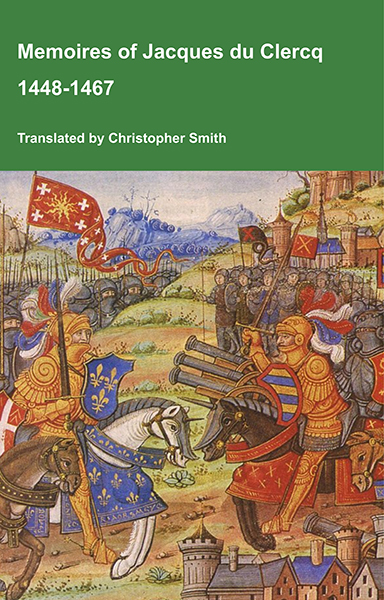
This is a translation of the 'Memoires of Jacques du Clercq', published in 1823 in two volumes, edited by Frederic, Baron de Reissenberg. In his introduction Reissenberg writes: 'Jacques du Clercq tells us that he was born in 1424, and that he was a licentiate in law and a counsellor to Philip the Good, Duke of Burgundy, in the castellany of Douai, Lille, and Orchies. It appears that he established his residence at Arras. In 1446, he married the daughter of Baldwin de la Lacherie, a gentleman who lived in Lille. We read in the fifth book of his Memoirs that his father, also named Jacques du Clercq, had married a lady of the Le Camelin family, from Compiègne. His ancestors, always attached to the counts of Flanders, had constantly served them, whether in their councils or in their armies.' The Memoires cover a period of nineteen years beginning in in 1448, ending in in 1467. It appears that the author had intended to extend the Memoirs beyond that date; no doubt illness or death prevented him from carrying out this plan. As Reissenberg writes the 'merit of this work lies in the simplicity of its narrative, in its tone of good faith, and in a certain air of frankness which naturally wins the reader’s confidence.' Du Clercq ranges from events of national and international importance, including events of the Wars of the Roses in England, to simple, everyday local events such as marriages, robberies, murders, trials and deaths, including that of his own father in Book 5; one of his last entries.
Available at Amazon in eBook and Paperback format.
On 26th February 1432 Ralph Longford [aged 31] died. St Chad's Church, Longford [Map]. Monument to Ralph Longford. Early Plate Bascinet and Gorget Period. Lancastrian Esses Collar. Hip Belt. IHC NASARE Lettering.
Ralph Longford: Ralph Longford and Margaret Melton were married. On 27th October 1400 he was born to Nicholas IV Longford and Sarah Harrington at Colwich, Staffordshire [Map]. He was baptised at St Peter's Church, Ellastone. On 19th May 1426, Whitsunday, King Henry VI of England and II of France was knighted by his uncles John Lancaster 1st Duke Bedford and Humphrey Lancaster 1st Duke Gloucester at Leicester, Leicestershire [Map]. Henry then went on to knight Ralph Longford, Thomas Courtenay 5th or 13th Earl Devon and Robert Wingfield.


On 27th May 1435 Nicholas Montgomery [aged 59] died at Great Cubley, Derbyshire [Map]. He was buried at St Andrew's Church, Great Cubley [Map]. Damaged. Probably carved in 1461. Early Suns and Roses Collar. Hip Belt. IHC NASARE Lettering. Early Plate Bascinet and Gorget Period. Chest with Angels with Rounded Wings holding Shields.
Nicholas Montgomery: Around 1376 he was born to Nicholas Montgomery and Margaret Foljambe at Great Cubley, Derbyshire [Map]. In or before 1390 he and Joan Longford were married.


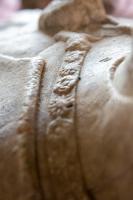


On or before 15th November 1448, the date he was buried at St Mary & All Saints Church, Willoughby-on-the-Wolds [Map], Hugh Willoughby died. Monument to Hugh Willoughby and Margaret Freville [aged 47]. Early Plate Bascinet and Gorget Period. Hip Belt. Horned Headdress. Chest with Weepers holding Shields. Dogs chewing at her dress with Studded Collar. Angels Supporting Pillow. Possibly Sutton and Prentys.
Hugh Willoughby: he was born to Edmund Willoughby and Isabel Annesley. Around 1395 Hugh Willoughby and Isabel Foljambe were married. Before 1419 Hugh Willoughby and Margaret Freville were married.
Margaret Freville: In 1401 she was born to Baldwin Freville. In 1493 she died.


